


Revisiting the Impact of Ethereum Shapella Upgrade: From Merge to Surge


introduce
Compilation of the original text: Deep Tide TechFlow
introduce
first level title
Post-Shapella situation

Despite fears of a possible sell-off following Ethereum’s Shapella upgrade, it appears to be attracting more investors. One month after the upgrade, about 18.9 million ETH was staked, served by about 588,000 validators, earning an average return rate of 5.5 percent, according to the Ethereum Foundation. The total value of staked ETH has risen, while the total supply of ETH as a whole has seen a considerable decrease. Ethereum transaction costs are at their highest point in a year, a situation that has resulted in higher returns for those staking their ether.
first level title
Current Pledge Analysis
Current Ethereum staking data shows that there is a clear demand for ETH yields, and there are not enough validators wanting to exit through the queue. According to data from Dune Analytics (as of May 31), the proportion of ETH staked is about 18%. Since Shapella happened on April 12th, the total net inflow to the deposit direction, approximately 2,263,119 ETH has flowed into pledged assets. This number can be calculated with the following formula:
Net Inflow = Staking Amount - Total Withdrawal Amount - Partial Withdrawal
Net inflow of ETH increased by about 33% to 3,338,055 ETH after withdrawing rewards. Most of the reward withdrawals happen in the first week after the Shapella upgrade. Total deposits are on the rise, while total withdrawals are the exact opposite – contrary to many initial predictions.
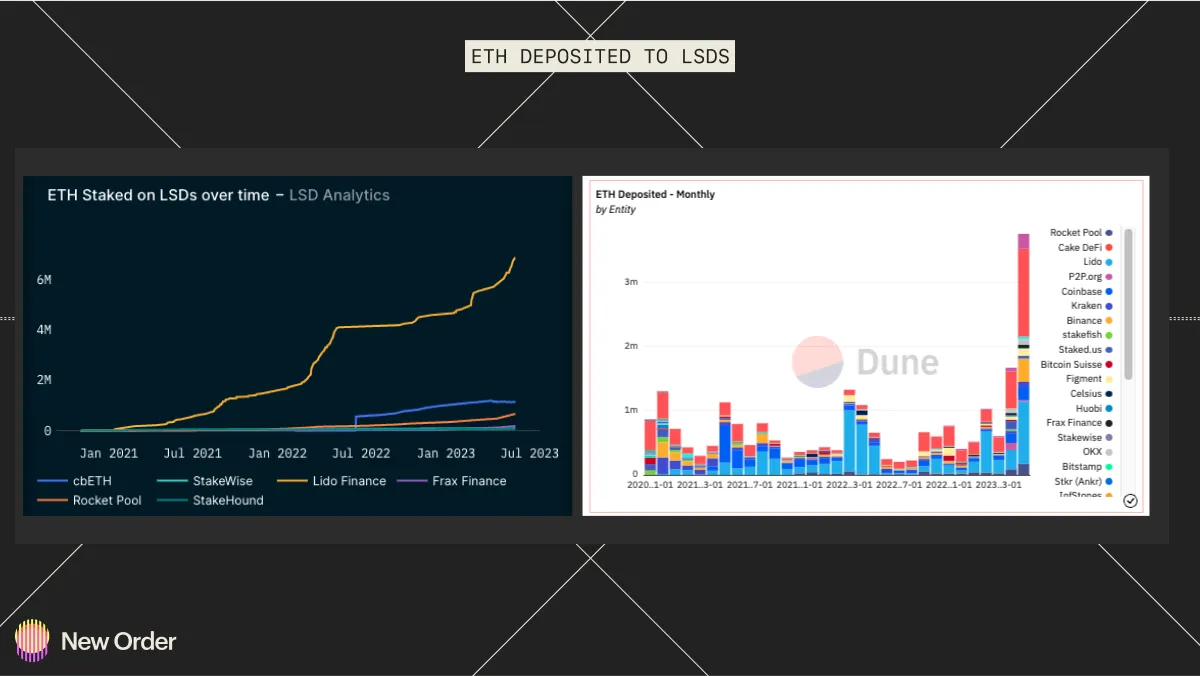
Most deposited ETH came from Liquid Staking providers like Lido, followed by unidentified stakers and CEX deposits. Lido still maintains 31.87% of the total Staking market share, occupying a large control.
Judging from the existing three categories, the Liquid Staking market is clearly controlled by one protocol, while Coinbase and Binance have obvious advantages in the CEX market. The staking pool category is the most fragmented, with Staked.us, Figment, Kiln, stakefish, and Bitcoin Suisse accounting for about 74% of its market share.
Current validator exits and entry queues further increase the demand for staked ETH. At the time of writing, there are 76,349 validators waiting to be reviewed in the admission queue, while only 21 validators are waiting to exit. The exit wait time was as little as 14 minutes, while new validators had to wait about 37.5 days.
One of the most controversial and important predictions for the second half of this year and 2024 is the collateralization ratio of ETH.
This is because users no longer pay the technical risk cost due to Ethereum switching consensus mechanism and Shapella's illiquidity premium. There are predictions that this figure will approach the average of 60% seen in other major proof-of-stake networks, and eventually trend towards more than 90%. This could increase the current number of validators from 730,000 to over 2 million. In this case, the rewards per validator are likely to be reduced. This is because of the composition of validator rewards and how they vary based on certain variables, such as the total amount staked. Ethereum validators earn rewards from three different sources: block rewards, gas tips, and maximum extractable value (MEV) rewards. Block rewards are new ETH tokens generated based on PoS. As the stake ratio increases, the annual inflation rate of the network also rises, reducing the rewards each staker receives. This can be roughly seen in the image below.
Gas tip means that users can pay extra ETH as a "tip" to the verifier to incentivize them to put their transaction first in the block. A typical example of why users do this is when hyping NFTs, many users are trying to buy the same item. While there are still reasons to tip validators, and the number will fluctuate due to demand stimuli such as memecoin mania, the NFT hype cycle is over, and there is little sustainable reason to predict this type of yield will be stable. Pay a large amount of rewards to validators.
The final variable that affects validator earnings is MEV. While there have been opportunities for high MEV yields over the past two years, those yields have been on the decline. As more and more Ethereum transactions are gradually transferred to its Rollup ecosystem, the amount of MEV that can be withdrawn on Ethereum will also gradually decrease and become less and less sustainable.
first level title
Interpretation of these numbers
Perhaps one of the main reasons for the surge in Ethereum staking post-Shapella is the removal of technical risk and illiquidity premiums. Both Merge and Shapella are among the most important events in the history of Ethereum, and both are highly uncertain events for investors. Upon successful completion, the risk of any technical issues due to changes to the Ethereum consensus mechanism is effectively eliminated. Also, now that investors no longer pay an illiquidity premium, they can withdraw their ETH at any time. Before Shapella, users had to sell their ETH LSDs on DEXs due to the inability to withdraw ETH.
After Shapella, the huge discrepancy between entering and exiting the queue may be due to people initially fearful of staking, now confident. Concerns about massive post-Shapella withdrawals and their lack thereof may be due in part to the queuing mechanism. Withdrawals are handled dynamically, which means it does not allow withdrawals at regular intervals. The Shapella update also makes Ethereum staking easier. The update removes the requirement that stakers must have a minimum amount of ETH, which allows a wider range of people to participate. The recent demand for staking is likely to come from institutional and private clients, as noted by Bitcoin Suisse's chief product officer in his comments on demand for staking ETH.
Overall, short-term user behavior regarding Ethereum staking indicates a positive overall market reaction. Shapella has led to huge growth in staking via the Liquid Staking Derivative (LSD) protocol and tokens such as Lido. After Shapella, growth in ETH collateralized via LSD and the industry as a whole saw the largest total deposit month across all categories.
first level title
What's next for Ethereum?
Overall, the impact of the Shapella upgrade on the Ethereum ecosystem is positive and lays the necessary foundation for future upgrades. The next step in the general Ethereum roadmap is now possible as the Merge and Shapella updates complete the basic upgrade. Scalability improvements through Rollups and data sharding followed, followed by dramatic improvements in efficiency, decentralization, and censorship resistance.
first level title
What's next for the industry?
ETH is the basic asset of the industry, and the upgrade of Shapella has a far-reaching impact. The supply of ETH in CEXs is currently being drained as staking becomes more secure as it can be withdrawn. As of Wednesday, May 31, centralized exchanges held 14.85% of the total ethereum supply, according to Glassnode. Such low levels have not been observed in the market since the early days of Ethereum in the summer of 2016, which clearly gave the price an upward momentum. Additionally, due to the aforementioned staking queue, demand for stETH as well as other liquid staking derivatives of ETH may increase, resulting in higher premiums. We have observed a situation where despite Lido/Rocketpool/Frax ETH premiums, users want to stake as soon as possible to generate these rewards. The results could further strengthen the market share of the leading staking protocol. At the same time, the use of DVT or a modified liquidity flywheel and token economics may lead to a market share allocation of the liquidity staking space. New entrants can incentivize users to migrate their staked ETH from big players to new platforms by offering substantial lucrative rewards and higher APY. Established protocols like Lido can defend against these attacks by continuously improving their products and maintaining strong security measures. This competition may improve the situation in the field as a whole and keep fees to a minimum, benefiting users in the long run.
Finally, as mentioned earlier, the Shapella upgrade represents a significant step forward in attracting institutional investors, but it is not the end of the journey. Current disincentives are mainly in the form of regulatory uncertainty, especially preventing Western institutional investors (pension funds and insurance companies) from making large-scale investments in the Ethereum ecosystem. However, the Shapella upgrade could spur favorable outcomes for regulatory discussions across the industry, especially as safety-related debates emerge. This potential was further enhanced by the issuance of cryptocurrency exchange licenses in Hong Kong on June 1. The convergence of these factors – expected capital inflows from the Eastern world and Shapella upgrades – has created optimism for a more transparent and regulated industry in the future.





