


ChainAegis: Data Analysis on Blend Chain


first level title
1. Blend Fundamental Analysis
Blend was built in collaboration between Dan Robinson, one of the inventors of Uniswap V3, and Transmissions 11, a researcher at Paradigm and a major contributor to Seaport. The main features of Blend are the following four points:
(1) Point-to-point mechanism. Blend operates on a peer-to-peer model where each loan is matched individually.
(2) No oracle. Using a complex offline quotation system does not rely on the oracle itself, and the protocol itself has greater self-consistency and security.
(3) No expiration date. By default, Blend loans have a fixed interest rate and never expire. Borrowers can repay at any time, which is the biggest improvement over the traditional peer-to-peer model.
(4) Can be liquidated. If the auction fails, the borrower is liquidated and the collateral goes to the lender.
Blend introduced the following two mechanisms:
(1) Term Loan (Limited Term Loan)
Lenders sign an offline offer to lend a principal amount of ETH at a specific interest rate and maturity for use in any specified series of NFTs. They make it public (for example, by posting it to an off-chain quote repository). Borrowers can select a suitable quote by browsing the off-chain quote library, and then the borrower creates an on-chain transaction, fulfills the lender's proposal, puts their NFT in a lien vault, and transfers the principal from Transfer from the lender to yourself. Before maturity, the borrower can withdraw the collateral by repaying the lender (repayment = loan amount + interest). After the due date, if the loan is not repaid, the collateral is liquidated and becomes the property of the lender. It should be noted that if the value of NFT is already lower than the repayment amount, the borrower can choose not to repay the loan.
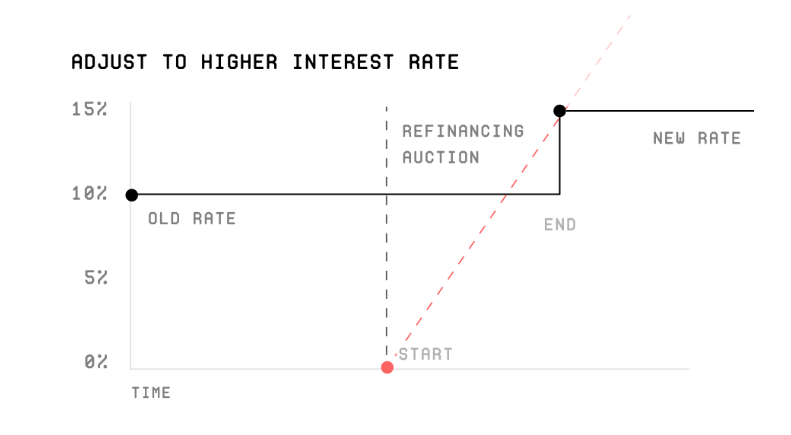
(2) Refinancing Auction
Rather than simply providing collateral to lenders, Blend uses a competitive auction process called a Dutch auction against the interest rate to extend the loan. Dutch auction, also known as "reduction auction", is a special auction form, which usually means that the seller asks the price from high to low until a buyer accepts the asking price and the transaction is completed.
first level title
secondary title
2.1 TVL
secondary title
2.2 Daily Loans
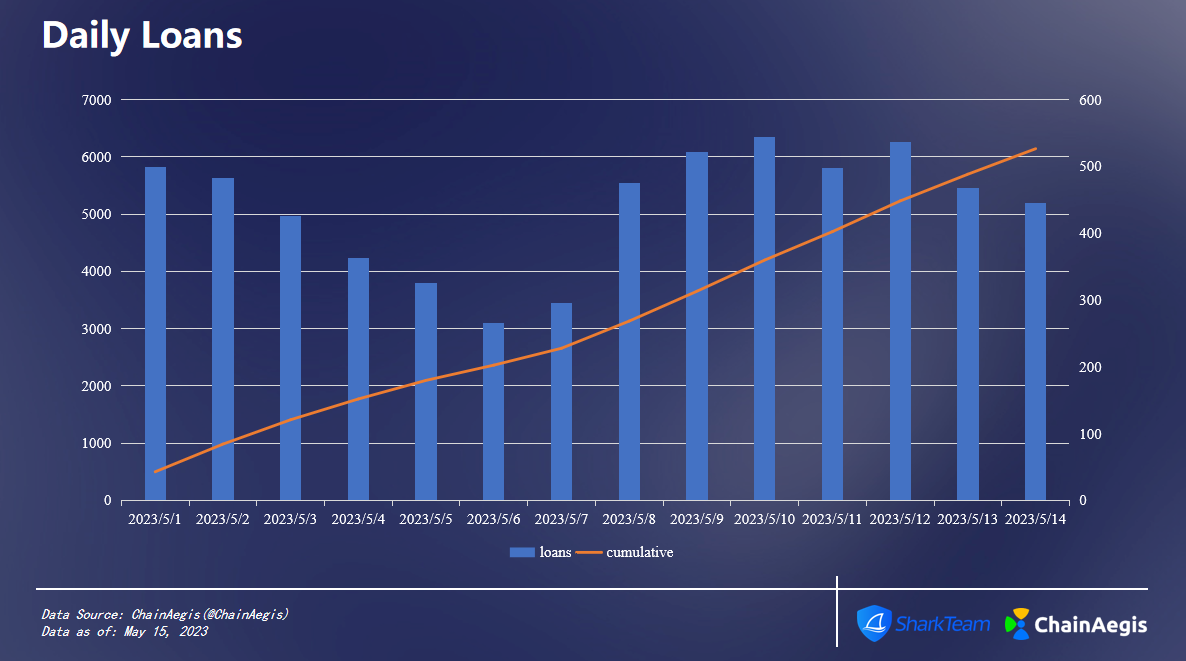
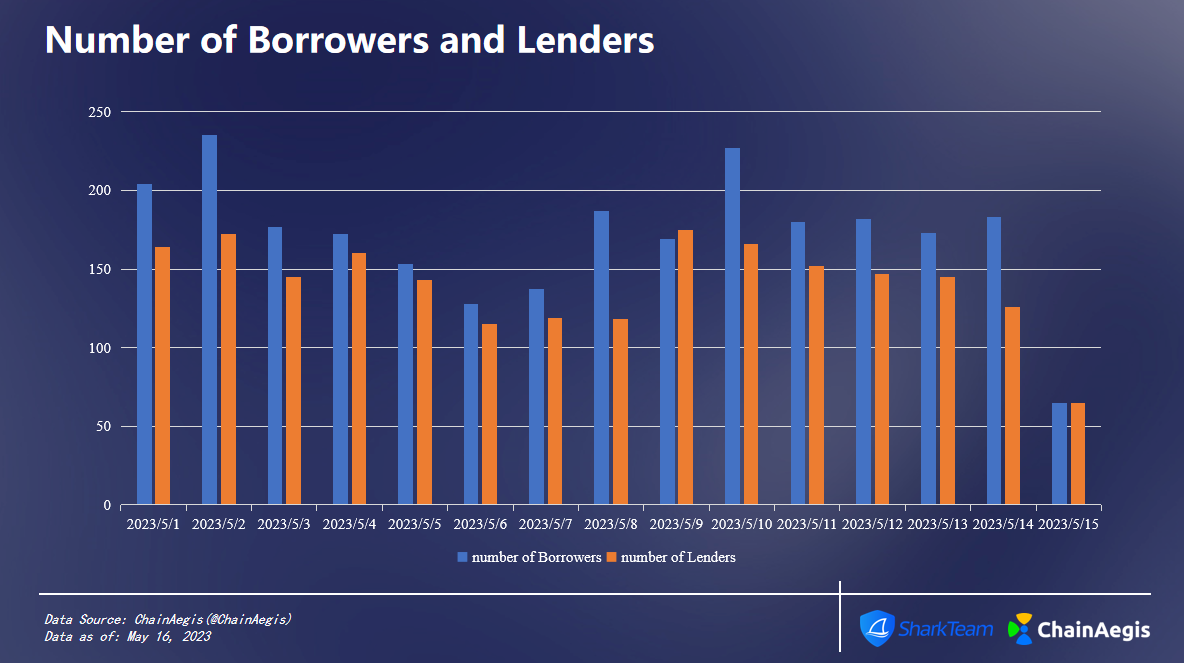
As of May 15th, Blend has lent a total of 81,661 ETH, a total of 4,667 loans, 787 independent borrowers, and 1,155 lenders. The following is the daily loan amount of Blend and its total change:
secondary title
2.3 NFT transaction data
At present, Blend has launched 6 NFT series, namely: Wrapped Cryptopunks, Azuki, Milady, DeGods, MutantApe YachtClub and Bored Ape Yacht Club. Among them, DeGods was launched on May 8, and MutantApe Yacht Club and Bored Ape Yacht Club were launched on May 15. ChainAegis’s analysis of its LTV, APY, daily transaction volume and daily refinancing is as follows:
(1) Evaluation of loan risk index LTV
Loan-to-Value (LTV) refers to the ratio of loan amount to collateral value. Taking a housing loan as an example, if the value of the house is 10 million and the loan amount is 7 million, the loan-to-value ratio is 70%. If the asset price is relatively stable, the loan-to-value ratio is relatively high, and the loan-to-value ratio of different collateral loans varies according to the bank's own policies.
Here’s how Blend’s loan-to-value ratio (LTV) has changed on a daily basis for each specific NFT series. In Blend, LTV=loan amount/collateral value (collateral value=average floor price).
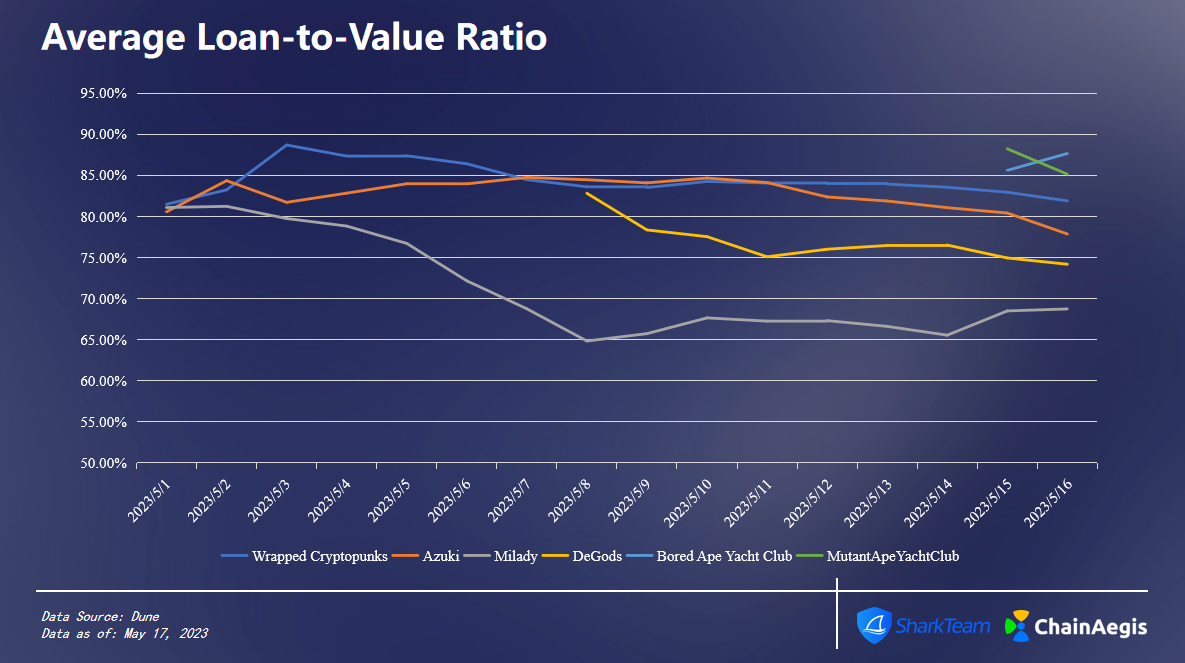
On the second day of launch, Milady had the highest LTV value, reaching 84.36%. Wrapped Cryptopunks overtook Milady for the top spot from May 2-9, and has since dropped. Mailady vs. DeGods LTV is relatively low. Previously, Blur officially stated that the three NFT series of Cryptopunks, Azuki and Milady will have a discount of 2 times the loan points. According to reports, the points will be related to the airdrop of the second season in the future. The more points you have, the more $BLUR airdrop tokens you have the opportunity to get.
(2 )APY
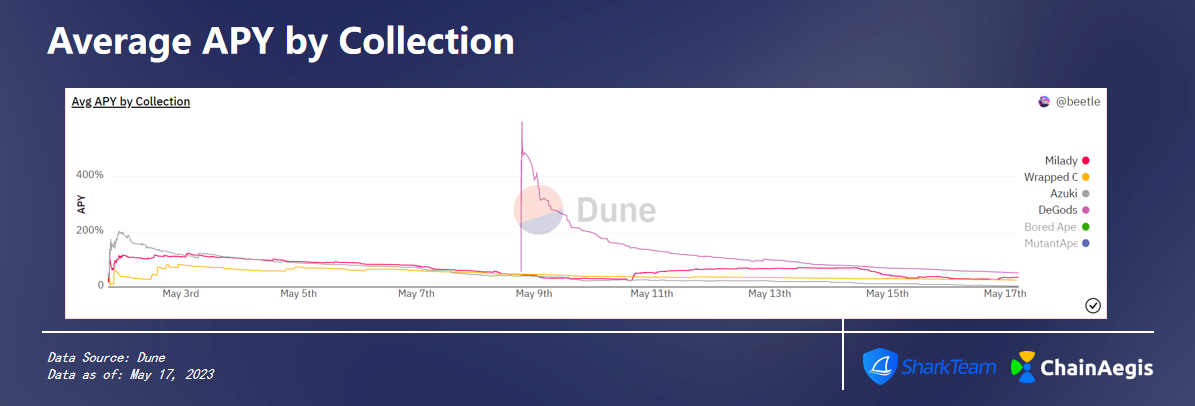
Annual Percentage Yield (APY) refers to the amount earned by compounding interest (interest + principal) in one year. According to Dune statistics, the APY of DeGods, MutantApe YachtClub and Bored Ape Yacht Club series on the first day of launch were as high as 479%, 230% and 260% respectively. After going online, it began to decrease rapidly. As of May 17, the APY of MutantApeYachtClub, DeGods, Azuki, Milady, Bored Ape Yacht Club, and Wrapped Cryptopunks were 39%, 19%, 7%, 30%, 8%, and 58%, respectively.
(3) Daily transaction volume
With the decrease of APY, the trading volume gradually increases, and the loan points that traders can obtain increase, and the probability of obtaining $Blur airdrops in the future increases.
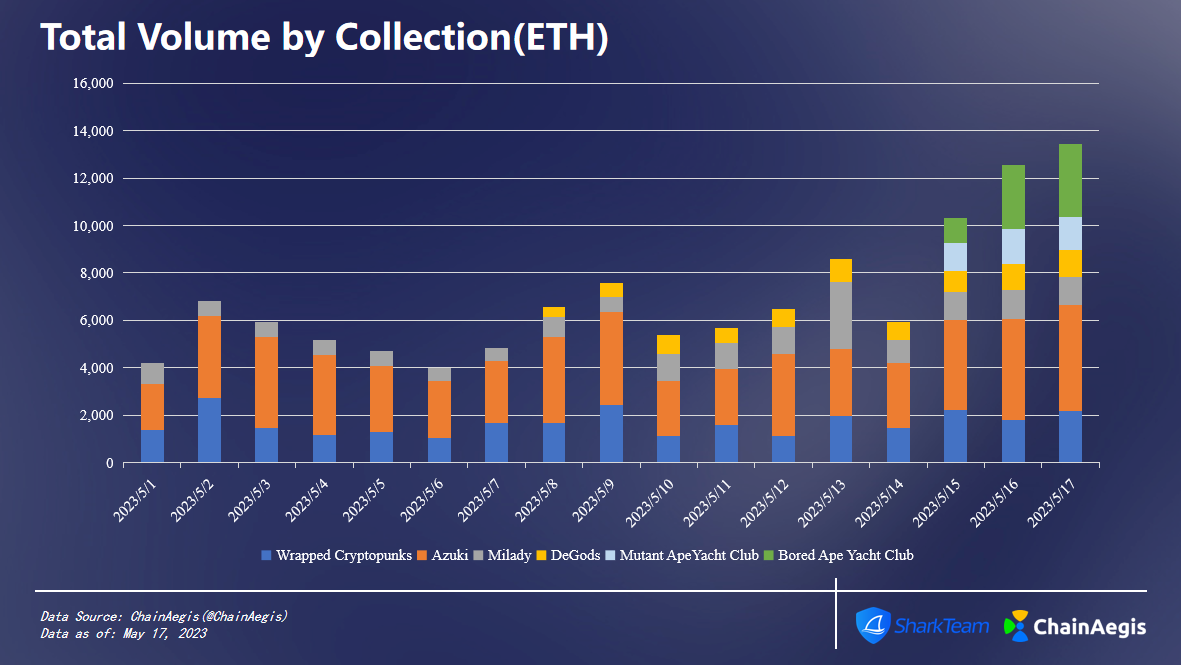
The above is the daily trading volume of different series of NFTs on Blend. As of May 17, the Azuki series (shown in orange) was the main transaction on Blend, with a cumulative trading volume of 54,100 ETH, accounting for 45.81% of the total trading volume; Wrapped Cryptopunks series (shown in dark blue) followed, The cumulative transaction volume is 28,200 ETH, accounting for 23.90% of the total transaction volume. The DeGods series has been relatively stable since its launch, with an average daily trading volume of 801.3 ETH. The daily trading volume of MutantApeYachtClub and Bored Ape YachtClub is also growing, up 13.5% and 191.3% respectively from the first day of launch.
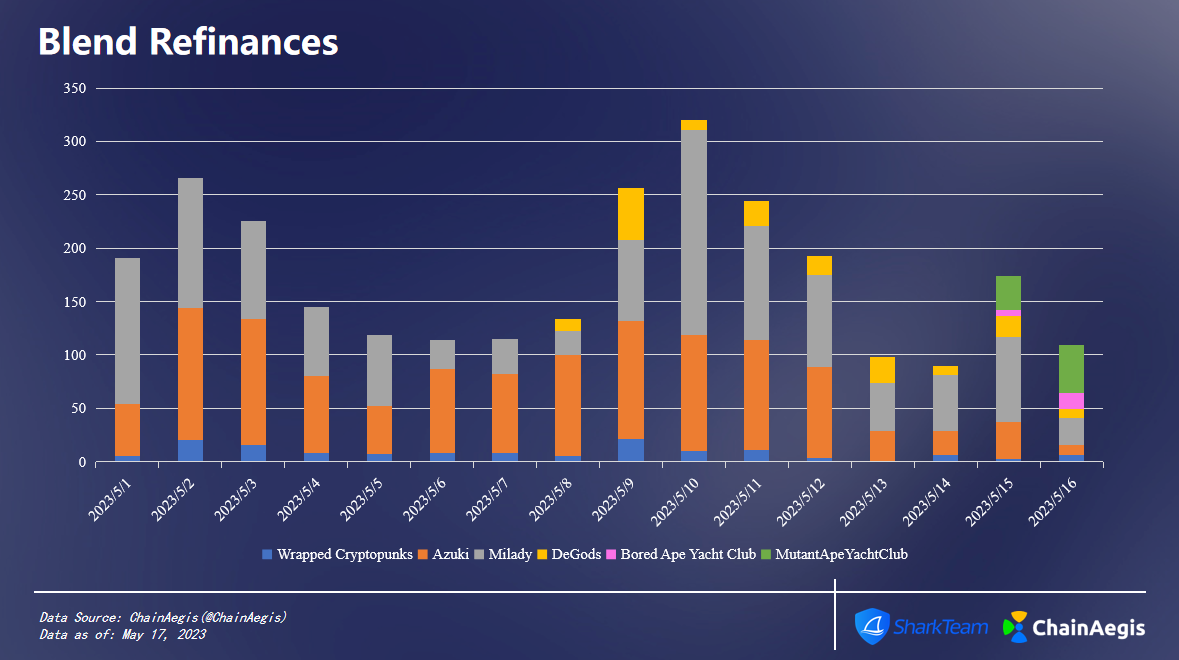
(4) Daily Refinancing
The following is the daily refinancing status of Blend. As of May 17, Blend's accumulated refinancing amount was 2, 793. On May 10, the number of refinancing in a single day reached a new high, reaching 320.
secondary title
2.4 Number of Borrowers and Lenders
secondary title
2.5 Top 10 Lenders
secondary title
2.6 Top 10 Borrowers
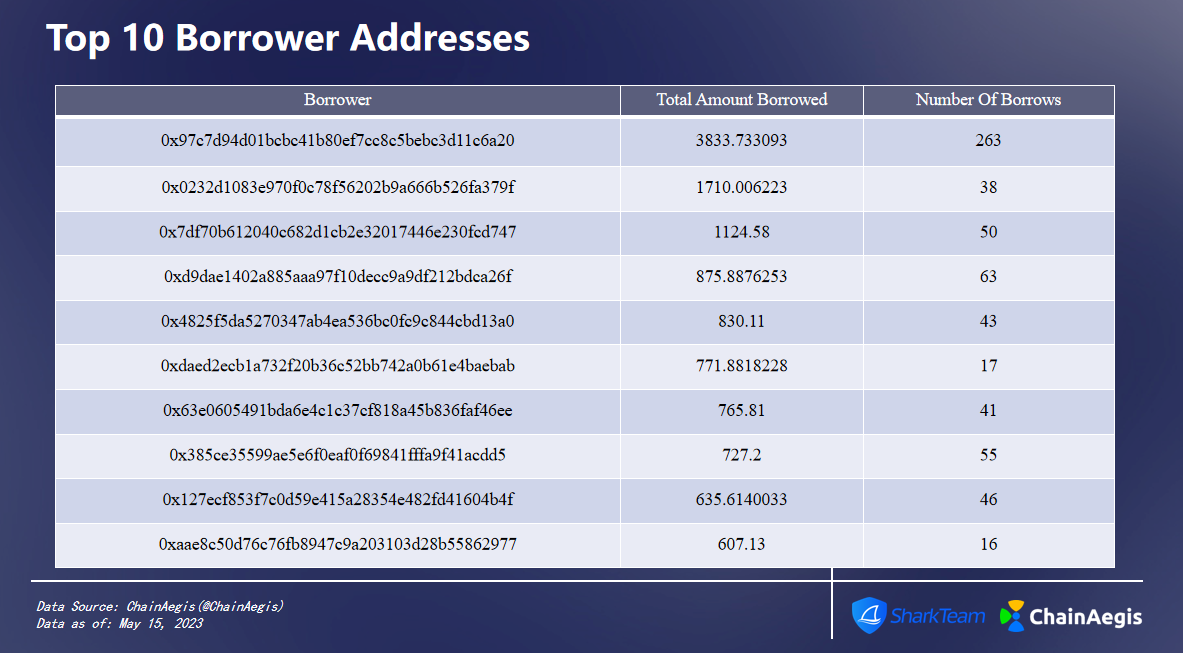
The following is the address information of the TOP 10 borrowers ranked by total amount borrowed. As of May 15, the address 0x 97 c...6 a 20 has accumulatively borrowed 3,833.73 ETH, ranking first. The address 0x 023...379 f accumulatively borrowed 1,710 ETH, ranking second.
first level title
About Us
SharkTeam's vision is to comprehensively protect the security of the Web3 world. The team is composed of experienced security professionals and senior researchers from all over the world. They are proficient in the underlying theory of blockchain and smart contracts, and provide services including smart contract auditing, on-chain analysis, and emergency response. It has established long-term cooperative relationships with key players in various fields of the blockchain ecosystem, such as Polkadot, Moonbeam, polygon, OKC, Huobi Global, imToken, ChainIDE, etc.





