






ETH Weekly | Curve’s native stablecoin crvUSD has been deployed to the Ethereum mainnet; Ethereum’s re-pledging protocol EigenLayer announced that it will soon launch the first phase of the mainnet (5.1-5.7)


1. Overall overview
1. Overall overview
DeFi protocol Curve Finance has deployed its native stablecoin crvUSD on the Ethereum mainnet. Since crvUSD is not yet integrated into Curve's UI, it won't be available to the public until the UI is deployed. In November 2022, Curve Finance developers released the official code and white paper of crvUSD. According to reports, crvUSD will have a mechanism similar to MakerDAO's stablecoin DAI, overcollateralized by encrypted assets. Users will be able to mint stablecoins by depositing excess collateral in the form of cryptocurrency loans in reserves, a mechanism known as a Collateralized Debt Position (CDP). crvUSD will also rely on a new algorithm, Lending-Liquidating AMM (LLAMMA), which will continuously liquidate and sell deposited collateral to better manage potential collateral risk.
In terms of the secondary market, the current ETH price may continue to consolidate in the short term, with support levels at $1,850 and $1,800, and resistance at $1,900.
Second, the secondary market
Second, the secondary market
image description
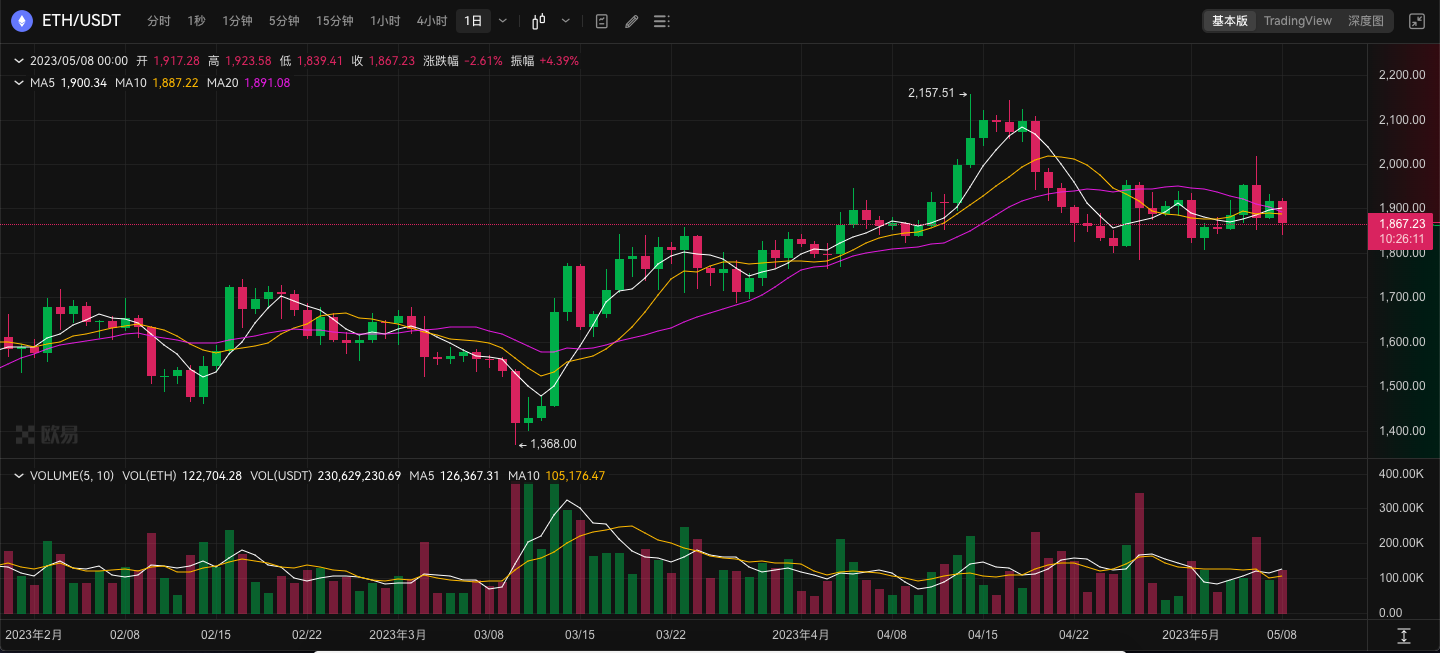
ETH daily chart via OKX
The daily chart shows that the price is currently consolidating around $1,850 and may pull back to $1,800 in the short term; if the support is valid, it is expected to rebound to above $1,900.
2. Network operation
Etherscan 3. Large transaction
3. Large transaction
OKlink data4. Rich list address
4. Rich list address
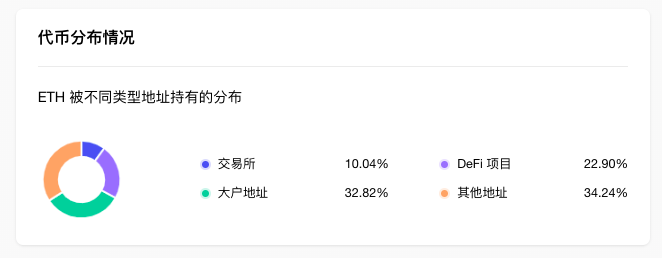
OKLink dataOKLink data
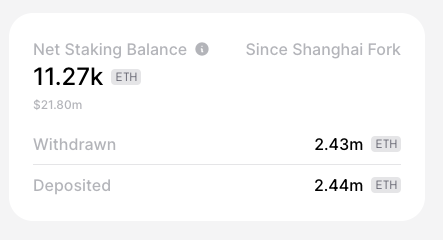
token.unlocks3. Ecology and technology
3. Ecology and technology
1. Technological progress
The 108th Ethereum Core Developers Meeting discusses and coordinates changes to the consensus layer, including Deneb future compatibility considerations and more
Christine Kim, VP of Research at Galaxy, posted a post summarizing the 108th Ethereum Core Developers Consensus (ACDC) meeting, where developers discussed and coordinated changes to the Ethereum Consensus Layer (CL).
- The developers will start work on including and testing EIP 4788 and EIP 6987 for the Deneb upgrade.
- Discussion on Deneb Blobs: Developers discuss introducing an additional variable and constant in the Deneb spec to allow EL more flexibility to adjust the maximum number of blob transactions per block independently of CL. Deneb Devnet #5's testing efforts resulted in several bugs and bugs in the client, more investigation will be done on this.
- Regarding diversifying MEV-Boost relay client dependencies: Ryan reminded developers that the revamp of the beacon chain authentication subnets (attnets) rolled out on May 4th and the upgrade is backwards compatible. In a future hard fork upgrade, developers may consider introducing a "downgrade" feature to prevent nodes that have not upgraded their attnet capabilities from connecting to upgraded nodes. The developers discussed diversifying the MEV relay client dependencies via PR#317, considering the recent MEV-Boost exploit, the relay now validates the contents of blocks before broadcasting them via gossip, this feature requires the native Define forks.
2. Voice of the Community
North Rock Digital founder Hal Press is convinced that Ethereum's current preeminence in Web3 is deeply rooted in years of experimentation and development. Press tweeted that Ethereum’s emergence as the “undisputed arena” for all the top on-chain players in the space is due to years of hard work by developers and not due to short-term speculative catalysts. Press highly praised the developers of Ethereum, and he also emphasized the role of the success of the Shanghai upgrade in the dominance of ETH. (U. Today)
3. Project trends
(1) EigenLayer, the Ethereum re-pledging protocol, announced that the first phase of the mainnet will be launched soon
Ethereum restaking protocol EigenLayer has announced the imminent launch of its Stage 1 mainnet. EigenLayer hopes to positively impact the industry with the introduction of its re-staking product, which provides additional staking opportunities for opt-in ETH stakers and helps spur innovation by reducing the cost of capital for AVS (Active Validation Service). Users interested in participating in the early re-staking experience can fill out the application form.
(2) Curve's native stablecoin crvUSD has been deployed to the Ethereum mainnet
(3) The total amount of ETH loaned by the NFT lending agreement Blend exceeded 10,000 pieces
(4) Ankr will provide RPC service for the build program on Mantle
(5) CoinDesk's Ethereum verification node Zelda has exited the Ethereum beacon chain, and users can withdraw pledged ETH
(6) Ethereum expansion project AltLayer launches multi-sorter test network Rollup
(7) Ethereum certification service EAS has supported certification and verification of any type of document
According to official news, Ethereum side chain SKALE has reached a cooperation with Web3 social platform OIX. Through this cooperation, OIX can provide users with cost-free, high-performance transactions, thereby improving user experience and scalability. It is reported that OIX supports content from images, video, audio and 3D, including augmented reality and virtual reality, and is available in seven languages. Through its mobile-friendly social feed, users can connect, socialize, interact and trade all types of digital assets without paying any marketplace fees.
4. Borrowing
DeFiLlamaThe data shows that the value of locked collateral on the chain fell from $28.23 billion to $28.1 billion last week, a month-on-month decrease of 1%. Specifically, the number of ETH mortgages dropped from 14.97 million to 14.82 million last week, a drop of 1%. From the perspective of individual projects, the top three lock-up values are: Lido $11.94 billion; MakerDAO $7.29 billion; Aave $4.51 billion.
4. News
(1) Data: The net position of ETH whale addresses decreased after the Shapella upgrade
Glassnode data shows that addresses with 1,000-10,000 ETH ("whales") held more than 14.033 million ETH on May 1. In comparison, on April 12, when the Ethereum network underwent the Shapella upgrade, the number of ETH held by such addresses was 14.167 million. Additionally, the price of ETH has dropped by more than 3.5% since the Shapella upgrade, suggesting that whales may indeed be selling ETH.
(2) Data: Last month, NFT wash transactions on the Ethereum chain exceeded 635 million US dollars
(3) V God transferred 200 ETH to Kraken, and the Ethereum Foundation address transferred 15,000 ETH to Kraken





