






In Hong Kong, we found a Web3 track worthy of long-term attention


Original source: Okey Cloud Chain Research Institute
Original Author: Jason Jiang
Original Author: Jason Jiang
Over the past 20 years, Hong Kong has had one of the freest economies in the world. Web3 digital nomads are now chasing the breath of freedom and gather on both sides of the Hong Kong River. However, the encrypted script that tries to continue to drift away from reality may not be able to be staged again, and RWA, which is more closely connected to the real world, may become the highlight of Hong Kong Web3.
The problem facing Hong Kong: how to make Web3 more closely connected with reality
image description
text
This separation between encryption and reality can guarantee the independence and autonomy of encryption innovation in the early stages of development. However, with the rapid expansion of the market volume and the increasing variety of encryption formats, it has also become the "shortest plank" that restricts the expansion of the encryption market: the market Practical problems such as the difficulty of having continuous liquidity, the difficulty of large-scale adoption of applications, and the difficulty of enterprises meeting compliance requirements need to be resolved urgently. At the same time, practitioners of virtual assets and Web3 often face soul torture because of this sense of separation: In addition to speculation, where is the value of virtual assets and Web3 reflected?textThese problems are now facing Hong Kong, and how to connect Web3 more closely with reality has become the key to solving the problems. Just as Okey Cloud Chain Research Institute is
As stated in the article, the development of Web3 and virtual assets in Hong Kong is not only a retreat, but also a pragmatic one. Only by bridging the gap between the encryption market and the real world, enhancing the practical value of virtual assets, and ultimately serving the economic and social development of Hong Kong, can Web3 truly take root in Hong Kong.
RWA (Real World Assets) is an important carrier for connecting virtual assets with Web3 applications and covering the real world, and it is also the most anticipated development direction of Web3 in Hong Kong in the future.
first level title
RWA will break encryption isolation and accelerate the mainstreaming of Web3 applications
RWA usually refers to real assets that can be represented and marked on the chain. Valuable assets such as commercial real estate, precious metals, stocks and bonds, and carbon emission rights can all be regarded as RWA, as long as they can be properly tokenized and accounted for.
There are two types of common RWA tokenization methods:
The first category is to realize asset tokenization after the existing assets are put on the chain, and a third-party custodian will manage the assets off the chain. Major stablecoins and bonds/stocks re-tokenized on the chain after issuance outside the chain is of this type;
The second category is the tokenization of native digital assets. These assets themselves are tokens issued on the chain and do not represent any off-chain assets, such as bonds issued directly on the chain in the form of tokens.
Just because RWA can migrate more valuable real assets to the chain and establish a connection between the encrypted market and the physical world at the asset layer and application layer, RWA is also regarded as a catalyst for the mainstreaming of virtual assets and Web3 applications. Bank of America identified the tokenization of RWA such as commodities, currencies and stocks as a “key driver of digital asset adoption” in a previous research note.
For the real world, RWA can enhance the liquidity of asset classes with limited liquidity, such as real estate and precious metals, and use blockchain technology to improve asset efficiency and transaction transparency, reduce transaction settlement time and costs, and make fragmentation and Global investment becomes possible, which in turn benefits a wider range of users.
image description
Fragmented NFT improves the liquidity of NFT assets, source: public network
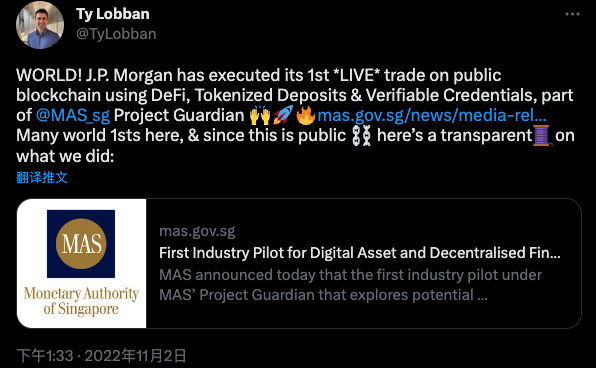
Today, many financial institutions and technology companies around the world are laying out the RWA track. Among them, the most watched RWA tokenization attempt is the "first real-world use case of an institutional-level DeFi protocol" announced by the Monetary Authority of Singapore at the end of 2022. Liquidity pools of tokenized SGS bonds, JGBs, JPY and SGD for forex and government bond trading. The pilot was eventually completed by JPMorgan Chase using the Aave protocol of the Polygon network to complete the first foreign exchange and government bond transaction based on the DeFi protocol, proving that financial transactions can be successfully completed on the public blockchain without the participation of any financial intermediary .
At the same time, encryption innovation projects represented by MakerDAO, AVAE, and Chainlink are also taking the lead in exploring the potential of RWA applications. After MakerDAO passed the proposal to accept RWA as collateral in 2022, it currently has a decentralized stablecoin DAI backed by RWA worth more than $680 million; the AVAE community also initiated a proposal to establish a RWA mortgage lending market in June 2021, and Build an RWA market using Tinlake, a DeFi platform launched by Centrifuge.
According to Boston Consulting Group, the market for tokenized assets will grow to $16 trillion by 2030, or 10% of global GDP.
first level title
Hong Kong's development status and prospects in the RWA track
Although we believe that RWA will gradually break the physical barrier between the encrypted world and the real world in the next few years, and allow more financial and economic activities to migrate to the chain. But the question is, what does this have to do with Hong Kong? Why do we say that RWA will become the most anticipated application direction of Web3 in Hong Kong?
First of all, Hong Kong has actually accumulated rich practical experience on the RWA track. In the policy declaration issued at the end of 2022, the Hong Kong government has launched three pilot plans, namely: the issuance of non-homogeneous tokens (NFTs) at the Hong Kong Fintech Week in 2022, the tokenization of green bonds, and the digital Hong Kong dollar. These three pilot programs may not be directly related, but from the perspective of RWA, we will find that the above three programs are all involved in the tokenized assets of RWA. Now that these three plans have been completed or achieved phased results, the Hong Kong government has made many attempts in the practice of RWA.
Take green bond tokenization as an example. On February 16, 2023, the Hong Kong government announced that Hong Kong had successfully sold 800 million Hong Kong dollars in tokenized green bonds. This is the first tokenized bond issued under the Hong Kong legal system, and also the world's first tokenized green bond issued only by the government. For the sake of prudence, the tokenization of green bonds is not directly issued on the chain, but the first type of RWA tokenization method mentioned above is adopted, that is, the bonds are first deposited in Hong Kong's central settlement system for debt instruments (CMU), and then the bonds are Tokenization. Even so, compared with the traditional issuance model, tokenized green bonds still significantly improve the issuance efficiency, shortening the settlement procedure from 5 working days (T+ 5 ) to 1 working day.
In addition, in order to improve efficiency, the bond tokenization issue also tokenizes the cash in the payment link: the bank provides legal cash in exchange for digital Hong Kong dollar tokens "minted" by the HKMA. This digital Hong Kong dollar token is also issued through the first type of RWA tokenization mentioned above, similar to a CBDC at the wholesale level. And this also involves another RWA that will play an important role in the future development of Web3 in Hong Kong: the digital Hong Kong dollar.
The Hong Kong Monetary Authority began to study CBDC in 2017. It first focused on the application of wholesale CBDC in processing large-value payments and settlement of goods and bank settlements. In 2019, it began to cooperate with the Bank of Thailand to launch the "Inthanon-LionRock" project. Later, with the addition of the Central Bank of China, the Arab Central Bank and BISIH, the project was renamed "Multiple Central Bank Digital Currency Cross-Border Network" (mBridge), focusing on the application of wholesale CBDC in cross-border payment scenarios. Yu Weiwen, President of the Hong Kong Monetary Authority, believes that future asset tokenization and the HKMA’s CBDC initiatives will have a huge synergistic effect. For example, establishing a connection between the tokenized asset platform and the mBridge platform may facilitate cross-border bond settlement and investment. .
image description
mBridge development history, source: open network
In addition to developing a wholesale CBDC, Hong Kong also announced in June 2021 plans to launch a digital Hong Kong dollar at the retail level under the “Fintech 2025” strategy. The Hong Kong Monetary Authority pointed out in the relevant technical white paper that the system design of the digital Hong Kong dollar is basically the same as that of the digital renminbi, and both adopt a two-tier operation system: the Hong Kong Monetary Authority is responsible for the R&D and design of the CBDC, and at the same time, the three Hong Kong dollar note-issuing banks are designated as operating agencies. Open for acceptance of digital Hong Kong dollars. According to relevant media reports, the Hong Kong Treasury Bureau is considering issuing digital Hong Kong dollars as "stable coins", and stable coins are currently the most important RWA use case and the most active type of virtual asset.
Perhaps as Liang Hanjing, director of financial technology of the Hong Kong Investment Promotion Agency, said in an interview with the media before, the Hong Kong SAR government focuses on how to convert the huge traditional assets into a market worth hundreds of trillions of dollars Tokenization is the biggest development opportunity for Hong Kong's virtual asset industry.
epilogue
first level title





