


ETH Weekly | Ethereum Cancun upgrade is expected later this year; Societe Generale launches euro stablecoin on Ethereum (4.17-4.23)


1. Overall overview
1. Overall overview
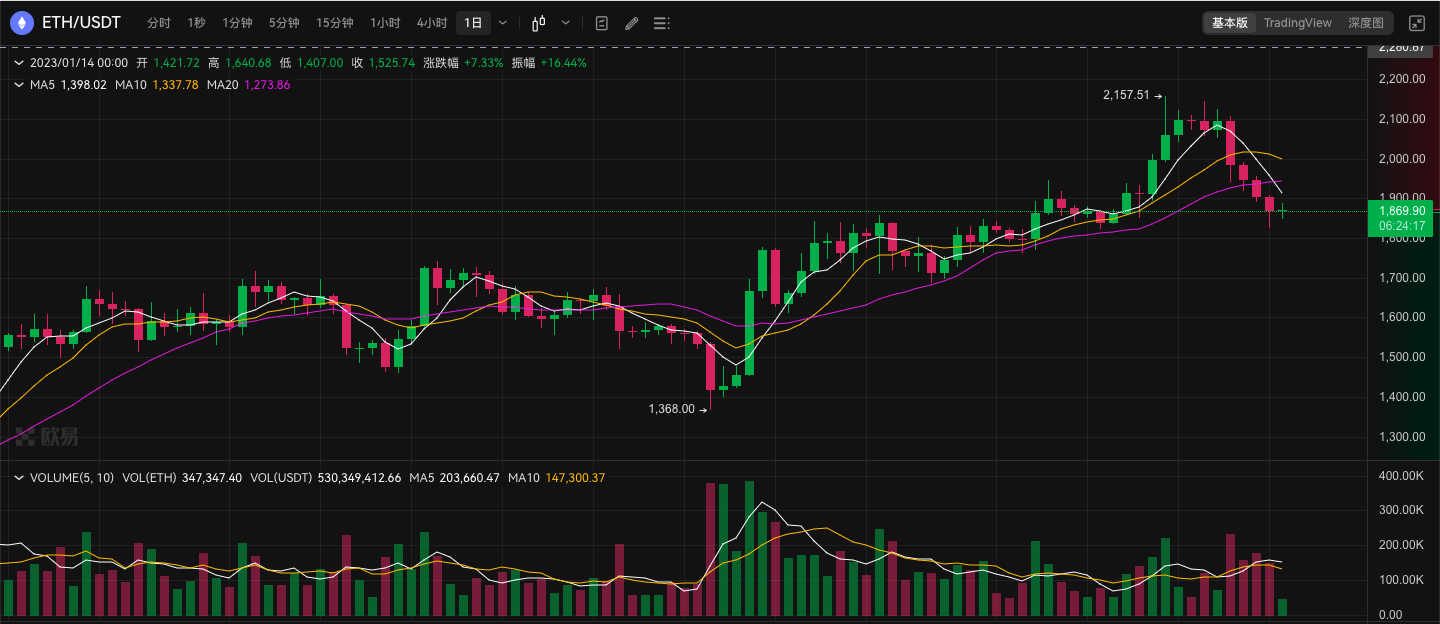
In terms of the secondary market, the current ETH price may continue to consolidate in the short term, with support levels at $1,850 and $1,800, and resistance at $1,900.
In terms of the secondary market, the current ETH price may continue to consolidate in the short term, with support levels at $1,850 and $1,800, and resistance at $1,900.
Second, the secondary market
Second, the secondary market
The daily chart shows that the price is currently consolidating around $1,850 and may pull back to $1,800 in the short term; if the support is valid, it is expected to rebound to above $1,900.
ETH daily chart via OKX
The daily chart shows that the price is currently consolidating around $1,850 and may pull back to $1,800 in the short term; if the support is valid, it is expected to rebound to above $1,900.
2. Network operation
Etherscan 3. Large transaction
3. Large transaction
OKlink data4. Rich list address
4. Rich list address
OKLink dataOKLink data
token.unlocks3. Ecology and technology
3. Ecology and technology
1. Technological progress
On Thursday, a meeting of ethereum’s core developers said it plans to make code changes to the blockchain’s consensus layer in preparation for the next Cancun-Deneb upgrade, which is expected to take place later this year.
The most significant change expected in ethereum's Cancun-Deneb upgrade will be EIP-4844, also known as "proto-danksharding". EIP-4844 aims to enable temporary storage and retrieval of off-chain data through Ethereum nodes to meet the data and storage needs of blockchain applications. If successfully activated, EIP-4844 promises to reduce transaction costs for layer 2 rollup solutions, including Optimism and Arbitrum.
The most significant change expected in ethereum's Cancun-Deneb upgrade will be EIP-4844, also known as "proto-danksharding". EIP-4844 aims to enable temporary storage and retrieval of off-chain data through Ethereum nodes to meet the data and storage needs of blockchain applications. If successfully activated, EIP-4844 promises to reduce transaction costs for layer 2 rollup solutions, including Optimism and Arbitrum.
It is reported that EIP-4844 has completed testing on four development networks. The fifth development testnet for EIP-4844 will launch sometime next week, according to ethereum core developer Tim Beiko. The developers discussed how to reinsert the blob transaction into the block in the chain reorganization event. Danny Ryan proposed two solutions: let the consensus layer pass the blob data of each block to the execution layer or let the user reinsert Submit the transaction. For the former, the developers started a discussion and talked about the data availability sampling DAS implementation will invalidate the hypothetical plan. However, due to the lack of relevant representatives of the executive layer client at the meeting, the issue is temporarily left for discussion at the executive layer developer meeting next week. .
Additionally, the developers discussed beacon chain authentication subnets (attnets), and Adrian Manning of the Lighthouse (CL) client team proposed a solution for subscribing validator nodes to long-term attnets, saying that this change does not have to go through a hard fork to execute.
2. Voice of the Community
Opinion: Institutions flock to Ethereum after Shapella upgrade
The number of active or open ether futures contracts traded on the Chicago Mercantile Exchange (CME) has increased by 39% to 6,248 ETH since April 10. In dollar terms, open interest rose more than 70% to $633 million. Institutions often prefer regulated products like CME futures, which allow them exposure to digital assets without owning them. As a result, CME futures tied to ETH and BTC are widely regarded as proxies for institutional activity. (CoinDesk)
3. Project trends
(1) Gala Games plans to launch the v2 upgrade on May 15, and will replace it with new tokens at a ratio of 1:1
(2) Ethereum domain name service ENS launched a new ENS App (Alpha) on the main network, supporting NameWrapper
(3) Rocket Pool completed the Atlas upgrade, allowing 8 ETH for node pledge
(4) Maverick Protocol, a decentralized liquidity infrastructure, has launched zkSync Era
(5) Layer 1 blockchain project LUKSO will launch the Genesis Validator deposit smart contract on the 21st
(6) InfStones launches Ethereum validator service
(8) Flashbots launches MEV-Share Beta test version to distribute part of MEV revenue to Ethereum users
Ethereum infrastructure service Flashbots has launched a beta version of the MEV-Share protocol, which aims to distribute a portion of Maximum Extractable Value (MEV) earnings to Ethereum users. The MEV-Share protocol is included in Flashbots Protect, a remote procedure call (RPC) tool that can be integrated with user wallets to fend off bots trying to profit from front-running user transactions.
(9) ZigZag announced the launch of Arbitrum, will soon add the meta transaction function and launch zkSync Era
(10) The non-custodial liquidity staking platform ether.fi will launch the mainnet in the first week of May
According to previous news in February, ether.fi completed a financing of US$5.3 million. North Island Ventures, Chapter One and Node Capital jointly led the investment, and BitMex founder Arthur Hayes participated in the investment.
4. Borrowing
DeFiLlamaThe data shows that the value of locked collateral on the chain fell from $31.99 billion to $28.86 billion last week, a month-on-month decrease of 9.7%. Specifically, the number of ETH mortgages rose from 15.1 million to 15.48 million last week, an increase of 2.5%. From the perspective of individual projects, the top three lock-up values are: Lido $11.51 billion; MakerDAO $7.44 billion; Aave $4.45 billion.
4. News
(1) CME plans to launch bitcoin and ethereum options contract products with new expiration dates
(2) Société Générale launches a euro-pegged stablecoin on Ethereum
Société Générale announced the launch of EUR CoinVertible, a euro-pegged stablecoin aimed at institutional clients. The stablecoin is based on Ethereum and will be traded under the symbol "EURCV" and will only be available to the bank through its existing KYC customers and anti-money laundering procedures. investors.
Chief executive Jean-Marc Stenger said that over the next few weeks, Societe Generale will gauge interest from potential customers and answer their questions for gradual adoption.
Societe Generale said the EUR CoinVertible stablecoin complies with major market standards, including an open-source interoperability and securitization framework known as the Security Token Compliance Architecture (CAST). The firm emphasized that it will ensure that the collateral assets backing the stablecoin’s value are “completely segregated” from the issuer and will provide daily transparency reports and collateral positions. The stablecoin smart contract has been audited by PricewaterhouseCoopers (PwC). For the stablecoin issue, SG-Forge has received advice from law firm White&Case. (Cointelegraph)
(3) V God and other eight members of the Ethereum Foundation confirmed to attend the Ethereum Conference EDCON 2023 held in Montenegro in May
(4) The 2023 Ethereum Devconnect conference will be held in Istanbul in November





