A detailed explanation of two protocols built on top of GMX: Rage Trade and Umami Finance


Original title: "Innovations of On-Chain Perpetual Protocols Part 2"
Original compilation: Kxp, Blockbeats
Original compilation: Kxp, Blockbeats
As the potential impact of FTX becomes apparent, the importance of decentralization and transparency is gaining attention. The migration of trading activities from CeFi to DeFi is no longer a question of "if", but a question of "when".
Perpetual protocols like GMX have grown significantly in the past few months, and GMX, with its unique design, has developed into an independent ecosystem. This study was divided into two articles.
herehereturn up.
In the second part, we will pay more attention to the GMX ecosystem and some interesting protocols built on top of GMX.
As we mentioned in the first part, the risks of GMX LP lie in: 1) the open interest (OI) on GMX and 2) the fluctuation of the underlying asset price.
first level title
Rage Trade
After a brief discussion with @crypto_noodles, founder of Rage Trade, we learned that the protocol aims to do two things: 1) provide GMX LPs with pre-packaged Delta neutral strategies, 2) provide stablecoin depositors with more income.
Rage Trade's vision is to become Arbitrum's largest stablecoin farm by leveraging real and sustainable GLP earnings.
To achieve this goal, Rage Trade plans to offer two products, Junior Tranche (Risk-On Vault) and Senior Tranche (Risk-Off Vault).
image description
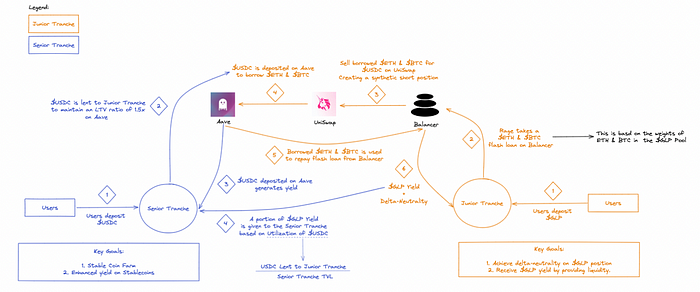
Referring to the mind map above, orange coded numbers/text provide information about Junior Tranches and blue coded numbers/text provide information about Senior Tranche.
Let’s start with Junior Tranche:
1. Users participating in Junior Tranche deposit GLP into Rage Trade's Risk-On Vault. Subsequent actions are handled entirely automatically by Rage's vault contract.
2. Based on the weight of ETH and BTC in the GLP pool, Rage Trade lends a corresponding amount of ETH and BTC flash loans on Balancer.
3. Then sell the borrowed ETH and BTC for USDC on Uniswap. Create a synthetic short position.
4. In addition to the proceeds from selling ETH and BTC on Uniswap, Senior Tranche's USDC supplement will be deposited into Aave as collateral to borrow ETH and BTC.
5. Then use the ETH and BTC borrowed from Aave to repay the flash loan from Balancer.
6. This whole process enables LPs on GMX to enjoy the benefits of GLP and effectively reduces the volatility of underlying assets.
Next is the Senior Tranche:
1. Users participating in Senior Tranche deposit USDC into Rage Trade's Risk-Off Vault.
2. Then lend USDC to Junior Tranche to maintain a 1.5x health factor on Aave.
3. Senior Tranche participants receive benefits in two ways. First, USDC deposited into Aave will generate additional income.
4. In addition, part of the income of GLP is allocated according to the utilization rate of USDC in Senior Tranche. The calculation of the utilization rate is explained in the mind map.
image description
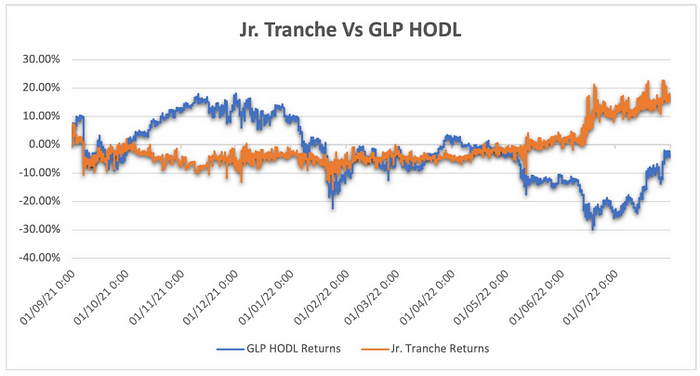
Source: @crypto_noodles
Assuming that the yield of ETH is about 20%, the net return rate of "Risk-On" Vault/Junior Tranche after considering the revenue sharing of GLP revenue and Senior Tranche is about 24.8%. Note that the "Risk-On" Vault automatically compounds the ETH rewards on a regular basis.
image description
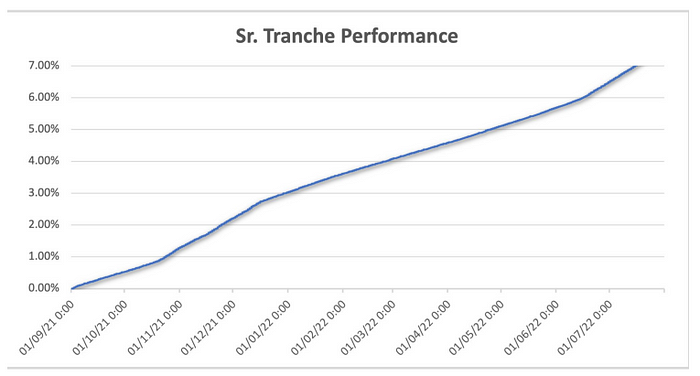
Source: @crypto_noodles
Assuming that the yield of ETH is about 20%, the net rate of return of the "Risk-Off" Vault/Senior Tranche after considering the GLP income is about 8.27%. Yields can be broken down into two parts: 1) interest on loans on Aave yields ~1.05% yield, and 2) ETH yield from GLP yields ~7.22% yield.
secondary title
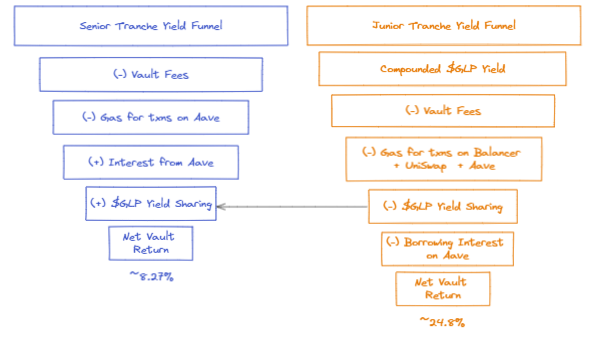
Rage Trade Yield Funnel
key challenges
Rage Trade has built an amazing product. At the same time, the agreement faces two main challenges: 1) balancing risks and 2) relying heavily on GLP benefits.
Adjusting positions in the vault can happen in two cases: 1) GLP pool weight changes or 2) ETH and BTC price changes.
Short positions on Aave are updated every 12 hours. This means that every 12 hours, if the price of ETH and BTC rises, the short position will be paid off with a profit from the GLP earnings. To improve capital efficiency, Rage Trade maintains a healthy factor of 1.5x on its short position in Aave.
If the price of ETH and BTC spikes within the allotted 12-hour window, there may be a possibility of being liquidated on Aave.
image description
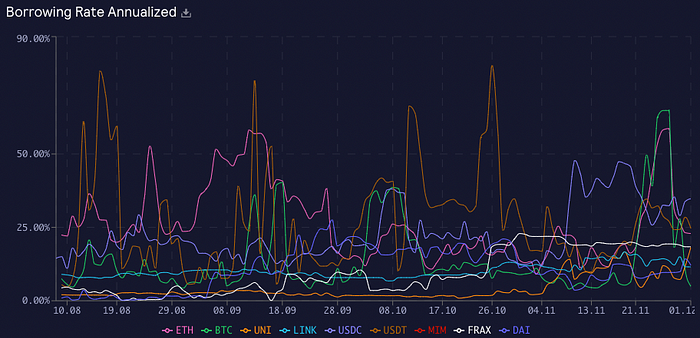
Source: GMX Statistics, GMX ETH Borrowing Rate, December 1, 2022
Naturally, the agreement relies heavily on GLP earnings. This is not a systematic risk, but users should be aware of the potential volatility of returns.
The team is very conservative in assuming that ETH's rate of return remains at 20%. Nonetheless, participants should be aware that ETH yields can fluctuate significantly.
first level title
Umami Finance
At the beginning of its establishment, Umami Finance aimed to attract institutional capital into Web 3.0 with a "sustainable" 20% annualized interest rate.
secondary title
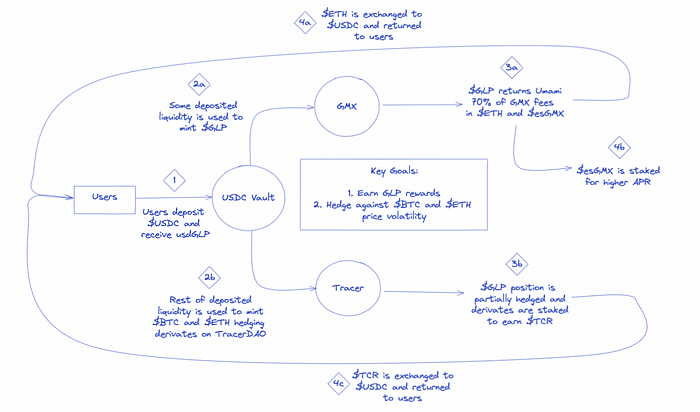
USDC Vault (discontinued)
In operation, Umami's USDC vault earns GLP yields by providing liquidity to GMX in return.
1. The user deposits USDC into the USDC vault and gets a receipt Token—ERC-4626 Token glpUSDC. Users can leave the vault at any time by exchanging glpUSDC for stablecoins on Uniswap.
2. The treasury uses an undisclosed ratio of deposit liquidity to mint GLP and charges GMX transaction fees.
3. The rest of the deposit liquidity is used to mint hedging derivatives of BTC and ETH on TracerDAO (now called Mycelium).
4. By purchasing leveraged tokens (3 S-BTC/3 S-ETH) for hedging, the vault creates a short position of ETH and BTC.
secondary title
Tracer Hedging Derivatives
Umami utilizes Tracer's perpetual pool to hedge against unwanted GLP price fluctuations. Tracer’s perpetual pools are synthetic derivatives that allow users to take leveraged long or short trades on assets. Each pool has an established risk limit (for example, 3 S BTC or 3 L ETH).
image description
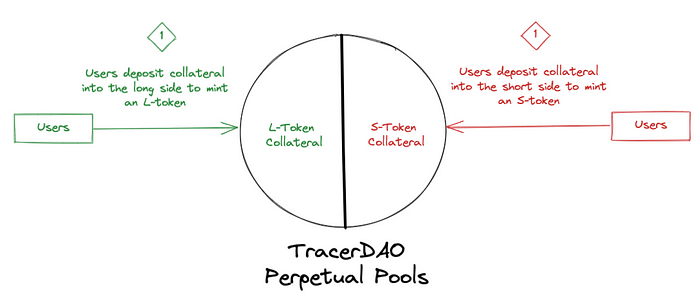
TracerDAO Perpetual Pool
The perpetual pool is managed by a contract that transfers value between the long and short side of the staking pool based on the underlying price source:
1. The pool has two directions: long and short. Users deposit USDC into the long side of the mortgage pool and mint long Token, and vice versa.
2. Users can convert long/short tokens to USDC by burning any token.
3. The value of Token is determined by the ratio of collateral held on both sides of the pool.
4. The amount of collateral held in the short pool and the long pool will change dynamically.
image description
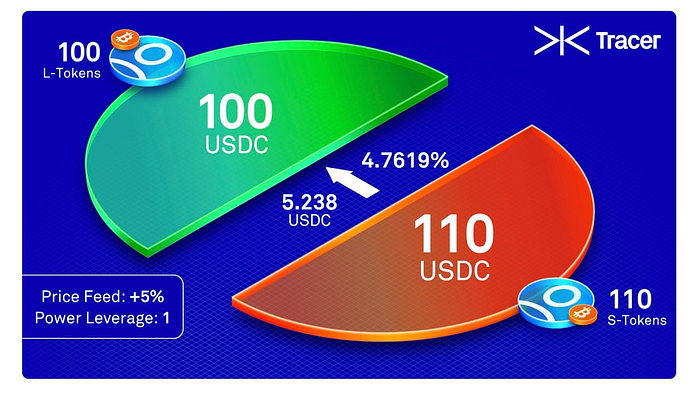
Source: TracerDAO, perpetual pool rebalancing
Taking the 1x pool as an example, when the price of the underlying asset rises, the collateral in the short pool will be transferred to the long pool.

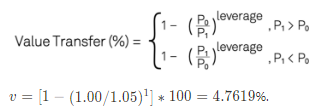
The calculation of value transfer will be divided into two steps:
1. Assuming a 5% increase in the base price, the value transfer is calculated as follows:
secondary title

image description
Source: TracerDAO, Power Lever Diagram
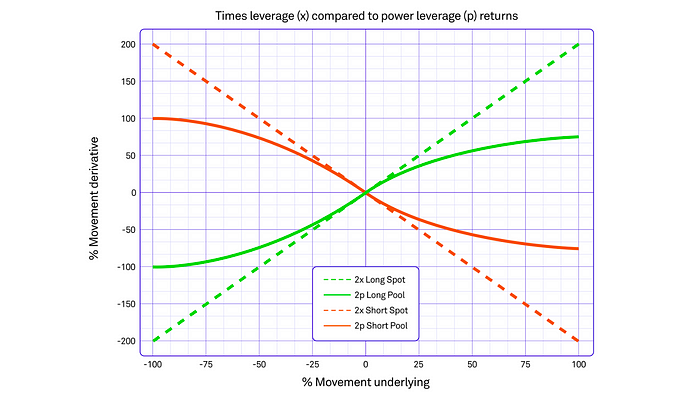
This function will effectively prevent either party from losing all value. Although liquidation risk is effectively eliminated, the returns are greatly reduced. Looking at the 2 p long spot (green dotted line), if the underlying asset appreciates by 100%, 2x leverage will bring a 200% return. However, under the power leverage function, the gain will be reduced to about 75%.
secondary title
main challenge
Underperformance of TracerDAO perpetual pools
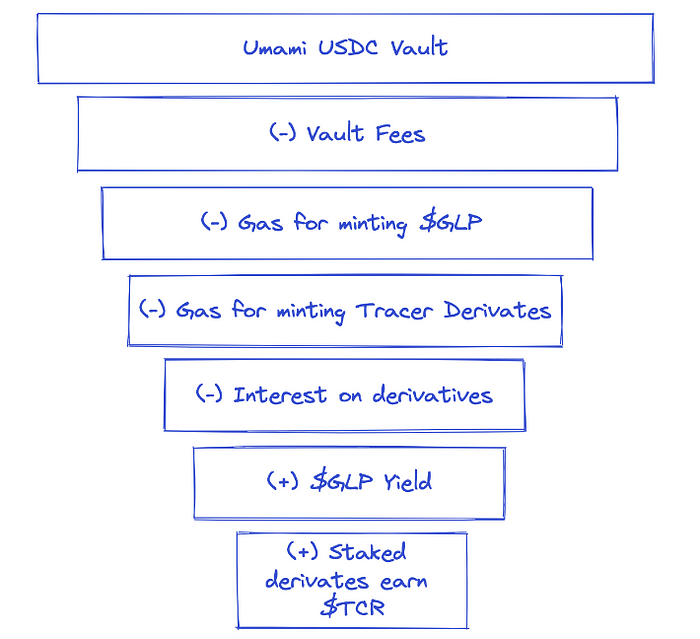
It should be noted that the hedging model of the USDC vault will not lead to complete delta neutrality.
Although TracerDAO’s perpetual pool design is flawed, Umami may be using it as a hedging tool as they initiated early campaigns to support liquidity in TracerDAO’s pool ahead of the launch of the USDC vault. The actual cost of hedging with these pools is much higher than anticipated.
The partiality of the TracerDAO pool limits the scalability and performance of the vault
Similar to Rage Trade, balance risk remains in Umami's USDC vault.
Vaults rebalance their Tracer hedges every 9 hours. If BTC or ETH is very volatile over a short period of time, this could have an adverse effect on Delta neutrality.
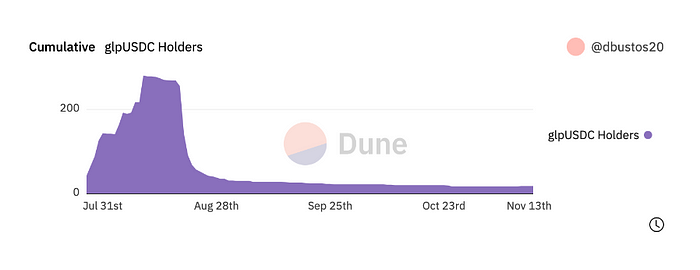
The vault is now out of operation
image description
Source: Dune Analytics, @dbustos 20
looking to the future
looking to the future
Both of the above protocols attempt to provide Delta neutrality for GLP pool LPs. Umami Finance said it would try again, while Rage Trade's product results are yet to be seen.
The development of the GMX ecosystem is worth looking forward to.
At ByteTrade, we are actively building our Web3 operating system (OS), which is based on an open Blockchain-Edge Node-Client (BEC) architecture, a decentralized version of the original full-stack Internet protocol, which will attract A large number of users and decentralized Internet applications to realize Web3.0, and finally return data ownership to users.
Original link