






Analysis of the Asian Crypto Market Overview from Six Aspects


Original title: A Primer of Asia's Crypto Landscape
Original compilation: Frank, Foresight News
Foresight News sorted out the original text of the report, and released a Chinese version of this article summarizing the main points of the report for readers to enjoy (click on the "source link" for the full text of the English report).
The report summarizes the regulatory trends, Crypto market size, talent and developer status, and infrastructure adoption in mainland China, South Korea, and Taiwan, and collects the opinions of more than 5,000 people across multiple cities and age groups in mainland China. Sample survey and another sample survey of more than 1,000 people for cryptocurrency holders. At the same time, CoinNess and BlockTempo conducted corresponding sample surveys in South Korea and Taiwan respectively. The status and trends of Crypto adoption presented show that the Asia-Pacific region is expected to become the future3 - An important driver of cryptocurrency industry growth over 5 years.
Supervision
China
Mainland China declared initial coin offering (ICO) as an illegal fundraising activity in September 2017, issued a mining ban in May 2021, and banned all cryptocurrency transactions in September 2021.
In Hong Kong, China, a number of regulatory actions related to cryptocurrencies will be launched in 2023, of which two main policies stand out:
foreign exchange policy. In February 2023, the Hong Kong Securities Regulatory Commission issued a consultation document, which introduced in detail the proposed guidelines for the exchange license (virtual asset trading platform). All centralized exchange businesses marketing to Hong Kong investors need a license to operate. Effective June 1, 2023;
Stablecoin Policy. Hong Kong's proposed stablecoin regulations require issuers to have a locally incorporated entity, and stablecoins must be fully backed by high-quality liquid assets and convertible at par to their anchored fiat currency;
The Hong Kong region of China can be regarded as a potential sandbox for future encryption regulation in mainland China, and Hong Kong will be a bridge for mainland China to expand globally.
South Korea
Most of the cryptocurrency trading volume in South Korea occurs on the 5 exchanges (UpBit, Bithumb, CoinOne, Korbit, and Gopax) authorized to have bank accounts. Trading of currency pairs is very limited (for example, USDT accounts for less than 1% of Upbit's trading volume).
In addition, South Korea is formulating relevant regulations for security token offerings (STO).
Taiwan
Regulators such as Taiwan’s Financial Supervisory Commission (FSC) classify cryptocurrencies as speculative commodities.
The FTX incident caused a loss of US$1.7 billion to US$2.1 billion in Taiwan, and more than 231,000 Taiwanese users were affected.
At present, the division of labor among the three major virtual asset regulatory agencies in Taiwan is as follows:
Taiwan Financial Supervisory Commission (FSC): responsible for supervising investment and payment platforms, CEX and asset management platforms;
Central Bank of Taiwan: Manage stablecoin transactions involving fiat currency exchanges;
Taiwan Digital Development Department: Responsible for NFT, Web3 chain projects and other encryption-related projects not covered by the other two regulatory agencies;
Market Size and Crypto Penetration
According to a sample survey of more than 5,000 people across multiple cities and age groups in mainland China + another sample survey of more than 1,000 people for cryptocurrency holders, it was found that only 2.6% of people over the age of 15 in mainland China of people own cryptocurrencies (86.0% have experience in trading crypto derivatives such as futures and options).
Compared with about 10% in developed countries such as the United States, South Korea, and Taiwan, China still has a lot of room for growth in the total number of cryptocurrency users.
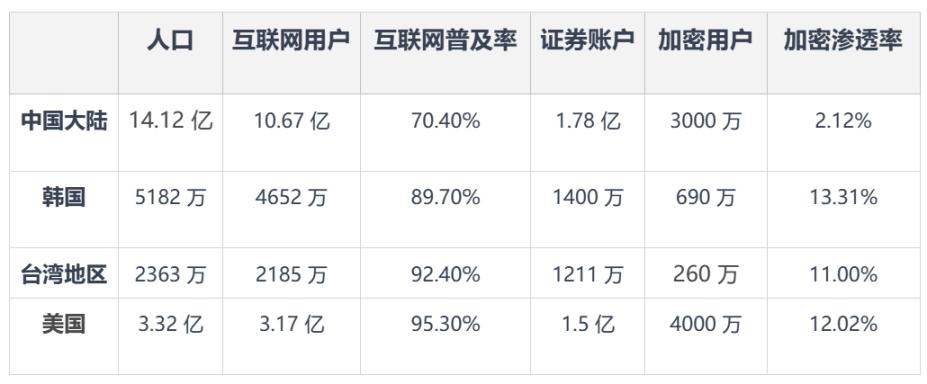
The South Korean cryptocurrency market is largely driven by retail trading, with trading volume concentrated on 3 exchanges—Upbit, Bithumb, and Coinone, with Upbit having a market share of 82.24% on Korean exchanges, and altcoins ( That is, cryptocurrencies excluding BTC and ETH) accounted for 92.9% of the total crypto transaction volume in South Korea.
The annual growth rate of encrypted trading volume in Taiwan has reached 31.5%, second only to Japan and Mongolia, and nearly half of the encrypted currencies received by CEX (about 30 billion US dollars) are DeFi tokens.
infrastructure
infrastructure
China
The People's Bank of China began to test the digital renminbi in 2019, and the official public test will be in April 2021. As digital payment penetration in China has been high, so far the digital yuan has not achieved widespread mainstream adoption.
South Korea
South Korea's encryption infrastructure is very mature:
Major commercial banks provide bank accounts to crypto exchanges, allowing deposits and withdrawals of virtual assets (NH Bank, ranked second in South Korea, etc.);
Officials are introducing various licensing systems such as Information Security Management Systems (ISMS) and Virtual Asset Service Providers (VASPs) to crypto companies to help crypto companies operate legally;
However, South Korea is still immature in terms of encrypted futures ETFs, and has not yet allowed custody and compliant institutional tools.
Taiwan
Taiwan’s encryption infrastructure is still under construction, including its central bank digital currency (CBDC), which is being evaluated and is not expected to be launched until 2026.
At present, local exchanges in Taiwan are unable to trade derivatives such as perpetual contracts. Most users trade on international exchanges (Binance, FTX before bankruptcy, etc.), and local exchanges are mainly used as fiat currency deposit and withdrawal channels;
talents
China
The talents in China’s encryption field mainly come from top universities. Among the top 100 universities in the blockchain field released by CoinDesk in 2022, there are 6 universities in mainland China on the list, including Peking University (PKU Blockchain), Tsinghua University (THUBA), Shanghai Jiaotong University University, Zhejiang University, Sun Yat-Sen University, Fudan University.
South Korea
Most Korean blockchain talents enter the industry after studying blockchain-related majors at the university/graduate level (such as Korea University, Sogang University, Hanyang University, Korea Institute of Science and Technology), and enter the industry through newcomer training camps (such as Codestates, Learnfree ).
Taiwan
Most schools in Taiwan lack blockchain professional education, and only a few universities provide related projects, courses, and student group activities. The blockchain talent pool mainly comes from top universities in Taiwan, such as the public chain OurChain being developed by National Taiwan University, National Taiwan University National Chengchi University is an important research center for Taiwan’s Ethereum, National Tsing Hua University established Asia’s first professional blockchain law and policy research center, and so on.
Investment agency
China
Hashkey Capital: Founded in 2015, one of the earliest institutional participants in the blockchain field, especially focused on the Ethereum ecosystem. In addition to investing in Cosmos, Polkadot, Coinlist and other related projects, it is also active in CeFi, general Web3 infrastructure and other fields ;
Dragonfly: Founded in 2018, it currently includes three branches: Dragonfly Ventures (VC), Dragonfly Liquid (LP), and Metastable (Hedge Fund). The investment fields cover DeFi, CeFi, infrastructure, NFT, and L1/L2, etc.;
Foresight Ventures: Founded in 2021, it is committed to discovering alpha investment opportunities in the market, making good use of various investment strategies, and empowering investment companies throughout their life cycle;
South Korea
Alphanonce: Founded in 2018, it provides full-stack solutions for various customers and counterparties, covering accelerators, investment, liquidity provision and trading;
Hashed: Headquartered in Seoul and Silicon Valley, focusing on the primary market;
100&100 Venture Capital: Started investing in blockchain projects in 2017, and is currently operating a $38 million Web3 game investment fund;
developers and operators
China
By the end of 2021, the number of developers in China will exceed 73 million, second only to the United States. Java developers account for 50%, 76% of programmers earn more than $1,200 a month, and 20.5% of developers earn between $2,500 and $4,500 a month.
The main reasons that hinder developers from entering the Web3 industry include lack of basic understanding of cryptocurrencies, lack of a systematic approach to the Web3 industry, fear of unstable or illegal jobs in the Web3 industry in China, and more.
China’s encryption projects cover almost all fields such as DeFi, infrastructure, GameFi, Metaverse, such as Loopring, Stepn, Lifeform, X2Y2, SpaceID, Conflux, Alchemy Pay, Animoca Brands, Certik, etc.
South Korea
Korean encryption projects are mainly driven by two large technology companies (Kakao, Naver) and large Web2 game companies (WEMIX, etc.).
Taiwan
Taipei Ethereum Meetup (TEM) is the largest developer community in Taiwan with more than 6,000 members. In addition, in terms of DeFi ecology, there is Perpetual Protocol; in terms of wallets, there are Blocto, etc.; NFT platform development includes Oursong and Lootex; and some entrepreneurial communities such as Bu Zhi DAO and government-involved organizations such as g 0 v.





