






An overview of the LSD track: long slopes and thick snow, stability and high speed throughout the year


Original source: LD Capital
Summary
Summary
The increase in the pledge rate of Ethereum will lead to an increase in the overall agreement fee of the LSD track. In the long run, the Davis double-click on the LSD track is not over yet. The current pledge rate of Ethereum is 14.56%. Since the pledge rate of other POS public chains mostly exceeds 60%, there is a greater growth expectation for the increase of the pledge rate of Ethereum. Assuming that the LSD track fee remains unchanged, we estimate that when the pledge rate of Ethereum rises to 29%, 44%, and 58%, the corresponding increase in the LSD track protocol fee will be 1.31 times, 1.55 times, and 1.76 times, respectively. From the perspective of P/F valuation, the current P/F of LDO, the leading target of the LSD track, is 3.89 times. Compared with the valuation levels of the old Defi protocols UNI 7.12 times and AAVV 10.35 times, there is still a lot of room for improvement.
After the Shanghai upgrade, the relative market share of the LSD agreement may change. In the medium term, focus on the track leader Lido and the high-yield LSD agreement represented by Frax, and in the short term, focus on the upgrade of Rocket pool Atlas. After the Shanghai upgrade, the exit of early nodes and the enhancement of users' willingness to pledge will provide conditions for the LSD protocol to compete with each other. At present, Lido has a long-standing experience in multiple dimensions such as popularity, capital scale, security, yield, liquidity, and combination. However, latecomers such as Frax realized the combination with Curve ecology through the design of self-sustained CVX and dual-currency model, so that it has a pledge rate of return much higher than similar pledge products, and successfully completed the cold chain of the product. Start-up and early growth. With the launch and popularization of income aggregation products in the future, the growth of high-yield products such as Frax is expected to further accelerate. It should be pointed out that Frax's high rate of return will continue to decrease with the increase of its TVL. According to the current situation, when its ETH pledge amount reaches 200,000, the pledge rate of return will drop to 6%; the recent Atlas of Rocket pool The upgrade is worthy of attention. It reduces the minimum number of pledges for node operators ETH from 16 to 8, improves the protocol capacity and enhances node incentives, which is expected to bring a large increase to its TVL.
Currently, DVT products represented by SSV, Obol, and Diva are positioned as an important infrastructure for Ethereum staking. DVT products are designed to ensure the stability of Ethereum verification blocks while improving the degree of decentralization of the network, which can reduce the operating costs of the node operation and maintenance team and reduce security risks. The development of SSV focuses on the construction of the operator network, and its tokens serve as the means of payment and governance certificates of the network to capture the protocol value; the development of Obol focuses on the adaptability of middleware, and the goal of Diva is to combine the two modes of LSD and DVT Create a one-stop product, currently in the early stages of development.
risk:
risk:
Regulatory risk, macroeconomic risk, technology upgrade less than expected risk
1. The overall space of the LSD track
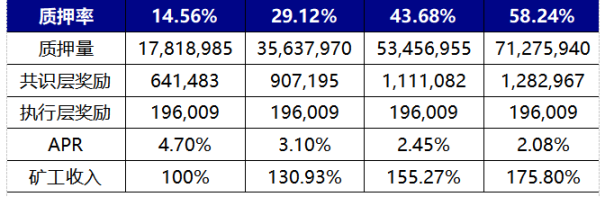
The increase in the pledge rate of Ethereum has promoted the increase in the income of miners, which has brought about an overall increase in the income of the LSD track. In the long run, the valuation of the track income is still in the double-up range. The current pledge rate of Ethereum is 14.56%. Since the pledge rate of other POS public chains mostly exceeds 60%, there is a greater growth expectation for the increase of the pledge rate of Ethereum. The figure below estimates that when the Ethereum pledge rate doubles, doubles, and triples to 29.12%, 43.68%, and 58.24%, the corresponding increase in LSD track protocol fees is 1.31 times, 1.55 times, and 1.76 times, respectively. The calculation method, assumptions and process are as follows:
The execution layer reward is determined by the Priority fee. Due to the balance setting of the Ethereum fee mechanism, it is assumed that the execution layer reward remains unchanged (a conservative estimate, when the network Gas fluctuates, the execution layer reward will rise sharply, such as USDC unanchored on March 10 The event led to a surge in transactions on the chain, and the rewards of the execution layer of Ethereum increased by 4-6 times as usual); the rewards of the consensus layer are determined by the block rewards of Ethereum, the total block rewards are proportional to the square root of the total pledged amount, and the APR of the consensus layer is proportional to The square root of the total pledged amount is inversely proportional, and the specific calculation formula is base_reward = effective_balance * (base_reward_factor / (base_rewards_per_epoch * sqrt(sum(active_balance)))). Based on the current 14.56% pledge rate corresponding to consensus layer rewards and execution layer rewards, according to the above two conditions, it is estimated that the pledge rate reaches 2-4 times the current miner income. At the same time, assuming that the fee standard of the LSD agreement remains unchanged, the increase rate of miners' income with the pledge rate is the increase rate of the LSD agreement fee as follows:
Source: LD Capital
Source: LD Capital
source:
source:https://ethereum.org/zh/developers/docs/consensus-mechanisms/pos/rewards-and-penalties/
2. Panoramic view of the LSD track
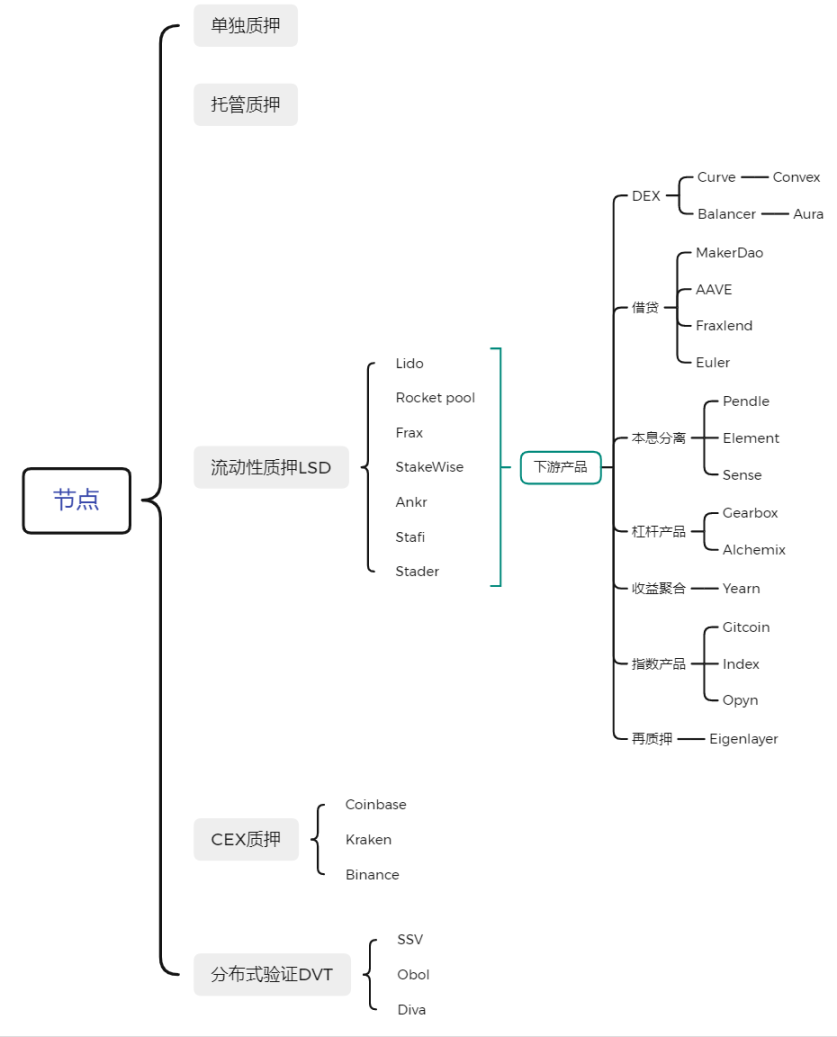
The LSD track can be expanded to Ethereum pledge solutions and their derivatives, including four Ethereum pledge solutions competing for market share, DTV technology to ensure security while expanding decentralization, and the second layer around the birth of LSD protocol pledge certificates Yield-enhancing products and leveraged agreements and index products.
Source: LD Capital
Source: LD Capital
2.1 Among the four pledge solutions, LSD has the highest market share and is expected to expand further
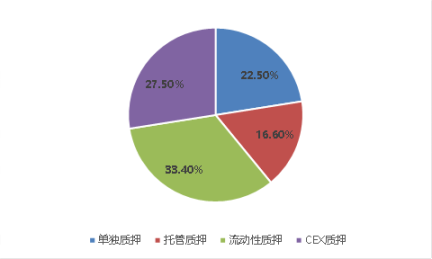
There are four types of Ethereum staking solutions, including individual staking, custody staking, liquid staking LSD and centralized exchange staking. Among them, LSD and centralized exchange pledge have achieved the vast majority of the market share due to the advantages of solving small capital participation, not requiring hardware infrastructure, and re-releasing liquidity through pledge certificates. From the statistical caliber of the number of nodes, the current market share of LSD accounts for 33.4%, CEX accounts for 27.5%, custody pledge (Staking pool) accounts for 16.6%, and independent pledge accounts for 22.5%.
image description
Source: beaconchain, LD Capital
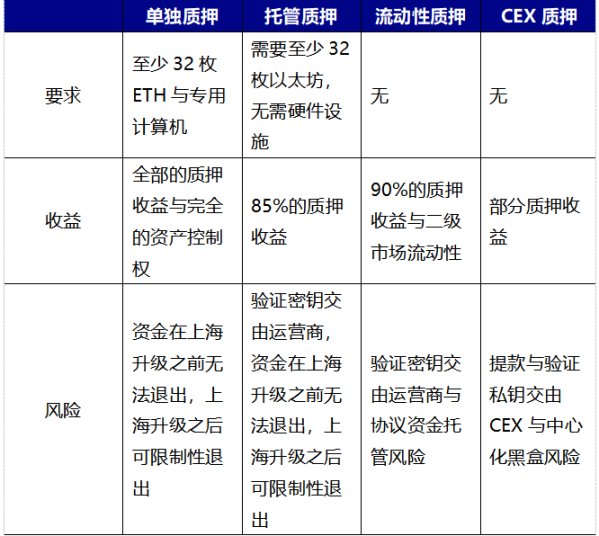
Specifically, let’s look at the basic situation of the four pledge solutions:
Separate pledge: At least 32 Ethereum and a dedicated computer are required, and the network, power conditions and methods of operating nodes are required; users can obtain all pledge income and complete asset control; funds cannot be withdrawn before Shanghai upgrades, After Shanghai is upgraded, it can be restricted to exit.
Pledge custody: At least 32 Ethereum are required, no hardware facilities are required, users entrust ETH to node operators to obtain pledge income; during this process, users need to upload signature keys, allowing service providers to verify on behalf of users; funds before upgrading in Shanghai Unable to exit, restricted exit after Shanghai upgrade.
Liquid staking LSD: 32 Ethereum and hardware infrastructure are not required, users entrust their custom Ethereum to the LSD protocol, and the LSD protocol matches the Ethereum entrusted by the user and selects the node operator to host the pledge to obtain the pledge income; the user It is usually necessary to distribute part of the income to the LSD protocol and node operators; usually, funds can be withdrawn from the secondary market at any time through the liquidity of lsdETH or leveraged to enhance income; the current degree of centralization of this scheme is relatively high.
Centralized exchange pledge: No need for 32 Ethereum and hardware infrastructure, or even a wallet on the chain. Users obtain most of the pledge income through the pledge service provided by centralized exchanges such as Coinbase, and a small part of the income is collected by the exchange. The operation difficulty of the program user is the lowest. Usually, the pledge can be rolled back in time or exited in the secondary market through the pledge certificate, and can also be leveraged through the lending agreement to increase the income; this scheme currently faces relatively high regulatory risks; this scheme is currently the most centralized.
image description
Source: LD Capital
However, it should be noted that the centralized exchange staking and LSD staking solutions face the unresolved regulatory issues of the US SEC. There has been no authoritative explanation on whether the staking business is recognized as a security. The staking business of the Kraken exchange was previously cracked down by the SEC, but it has not yet substantially affected LSD agreements such as Coinbase and Lido. The main reason is that Kraken did not disclose the whereabouts of user funds at the time. The black box operation, while promising a high rate of return far exceeding the Ethereum pledge, has led to regulatory attacks. But from the perspective of the Howie test, LSD protocols such as Kraken, Coinbase, and Lido all participate in Staking by hosting user funds, and there is no essential difference. Therefore, the development of LSD business is currently facing uncertainty from US regulations.
From a product point of view, although the pledged Ethereum can be redeemed and withdrawn in the primary market after the Shanghai upgrade, the quantity is limited. According to the current pledge scale, 1,800 nodes can be withdrawn every day corresponding to 57,600 ETH. Due to the LSD protocol's advantages in solving small funds to participate in the pledge, releasing the liquidity of the pledge certificate, and the agreement can be combined to enhance the rate of return, it will still occupy a major market share after the upgrade in Shanghai. It may appear shortly after the upgrade in Shanghai that the overall market share of the LSD protocol has passively increased due to the early redemption of ETH that was pledged individually or escrowed and pledged and profit-making withdrawals. From the perspective of LSD agreement competition, the factors that currently affect the development of each LSD agreement include popularity, yield, capital security, anchoring situation, degree of decentralization, and combination. This dimension can be combined to analyze the current mainstream LSD in the market Differences between agreements.
Lido is currently the largest LSD protocol in TVL, 13 times larger than the second Rocket pool. Lido currently screens operators through a whitelist mechanism to ensure the good operation of pledge nodes so as not to affect the rate of return or cause capital penalties; at the same time, Lido uses compound interest on the execution layer to maintain the annualized rate of return of its users' pledge at 4.5% after pumping 10% -5 % At this high level, it is second only to Frax among the current mainstream LSD protocols, and surpasses other protocols such as Roceket pool, StakeWise, and Anrk. It should be noted that Lido will upgrade the V2 version in mid-May, introducing a pledge routing module, allowing anyone to create a pledge node and access DVT, aiming to ensure network stability and security while improving the degree of decentralization.
The uniqueness of Rocket pool is that there is no access permission for pledged nodes, and anyone can become a node operator in the network by creating a Minipool; currently node operators need to deposit 16 ETH (the remaining 16 ETH comes from user deposits) and also A minimum pledge of 1.6 ETH worth of RPL Token is required as confiscated funds; Rocket pool currently provides RPL subsidies to node operators on the platform to incentivize node deployment. Rocket pool will undergo an Atlas upgrade within one month. This upgrade is the most important upgrade since Rocket pool went online, and it will also have a major impact on its business development. The main contents of the upgrade are: 1. LEB 16 — — LEB 8: Reducing the minimum pledge required by node operators from 16 ETHs to 8 ETHs will greatly improve the current situation where the scalability of Rocket pool is limited by nodes. Assuming that the total amount of ETHs of node operators remains unchanged, this improvement can theoretically make the protocol TVL doubled, deposit capacity tripled, after node-side scalability is opened, the number of deposits in the dynamic deposit pool will become a leading indicator for observing Rocket pool TVL growth; 2. Node incentives are further increased, excluding RPL incentives, LEB 8 nodes The reward will be 25% higher than that of LEB 16; 3. Launch tools so that Solo Staker does not need to exit the validator to complete the migration to the Rocket pool platform; 4. Optimize the dynamic deposit pool. When the ETH required by the minipool queue exceeds the upper limit of 5000 ETH, the deposit pool will The upper limit will also increase accordingly.
Frax Ether is characterized by its current high staking yield. The previous pledge rate of sfrxETH was maintained at 7% to 10%. The reason is that Frax built a dual-currency model of frxETH and sfrxETH. frxETH and ETH in the Curve group LP use Frax's own CRV governance resources to obtain CRV income, and all pledged The income is distributed to sfrxETH; on the whole, the high rate of return of the Frax Ether system, which is different from other liquid mortgage products, comes from its additional layer of CRV rewards; the CRV reward for the overall system’s income increase depends on Factors such as the proportion of ETH gauge pool, the TVL of the Frax Ether system, and the price ratio of CRV/ETH. According to the current situation, when the pledge amount of Frax Ether reaches 200,000 ETH, the pledge income of sfrxETH will drop to about 6%.
The above three mainstream LSD protocols have developed three main ETH pledge models, and the remaining small LSD protocols are mainly aimed at improving and fine-tuning some user pain points of the above three protocols. For example, Stafi and Stader have improved on the problems that currently Rocket pool node operators need to pledge 16 ETH, low capital utilization efficiency and operators are forced to increase RPL risk exposure. They only require node operators to pledge 4 ETH, and at the same time Provide node operators with a solution that does not increase exposure to protocol tokens. However, it should be noted that blindly reducing the proportion of ETH pledged by node operators may increase the risk of user fund loss, and unlike Rocket pool, Stafi is currently facing the growth pressure of user funds.
image description
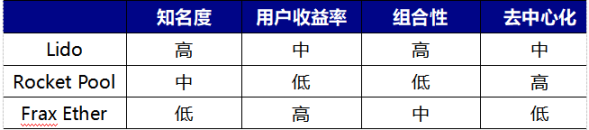
Source: LD Capital
At present, from the perspective of protocol valuation, whether it is FDV/Revenue or FDV/TVL, Lido is at a relatively low level, but LDO currently only has governance rights, while RPL and FXS have corresponding token empowerment. Enjoy the corresponding valuation premium.
Frax currently holds about 3.5 million CVX, the largest holder in CVXDAO
image description
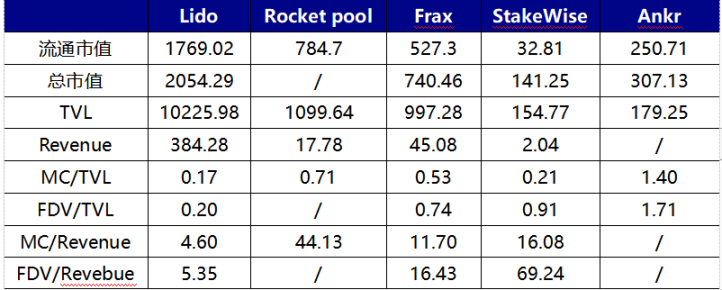
Source: LD Capital, Token Terminal
3. DVT products will become an important infrastructure for Ethereum pledge
Decentralization and security assurance are the spiritual core of Ethereum, on the basis of which Distributed Verification Technology (DVT) came into being. At present, various Ethereum pledge solutions are facing the contradiction between decentralization and stable operation of nodes. Represented by Lido and Rocket pool, in order to ensure that users' funds will not be lost due to node disconnection and failure, Lido currently uses a white list to screen qualified operators to ensure the effectiveness of block generation, traceability and security of funds This makes Lido currently have the problem of centralization; Rocket pool binds the interests of the two through the joint pledge of nodes and users, and further guarantees the safety of users' funds in the form of nodes mortgaging RPL to make confiscated funds, but this is undoubtedly Increased the cost of operating nodes on the Rocket pool platform. At present, Rocket pool uses RPL to motivate nodes to balance, but this undoubtedly increases the protocol expenditure and limits the scalability of the protocol.
The DVT product makes an operator and a node change from a one-to-one state to a many-to-one state through technical solutions such as fragmented verification of private keys and leader node rotation, and improves the security and robustness of the system from the perspective of the underlying network architecture. Stickiness also allows for a higher degree of decentralization.
The specific principles are as follows:
DVT consists of 4 key parts, distributed key generation DKG, Shamir key sharing of BLS signature, multi-party secure computing and IBFT consensus layer, as follows:
Distributed key generation DKG is the first step in the realization of DVT. Its function is to fragment a validator's private key into 3 n+ 1 shares, and multiple fragmented private keys correspond to multiple operators; DKG technology is the cornerstone of realizing DTV products . The private key sharing of BLS signature is complementary to DKG. Its purpose is to realize multi-party aggregate signature, that is, to be able to combine block fragmented signatures into a single signature. Because DKG allows private key fragments to be held by multiple parties, then multiple People's signatures are aggregated into one signature, and fragmented private keys and multi-party aggregated signatures constitute the skeleton of the entire DVT product. The role of multi-party secure computing (MPC) is to securely distribute the split keys among the various nodes to perform the verifier's responsibility to complete the verification of network information without rebuilding the verifier's key on a single device, eliminating the need for Risk of centralizing private keys during computation. Istanbul Byzantine Consensus IBFT will randomly select a validator among the DVT nodes as the leader node, responsible for block proposals and other work, if most nodes in a single cluster agree that the block is valid, it will be added to the blockchain; if the leader If the node is offline, the algorithm will reselect the leader node within 12 seconds to ensure the stability of the system.
To sum up, DVT distributes DKG fragmentation verification keys to different operators, realizes multi-party aggregate signatures through BLS private key sharing, and uses multi-party security calculations to ensure data security. Finally, IBFT leader node rotation ensures that nodes will not generate blocks maliciously. Or because the overall revenue is affected by the disconnection, it is finally possible to hand over a validator node to multiple operators instead of the current industry standard separate operation, thereby greatly improving the robustness of the overall system.
3.1 Comparison of DVT products currently on the market: SSV.Network, Obol Labs and Diva
SSV Network has built a DVT-based operator network, which is the fastest-growing product in the DVT track. It has received a donation of US$188,000 from the Ethereum Foundation and a US$100,000 LDO donation from Lido. SSV Network is currently the only subject of currency issuance, and the main purpose of its Token SSV is the payment method and governance certificate of the network. Pledgers participating in staking on the SSV network need to pay operating expenses to node operators, and the specific expenses are determined by each operator based on operating costs and market competition; at the same time, operators currently need to pay 1/4 of their network revenue to the SSV treasury (charges The standard is determined by DAO), and the above payment links need to use SSV tokens. SSV plans to hold a community meeting on March 30 to discuss the launch time of the mainnet.
Obol Labs is committed to building a staking middleware, Charon, so that any node can participate in the distributed validator operation of the DV cluster. Obol also received a $100,000 LDO token donation from Lido DAO, and completed a $12.5 million A round of financing co-led by Pantera Capital and Archetype, with participation from Coinbase, Nascent, Block Tower and other institutions. In terms of development progress, Obol is currently in the Bia public testnet stage. It is expected to open the Circe testnet in June this year, and then complete the mainnet launch; in terms of development progress, it is slightly behind SSV.
Diva is a new product of the DVT circuit. It has completed a US$3.5 million seed round of financing led by A&T Capital and participated by Gnosis, Bankless, OKX and other institutions. It will combine the two models of LSD and DVT to create a liquid staking and Distributed verification one-stop product.
4. The development trend of the LSD track and its impact on the current mainstream track
After the Shanghai upgrade, the pledged Ethereum on the Beacon Chain can be withdrawn, and the willingness of users to participate in the pledge has increased to promote the increase in the pledge rate, which has brought about the expansion of the scale of lsdETH, an interest-bearing asset. Therefore, in addition to the possibility of more and more liquidity staking agreements in the future, Defi products around lsdETH, an asset, will also usher in a new growth curve.
Decentralized exchange: The liquidity construction of lsdETH is the most important part of the lsd protocol. As similar assets, lsdETH/ETH is the best choice for liquidity construction. It is Curve and its similar products. If there are more and more The lsd protocol, the problems built around different types of lsdETH liquidity may trigger a new round of Curve war. It should be pointed out that the current cost of building liquidity in the Balancer ecology is lower than that of Curve. At the same time, because Balancer's basic market is smaller, from the perspective of marginal changes, the prosperity of lsdETH will have a higher impact on the Balancer ecology than Curve (Related protocols Aura, Convex, Balancer, Curve).
Lending agreement: The market demand for using lsdETH to increase leverage will promote lending business based on this asset class. At present, there are two main needs for increasing leverage: one is revolving loan for income enhancement. This business is currently represented by AAVE, mortgage stETH to lend ETH, the maximum LTV is 90%, and the maximum leverage can be 10 times regardless of intermediate fees; There is a problem with the high lending rate of ETH in the model (after the Shanghai upgrade, the interest rate of the AAVE ETH deposit pool may be equal to the interest rate of ETH Staking, which will make the borrowing rate of ETH in AAVE higher than the interest rate of Staking, making the current demand for revolving loans disappear), the core reason is that the borrowing rate of ETH needs to cover the deposit cost of depositors; in the future, it is possible to mint stable coins anchored to ETH in the form of CDP, and replace the user's deposit cost with more efficient liquidity costs, enhancing the combinability between protocols At the same time, it can better meet the needs of users to increase leverage and enhance income (related protocols AAVE, Compound). The second is to mortgage lsdETH to lend stable currency to increase the overall risk exposure of the investment portfolio. It can also be operated in two modes: normal lending and CDP (related protocols Fraxlend, MakerDao).
Derivatives such as separation of principal and interest: lsdETH, as an interest-earning asset with a floating rate of return, can generate financial derivatives such as separation of principal and interest and interest rate swaps. Principal and interest separation products can realize short future yield (sell interest tokens to buy principal tokens, low leverage ratio, usually used to lock in income in advance), long future yield (sell principal tokens to buy interest tokens) currency, high leverage ratio, usually meeting speculative needs) and enhanced returns. Before the outbreak of LSD, the underlying interest-earning assets of derivatives such as separation of principal and interest were mainly concentrated in the LP of the stable currency. Since the asset size of this part is smaller than that of lsdETH, and the yield is lower than that of lsdETH, there is still the problem of liquidity segmentation. Therefore, the starting amount of the lsdETH asset will greatly promote the business development of principal and interest separation products (related agreements Pendle, Element, Sense).
Re-pledging: The concept of re-pledging was proposed by Eigenlayer. Eigenlayer is a protocol that modifies Ethereum on the base client side, allowing validators to re-mortgage their ETH stake to verify other protocols in parallel, such as oracles and data availability modules. It should be noted that Eigenlayer endows staked ETH with a second rate of return but sacrifices the liquidity of some tokens and requires users to bear additional AVS (Actively validated services) security, which increases the penalty risk of Restaked ETH.
image description
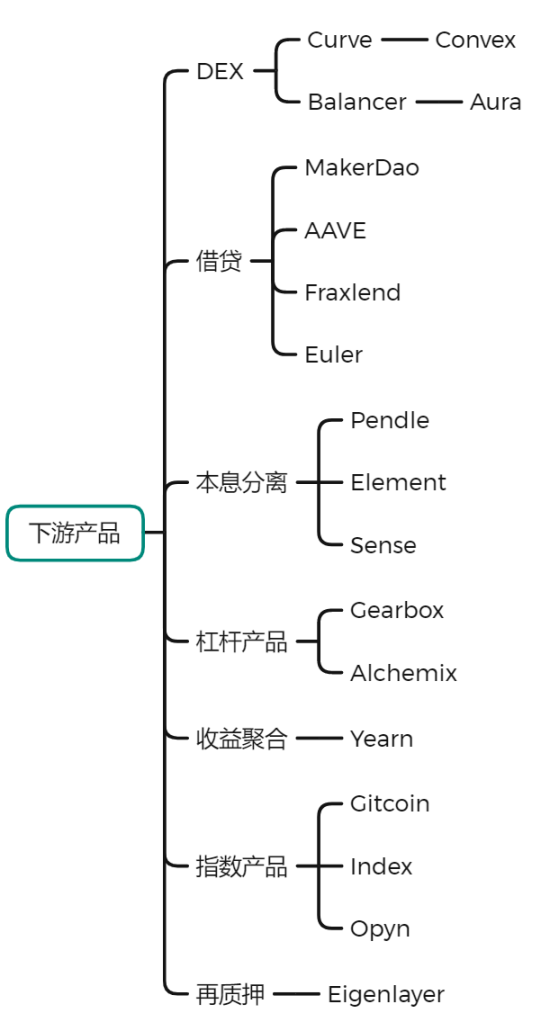
Original link





