






The Polygon zkEVM mainnet test version is online, how will it affect the Polygon ecology?


Original author: Grapefruit, ChainCatcher
Original author: Grapefruit, ChainCatcher
On March 27, the Polygon zkEVM mainnet beta version (Beta) was officially launched, and Ethereum founder Vitalik Buterin completed his first transaction on the Polygon zkEVM mainnet.
However, the price of MATIC tokens did not rise as expected by users. Instead, it fell by 5% within 24 hours, and is now quoted at $1.04. Of course, this is affected by the broader market to a certain extent. The main reason is that it is only a beta version at present, and it may be necessary to wait for the mainnet to be officially launched to truly see the impact.
Compared with Binance’s FUD incident, the market’s attention to the beta version of the zkEVM mainnet does not seem to be high. Nevertheless, the release of the Polygon zkEVM mainnet shows that the ZK Rollup expansion solution has made a major breakthrough in compatibility with EVM.
According to the Polygon zkEVM browser, in less than 24 hours after the mainnet beta version was launched, 7821 transactions have been completed, 598 batches of transactions have been submitted, and 7873 blocks have been generated.
first level title
Polygon zkEVM principle
Polygon zkEVM is an Ethereum Layer 2 zkEVM expansion solution based on ZK Rollup technology. ZK Rollup uses the "zero-knowledge proof" verification method to implement Rollup's expansion solution.
Specifically, under the ZK Rollup expansion scheme, off-chain (Layer 2) executes transactions and completes complex calculations. After multiple transaction data are batch-processed and compressed, a "zero-knowledge proof" result of off-chain calculations will be created and submitted. Go to the main network (Layer 1) for proof verification. The verifier on the main network can quickly check whether the proof is correct, and store part of the data on the main network to share the security of the main network.
The data verification method of zero-knowledge proof is the important difference between Optimistic Rollup and ZK Rollup. The former uses a "fraud proof" that requires a dissent period, so transfers from L2 to L1 require a waiting period; the latter uses a zero-knowledge proof algorithm that can instantly check the validity of data without any waiting for transfers.
However, due to the complexity of the zero-knowledge proof algorithm used by ZK Rollup, it is not compatible with the Ethereum Virtual Machine (EVM), which makes applications on Ethereum want to be deployed on this chain. Developers not only need to rebuild the application but also need to relearn The underlying code language applicable to this solution can be described as time-consuming and labor-intensive. This is why it has always been said that "the expansion plan looks at Optimistic Rollup in the short term and ZK Rollup in the long term".
In order to solve this problem of compatibility with EVM, some ZK Rollup series expansion solutions redesigned the underlying programming language, and some developed special compilers to achieve compatibility.
In addition to Polygon zkEVM, there are already several projects in the market researching and deploying zkEVM related products, and are competing to launch the "first" fully functional zkEVM. For example, on March 24, the zkSync Era mainnet was officially released and opened to users. The mainnet is a zkEVM solution; in February, Scroll zkEVM announced that its Alpha testnet is now live on Goerli; StarkNet is building an EVM-compatible The compiler, the mainnet is about to be released and so on.
So, how does Polygon zkEVM differ from these zkEVM projects?
Polygon zkEVM is fully equivalent to EVM, that is, developers can migrate EVM-compatible on-chain applications to this chain without modifying any code, and can also use all Ethereum tools to work seamlessly on the zkEVM chain.
What exactly does ZK Rollup and EVM equivalence mean?
ZK Rollups, which is truly equivalent to EVM, provides developers with the same experience as developing on Ethereum, allowing developers to use all the same tools and frameworks used when developing on the Ethereum mainnet without having to worry about L1 contracts in L2 Interrupted while deploying on-chain. This is critical for developers as it means much less overhead when migrating from L1 to L2. Users can also benefit from the EVM equivalent chain. Users of the EVM equivalent chain can use the familiar wallets and tools on the Ethereum mainnet.In August last year, Vitalik, the founder of Ethereum, published an article titled "The different types of ZK-EVMs The different types of ZK-EVM

On February 15th, Polygon officially issued a document stating that Polygon zkEVM has passed 100% of the Ethereum test vectors suitable for zkEVM. Developers do not need to modify or rewrite any code, and all Ethereum tools can work seamlessly with Polygon zkEVM. Fully equivalent to EVM.
first level title
How will the Polygon zkEVM affect the Polygon ecosystem?
In addition to product and technical innovations that deserve attention, for most ordinary users, what is more concerned about is the impact of the launch of the Polygon zkEVM mainnet Beta on the original Polygon PoS sidechain and the Polygon ecological token MATIC?

According to DefiLlama data, as of March 28, the value of encrypted assets (TVL) locked on the Polygon PoS chain was 1.064 billion US dollars, ranking fourth in the entire public chain track, and the number of active addresses on the 24-hour chain was 360,000 . However, TVL has dropped around 8% in the last 30 days.
The currency price of MATIC and the data performance of TVL on the chain seem to reflect the general attention of the Polygon zkEVM market.
In addition, some people questioned: "Will Polygon zkEVM replace Polygon POS when it comes out?"
Polygon's official answer to this is "NO", indicating that zkEVM is not used to replace the POS side chain.
Polygon co-founder Mihailo Bjelic also said in an interview, "The launch of Polygon zkEVM will be a separate block network, and the Polygon POS chain will continue to operate as a side chain. There will be two parallel networks in the Polygon ecosystem, With different value propositions, namely features and trade-offs, developers can choose the network accordingly based on different concerns about security, scalability and transaction fees. However, POS side chains are not as secure as ZK Rollup, because ZK Rollup will store its transaction data It is stored on the Ethereum main chain, which inherits the same underlying security as the Ethereum blockchain; the data of the POS side chain exists on its own chain, rather than not being stored on Ethereum.”
In addition, Mihailo Bjelic also added that the Polygon POS chain is planned to carry out some ZK-based enhancements, and the blockchain bets that this scaling technology can promote the development of its ecosystem. Explore how to integrate ZK technology into the Polygon POS chain to improve the security of the POS chain. However, he also said that if Polygon POS becomes compatible with ZK, it just uses proofs like ZK Rollups to ensure that transactions are not cheated, and it still does not store data on Ethereum, but stores it on its own network or on a separate network off the other chain. Unlike ZK Rollup, it does not store data on Ethereum, but on a separate network off-chain.
Since Polygon zkEVM is a separate block network, many users are confused, will it issue separate tokens?

From this point of view, the role of MATIC in the Polygon ecosystem is governance Token, which is mainly used for the safe operation and maintenance of the Polygon zkEVM network and other chains. For example, pledge MATIC on the Polygon POS side chain to become an operation node; pledge MATIC on zkEVM Obtain the sorting right to submit transaction data, etc. ETH is only used as a means of payment for the gas fee on the chain.
first level title
What are the ecological applications on the Polygon zkEVM chain?
According to zkRollup's high security, low GAS fee, real-time verification of transaction data, and no need to wait for transfers, the Polygon zkEVM chain is more suitable for building DeFi, NFT, Gamefi and enterprise applications, payment and other applications.
At present, Polygon zkEVM has officially announced a lot of cooperative ecology. On March 24th, Web3 game developer zkMeta will use zkEVM on the Polygon network to build a dedicated zkRollup network for GameFi; on March 20th, the game public chain Immutable announced that it will build a dedicated game blockchain with Polygon; on March 28th, Layer 2 cross-Rollup bridge Orbiter Finance announced that it has integrated the Polygon zkEVM network, allowing users to transfer assets across chains between Polygon zkEVM and other supported networks.
In addition to cooperation projects, there are also native cross-chain bridges, DEX and other products on the Polygon zkEVM chain.
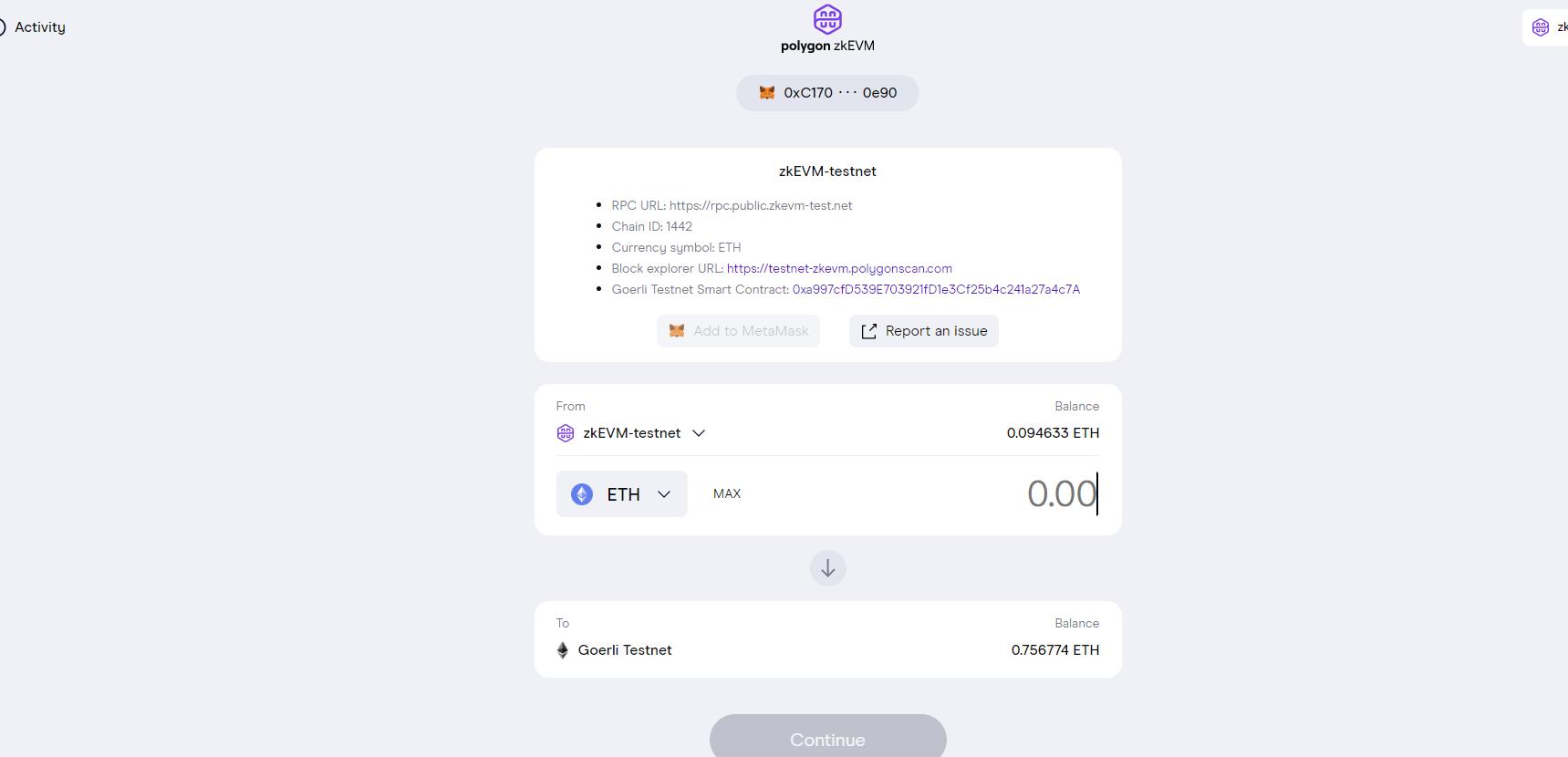
The official cross-chain bridge zkEVM Bridge - supports users to transfer assets between L1 and zkEVM (L2). Currently, users are only supported to transfer ETH between zkEVM-testnet and Ethereum Goerli Testnet.
Clober, a decentralized trading platform, is a native order book DEX on the zkEVM chain, which can realize order matching and transaction settlement on the chain.
Lending application 0 VIX——is an over-collateralized lending platform that supports users built on zkEVM to deposit or mortgage assets.In addition, Polygon officially issued a commemorative NFT "To Ethereum, with Love" to commemorate the launch of the beta version of the zkEVM mainnet.Casting is now open





