Bankless: $1 million at the end? Bitcoin's Betana Index and the Battle for Digital Gold


Original Author: Bankless
Original compilation: aididiaojp.eth, Foresight News
Bitcoin climbed even as the macro environment became more worrisome.
The latest debacle started with the collapse of Silicon Valley Bank and has since spread to other institutions around the world. In response to this banking crisis, central banks and governments did what they always do: print money to keep the system going.
Since the start of the crisis, the Fed's balance sheet has grown by almost $300 billion, offsetting nearly half of the $600 billion in quantitative tightening they have implemented since March 2022.
In the past, almost no one could escape this dollar system, maybe you could buy some gold and try to bury it in your backyard. Thankfully, cryptocurrencies are making it easier for us to navigate this crisis. Led by Bitcoin, crypto assets are surging since the beginning of the banking crisis in 2023.
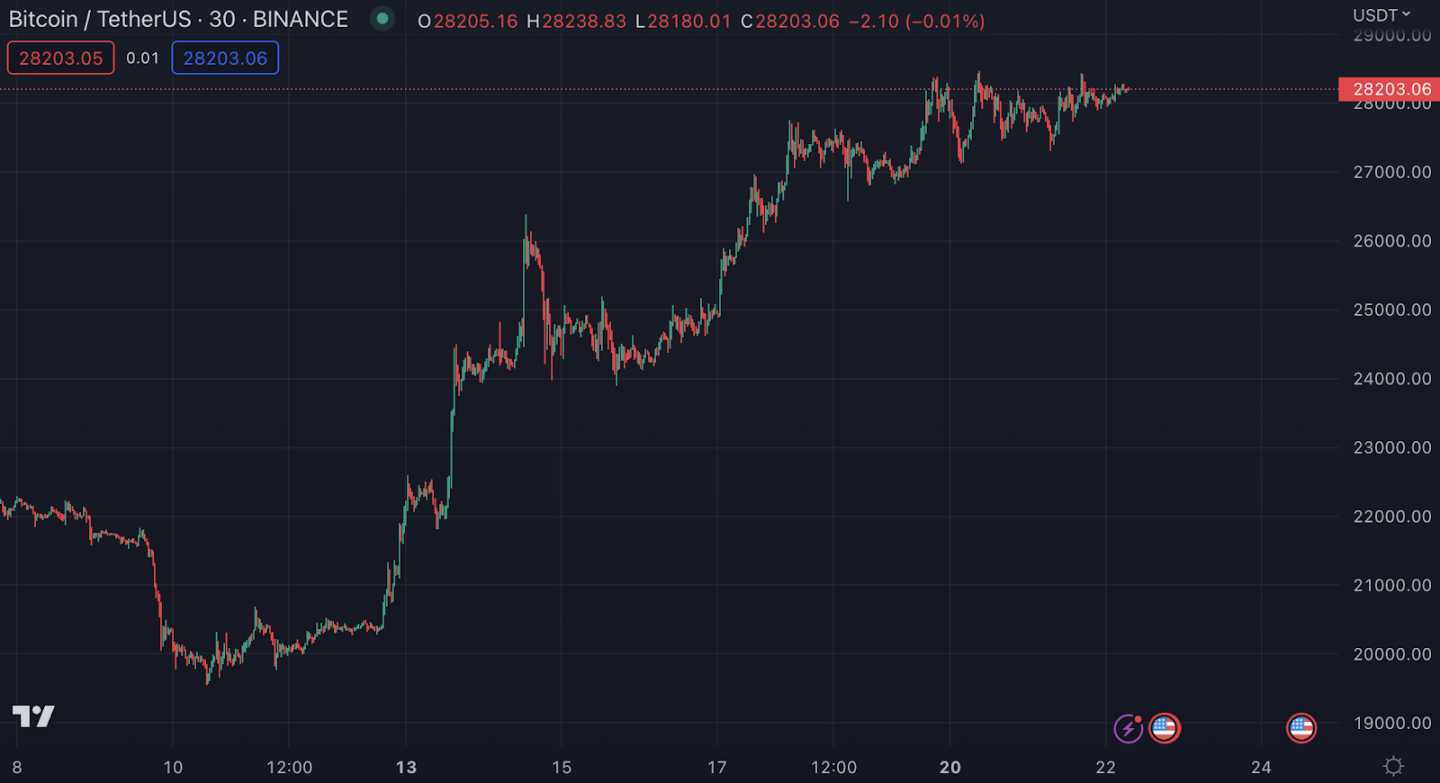
Bitcoin's sharp rise over the past few weeks has been good news for cryptocurrency holders, but its impact is far more important than double-digit percentage gains.
This rally has the potential to change the way people think about cryptocurrencies forever. how so? Let's find out by exploring how the market has reacted since the collapse of SVB, so we can assess how it affects Bitcoin now and in the future.
Bond Market
The bond market has experienced huge volatility over the past few weeks, with prices surging and yields plummeting since the crisis began.
image description
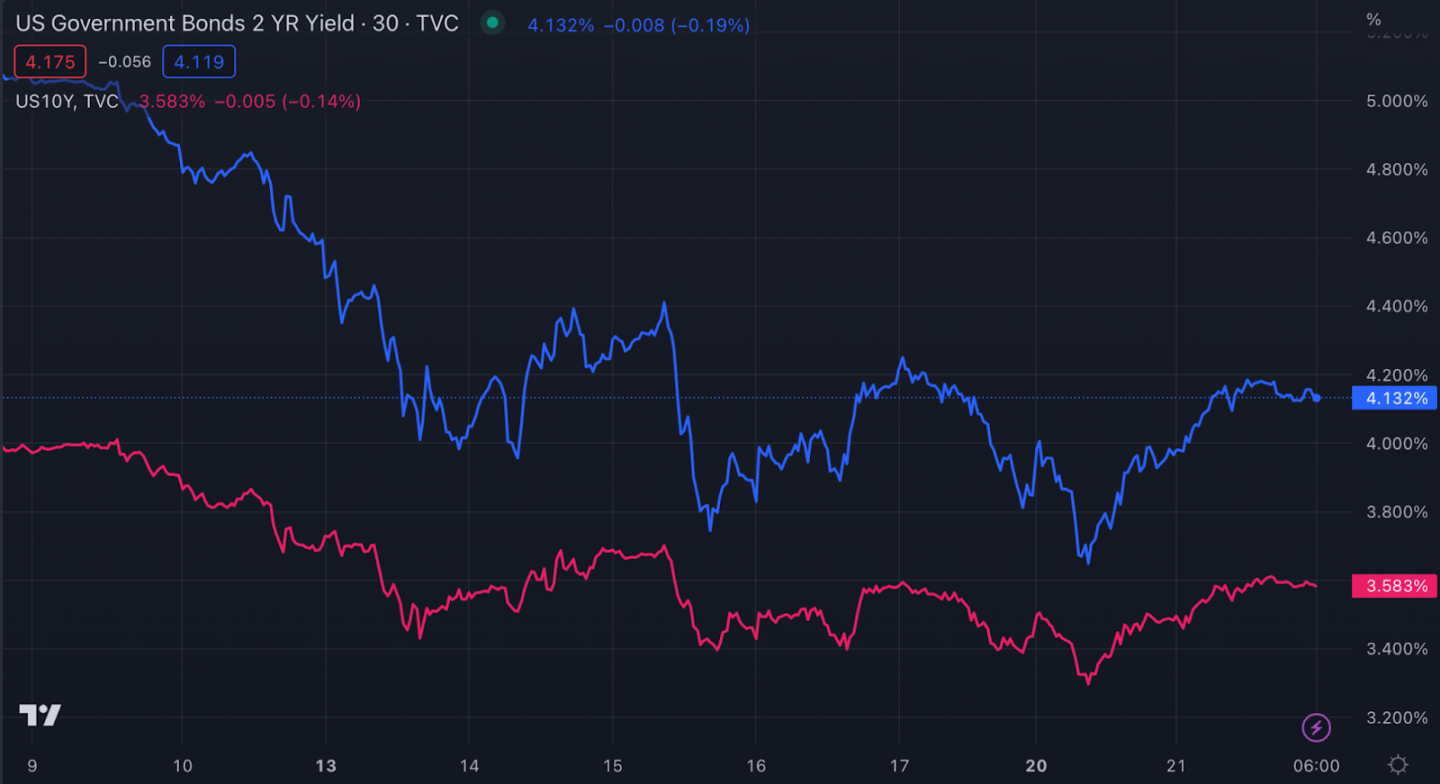
U.S. Two-Year and Ten-Year Treasury Yields 3/9-3/21 - Source: TradingView
The drop in yields could be due to a number of factors. One is due to "safety aversion," investors buying Treasuries because they are less risky and the U.S. government is (at least nominally) less likely to default. The move could also be driven by investors, who are running ahead of a potential Fed pause or pivot. Although as we found out today, rate hikes are not quite over yet.
stock
Stock markets have experienced wild volatility since the crisis began.
image description
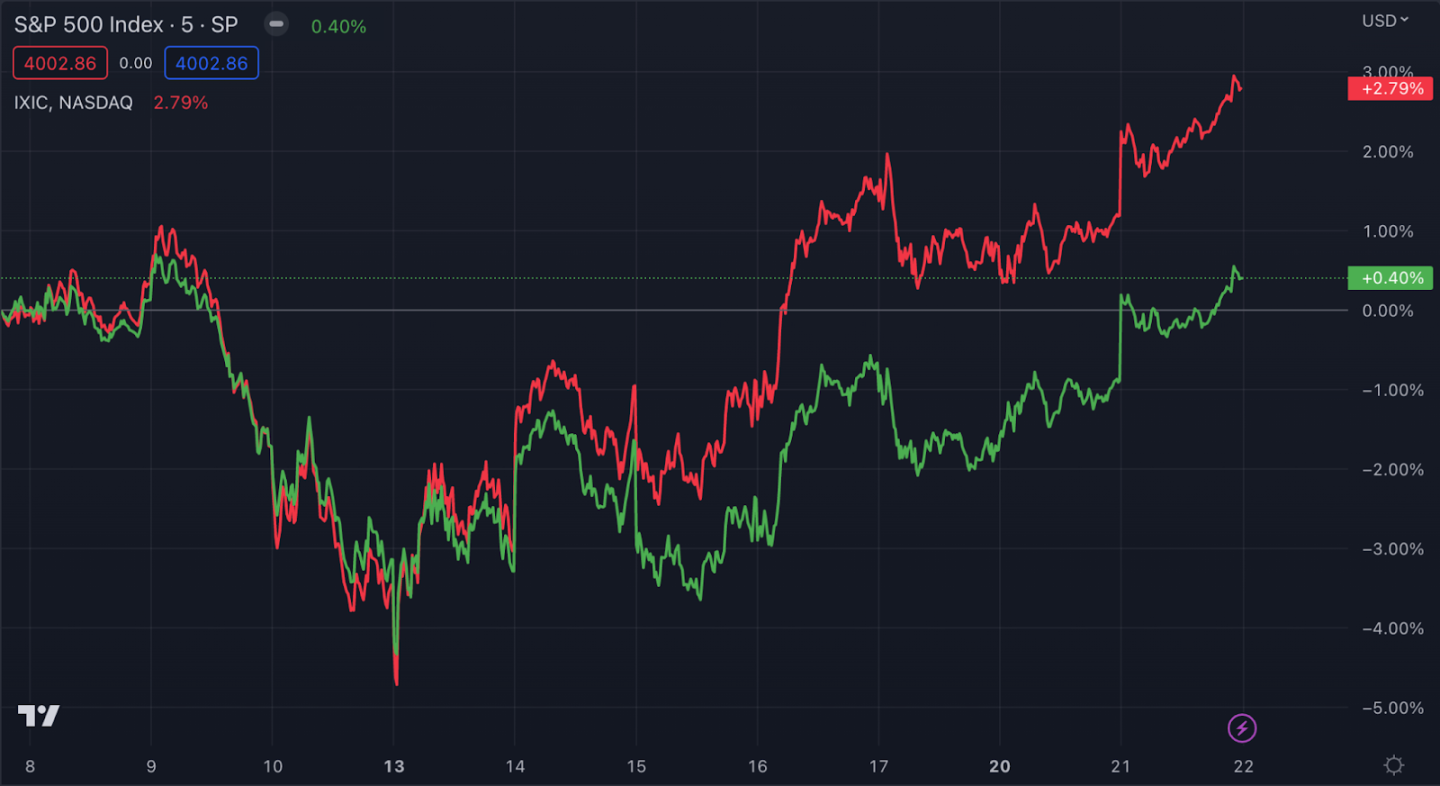
S&P and Nasdaq 3/9-3/21 - Source: TradingView
While individual sectors, such as regional banks, continue to be battered, losses may be halted by government measures to prevent further spread of fear and the aforementioned Fed rate cut expectations. The Nasdaq's outperformance relative to the S&P may have been due to investors flocking to the safety of big tech stocks, with the likes of Apple, Microsoft, Google and Meta all seeing gains since bottoming out on March 13. soaring.
precious metal
image description
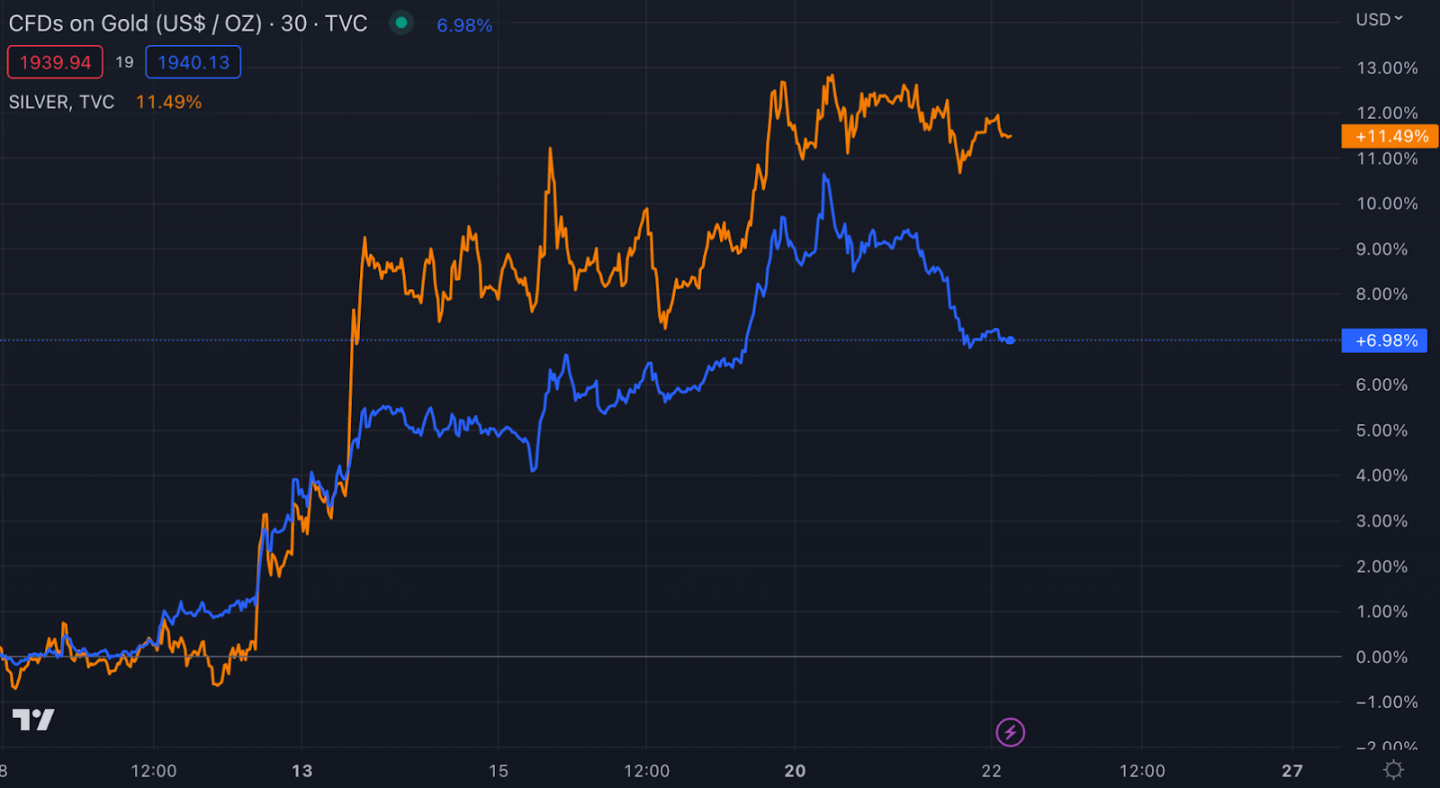
Gold and Silver 3/9-3/21 - Source: TradingView
cryptocurrency
cryptocurrency
image description
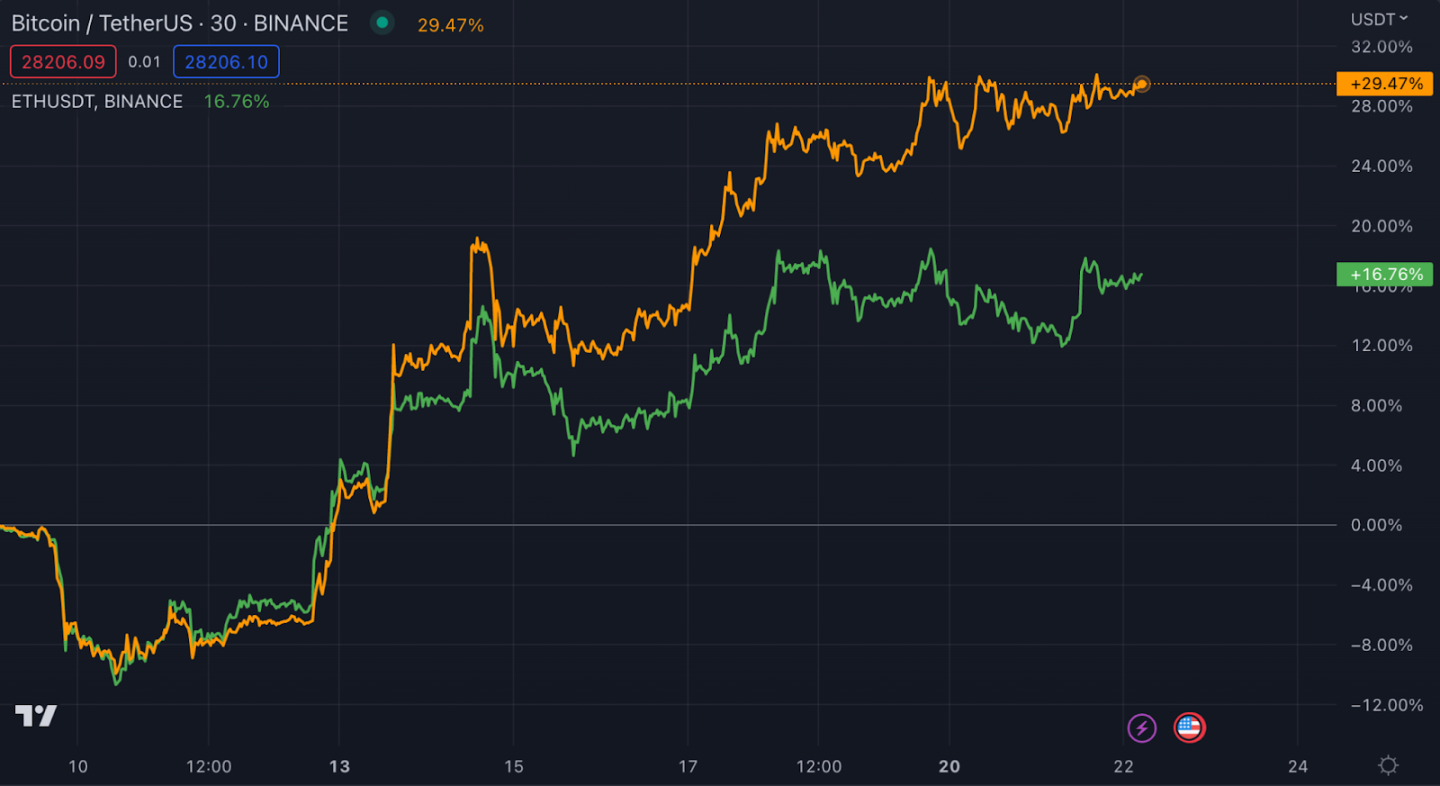
BTC and ETH March 9-21 - Source: TradingView
Although BTC and ETH fell by 10.1% and 10.6% respectively during the "stablecoin panic" between March 9 and 10, this was due to the decoupling of USDC due to the inability of the market to withdraw Circle's $3.3 billion deposit in SVB panic.
image description
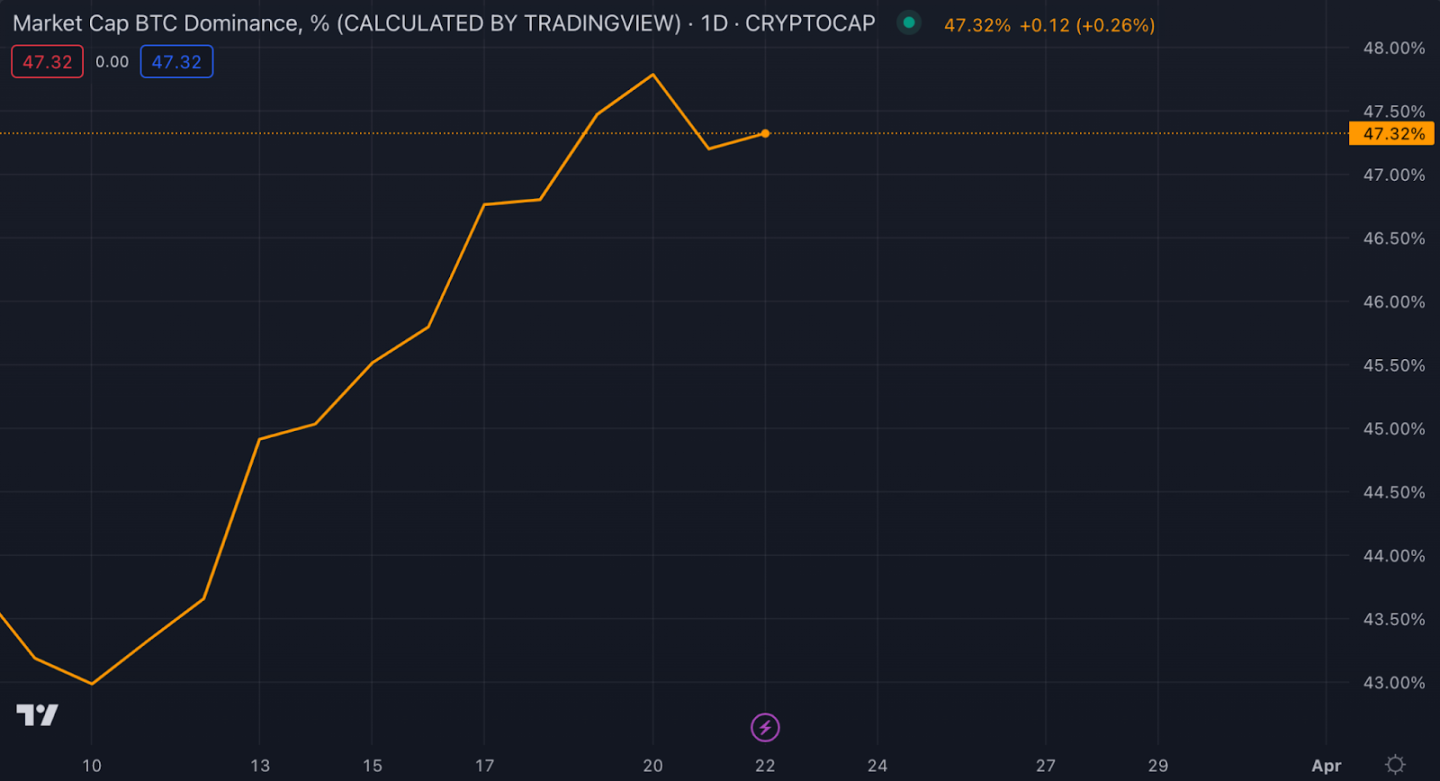
BTC Advantage - Source: TradingView
Also, like the other asset classes mentioned above, cryptocurrencies could also see a trend reversal before the Fed pauses or turns around in anticipation of the end of the Fed’s tightening cycle. Crypto assets such as Bitcoin, which are more sensitive to liquidity, seem to be sniffing out the massive increase in the Fed's balance sheet and the implicit depreciation of the dollar that occurred after the SVB.
Why the game has changed
The game has changed for Bitcoin, which, despite being viewed by skeptics as a risky asset, has instead acted as a safe haven during the biggest banking panic in decades. In fact, it has outperformed every major asset class since the crisis began.
While the banking sector was in crisis, Bitcoin soared and became the best protection against the collapse of the fiat system. Theoretically, the reason Bitcoin is performing so strongly makes sense, as it has all the attributes of a safe haven and store of value. As mentioned above, Bitcoin is a non-sovereign asset that is scarcer, more portable, and harder to obtain than gold.
image description
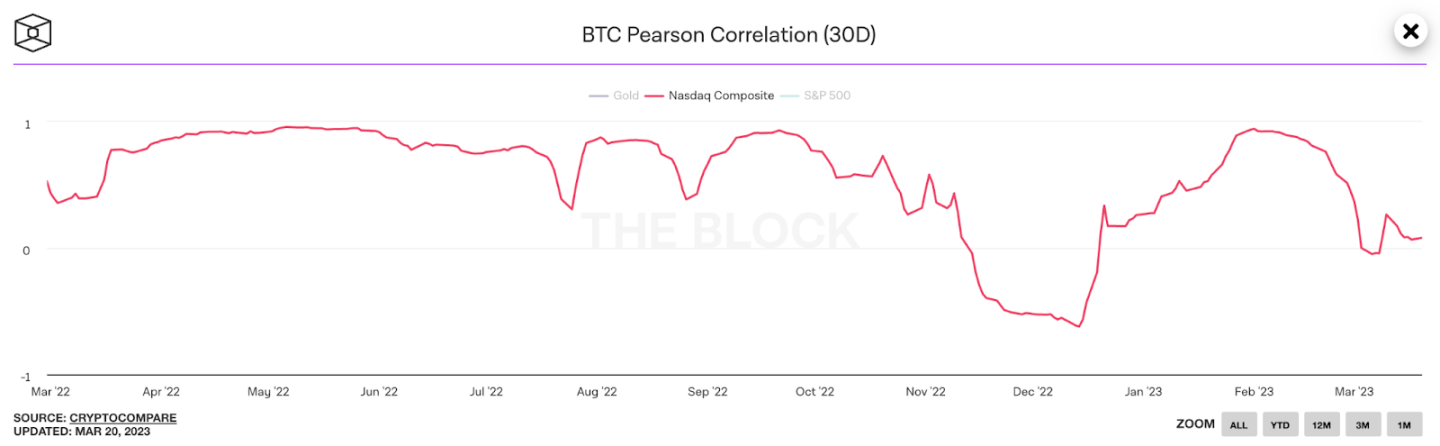
Correlation between BTC and Nasdaq - Source: The Block
image description
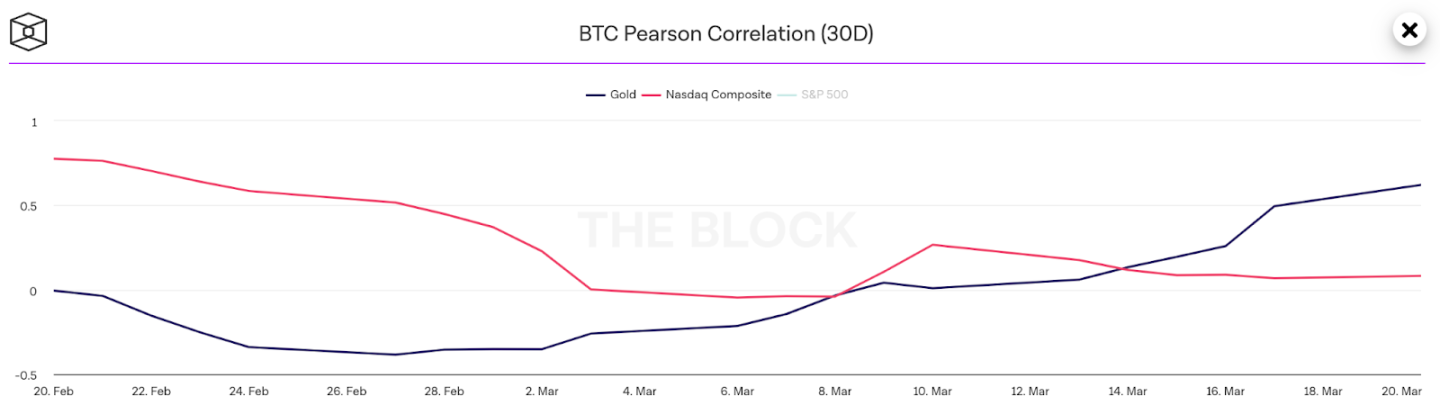
BTC Correlation with Gold and Nasdaq - The Block
As we can see, the correlation between BTC and Nasdaq has changed since the crisis began, while the correlation between BTC and gold has strengthened. Of course this may only be a small sample size, but given the magnitude of the events of the past few weeks, this price action cannot be ignored. This seems to indicate that Bitcoin is transforming from a technological play to true digital gold.
This is a major shift in how Bitcoin is viewed and traded. Whether crypto natives, traditional financial institutions, retail investors or nation-states, investors will now increasingly view Bitcoin as a safe haven rather than a purely speculative vehicle.
Not only does Bitcoin protect against institutional failure, it also serves as a hedge for its holders against currency debasement due to massive increases in the money supply, such as we have seen since the creation of the Bank Term Funding Program BTFP. Investors have benefited from holding BTC during this crisis, which increases the likelihood that they will behave similarly in the next crisis.
Will BTC hit $1 million?
As usual, the community has been energized by Bitcoin’s rally, with bold price predictions from some of the biggest names in the industry. Some of the hottest of these views come from industry heavyweights such as Balaji Srinivasan and Arthur Hayes. They think that BTC will reach $1 million due to the depreciation of the dollar due to the unlimited printing of money by the Fed.
The difference in forecasting is the time horizon. While Hayes predicts we'll see seven-figure BTC in the next few years, Balaji thinks it could hit $1 million within the next 90 days.
Balaji's call is enough to make anyone anxious, whether they are holders of cryptocurrency or fiat currency, because if the dollar hyperinflate within 90 days, it will cause serious instability in the entire world.
Whether or not the timetable will prove correct, the monetary system is collapsing, a dead tree that never recovered from the global financial crisis and continues to be propped up by printing money.
With every emergency, bailout, and printing of dollars, the fragility of the monetary system becomes more apparent, as if all roads lead to endless money printing. Instead of curing the causes, however, central banks simply continue to perpetuate crises into the future in order to prolong their inevitable demise.
One aspect that I agree with Balaji is that hyperinflation happens very quickly, whenever it comes. Balaji believes that due to the digitization of the world and the speed at which we transfer information and value, the collapse of the dollar relative to Bitcoin will happen with incredible speed. This makes sense, as we have seen over the years with cryptocurrencies and now traditional finance, in the age of the internet people can lose faith in money and financial institutions at breakneck speed.
Original link