The NFT variety under "hormone liquidity": Has Blur made the NFT market better?


Original author:Jack、Cookie,BlockBeats
Original author:
The "El Niño phenomenon" is happening in the NFT market.
Until the launch of the “Bid for Airdrop” incentive mechanism in early December last year, Blur became the “engine” of NFT market liquidity. The last two long lines suddenly rising in the black box in the picture below tell us that Blur's "engine" has "heated up" abnormally in the past two weeks.
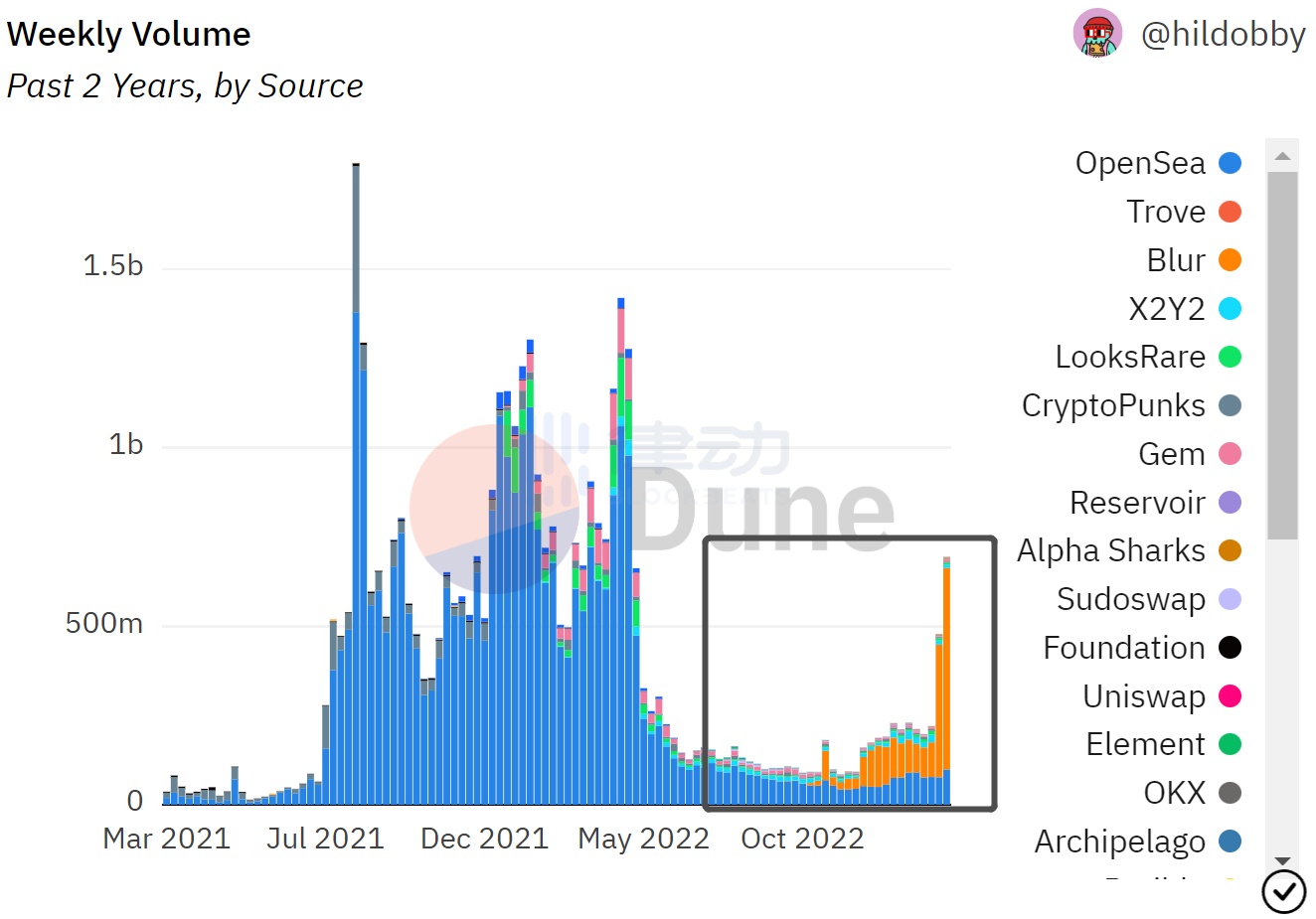
image description
Accompanied by this sudden surge of liquidity, many "abnormal phenomena" that have never been seen before have appeared in the NFT market. Bid's bid exceeded the floor, NFT price "drawing the door", and then last weekend's "the biggest smash in NFT history", the NFT market in front of us feels strange, we can't help but re-examine, the current liquidity of the NFT market. The increment of mechanism innovation, or the inward rolling of stock funds between platforms?
first level title
"The biggest hit in NFT history"
On February 25, Nansen researcher Andrew Thurman tweeted that the sell-off that occurred in the past two days is very likely to be "the largest dump in the history of the NFT market."
Under the dual effects of Maji's drop and panic, the floor price of BAYC fell by 25.5%, from 75 ETH to 55.89 ETH, the floor price of MAYC fell by 11.7%, Azuki fell by 11.3%, and Otherdeed fell by 10%. According to NFTGo data, from February 23 to February 25, the total market value of the entire NFT market evaporated by more than 320 million US dollars.
first level title
"Maji Flywheel" has become "Maji Dacut"
Although Huang Licheng quickly bought back most of the blue-chip assets, and there are still nearly 7,000 ETH in his Blur Biding pool, this has not changed the community's opinion on this smashing behavior: Huang Licheng once again fell from being a big brother of Maji. For "Maji Dacut".
Readers who understand the Blur Biding mechanism will naturally know why this transaction is called "passive takeover". Simply put, Huang Licheng listed a lot of bids at an average price of 78 ETH, but he may not have thought that someone would suddenly bid Sell so many monkeys. In other words, our brother Maji was "sniped".
In order to get more points on the Blur platform, Huang Licheng has been listing a large number of high-priced Bids in blue-chip NFT projects such as BAYC, MAYC, and Azuki. first name. Some people in the community have summed up Huang Licheng's strategy as "Maji Flywheel", and the cycle process is summarized as follows:
1. Maji pledged his own BAYC and APE to obtain APE income. Mochi then converts these earnings into ETH and accumulates them.
3. Maji received 1.84 million BLUR in the first airdrop, half of which will be converted into ETH once the airdrop is received, and participate in Bid again.
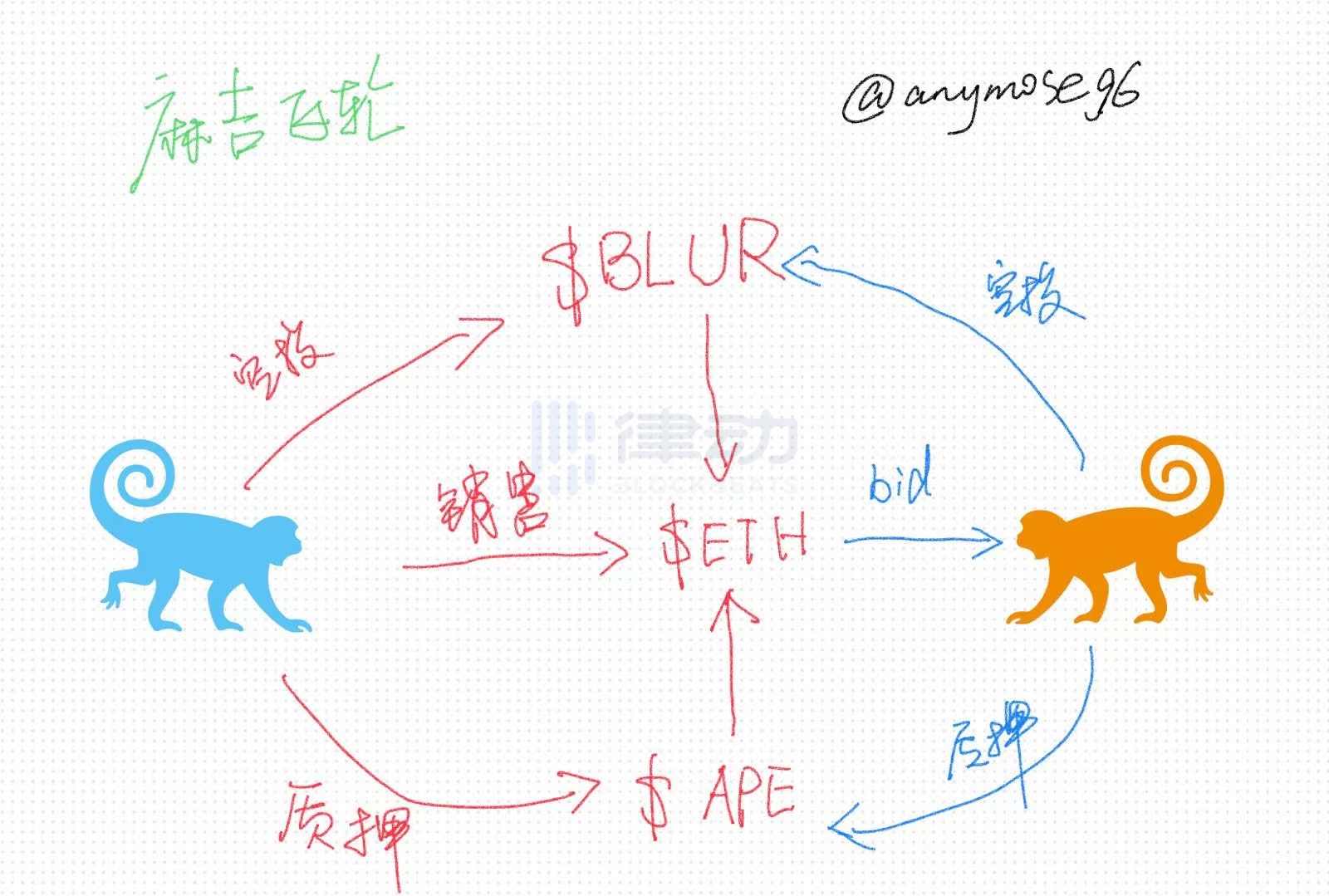
image descriptionanymose.eth
In fact, Maggie’s strategy is similar to that of most Blur Bid players. In other words, this is the basic logic of Blur’s continuous liquidity. But perhaps because the gun is the first bird, the fattest liquidity will always be planned by others. Brother Maji is eyeing the Blur points, but he did not expect others to be eyeing the ETH in Maji’s hand. Let's take a look at the whole process of "Maji Flywheel" being sniped.
first level title
Since the Blur airdrop points entered a white-hot stage in early February, our big brother Maji has been listing high-priced Bids, and slowly raising the floor of BAYC, and took some BAYC sales orders sporadically along the way. But as you can see from Blur's trading charts, Maggie hasn't invested much liquidity during this time. For example, around February 8, after the price of BAYC rose above 70 ETH, the transaction density immediately became very dense, but the Bid wall around this price was not thick enough, so the floor was quickly smashed down.
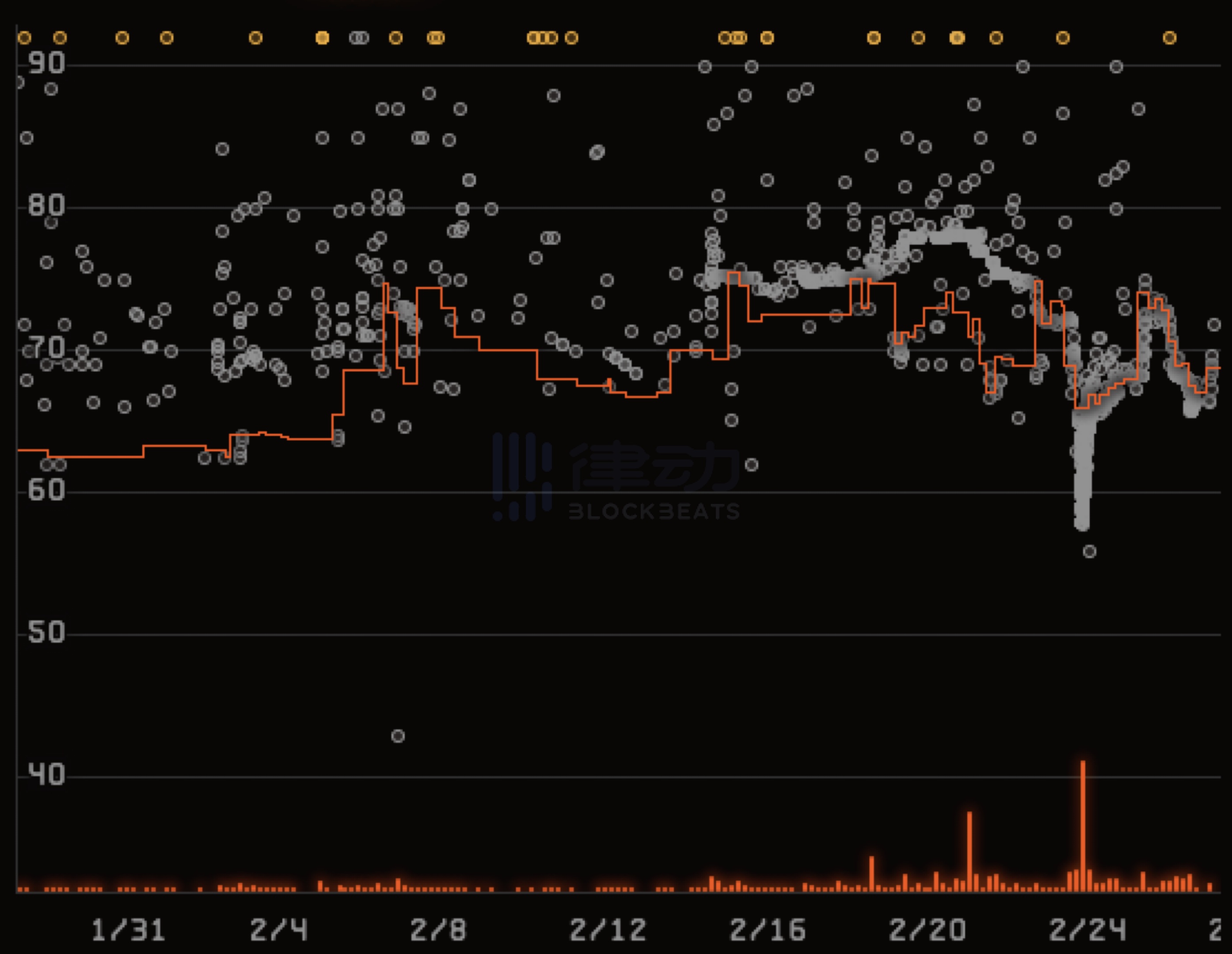
image description
Image source screenshot from Blur
However, after the first round of Blur airdrops was issued on February 14, Maji immediately sold BLUR Token worth 600,000 US dollars. Then we can clearly see that the Bid wall above 70 ETH has become thicker. Even though the transaction is more intensive than before, because of the wealth creation effect of BLUR, there is always sufficient liquidity to maintain the floor price of BAYC. As the No. 1 player in Blur's standings, Maji is naturally the main force in BAYC's liquidity.
It can be seen that during the period from February 14th to 22nd, the floor price of BAYC has been very stable, and even reached a new high recently. Mando and OSF saw this, so they decided to cash out a large amount of BAYC in their hands when the price and liquidity were at a high level. You will obviously find that during the period from February 20th to 22nd, the transaction density of BAYC increased rapidly, but the floor price remained relatively stable. This is the data that snipers such as Mando and OSF are quickly eating up the data of the Maji Bid wall. Performance.
It was not until February 22 that Maggie took over 71 BAYC at one time, and Mando and OSF cashed out nearly 9 million US dollars. The whole community began to notice this matter. During the entire 22nd, there were a total of nearly 300 BAYC was sold. Mando then directly posted on his social media that he chose to sell BAYC after careful consideration and decided to use the current NFT liquidity to make a profit.
In the season of strong liquidity, only 19 million US dollars caused a major earthquake in the entire NFT market. We have to rethink, how much money is there in the NFT market? Does the current liquidity come from OTC funds, or is the stock funds rolling between platforms?
first level title
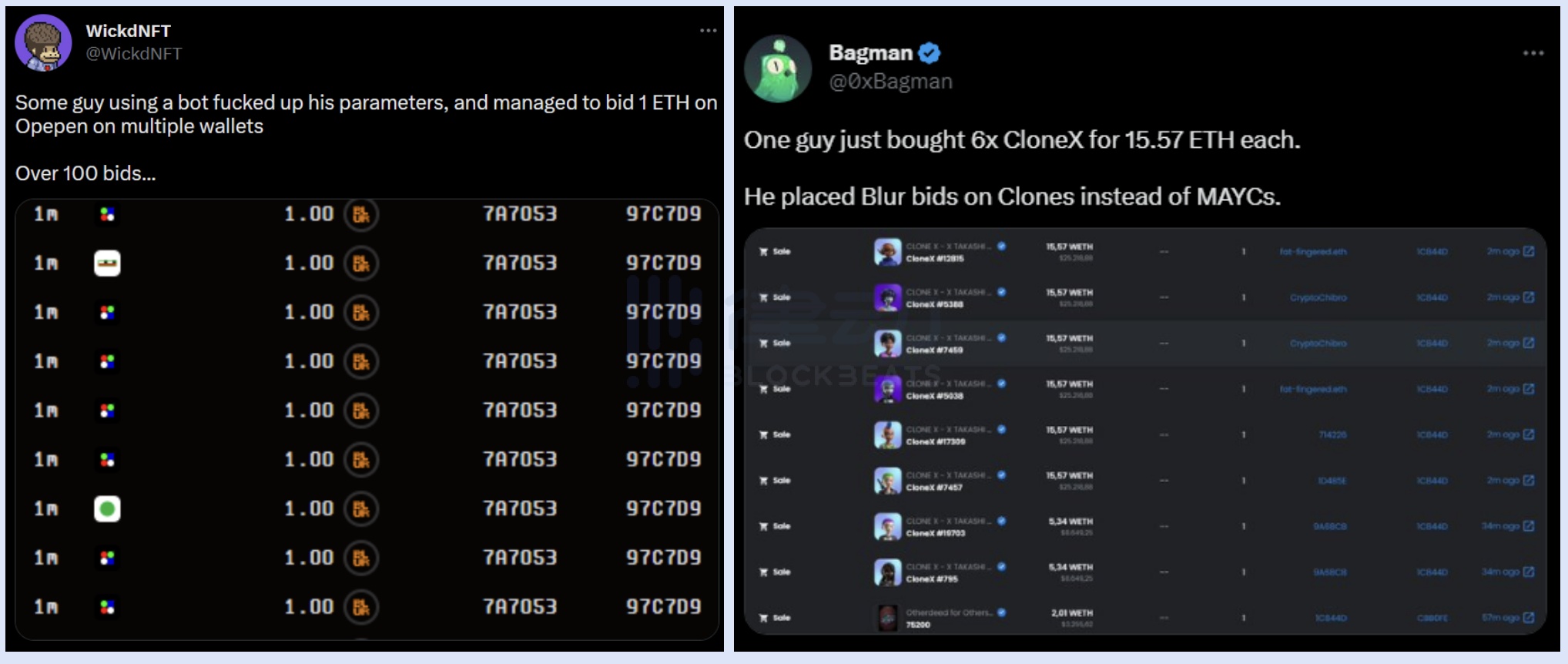
Robots and villains, NFT under "hormone liquidity"After the Blur airdrop appeared, the NFT market was like a chicken blood, and there was a surge of liquidity with a smell of hormones. What followed were various "hormonal side effects". In addition to this "Maji Dacut" incident, there are many similar situations in which Bid took over NFT in batches at a price higher than the floor price. We will also frequently see that some NFT projects have high transaction volumes at high prices, and there are more cases of floor prices "painting the door". Even on the Ethereum Reddit forum, Questioning the existence of the Blur team using robots to brush BLUR airdrops. For a while, the NFT market in front of me even felt a little strange.
first level title
New Business! The Great Migration of Robotic Strategies
Bots are already very common in the Web3 field. From trading bots, rush-running bots to contract bots, they are almost everywhere in the encryption field, and the same is true in the NFT field. A bot strategy developer told BlockBeats that, in their view, the entire Web3 is almost entirely bots. "You click on a popular NFT collection on OpenSea. Most of the Offers are those bidding robots buying and selling NFTs. They usually place an order every 30 minutes. Many times the price is driven by these robots. This robot drops 0.1 ETH, and that robot Also drop 0.1 ETH, so that the price will slowly come down, and the price increase of Offer is the same reason.”
So to say that the main force of NFT liquidity has actually been these robots, and they make profits by handing over NFT on OpenSea. This is also in line with common sense. After all, the winning rate of the algorithm is always better than that of real people, and capital always flows in the direction of maximizing income. Following this logic, Blur has also created a new business for NFT robots.
"In the past, NFT robots pursued lossless, sniping those "fat fingers" without losing money (for example, the wrong Bid placed a high-priced order, the robot preemptively bought at a low price, and then accepted the Bid at a high price), as well as a high profit-loss ratio, Combined with the previous floor price and recent sales volume of this NFT collection, software analysis is used to make buying and selling judgments. But it’s different now, basically all robot strategies have been changed to brushing points, and the NFTs you buy can be accepted without losing money, or even a little less.” The developer of the robot strategy told BlockBeats that compared with the past in Buying and selling on OpenSea, and airdrops on Blur have higher certainty and return on investment ratio. Therefore, from the perspective of development strategy, few people will choose to invest a lot of money in the former.
This is one of the important factors that Blur defeated OpenSea in the liquidity war: they bribed the main force in the market liquidity, and these backbone liquidity made the choice to migrate from OpenSea to Blur.
Now, most of the addresses that participate in Bid are robots. "You just click on the homepage of an address. If you bid more than one or two hundred times a day, it must be a robot, because if you bid manually, the signature alone will consume energy. a long time". So what does the NFT robot's airdrop strategy look like? In order to protect the profits of strategy developers, BlockBeats only shows some of the eliminated scoring strategies here.
Strategy 1: MEV Preemption
This strategy takes advantage of Blur's loopholes in the Bid transaction process to score points at zero cost. Assuming that the current floor price of BAYC on Blur is 70 ETH, and the highest Bid is given to 71 ETH, the robot will place a pending order for a Bid of 71.1 ETH, then if someone accepts the Bid, his BAYC will definitely be sold to 71.1 ETH This pending order.
From the perspective of trading strategy, this transaction must be a loss, because the highest Bid will soon fall back to 71 ETH after the transaction. But before Blur's Bid transaction and point mechanism is: Bid is accepted, points are settled for the bidder, funds are removed from the Bid pool, and finally the NFT is transferred to the bidder. This process takes about 5 to 10 minutes. During this period, the robot will use the MEV mechanism of Ethereum to rank the operation of "retrieve ETH from the Bid pool" in the "Blur section" in the same block as the Bid transaction. out in front of bidder funds". In addition, the operation of "withdrawing money" can be done directly through Blur's API in addition to the way on the chain.
That is to say, when Blur actually wants to withdraw money from the Bid pool of the bidder, the funds in the pool have already been transferred. The robot is "whoring for nothing", "During the whole process, the cost paid by the robot is only 2 U of Gas". A robot strategy developer told BlockBeats that this strategy has exceptionally high returns on blue-chip NFTs such as BAYC, Doodles, and Azuki, because as long as the Bid pending order here occupies the first place, even if it only lasts for 5 minutes, the rewards of points are very substantial.
Of course, Blur has officially fixed this point loophole and added an interface to the API to cancel the pending order. If an address cancels the pending order or rushes for many times, not only will it not add points, but points will be deducted, and even the account will be banned in serious cases.
Strategy 2: Unlimited Bid New NFT Collection
This strategy is to use Blur's trading ban on newly listed NFTs to carry out a certain degree of "unlimited brush points". Since Opensea will mark the stolen NFT, in order to prevent Bid participants from receiving the stolen NFT, Blur does not allow the newly transferred NFT to be traded within 3 hours of the transfer transaction. Therefore, the robot can bid without worry during these 3 hours. For example, if the floor price of an NFT collection is 1 ETH, the robot will compete to place Bid orders of 2, 3 or even 10 ETH. While sellers cannot accept Bid at this time, bidders are eligible for points.
The Blur team also took advantage of the plan, and suddenly revised this policy some time ago, adjusted the trading ban for new NFT collections, and changed 3 hours to 1 hour. According to some strategy developers, many people took over a large number of NFTs with a floor price of 0.1 ETH at a price of 3 ETH or 5 ETH, and the robot strategy made a serious mistake.
Of course, strictly speaking, we cannot call the loss caused by the team's change mechanism a mistake, but according to some robot players, there are indeed some "clumsy" players in the current NFT robots, because of the loopholes in the strategy that lead to the emergence of funds loss. For example, some bidding robots calculate the Bid interval by crawling the floor price of OpenSea, but NFT on OpenSea sometimes adopts other bidding mechanisms, such as accepting USDC for transactions, but some robots do not distinguish between pricing units, so 10 USDC mistakenly thinks that 10 ETH is used for calculation, which will cause a large loss.
According to a strategy developer, most of the high-priced batch access to blue-chip NFT circulating in the community is not a mistake of robots, but some people think that Blur can Bid for rarity like OpenSea. These users gave a high price Bid after screening the rarity, only to find that they were bidding on all NFTs.
That's right, robots are often reduced to appetizers for dealers, which also leads to the next topic, that is, in the current NFT liquidity, how do "evil dealers" "harvest"?
first level title
Better Liquidity = More + Worse Banks
On the one hand, it is shouting "high and hard liquidity", on the other hand, it is the "Drawing Gate Incident" of NFT projects such as Franklin and Bump World. This is the current status of NFT liquidity. It has to be admitted that Blur's Bid mechanism and airdrops have indeed brought some off-market funds to the market, but it needs to be seen clearly that this part of off-market funds is not much. As we can see, the NFT market is harvesting inwardly through the false name of liquidity, retail investors use this to cash out, and project parties use this to hunt for liquidity with little stock.
An NFT project founder told BlockBeats in an interview that many small NFT projects now use Blur's mechanism for insider operations. These project parties will first increase the trading volume on OpenSea, and then go to Blur's discord to invoice and list their own NFT collections. After the bottom price on OpenSea, they will start to slowly increase Bid orders on Blur and earn points. During this process, some project parties choose to list part of the NFT at the same time, so that even if their Bid is sold, the sold NFT can also achieve partial blood recovery. Some project parties hold most of the NFTs in the collection, so they can raise the price at will to collect points, and others will not ship them if they bid.
Of course, the ultimate goal is to attract retail investors or robots to participate in Bid. Retail investors are due to the FOMO sentiment caused by the rapid rise of floor prices, and robots are climbing to their higher trading volume. After the Bid wall reaches the expected thickness of the project party, they will immediately withdraw their Bid, and then sell the NFT in their hands to these bidding retail investors and robots.
With more abundant liquidity, the market also ushered in a more dangerous trading environment. According to a Bid participant, the above-mentioned projects were very common during the first airdrop of Blur, and he himself was cut many times. The probability of the project is basically 100%. One night I fell asleep and didn’t watch the market, but when I woke up, all the money in the robot was gone.”
Of course, after the volatility intensifies, we also need to start to develop some new habits, such as paying attention to the price of the NFT floor in real time, so as to prevent the Bid that we are "eating subsistence allowances" from being passively traded. We can use SnipeNFT on Discord or SnipeNFT on Telegram Etherdrops prompts bots to follow up in real time. In addition, before recharging ETH to the Bid pool, you also need to make sure that you have no Bid that has been deactivated due to insufficient funds, so as to prevent the previous Bid from being activated after putting in ETH, and then buying NFT at a high price.
first level title
According to the data released by NFTstatistics.eth, the research director of PROOF, from February 15th (Blur started the second quarter airdrop campaign) to March 1st, the transaction returns of the top 10 Blur Bid Farmers were all negative.
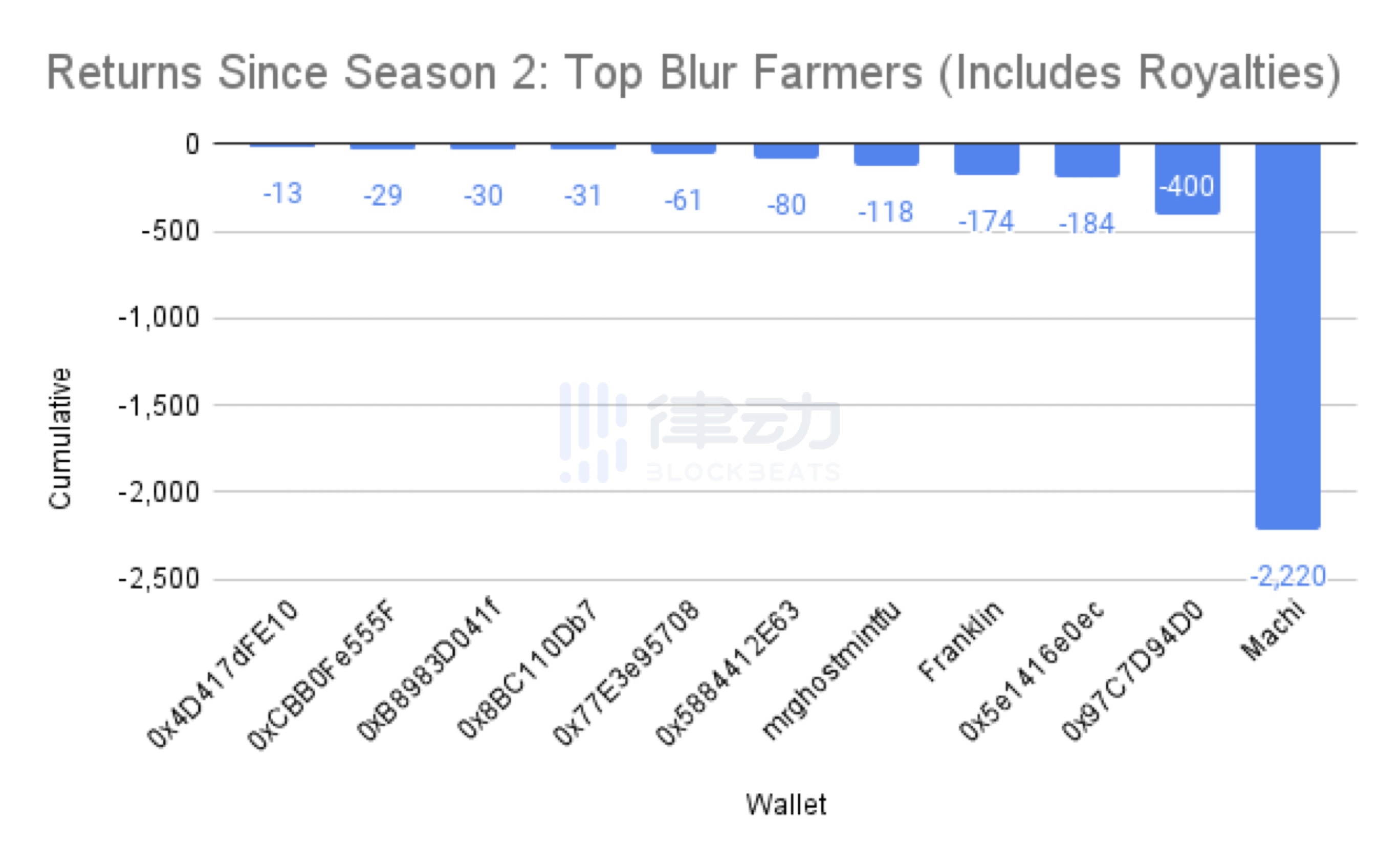
image description
The source of the picture is taken from NFTstatistics.eth
Echoing this data, 20% of Blur's total volume was contributed by only 17 wallet addresses, and 50% was contributed by only 292 wallet addresses. In the Blur Bid Pool, the wallets with the top 1% of ETH deposits contributed more than 73% of the total pool. Whales seem so certain that Blur's second airdrop will cover all their "Bid War" costs that @ShaneCultra, a former CBOE market maker, says, "Traders on Blur say no They just think that the profits from the Blur airdrop will cover their trading losses and become a tornado instead of maintaining a reasonable price difference measured by $BLUR between their Bid and List prices.”
On the projects where whales are active, retail investors get the "dream package" they have been dreaming of in the past - the lowest optional royalties of 0.5%, 0% platform handling fees, lower slippage and better depth. It seems that this time retail investors and The whales won together. However, the "dream package" is essentially a "paid service" provided by whales to retail investors in order to pursue the potential profits of Blur airdrops. Will such happiness last long? Also, @takenstheorem analyzed 100,000 transactions as of February 14th, Blur had 80% of its volume concentrated in the top 24 projects, while OpenSea's 80% of its volume was scattered among the top 90 projects, Blur is making big players and big projects stronger. In this regard, Maggie said, "Don't blame Blur, it's just your project garbage." For the vast group of small and medium-sized creators, is this statement really fair?
It is the dream of NFT players that NFT has FT-like liquidity, but are we now pursuing better liquidity solutions, or have NFT’s liquidity been regarded as the greatest value of NFT?
NFT must have an FT-like experience, but it is by no means moving closer to FT in terms of value logic. Liquidity solutions are "catalysts" rather than "raw materials" for the NFT market. The bubble in the NFT market can be magnified, but the application scenarios that need to be implemented, solid brand development, and constantly updated development narratives allow the bubble to land steadily.