Rug, Rug or Rug, an article reviewing the history of blood and tears in (3,3) mode


Recently, the "reverse (3, 3)" project represented by EggsCare has become popular, not only because of the sharp rise of Token, but also because of its price performance of "not being popular for a day". According to incomplete statistics from BlockBeats, the Token price of most reverse (3, 3) projects such as EggsCare has risen several times in a day and then quickly dropped by 80%, and many projects are even more blatantly Rug.
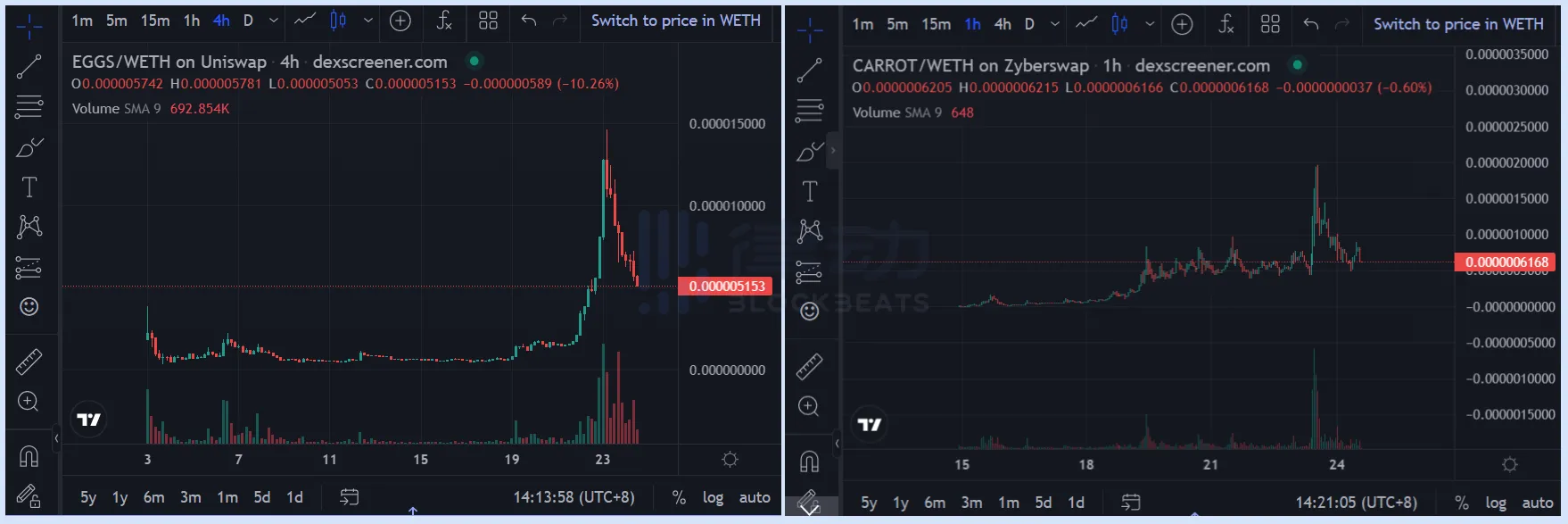
The historical performance that is almost consistent with (3, 3) has to make us think, why does the (3, 3) mode always appear Rug? What is its essence?
What new tricks does inverse( 3, 3) do?
The reverse (3, 3) model refers to Camelot and OHM, both of which reward Token pledgers and LP pledgers through inflation, and use treasury funds to repurchase Token prices at the same time. Inverse (3, 3) projects such as Carrot and Eggs use deflation to punish holders who do not pledge Token.
Taking EggsCare as an example, the number of Tokens in the holder's hands will be automatically reduced, so in order to ensure their own holdings, participants must lock their own Tokens in the Vault. The supply of EGGS Token decreases at a rate of 0.001% per block, which is about 7% per day. In order to avoid deflation of holdings, holders need to put Tokens into three vaults:
1. Full Protec Vault, the lock-up period of this method is 7 days, users can deposit EGGS and withdraw it after 7 days without losing any EGGS;
2. Big Protect Vault, the lock-up period of this method is 24 hours, but it needs to be deposited into EGGS/ETH, ETH will not be affected, and EGGS will still be depleted by 7% per day, the difference is that users will get 90% rewards, that is 10 million EGGS per block;
3. Small Protect Vault, the lock-up period of this method is 24 hours, and it also needs to be deposited into EGGS/ETH as LP, ETH will not be affected, EGGS will still be depleted by 7% per day, and users will get Big Protect Vault rewards (per 10% of the standard of 10 million EGGS per block.
In the initial stage, EggsCare also received good evaluations from participants, and EggsCare imitation projects also emerged in the market. Yesterday, the price of EGGS rose sharply, and the community also had a very high FOMO sentiment, shouting "a new experiment that changes the (3, 3) pattern" everywhere. However, in less than a day, these reverse (3, 3) Tokens fell sharply like Rug, and projects such as Bird Finance and Golden Cow Farm even directly cut off their official websites.
( 3,3) The history of blood and tears, the fate of Rug engraved in the genes
In the second half of 2021, OHM, whose price has been rising all the way, made everyone remember the Meme "(3, 3 )" with a return rate of nearly a thousand times. Since then, Olympus DAO has raised the "protocol has liquidity" Daqi declared that it would bring DeFi into the 2.0 era, and the story of (3, 3 ) began like this.
OHM and its forks
In the currency circle at that time, 7,000% APY annualized income could not be found anywhere, but since the birth of OHM's (3, 3 ), the thousands of percent APY has become insignificant. For a time, OHM forks with APY 70,000%, 7,000,000%, or even 7,000,000,000% grew everywhere on various public chains (mostly in the Avalanche ecosystem), and DeFi also ushered in " (3, 3) Summer".
Regarding the specific mechanism of (3, 3), BlockBeats in "APY 70,000%, DeFi 2.0 dominated by OHM forks"There are detailed explanations. To put it simply, it is a game. Token holders can lock their positions to get more Tokens. Arbitrageurs can use Bond to buy these "air coins" at a low price. The agreement gets real money and silver in return. Purchase to guarantee the Token price.
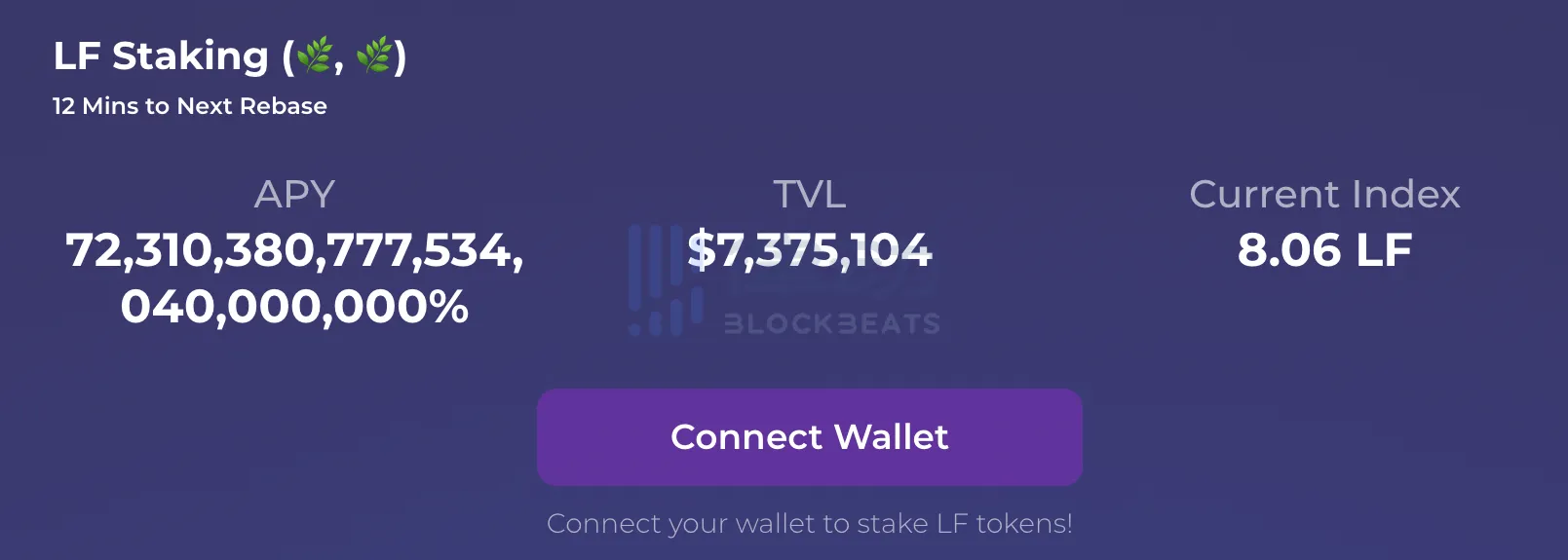
And by sacrificing part of the savings income, the forks of OHM continue to increase their APY, attracting the attention of retail investors in this way, "3, 3" has also become "4, 4" or even "9, 9" , to develop the concept of OHM to a daunting level. For example, the following fork called LF Staking provided investors with an APY of countless multiples. At that time, this level of APY was only at a moderate level, and the APY provided by many protocols could even allow the number of Tokens of users to exceed two doubled in days...
Of course, higher APY also means faster fund rotation. Those early participants (mostly team members) immediately withdrew their funds after receiving the "tuition fees paid" by later participants, and Token entered death Spiral, the price quickly returns to zero. This is actually the reason for the ultimate failure of the (3, 3 ) model: some speculators have found this fastest, purest and most attractive money-circulating model, and have played its role to the greatest extent.
Let's briefly sort out the "harvesting process" of the (3, 3) project:
1. The team forked the OHM contract, slightly modified the parameters, and then started to promote it on Twitter.
2. Some Degen users saw the project, began to participate in the public offering, and locked positions to earn more Tokens, and gradually became big investors like the team.
3. The team raised the price of Token with public funds to attract more retail investors. Some of them bought through Bond, and some directly bought Token.
4. The team has earned enough funds, no longer repurchases and runs away. When the big players hear the news, they start shipping first. At this time, there are still retail investors shouting "buy the bottom" and keep entering.
5. In the end, big investors began to sell on a large scale, the price of Token quickly returned to zero, and the funds of retail investors were all swept away.
There are also forks like SnowDog DAO, Rug's is more straightforward. The team received 44 million US dollars during the one-week public offering, but immediately transferred most of the funds on the grounds of mistakes when the market was about to open, which made the agreement lose its ability to repurchase, and the price of Token plummeted by 99%.
But people are always greedy, losing money on this project is like earning back on the next project. After seeing the higher APY, many people rushed into this fund again. In this way, the APY of the OHM fork is getting higher and higher, and the life cycle of the project is getting shorter and shorter. In the end, the life of most of the forks will not exceed one week at most.
Sifu Steals Himself, AC Retires, Rug of the Turning Point of ( 3, 3)
( 3,3) When it was still prosperous, there was a protocol called Wonderland, which was recognized as the best OHM fork, even surpassing OHM. Wonderland is the work of Daniele Sesta, the founder of Abracadabra and known as the "Frog Gang" of DeFi. It is also built in the Avalanche ecology. The APY is not high, only 70,000%.
Unlike other forks, Wonderland not only has Daniele's endorsement, but also has the ecological support of the Abracadabra platform. Its Token TIME can also be pledged to the platform, and more interest-earning assets can be borrowed and pledged to the Wonderland protocol. The original "3, 3" became "9, 9" in this way, and the team also claimed to activate Launchpad to actually empower TIME.
But one early morning in early 22, 0x Sifu, a core member of the Wonderland team, was exposed to have participated in fraud crimes many times (Note by BlockBeats, for more information, please read "Frog becomes F "rug", a tweet sparked a billion-dollar scare"). 0x Sifu was arrested and imprisoned for cybercrime in his early years, and later founded the notorious Ponzi encryption platform QuadrigaCX under the aliases of Michael Patryn and Gerald Cotten. Months later, Cotten dies unexpectedly and 0x Sifu gets away with money.
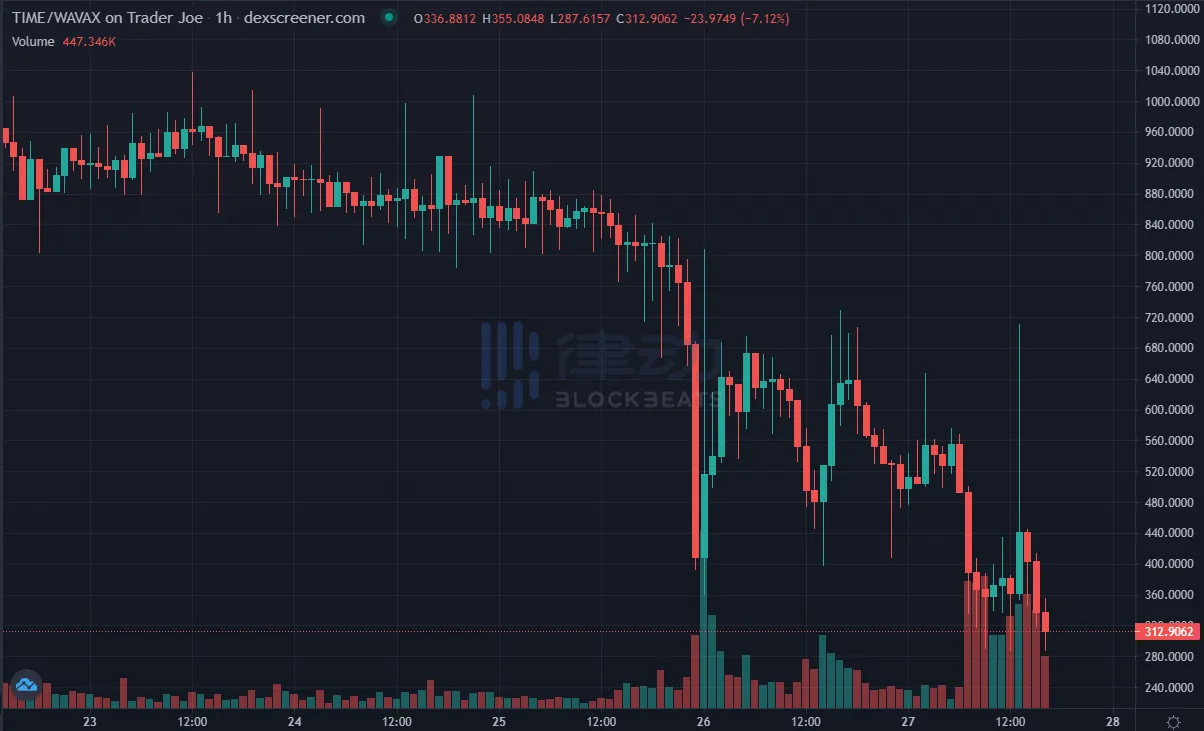
Daniele, the founder of Frog Nation, knowingly appointed 0x Sifu as CFO, in charge of nearly $800 million in assets in the Wonderland treasury. After the news came out, a large-scale liquidation occurred in Wonderland, TIME Token plunged in a straight line, and even Abracadabra was affected, and the platform stable currency MIM once appeared riveting.
Someone also found that the trigger of this liquidation is also inseparable from Daniele and 0x Sifu. Before the large-scale liquidation occurred, team members such as Daniele and 0x Sifu used Wonderland's new Token wMEMO as collateral to lend a large amount of MIM, and transferred these stablecoins to the Bitfinex exchange for cash out.
With the sudden collapse of Wonderland, the (3, 3) music swivel chair game also came to an abrupt end. 3, 3 Tokens such as OHM and TIME plummeted one after another. .
On the other hand, Andre Cronje, the godfather of DeFi, is posting three articles a day, and is planning his own new project ve(3, 3), hoping to combine veToken and the protocol to have a liquidity model (BlockBeats note, update on the ve(3, 3) mechanism For more content, please read "What exactly is ve( 3, 3) that AC is trying to advertise?》)。
However, the thunderstorm in Wonderland caused Daniele, who originally cooperated with AC, to withdraw from the development. Although the enthusiasm was high, problems frequently surfaced. In the beginning, in order to obtain the initial quota of SOLID Token, various agreements in the Fantom ecology fought against each other and launched a TVL war (BlockBeats note, for more information about the ve( 3, 3) TVL dispute, please read "How hot is the new AC project? Detonate Fantom's Vampire War overnight"). After the Solidly protocol was officially launched, problems such as front-end bugs and capital pool vulnerabilities made AC a target of public criticism. Under the poor performance of the project and the pressure of public opinion, AC deleted his Twitter account and chose to leave the DeFi and encryption industry.
new lasso cloud
Whether it is (3, 3) or reverse (3, 3), the evolution of the mechanism cannot change the essence of the game behind them. Running away is also a matter of time, but there are different forms. A cat or a dog, in the end it's the same.
BlockBeats in "APY 70,000%, DeFi 2.0 dominated by OHM forksAs explained in the article, (3, 3) such an agreement is like a lasso cloud (Lassoing clouds). The only strength is the belief of the participants. Once people lose confidence in the agreement, this lasso cloud will inevitably disappear into the blue sky.
In the DeFi 2.0 era where "the agreement has liquidity", high APY has brought extreme FOMO emotions and irrational behaviors, and users and the agreement have also exchanged positions. The promise of the agreement and the trust between users seem to be an investment The only reliance of the reader. At the moment, in the context of the recovery of the encryption market, there are anti-(3, 3) and ve( 3, 3) imitations such as Eggs and Carrot. BlockBeats here reminds readers to be cautious in participating in such "drumming and spreading flowers" "James of the Brave".