How did the NFT royalty war evolve into today's "buyer's market"?


This article comes from SubstackThis article comes from
 , Original author: Joel John & Siddharth, compiled by Odaily translator Katie Ku.
The author of this article has been researching the future of the NFT market, specifically a battle that is ongoing and will determine the structure of royalties for NFT creators in the coming months. But before we do that, it's worth reviewing how the royalty war started to evolve into today's "buyer's market".
secondary title
Looking back at the "first show" of NFT in 2019
The bear market of 2019 made retail investors give up almost all cryptocurrencies on hand. Even the beautiful girl you matched on Bumble (dating software) doesn’t care about the bitcoin you wrote on your self-introduction page. With the explosion of DeFi in 2019, people's confidence was rekindled by using digital tokens to obtain Internet loans. The Simple Agreement for Future Tokens (SAFT) is the most common form of NFT financing. SAFT NFTs are investment contracts for VC investments who want to acquire more tokens in the future.
But most founders have been delaying their token offerings, while VCs pretend to want to keep working with the founders while trying to find off-market buyers for token agreements. The concept of NFT was officially proposed by Dieter Shirley, the founder of CryptoKitties in 2017. As the earliest popular chain game, this series has repeatedly blocked the Ethereum network because of its popularity. Afterwards, due to the bear market, the funds in the entire cryptocurrency market continued to leave, and CryptoKitties, which was not supported by other application scenarios, quickly disappeared.
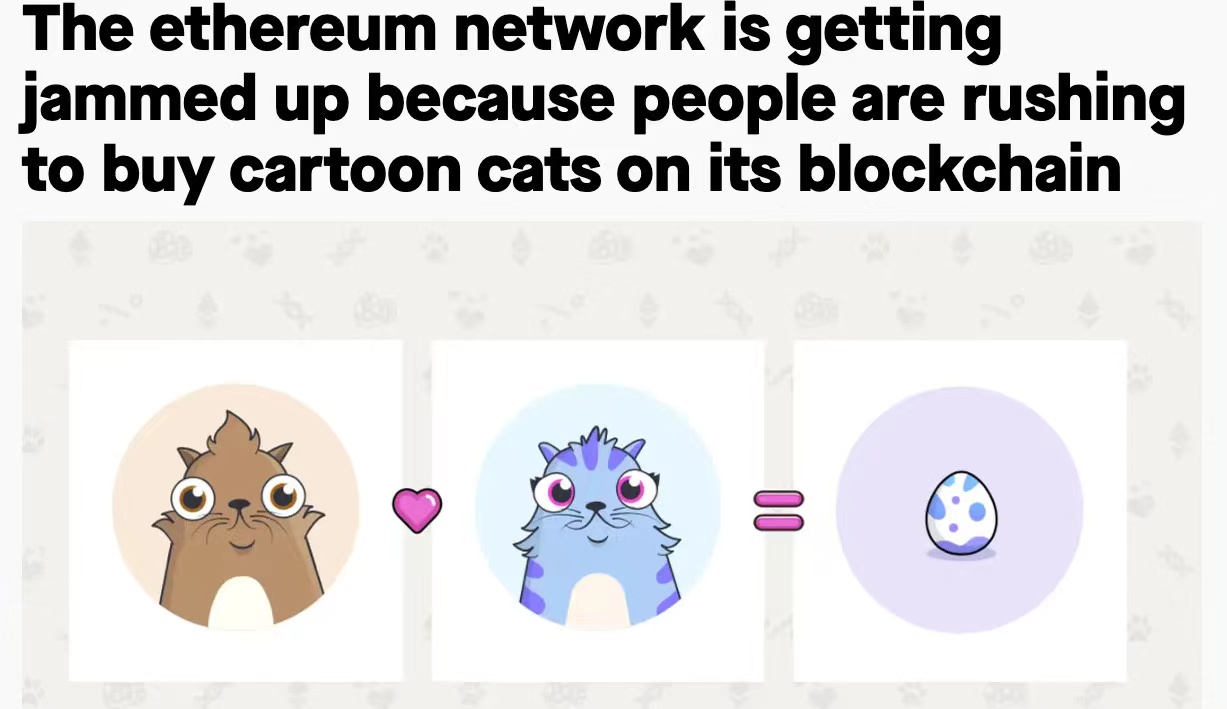
image description
Source: Quartz.
Looking back at the NFT market in 2019, due to the ICO boom in 2017, tokens have product-market fit. At the time, users were used to transferring, trading and losing cryptocurrencies in hacks. At that time, there was only a small group of Silicon Valley people talking about NFT.In the real world, an artist can only make money from selling a work once. So their income is linear, and the artist has to keep creating work to make a living.
NFTs allow works of art to evolve into financial assets, accumulating value for creators every time a person trades their work of art. This is the magic royalty concept. Royalty allows creators to receive a portion of every sale of a work. If an ordinary work of art is turned into an NFT that pays the creator's royalties, the benefits are very objective.
Refer to the transaction example in the figure below:
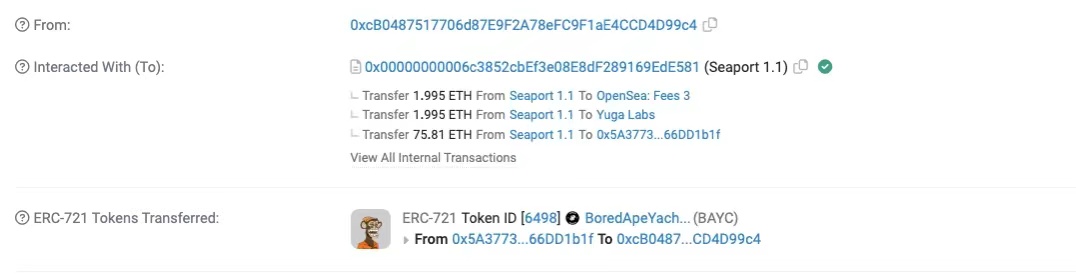
image description
Source: Etherscan.
OpenSea advances the idea that NFTs can enforce royalties and empower creators. Everyone loves empowerment, but NFTs cannot pass royalties on their own to end users. Typically, smart contracts established by NFT marketplaces like OpenSea pass on royalties. Therefore, royalties are usually collected by the marketplace that facilitates the transaction. But what if a marketplace doesn’t want to enforce zero royalties to reduce transaction costs for users? This is the “pain point” of the problems plaguing the NFT market today.
secondary title
Competitors issue coins and enter the game, disrupting OpenSea's business plan
2022 is a year of transformation for the NFT market. Ample liquidity and fees incentivize the market to try other models. It all started with LooksRare’s token launch in January. The value proposition is simple - users will earn tokens for transactions on the platform. Users can use tokens to manage the platform and collect fees as token holders instead of burning cash to build brands, advertise and educate users. The token also has a liquid market.
At the time, LooksRare was getting a lot of attention for having liquid tokens, and OpenSea was starting to be upstaged. Even at the time, LooksRare had a “weakness” — on LooksRare you could hardly sort NFTs by price. Over the past year, the bear market and falling returns have made it difficult for LooksRare to really build a moat against OpenSea. OpenSea's management may have recognized the threat of new-age platforms to its market monopoly and acquired Gem a few months later. At the time of the acquisition, Gem was one of the fastest growing aggregators in the market.
The NFT market has already tried the token model. Incentivizing users to trade on your platform with tokens can help improve volume metrics. But there’s another lever that can’t be ignored — creator fees. Over the past year, several exchanges have begun cutting fees for creators. DeFi markets also offer the same native products. For example, SudoSwap can set up pools for NFTs like Uniswap does. Users can buy or sell large quantities of specific NFTs through the trading pool. The platform fee was reduced to 0.5%, with the aim of competing for market share with key competitors such as OpenSea.
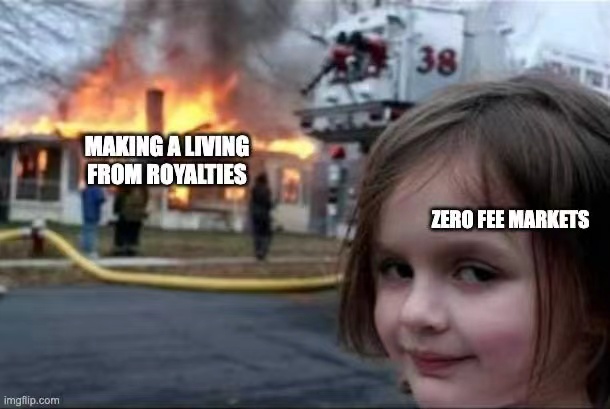
Suppose you are a trader and want to buy a Boring Ape NFT. If the 2 ETH paid to the creator and the 2 ETH paid to the platform can be eliminated, traders will be incentivized to trade from the platform, which is currently the case in the market. In some markets outside of OpenSea, transaction costs for NFTs may be reduced by 5%. This greatly reduces costs. All of a sudden, the royalty model that supported creator earnings collapsed, and the royalty narrative shattered.
Despite this, the "big bosses" in the NFT world have no sense of crisis. No one sees the threat from a few hundred traders and their volumes, most of which are "wash trades". Low price incentives caused the loss of most users of OpenSea. With fewer platform incentives, washtraders can’t make much money on platforms like X2Y2 (which rewards active users based on their trading volume), and platform trading volumes have also shrunk. In October 2022, the NFT industry faces a nightmare. A trader-oriented platform with a product that far outstrips top-notch new players is ready to go live, and that's Blur.
Three highlights of Blur:
First, they attract users through a potential airdrop, increasing liquidity for both buyers and sellers, close to the settlement price of NFT and ETH. This allows traders to enter and leave the system in batches.
Second, they no longer focus on retail traders, but instead pursue high-volume NFT traders. The Blur platform has several complex trading options that traditional platforms do not offer. It’s like moving from spot markets of altcoins to a “one-stop” trading platform for all your professional trading needs.
Finally, just like when Gem first launched, Blur integrates a series of charting and data functions in its core product. Traders can access information such as historical pricing, order book depth, rarity and overall volume trends all through the same platform they trade on.
Between attracting users with tokens and launching a better platform, Blur wins by accounting for 40% of weekly NFT transactions on Ethereum. As of February 2023, Blur's transaction volume is 77%, while OpenSea's transaction volume is 16% during the same period.
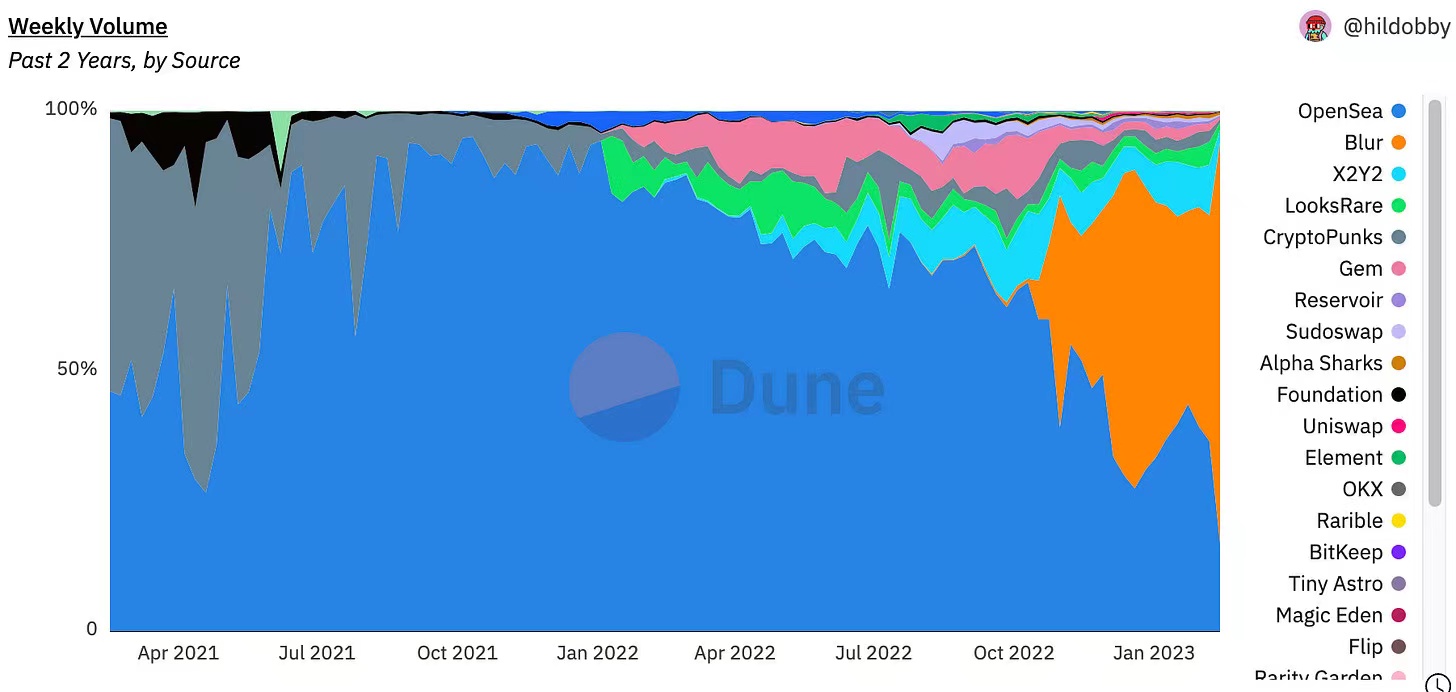
Note that in contrast to OpenSea, Blur issues tokens, so these transaction volume figures must be viewed with “discernment”. The issuance of Blur tokens also has some innovative elements. They abstracted the tokens - opened "blind box" airdrops, and these "blind boxes" will generate tokens at some point in the future. Therefore, no one knows how many tokens they can get between October and February, and the "possibility of getting rich brought by Blur" drives user behavior.
Blur hit two goals in one quarter. First, it begins to temporarily dissipate the idea that royalties are a "necessity." Traders are increasingly used to not paying creator royalties in marketplace transactions. Paying a creator tax on every transaction simply doesn't make sense when the purpose is speculation. Second, Blur eliminates its royalties. Blur has no royalties until December 2022. Since then, they have transitioned to a 0.5% royalty model.
The data below shows the royalties paid by the Boring Ape NFT for certain times of the year. With some marketplaces already offering zero-royalty deals, August kicks off at less than 5%. The trend picked up steam in October when Blur went live.
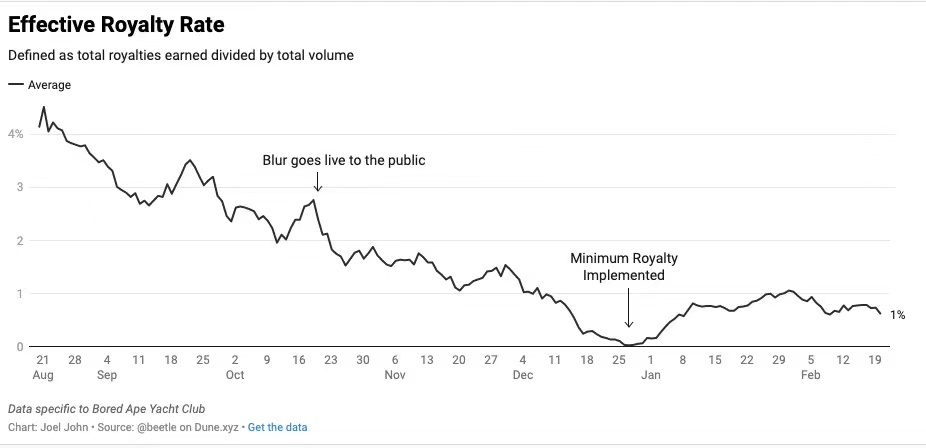
image description
It's not just about royalties. As the data below shows, across the market, the number of transactions where the Boring Ape NFT is now generating royalties is starting to trend down.
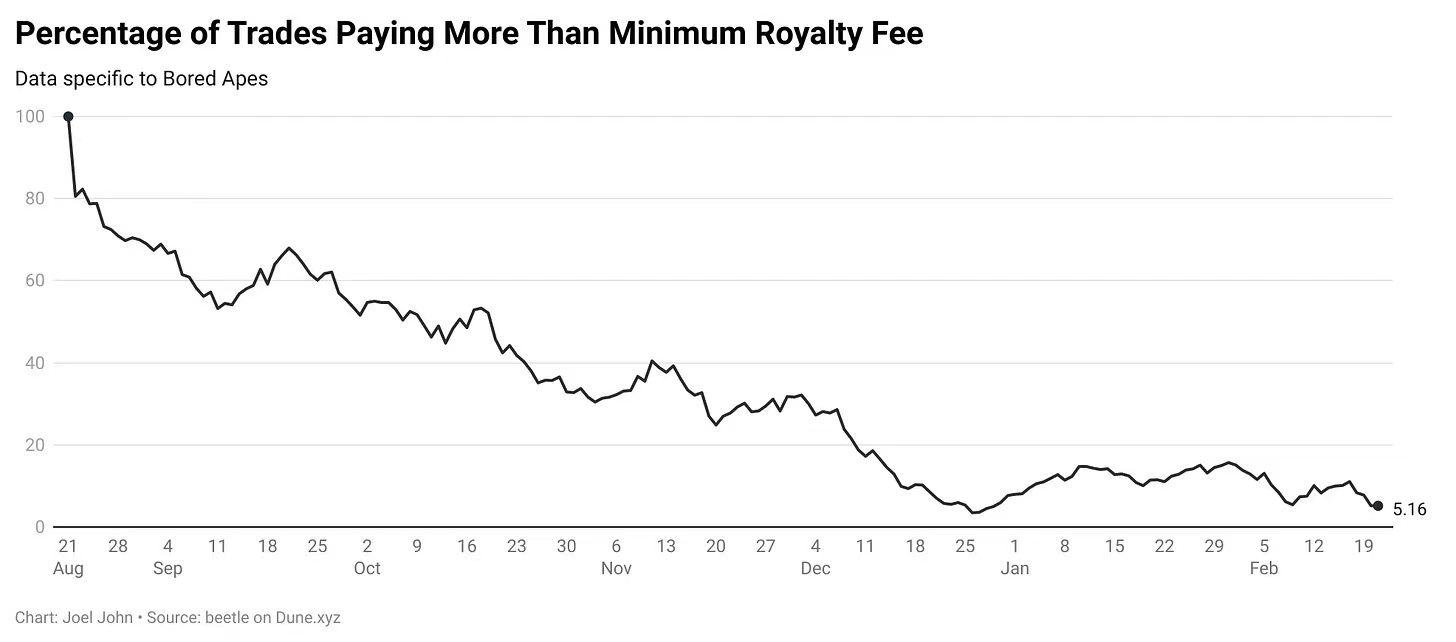
secondary title
When "filter" + "blacklist" encounters a reboundIf you are a participant in the NFT ecosystem, all of a sudden, a new player storms the market, steals your users and transaction volume, and disrupts your business model.For a while, multiple NFT marketplaces took a stance to protect creators’ income.
OpenSea publishes a "blacklist" mechanism. If a platform, such as Blur, allows users to bypass the creator's earnings when using creator royalties on OpenSea, the platform will add the project to the "blacklist". As the months passed, the market clearly changed its mind about paying royalties. OpenSea is selling only a fraction of what it once was, and was forced to "slap in the face" and cancel royalties not long ago.
Why would a platform like OpenSea bother publishing a protocol? Their goal is to provide new ways for more people to participate in NFT transactions. If the entire market continues to expand and OpenSea continues to become the largest NFT platform, it will be open to more users. But in a way, this hurt OpenSea in turn. Now whenever an NFT series shields Blur, they provide liquidity to the asset through OpenSea's protocol. In fact, there is no way to prevent Blur from using the protocol to obtain liquidity for assets. Below is a Twitter thread by a user named PandaJackson explaining how this works.
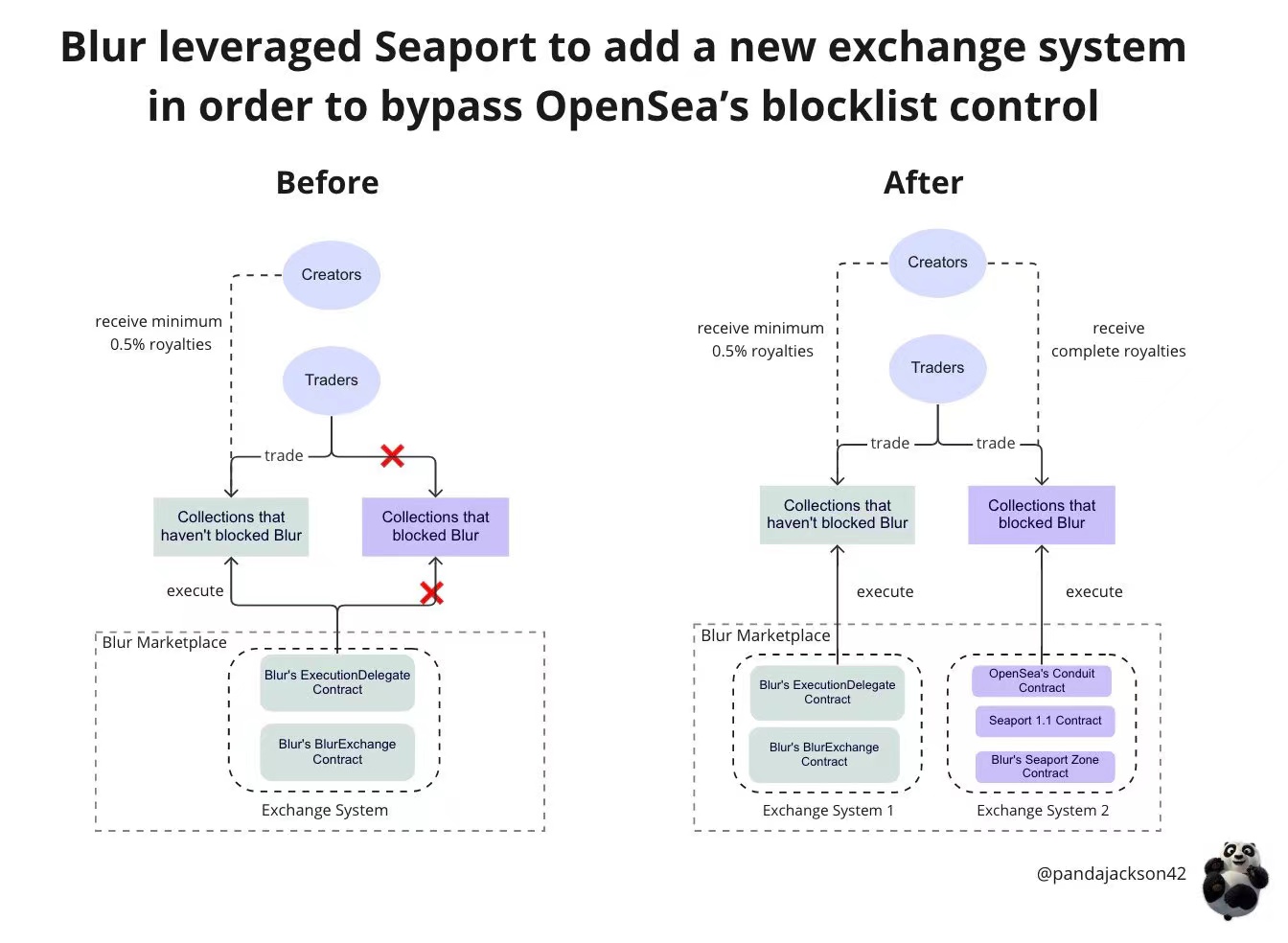
image description
Blur made more than 4,000 transactions for the Boring Apes new game ticket Sewer Pass, and avoided paying OpenSea about $220,000 in fees. This is a 40% fee penalty for OpenSea. OpenSea's "blacklist" mechanism became a joke when Blur exploited the Seaport protocol to bypass the "blacklist". Even if OpenSea found a way to prevent Blur from querying liquidity from the Seaport protocol, that would defeat the reason they introduced the Seaport protocol in the first place (besides, Opensea cannot make changes to the Seaport protocol at will). Judging from recent order source data, this "arm wrestling" competition has been in full swing.
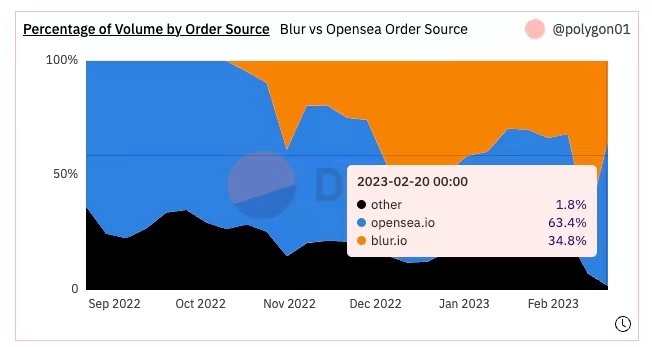
Source: SeaLaunch Data Dashboard.
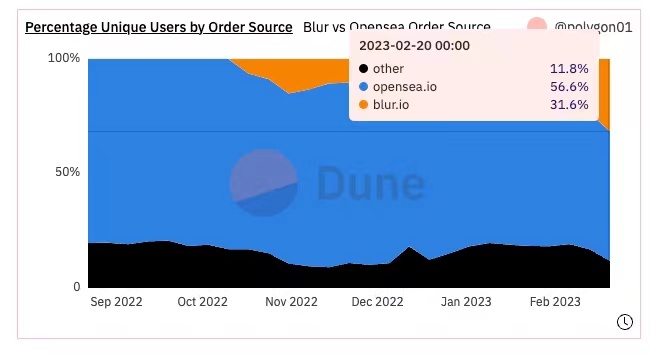
image description
Source: SeaLaunch Data Dashboard.The first chart shows the volume percentage of the order origin, i.e. the market from which the order was placed. When Blur goes live in October 2022, it will account for nearly 60% of order origins.
In fact, from the perspective of B2C investors, Blur may not pose a real threat to OpenSea. As you can see in the second chart, most independent users still use OpenSea. There's no way a new entrant like Blur can replicate their brand equity overnight. The problem is that Blur has gone from being a place to generate orders to being a place where users can find liquidity within a quarter.
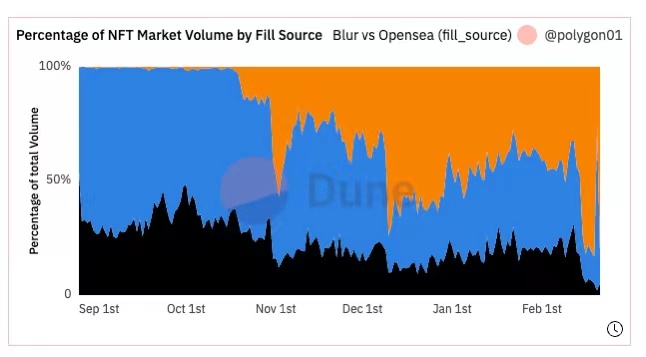
For the data below (Blur is in orange), Blur had 83% of fill sources on February 19th, dropping to 26% by February 20th. This is a big airdrop, as Blur's ICO airdrop just ended.
The image above breaks down this fact. The fill source refers to the market where the order is fulfilled. If you are an upcoming aggregator, you may be the source of the order, but the filling may be through a third party. When you can do a lot of order matching on your platform, you become an independent marketplace. As of February 2023, only about 16% of orders on Blur are fulfilled through liquidity on OpenSea.
Blur's transition from an aggregator to a platform is an important factor threatening OpenSea's future dominance. A large amount of transaction volume is lost to third-party platforms, which makes the market have no incentive to maintain high fees. OpenSea has also evolved from publishing a registry to blacklisting marketplaces that don't enforce creator royalties.
From an ecosystem that believes that creator royalties are a sacred right that should be protected and enforced across markets, to finding ways to avoid paying creators, this is the evolution of the NFT market into a "buyer's market." It’s also interesting that in just 6 months as a startup, Blur has convinced the global NFT market that eliminating royalties is justified, if only for a brief period of time.
Is zero royalties + coin issuance the best choice?
The premise for LooksRare a year ago was that issuing a token could revolutionize the NFT market. The tactic seems simple, remove the fee and introduce a token. Teams profit from the tokens they issue, not from any revenue they generate. But my judgment was wrong, because in the past year, the daily activity of the LooksRare platform has been as low as 200 or so.
Blur poses a bigger threat, as LooksRare has an 11% share, while Blur has more than 70%. The fact that OpenSea had to go from using a registry to block platforms that don't charge to minimizing fees shows that Blur is a threat to the market. OpenSea's "counterattack" has a certain effect, but once the market changes, can OpenSea's transaction volume and users be "stable as Mount Tai"?
On this issue, there are people on both sides of the "side". One would argue that Blur has a better product for traders, and the volume is here to stay. A great product coupled with "empowering" users through tokens will allow it to grow massively. Another way of saying it is that Blur's "counterattack" is just a temporary blip, and within a few months OpenSea will return to dominance. There are several reasons why this might happen.
First and foremost, OpenSea has kept fees to a minimum. Therefore, for users who migrated to other NFT platforms, if they left OpenSea due to cost issues, they may now return to OpenSea. Second, the IPO may no longer happen as fees are minimized. In this case, issuing tokens is possible.
OpenSea is in no rush to tokenize itself. Possibly by tokenizing assets held by the company. For example, Gem is an aggregator site that OpenSea acquired a year ago. Introducing tokens to it could be the first step. If that wasn’t enough, they could go ahead and tokenize the Seaport protocol (which OpenSea launched a year ago). For OpenSea, tokenizing the protocol and incentivizing individual smaller markets could have a positive impact. As long as Seaport becomes the standard for NFT transactions, they can enforce royalties at the protocol level and blacklist bad actors.
Just like Ronin, the underlying blockchain network supporting the well-known chain game Axie Infinity, any protocol released by OpenSea may be determined by an alliance of game studios, large NFT issuers, and traditional retailers to determine the evolution of shared standards.
The stalemate in the NFT market is caused by the current two NFT platform giants, both of which have enough venture capital to "stand" for them, and both have the strength to survive for several years without income. The "competition" between them affects creators and small NFT markets who believe that the royalty model will continue, such as NFT royalties can drive the user-generated game content market.
Without NFTs, the user-generated game content market would completely collapse. Games will move to operating closed-loop and conservative marketplaces to avoid regulatory scrutiny or app store policies dealing with digital assets.A large part of the meaning of NFT comes from intellectual property rights.Yuga Labs or Nike are incentivized to keep developing NFTs because they earn income from royalties. The two companies earned more than $100 million in royalties from NFTs alone last year.
We are eager to declare that royalties are a flawed model that could set the NFT market back a few years.
To save themselves, creators may do so by launching their NFT platforms. There are a lot of great tools out there for creating your own platform and publishing licenses on top of it. In this process, creators will inevitably return to the challenge faced by the previous art sales process-the "intermediary" takes a cut of their income.
Trading occupies a large portion of the digital asset ecosystem today. Most of the money invested and income generated comes from financial applications. These apps will continue to trend towards the lowest price to acquire users and usage.
Not all assets are meant to be traded in large volumes. At least not as a tool for non-homogeneity. Like no reason to trade (multiple times in one day) the rights to Jay Z's album from 2000. High royalties are justified if assets change hands infrequently.
We're going to have a completely different user base. Each requires a different royalty model, depending on the asset being traded. One way to resolve the impasse is to give creators enough power to earn royalties at the protocol level. The market can then decide if it wants to trade multiple times. While NFTs have innovated over the years, little progress has been made in this regard. Canto's Contract Guaranteed Revenue allows developers to take a cut of the fees generated by users of a particular Dapp. Perhaps, there is a way to adjust for the NFT fee issue as well.
secondary title
Summarize
SummarizeBlur's valuation at the time of writing is $3.2 billion, higher than some agreements.We may be transitioning from the era of "fat protocols" to the era of value accumulation of applications. Teams like Blur have demonstrated that standalone applications can often generate more transactions and serve more users than the entire protocol.
Blur is the "new script" for NFT market gameplay - to stimulate trading volume through tokens and launch a market with low or no fees. Ownership is passed to users through tokens in exchange for user activity on the platform.
Essentially, we want to start from the perspective of user needs and build products that people want, rather than building products that people can build on top of. We've finally reached a stage where, with a focus on empowering users, product-based moats can become mainstream.
This article does not argue that the zero-royalty market will eventually prevail. As I said at the beginning of this article, evolution is the norm in the market. As we see in nature, apps will evolve to compete and acquire niche user groups. After a quarter, the heat around Blur will likely die down and we'll be back to normal. It is also possible that creators will stop issuing NFTs entirely, relying on the innovation and development that this industry has accumulated over the past three years to "eat their laurels".No one knows where the NFT market will go in the future. But if we wrap up with Elon Musk's words, namelyThe most interesting outcome is the most likely