Shanghai upgrade is coming soon, what preparations should POS service providers make?


After the launch and merger of the Beacon chain, Ethereum 2.0 will usher in another major update in March (according to the latest news, it is expected to be postponed to early April)—the Shanghai upgrade. Among them, the Eth 2.0 pledge asset withdrawal issue is one of the core issues that need to be resolved in this upgrade. With the approach of the Shanghai upgrade, Ethereum staking products have recently gained a high degree of attention in the market. Xi Jiazhen (common name in the industry: Token), the person in charge of Huobi POS, shared the advance work that POS service providers need to do. He said , as an important participant of ETH2.0, Huobi has already prepared for the Shanghai upgrade.
Pledge users should do withdrawal work in advance
After the Shanghai upgrade takes effect, users can withdraw the principal or income previously pledged on the Beacon chain to the address provided by themselves, so as to freely control the corresponding assets. Withdrawal can be divided into all withdrawals and withdrawal rewards, both of which need to set a withdrawal address, once the withdrawal address is set, it cannot be modified. All withdrawals require the user to initiate a request to withdraw from the validator and wait in line for confirmation. After the user confirms the withdrawal, all funds can be retrieved; the withdrawal of rewards is in the form of automatic distribution, which is automatically credited to the account every few days on average. Neither type of withdrawal involves a gas fee.
Whether it is a full withdrawal or a withdrawal of rewards, the user needs to set the withdrawal address in advance. Before the upgrade in Shanghai, users can only set the withdrawal address when initially creating a validator, and cannot set it after the validator is created. Since the Beacon chain does not make mandatory requirements for setting the withdrawal address, the withdrawal address of some validators is null. As of February 13, only 205,178 of the total 517,052 validators on the entire network have set withdrawal addresses, and 311,874 have not set addresses, accounting for 60.3%.
After the Shanghai upgrade, users can initiate a request to set a withdrawal address for a validator that has not set a withdrawal address, but cannot modify the withdrawal address. According to the theoretical calculation that 16 withdrawal addresses can be set in each block, all settings can be completed within 3 days (3 11874/1 15200 about 2.7).
When it comes to all withdrawals, the user needs to initiate the operation of exiting the validator first. For specific operations, please refer to:https://docs.prylabs.network/docs/wallet/exiting-a-validator。
It is understood that the number of validators that can be withdrawn per day is 2 25 (the number of epochs per day) * 7 (the number of validators that can be withdrawn per epoch corresponding to the current number of validators), and the total is 1575. In extreme cases, all current validators exit at the same time, theoretically it takes up to 517052/1575, about 328 days. In fact, since the number of validators that can be exited in each epoch is related to the current total amount of validators, it will take longer for all exits.
The final step is about reward release/full withdrawal.According to the requirements, the user's withdrawal conditions have different requirements for different situations:
The first is a partial withdrawal. The validator needs to set a withdrawal address, and the status is active, and the balance must be greater than 32 ETH (including unclaimed earnings).
The second is full withdrawal. The validator needs to be set with a withdrawal address, and the status is withdrawable (usually it indicates that the validator exited successfully).
Eligible validators can enter the withdrawal queue, and Ethereum will automatically send ETH to the withdrawal address without additional operations by the user. The current withdrawal cycle is 517052/115200, about 5 days.
TO DO LIST for POS service providers
At present, there are various types of POS service providers, including traditional decentralized LSD products, CEX (centralized exchange) POS products, and SaaS (Staking as a service) products. The same, but basically the following aspects need to be considered.
First of all, POS service providers need to solve customers' withdrawal needs and develop corresponding product functions.The general withdrawal process is as follows:
1) Provide product entry and receive withdrawal requests from users
2) Set the withdrawal address and prepare for the withdrawal
3) According to the number of withdrawal requests of the user, confirm how many validator nodes need to exit
4) Initiate a request to exit the validator
text
The second is to release capital risk.
Beacon chain staking began as early as December 2020, and the staking cycle of the earliest batch of funds has exceeded two years. Since the withdrawal function is not enabled in Ethereum, users cannot retrieve the pledged assets, and cannot change the validator address of the pledged assets. Unable to perceive. Therefore, the pledged assets on the chain face a large risk exposure, and risk elimination needs to be carried out in advance. The preparations to be done by POS service providers include three parts:
1) Audit of pledged assets on the chain
The service provider needs to check the number of pledged assets on the chain to confirm that it is consistent with the principal + income pledged by the user; to confirm that the certificates under their control correspond to the assets on the chain; to confirm that the withdrawal address has been set and the private account of the withdrawal address The key is controlled by yourself. If you have not set a withdrawal address, you need to set a safe withdrawal address as soon as possible after Shanghai upgrades.
2) Data security verification
Security verification of the withdrawal certificate; security verification of the private key of the withdrawal address.
3) Risk prevention
text
The third is to enhance product attractiveness, including optimizing product experience, increasing APY and improving token liquidity of LSD products.
While meeting the withdrawal needs of users, it is necessary to optimize product details, including but not limited to increasing the deposit logic, providing a silky withdrawal experience, and shortening the queuing cycle; providing an appointment withdrawal function to shorten the queuing cycle
After the upgrade of Shanghai, the staking rewards on the chain can be withdrawn, and (automatic) reinvestment can be done after withdrawing, the overall income will be significantly improved, and the APY is expected to increase by more than 1 0%.
Before the upgrade in Shanghai, due to the inability to withdraw cash, the ETH equivalent tokens (such as stEth) of various LSD products have a certain slippage relative to ETH. After the upgrade in Shanghai, the corresponding slippage will be quickly smoothed out, and the value of ETH equivalent tokens will be more widely recognized by the market. Service providers can add more ETH equivalent tokens to Cefi and Defi products. Use scenarios to improve liquidity and increase user income.
Huobi POS is ready for Shanghai upgrade
As one of the main participants of Eth2.0, Huobi POS is ready for the upcoming Shanghai upgrade. It is reported that the core functions of Huobi POS are ready and waiting for a new round of test network verification.
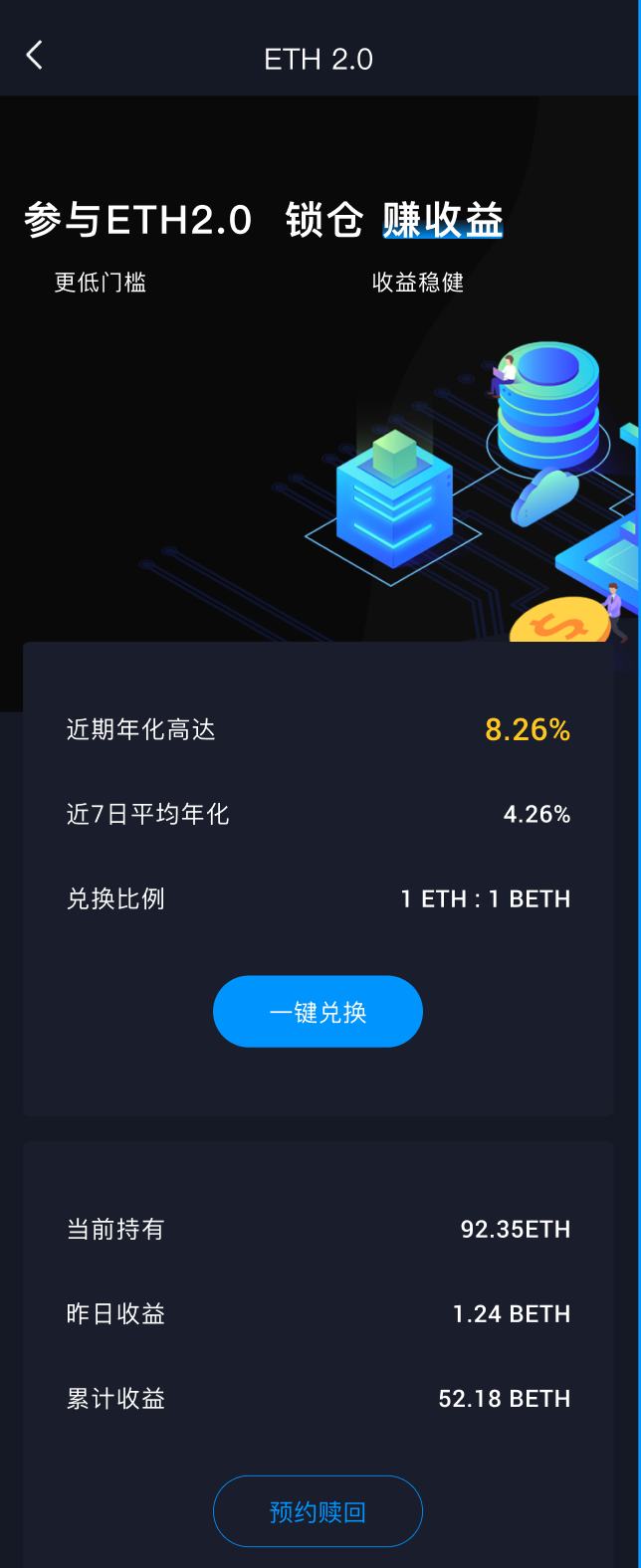
At present, Huobi POS has completed the product function development of the whole process of withdrawal, including user reservation and redemption, redemption details query, on-chain exit validator, on-chain income automatic reinvestment, provision of withdrawal reserve, etc., has been launched in zhejiang The test chain has done a functional test, and we will follow the Ethereum test chain and mainnet upgrade for regression testing to ensure that users will be provided with the withdrawal function as soon as possible after the Shanghai upgrade.
Since its establishment 9 years ago, Huobi has always regarded the protection of user asset security as the most important mission. For the risks that ETH2.0 assets may face, Huobi has conducted relevant risk investigations in advance, including:
1) Audited the consistency of user assets and assets on the chain
By verifying the correlation between the certificate and the assets on the chain, the consistency of user rights and assets locked on the chain is confirmed.
2) The security of the withdrawal certificate is confirmed
Withdrawal vouchers are encrypted and stored in the form of a signature machine, which eliminates the risks introduced by artificial storage.
3) Eliminate potential risks to assets
text
andhttps://beaconscan.com/main/eth1deposits?eth1=0x194BD70B59491ce1310ea0BCeAbdb6c23aC9D5b2andhttps://beaconscan.com/main/eth1deposits?eth1=0xB73f4d4E99F65Ec4B16B684e44f81Aeca5ba2B7Ctext
In response to this Shanghai upgrade, Huobi provides users with functions such as real-time display of the current on-chain pledge, queuing, and withdrawal details to further enhance the transparency of assets.