A Comprehensive Interpretation of the Unanchor Risk of the Seven Stablecoins


Original author: 0 xhankerster.eth, Biteye core contributor
Original editor: Crush, Biteye core contributor
The unanchoring of the "stable" coin UST in the first half of the year directly brought the encryption market into a bear market, and its domino effect also brought down a series of star projects. So, are other stablecoins stable? If there is another broken anchor, the encryption circle will still bleed like a river!
This article comprehensively analyzes the unanchoring risks of the current seven popular stablecoins, and lists the usage guidelines to help everyone better protect their assets.
Introduction to Stablecoins
Stablecoins usually refer to cryptocurrencies whose prices are anchored to fiat currencies such as the U.S. dollar or other assets of stable value. Common anchored assets include U.S. dollars (USDT, DAI, etc.), euros (EURT, etc.), gold (PAXG, etc.) and other assets.
At present, the most common anchor asset is the U.S. dollar, so the following will focus on the U.S. dollar stable currency, and the mentioned stable currency refers to the U.S. dollar stable currency without explanation.
Why Stablecoins Are Necessary
Value scale: People are used to measuring the price of goods or assets in fiat currency, including encrypted assets. Although many NFTs issued based on Ethereum are denominated in ETH, buyers will still estimate the legal currency value of NFT in combination with the price of ETH. Measuring the value of encrypted assets in U.S. dollars is often referred to as "U standard", and measuring the value of encrypted assets in units of other cryptocurrencies is usually referred to as "coin standard".
Storage means: For stable assets such as the U.S. dollar, they have a strong government credit endorsement and have extensive purchasing power in reality. They will not "return to zero" like encrypted assets. Therefore, when Web3 users want to keep assets on the chain as stable as possible, You can choose to exchange the risk assets in the account into stable coins anchored to stable assets to preserve value.
Means of circulation: In the encrypted world, people need to hold stable currency assets to store value, and measure the value of assets through legal currency units, so the legal currency stable currency has also become the main means of circulation in the encrypted world. The stable currency issued based on the blockchain allows users to directly purchase goods, services or assets based on the blockchain, enjoy the good characteristics of the blockchain ledger, and does not need to frequently convert legal currency into stable currency and then mention it to the wallet on the chain. Buy.
Classification of Stablecoins
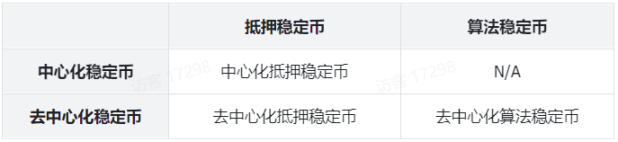
The most important property of a stablecoin is the anchoring of its price to the U.S. dollar. The anchoring of the price to the U.S. dollar can be achieved through a variety of mechanisms. Different mechanisms also bring corresponding risks. Usually, we can follow the "issuer" and "anchor" "Determining Mechanism" to roughly classify stablecoins.
According to the issuer, it can be divided into two categories: "centralization" and "decentralization":
Centralized stablecoins are usually issued by an entity under the chain
Decentralized stablecoins are typically generated for on-chain decentralized stablecoin protocols
According to the anchoring mechanism, it can be divided into two categories: "mortgage stable currency" and "algorithmic stable currency":
Collateralized stablecoins are usually collateralized with sufficient or excess assets
Algorithmic stablecoins maintain the price anchor to the US dollar through a certain algorithm combined with an arbitrage mechanism
Typical risks of stablecoins
The core nature of stablecoins is the anchoring of the price of the US dollar. Based on the anchoring of the price of the U.S. dollar, stablecoins can function as a value measure, a means of storage, and a means of circulation in the encrypted world, and become an asset type that users cannot bypass.
Therefore, the biggest risk of stablecoins is the de-pegging of the US dollar price, and the de-pegging risk usually comes from different stablecoin issuers.
Risks from native issuers
① Mortgage of stablecoins: Insufficient collateral reserves
Regardless of whether a collateralized stablecoin is issued by a centralized or decentralized organization, its price is anchored to the U.S. dollar depends on whether the issuer reserves sufficient assets to support the stablecoin, ensuring that users can at any time 1: 1 price for exchange.
Decentralized mortgage stablecoins are usually minted and issued by smart contracts on the chain. The value of mortgage assets is transparent and visible, and the risks mainly come from the level of smart contracts.
Issuers of centralized collateralized stablecoins store reserve assets in accounts, which are not as transparent as decentralized collateralized stablecoins, and there is a risk of misappropriation. Therefore, issuers of centralized stablecoins usually need to publish collateral to gain user trust.
② Algorithmic stablecoins: risks such as unlimited issuance caused by algorithm loopholes, decoupling caused by confidence shakes, etc.
Risks from Derivative Issuers
It is difficult for the original stablecoin issuer to issue native stablecoins on all chains. Therefore, when users need to use a certain stablecoin on an unofficially issued chain, they can only pass through cross-chain bridges or centralized exchanges. Stablecoins cross-chain to the target chain.
The corresponding stablecoin on the target chain is usually issued by the corresponding cross-chain bridge, centralized exchange and other derivative issuers, and its security also depends on the corresponding derivative issuer, so the following two corresponding risks will arise .
Cross-chain bridge risk: When a user uses a cross-chain bridge to cross-chain, the cross-chain bridge usually locks the user's stablecoin on the original chain and sends the corresponding stablecoin to the user on the target chain. When the corresponding stablecoin of the target chain is issued by the cross-chain bridge, if the cross-chain bridge is attacked, the user's stablecoin on the target chain will lose its supporting property, resulting in the risk of unanchoring.
Centralized exchange risk: When a user uses a centralized exchange to deposit and withdraw cross-chain, the exchange will accept the user's stablecoin off-chain and send the corresponding stablecoin to the user on the target chain. When the corresponding stablecoin of the target chain is issued by a centralized exchange, the exchange has a super engine, resulting in insufficient collateral and the risk of unanchoring.
Analysis and comparison of the seven major stablecoins
image description
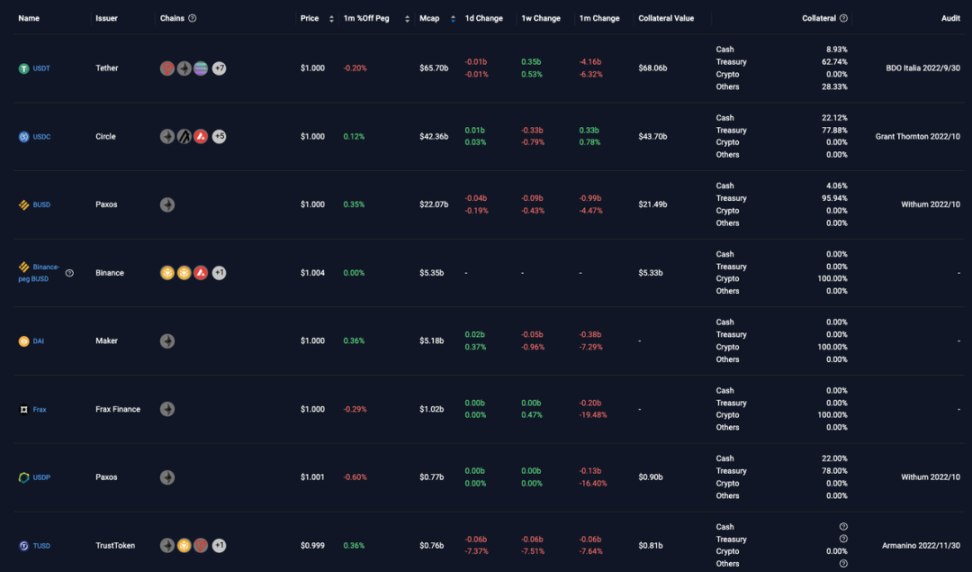
Stablecoin market value ranking, source: https://chaineye.tools/stablecoins
Introduction
Introduction
Tether USD, referred to as USDT, is issued by Tether and is currently the most valuable stablecoin with a total market value of about 65.7 billion US dollars.
Public chain distribution
USDT circulates on 61 public chains including Tron, Ethereum, BSC, Solana, etc., and has the largest market share in circulation on Tron and Ethereum, accounting for 51.22% and 38.34% respectively
USDT issued by Tether, the native issuer, is on 14 public chains including Tron, Ethereum, Solana, Omni, Avalanche, Tezos, Algorand, EOS, Liquid, Statemint, SLP, Near, Statemine, and Polygon
image description
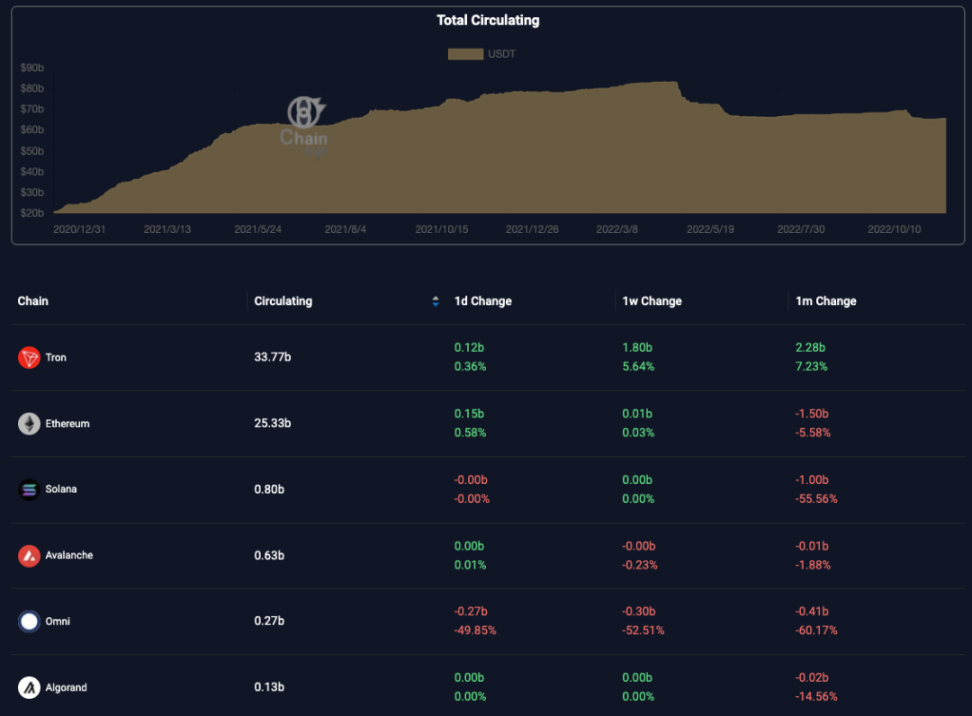
USDT public chain distribution, source: https://chaineye.tools/stablecoins/stats/USDT
anchoring mechanism
The issuer reserves sufficient funds so that users can use USDT and USD for 1: 1 exchange at any time.
Potential Risk Analysis
① Risk of insufficient collateral of the original issuer
Tether's reserves of assets supporting USDT are not completely transparent, and there is a risk of misappropriation by the company and corresponding investment risks.
USDT holders can view Tether's assets and liabilities and the distribution of reserves through Chaineye to judge its potential risks.
At present, Tether is USDT's reserve assets worth about 68.06 billion U.S. dollars, exceeding the circulation of 65.7 billion U.S. dollars. About 90% of its reserve assets are cash and cash equivalents with good liquidity, and 9.02% of the shares (about 6.14 billion U.S. dollars) are used For investments involving cryptocurrencies, there are certain risk factors.
image description
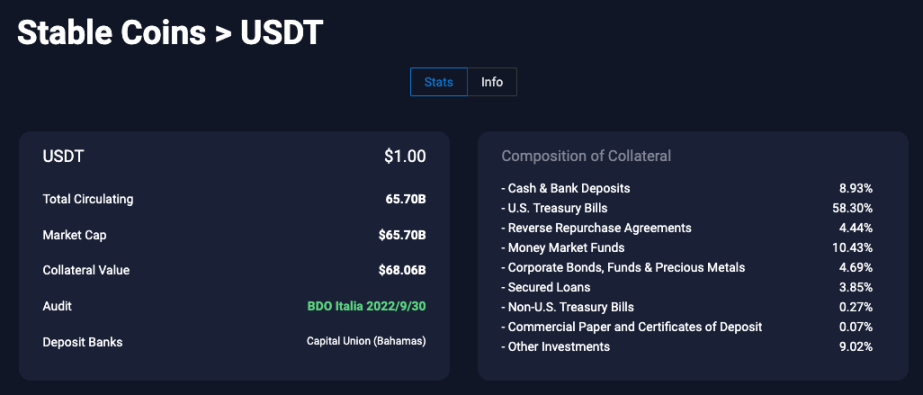
USDT reserve assets, source: https://chaineye.tools/stablecoins/stats/USDT
② Derivative issuer risk
Cross-chain bridge: The security of USDT transferred through the cross-chain bridge is affected by the security of the cross-chain bridge, which can be found inDefiLlamaQuery the specific information related to the cross-chain bridge
Centralized exchange: Depending on the specific exchange and the specific currency issued on the target chain, you can check the asset reserves on the corresponding official website.
Introduction
Introduction
Issued by Circle, a blockchain payment company jointly formed by Coinbase and other companies, it is currently the second largest stablecoin in terms of market value, with a total market value of about 42.36 billion US dollars.
Public chain distribution
USDC circulates on 59 public chains including Ethereum, Solana, Avalanche, Tron, etc., and its share on Ethereum reaches 83.7%
image description
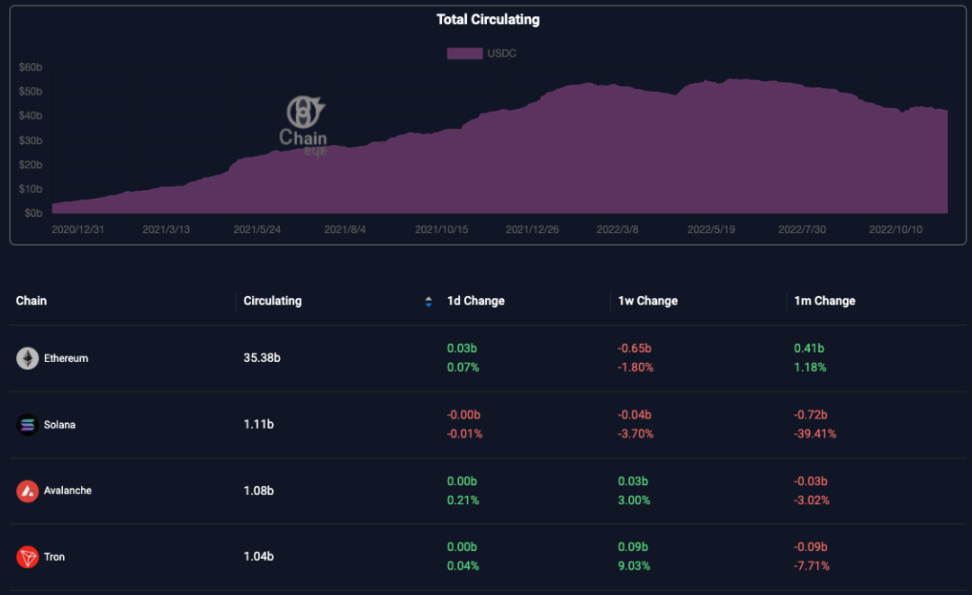
Distribution of USDC public chain, source: https://chaineye.tools/stablecoins/stats/USDC
Anchoring mechanism: The issuer reserves sufficient funds so that users can use USDT and USD for 1: 1 exchange at any time.
Audit and Compliance: USDC Reserves
Potential Risk Analysis
① Risk of insufficient collateral of the original issuer
USDC holders can view Circle’sAssets and liabilities and distribution of reserves, to judge its potential risk.
Circle will update the reserve and circulation information once a week. On December 10, 2022, Circle’s USDC reserve assets are worth approximately US$43.7 billion, exceeding the current circulation of US$42.36 billion. Its reserve funds only include cash and short-term US treasury bonds accounted for 22.12% and 77.88% respectively, and the risk is low.
image description
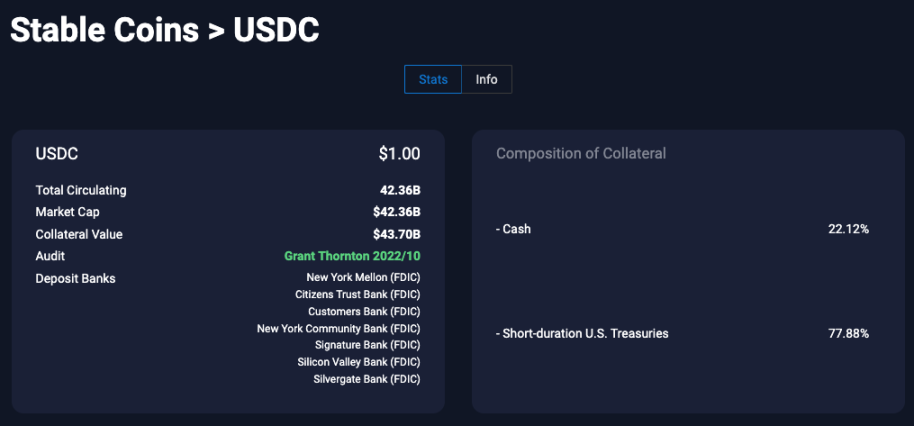
USDT reserve assets, source: https://chaineye.tools/stablecoins/stats/USDC
② Derivative issuer risk
Cross-chain bridge: Available atDefiLlamaQuery the specific information related to the cross-chain bridge.
Other derivative issuers: specific analysis of specific issues.
Introduction
Introduction
BUSD is a stablecoin jointly issued by Binance and Paxos (Paxos is also the stablecoin USDP issuing company), approved and regulated by the New York State Department of Financial Services (NYDFS). BUSD is currently the third largest stablecoin in terms of market value, with a total market value of about 22.07 billion US dollars.
Public chain distribution
BUSD circulates on 33 public chains such as Ethereum and BNB, and its share on Ethereum reaches 77.96%.
Native BUSD issued only on Ethereum
In order to expand the liquidity of BUSD to other chains, Binance fully mortgaged part of the native BUSD on Ethereum, and issued Binance-Peg BUSD on BNB, BSC, Avalanche and Polygon
image description

BUSD public chain distribution, source: https://chaineye.tools/stablecoins/stats/BUSD
anchoring mechanism
The issuer reserves sufficient funds so that users can use USDT and USD for 1: 1 exchange at any time.
Potential Risk Analysis
① Original issuer risk
BUSD holders can use ChaineyeCheckimage description
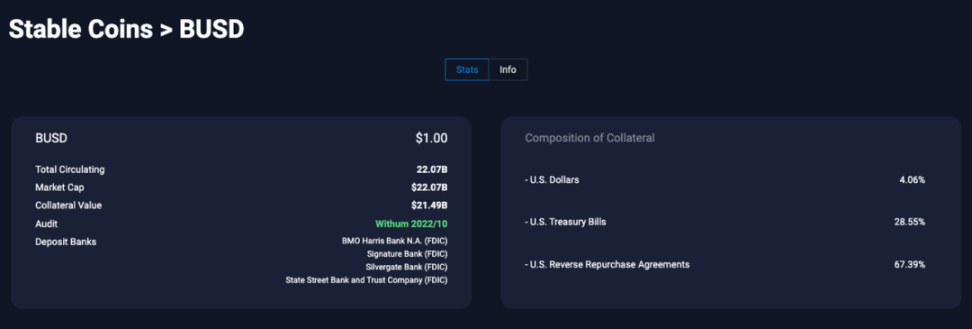
BUSD asset reserves, source: https://chaineye.tools/stablecoins/stats/BUSD
Paxos releases a reserve asset report at the end of each month, and there is a time lag between the last published collateral data and the latest circulation. At present, the total circulation of BUSD is 22.07 billion US dollars (2022.12.10), and the corresponding report has not yet been published.
The latest report was released on November 30, 2022. The market value of the net assets of the reserve is 22.65 billion US dollars, exceeding the 22.38 billion US dollars in circulation that day. Its reserves consist of cash, U.S. Treasury bills and U.S. Treasury-backed reverse repurchase agreements, which are less risky.
datadataimage description
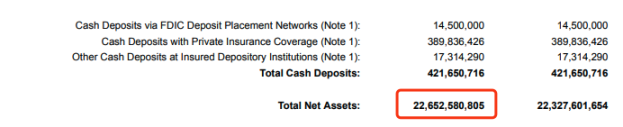
The latest announcement of BUSD reserve assets, source: Paxos official website
BUSD reserves are held by banks such as BMO Harris Bank. The audit report of Paxos is provided by the third-party audit firm WithumSmith+Brown, which ranks among the top 25 accounting firms in the world.
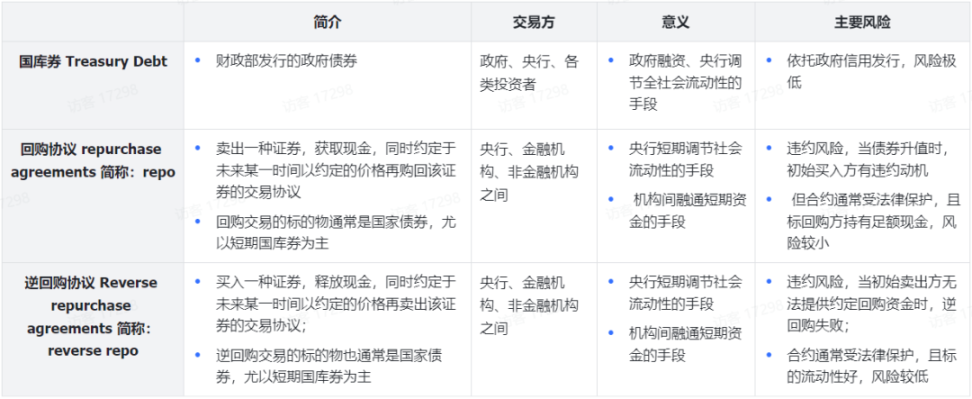
② Derivative issuer risk
Cross-chain bridge: Available atDefiLlamaQuery the specific information related to the cross-chain bridge
Centralized exchange: Binance fully mortgaged part of the native BUSD on Ethereum, and issued Binance-Peg BUSD on BNB, BSC, Avalanche and Polygon, which can be accessed through ChaineyeInquireimage description
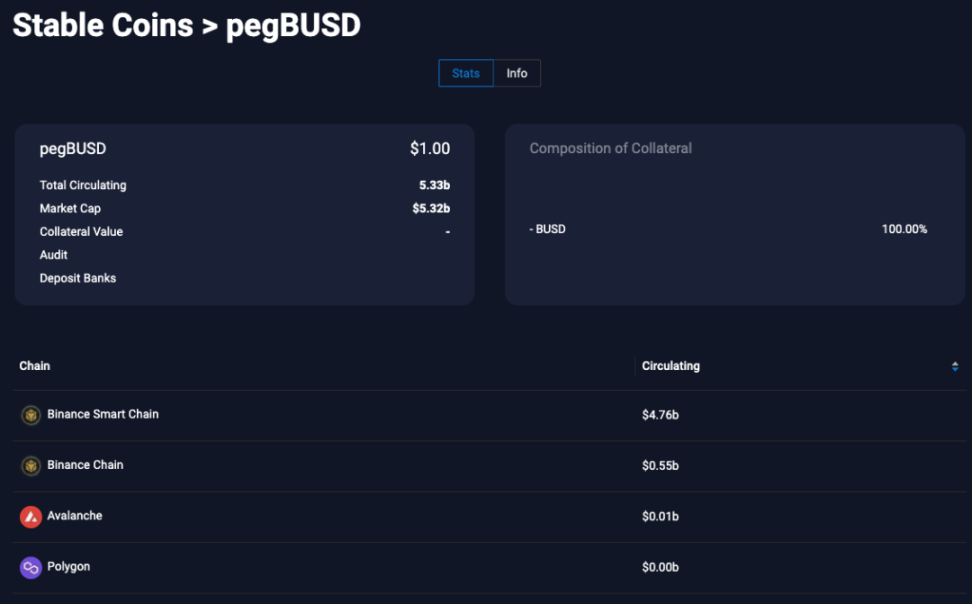
Binance-Peg BUSD reserves, source: https://chaineye.tools/stablecoins/stats/pegBUSD
Other derivative issuers: specific analysis of specific issues
Introduction
Introduction
DAI is a stable coin minted by the decentralized lending protocol Maker DAO. It currently ranks fourth in market value among all stable coins, with a total market value of about 5.42 billion US dollars.
Public chain distribution
DAI circulates on 40 public chains such as Ethereum, Polygon, and BSC, and its share on Ethereum reaches 88.33%.
MakerDAO is only deployed on Ethereum, so native DAI is on Ethereum
image description

DAI public chain distribution: Source: https://chaineye.tools/stablecoins/stats/DAI
distribution mechanism
DAI is minted by users through the Maker agreement to over-mortgage assets. The amount of DAI that can be minted cannot exceed a certain ratio of the value of mortgage assets, which is equivalent to lending cash to assets such as mortgaged properties in traditional financial services. Users can use DAI to redeem mortgage assets and destroy DAI at any time, and a stability fee is required for redemption
When the value of the user's mortgaged assets falls, resulting in a drop in the mortgage rate, liquidation will be triggered, and the user's mortgage will be forced to sell at a premium and a 13% penalty will be required. After the collateral is liquidated, the user no longer needs to repay the DAI
image description
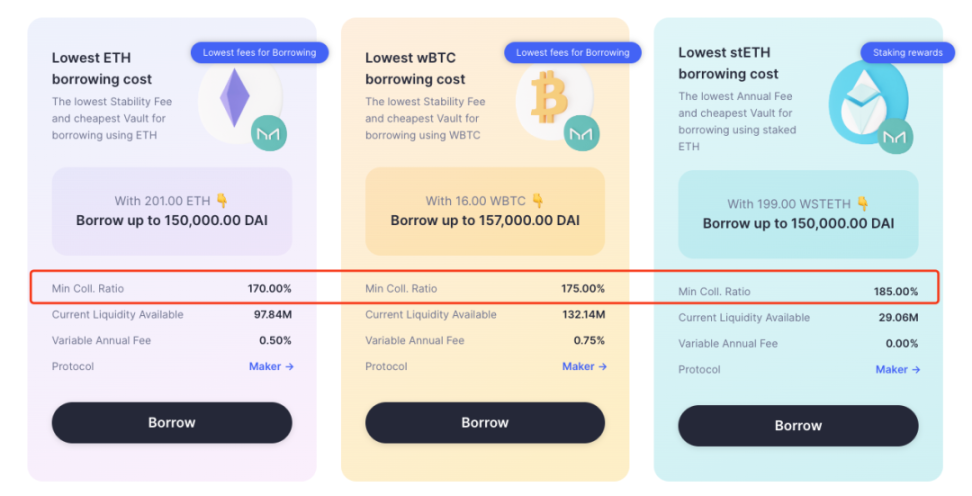
DAI supports mortgage assets, source: MakerDAO official website
stabilization mechanism
When the price of DAI is lower than 1 USD: The amount of DAI minted is determined according to the USD assets of the collateral, and when DAI is used to redeem the collateral from the Maker agreement, the value of DAI is recognized as 1 USD by the agreement, so users can choose Redeem collateral with a certain amount of DAI, and destroy DAI to reduce the supply of DAI.
When the price of DAI is higher than $1: users have an incentive to continue to mint more DAI and sell it for profit; at the same time, MakerDAO provides a DAI deposit mechanism, the community will increase DAI deposits, encourage holders to lock DAI, and reduce circulation quantity. The interest of DAI is paid by the MakerDAO stability fee income. If the stability fee income cannot cover the total expenditure of the DAI deposit interest rate, Maker will issue MKR to make up the difference.
A proposal to allow DAI to be decoupled from the U.S. dollar: On August 28, 2022, Rune Christensen, co-founder of MakerDAO, published the article "The Road to Compliance and the Road to Decentralization: Why Maker Has No Choice but to Prepare Free-Floating DAI", stating that With over 50% of DAI currently collateralized by USDC, regulatory crackdowns on cryptocurrencies can happen without prior notice, with no possibility of recovery even for legitimate, innocent users.
Therefore, Rune Christensen suggested gradually increasing DAI's decentralized asset mortgage share through a plan called "Endgame Plan" to improve the degree of resistance to censorship. Rune pointed out that this process may lead to the loss of 50% of users, but Maker will give priority to decentralization and allow some decoupling of DAI from the US dollar to maintain decentralization.
① Main content of "Endgame Project"
a. Split the complex MakerDAO governance into multiple MetaDAOs, responsible for specific governance responsibilities, and improve the degree of decentralization of governance: each MetaDAO can focus on its own tasks, realize multi-center governance, and allow MetaDAOs to execute in parallel, Speed up the governance process.
MetaDAO is independent of each other, has its own governance token and governance process, and needs to earn its own income.
b. Introduce more decentralized assets: reduce the stability fees of collateral assets such as ETH and wBTC, and reduce the need to mint DAI through USDC;
The introduction of ETHD allows users to mint ETHD through stETH and then mint DAI to increase the share of ETH in mortgage assets, thereby increasing the proportion of decentralized assets.
c. Three progressive collateral strategies to gradually realize decentralization: the three strategies are dove, eagle, and phoenix, which gradually develop forward with the timeline and gradually advance according to the threat of supervision.
Dove strategy: Increase mortgage assets as much as possible to maintain rapid asset growth; Eagle strategy: If DAI is attacked by authority, limit the risk exposure to real assets (RWA) that can be controlled by the authority to 25%, in order to seek performance growth balance between flexibility and
Phoenix strategy: If there is evidence that an authority attack is imminent or all collateral of RWA has been confiscated, it will transition to the Phoenix strategy that eliminates all RWA risk exposure, and only RWA that cannot be controlled by the authority can be used as collateral.
d. Will allow DAI to be de-pegged from the USD in the event of an authority attack: Rune assumes that in the initial stages of activating DAI's free float, as many as 50% of the protocol's users will leave within a short period of time.
At this stage, Maker allows DAI to float freely from the US dollar at 1:1, and gradually change its price according to the target interest rate. A positive target interest rate increases the demand for DAI and reduces the supply of DAI, while a negative target interest rate has the opposite effect. Effect.
The relative stability of DAI is achieved by adjusting the interest rate, and it does not need to be pegged to the US dollar 1:1. Rune also stated that DAI will remain pegged to the US dollar for at least 3 years, and this time will be extended if there is no direct threat.
If collateral decentralization can be increased to 75%, then the peg to the US dollar will be maintained indefinitely.
② "Endgame Project" progress
The "Endgame Plan" proposal was launched on October 10, 2022, and has been voted by the community. The roadmap of the Endgame Plan is divided into 4 main stages.
image description

image description
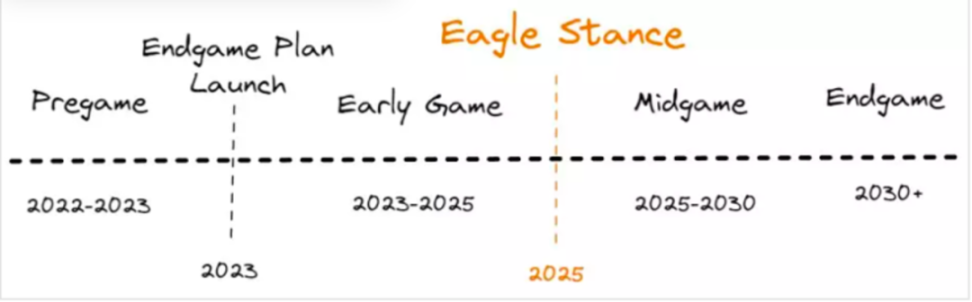
Endgame plan roadmap, source: https://www.defidaonews.com/article/6774636
Potential Risk Analysis
① Original issuer risk
There is a loophole in the MakerDAO protocol, which is exploited by attackers for malicious issuance. MakerDAO has been running stably for 5 years since the mainnet went live in 2017, and the code has undergone good verification. At the same time, MakerDAO has restricted the types of mortgage assets supported, and most of them are well-qualified tokens.
Liquidation risk: When the market encounters an extreme black swan event, resulting in a rapid decline in the price of collateral assets as a whole, or when USDC’s compliant assets are frozen for some reason, Maker will lose the value of collateral that is too late to be liquidated, resulting in a risk of de-anchoring .
② Derivative issuer risk
Cross-chain bridge: Available atDefiLlamaQuery the specific information related to the cross-chain bridge
Other derivative issuers: specific analysis of specific issues
Introduction
Introduction
Frax is a decentralized stablecoin protocol that uses a mixture of collateral and algorithms, and FRAX is the stablecoin it issues. FRAX currently has a market capitalization of approximately US$1.18 billion, making it the fifth-ranked stablecoin in terms of market capitalization.
Public chain distribution
image description

FRAX public chain distribution, source: https://chaineye.tools/stablecoins/stats/FRAX
Issuance and Redemption Mechanism
When the user injects 1 USD of collateral into the Frax system, Frax will mint 1 FRAX to the user, and the injected collateral is a combination of stable currency and FXS; at the same time, the user can also return 1 FRAX to the agreement to obtain 1 USD worth of Combination of FXS and U.
During the process of minting FRAX and redeeming FRAX, the FXS involved will be destroyed and minted, changing the supply of FXS in the market.
During the casting and redemption process, the mixing ratio of stablecoins and FXS (Frax’s governance token) is equal to the target mortgage rate of the Frax protocol (FRAX amount / stablecoin mortgage amount). For example, when the mortgage rate is 80%, the user mints A FRAX requires 0.8 U and 0.2 U worth of FXS. The target mortgage rate is adjusted every hour by the community holding FXS.
anchoring mechanism
When the price of FRAX is higher than $1, arbitrageurs can inject a value of $1 into the system to mint FRAX and sell it in the market for profit
When the price of FRAX is lower than 1 US dollar, arbitrageurs can buy FRAX at a low price in the open market and exchange the value of 1 US dollar in the system
When the market conditions are good and users have sufficient confidence in Frax, Frax tends to lower the target mortgage rate, so that the same stablecoin collateral can mint more FRAX to enter the market circulation, and the minimum mortgage rate is 0%
When the market conditions are poor and users' confidence in Frax declines, Frax tends to increase the target mortgage rate to prevent excessive issuance of FRAX, and at the same time increase the reserve of stablecoin collateral, with a maximum mortgage rate of 100%
image description
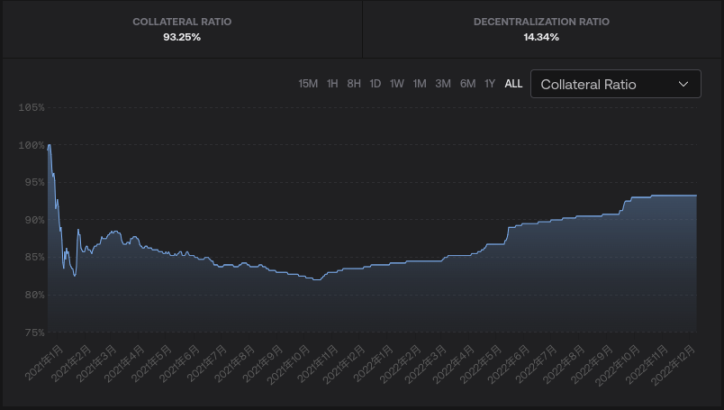
FRAX mortgage rate, source: https://app.frax.finance/
Potential Risk Analysis
① Original issuer risk
There is a vulnerability in the Frax protocol, which is exploited by attackers for malicious issuance. Frax will be launched at the end of 2020, and there are currently no protocol vulnerabilities.
② Mechanism risk
When the price of FRAX falls, it relies on arbitrageurs to buy FRAX and deposit it in Frax, mint FXS with the target mortgage rate and get back part of U to push the price of FRAX back to $1. If FXS is issued excessively, it will dampen market confidence and make the Frax community lose control.
Frax adopts U+FXS mixed mortgage, and can adjust the stability mechanism of the target mortgage rate, which can reduce the arbitrage space under extreme unilateral market conditions, and maintain the stability of FRAX price to a certain extent.
When FRAX is lower than $1, arbitrageurs will buy a large amount of low-priced FRAX, mint a combination of U and FXS worth $1, and sell them for a profit. The selling pressure of U will not cause the price of U to drop, but the selling pressure of FXS will cause the price of FXS to drop, triggering a chain reaction. Over-casting of FXS will cause the agreement governed by FXS to lose control, and let the price of FXS "return to zero".
The existence of U reduces the selling pressure caused by over-casting FXS, and at the same time supports the bottom price of FRAX: when the mortgage rate is x, arbitrageurs need x ratio of U and (1-x) ratio of FXS, the higher the mortgage rate x The larger the FXS ratio (1-x), the smaller the FXS selling pressure formed, thus slowing down the chain reaction. At the same time, the x ratio of U as the supporting asset of FRAX forms the bottom price of FRAX, so that FRAX always has the recognized value of xU and will not be "returned to zero" directly.
The minting and redemption of FRAX is not open all the time, which increases the cost of malicious attacks on Frax: only when FRAX is sold out in large quantities and causes breakage, arbitrageurs have the incentive to issue additional FXS.
When the market price of FRAX is in a stable range ($ 1.0033 ≥ FRAX ≥ $ 0.9933 ), the FRAX protocol will not open the casting and redemption of FRAX. Therefore, malicious attackers of Frax need to sell a large amount of FRAX before they can drop the price below 0.9933 to launch an arbitrage attack. Therefore, the design of the arbitrage interval greatly increases the attack cost.
At the same time, a slight de-anchoring will not immediately trigger a large number of additional issuance of FXS, which brings Frax a self-rescue window, allowing it enough time to adjust the mortgage rate or replenish mortgage assets. Based on the above, the mechanism of FRAX-FXS is more stable than the combination of UST-LUNA.
② Derivative issuer risk
Cross-chain bridge: Available atDefiLlamaQuery the specific information related to the cross-chain bridge
Other derivative issuers: specific analysis of specific issues
Introduction
Introduction
USDP is a collateralized stablecoin issued by Paxos Corporation, approved and regulated by the New York State Department of Financial Services (NYDFS). At present, its market value is about 768 million US dollars, making it the sixth stable currency in terms of market value.
Public chain distribution
image description

USDP public chain distribution, source: https://chaineye.tools/stablecoins/stats/USDP
anchoring mechanism
The issuer reserves sufficient funds so that users can use USDT and USD for 1: 1 exchange at any time.
Potential Risk Analysis
① Original issuer risk
USDP holders canChaineyeimage description

USDP reserve assets, source: https://chaineye.tools/stablecoins/stats/USDP
Paxos releases a reserve asset report at the end of each month, and there is a time lag between the last published collateral data and the latest circulation. At present, the total circulation of BUSD is 770 million US dollars (2022.12.11), and the corresponding report has not yet been published.
The latest report was released on November 30, 2022. The market value of the net assets of the reserve was 774.9 million US dollars, which was less than the USDP circulation of 790 million US dollars on that day, but its circulation on December 1 dropped to 767 million US dollars. There may be a time caliber problem .
datadatafor the most recent third-party audited report)
image description

The latest announcement of USDP reserve assets, source: Paxos official website
② Derivative issuer risk: risk of BSC Bridge
Introduction
Introduction
TUSD is a collateralized stablecoin issued by TrustToken, a company backed by Stanford Venture Fund. TUSD currently has a market value of about 756 million US dollars, making it the seventh-ranked stablecoin by market value.
Public chain distribution
TUSD is circulated on 10 public chains including Tron, Ethereum, and BSC, and its shares on Tron and Ethereum are 49.8% and 33.57% respectively
The native TUSD issued by TrustToken is distributed on the four chains of Ethereum, BSC, Tron and Avalanche
image description

TUSD public chain distribution: https://chaineye.tools/stablecoins/stats/TUSD
anchoring mechanism
The issuer reserves sufficient funds so that users can use USDT and USD for 1: 1 exchange at any time.
Potential Risk Analysis
① Original issuer risk
Users can check the reserve status of TUSD through Chaineye.
At present, the value of TUSD's reserve assets is 810 million US dollars, with a circulation of more than 756 million US dollars, and there are multiple bank accounts, but the specific asset allocation in the bank cannot be seen.
image description

TUSD reserve status, source: https://chaineye.tools/stablecoins/stats/TUSD
Derivative Issuer Risk
Cross-chain bridge: You can check the specific information related to the cross-chain bridge on DefiLlama: https://defillama.com/stablecoin/trueusd
Replenish
Replenish
Silvergate has appeared in the custodian banks of BUSD and TUSD. Silvergate is a US-based bank mainly serving cryptocurrency companies. Its customers include well-known cryptocurrency companies such as FTX, Coinbase, Circle, and Paxos.
FTX has about $1 billion in deposits in Silvergate. On the day when FTX filed for bankruptcy, Silvergate issued a statement stating that its bank did not have any risk in FTX. FTX's deposits in Silvergate accounted for less than 10% of the bank's total deposits, and the deposits will be returned to FTX's creditors through the FTX bankruptcy process .
Summarize
Summarize
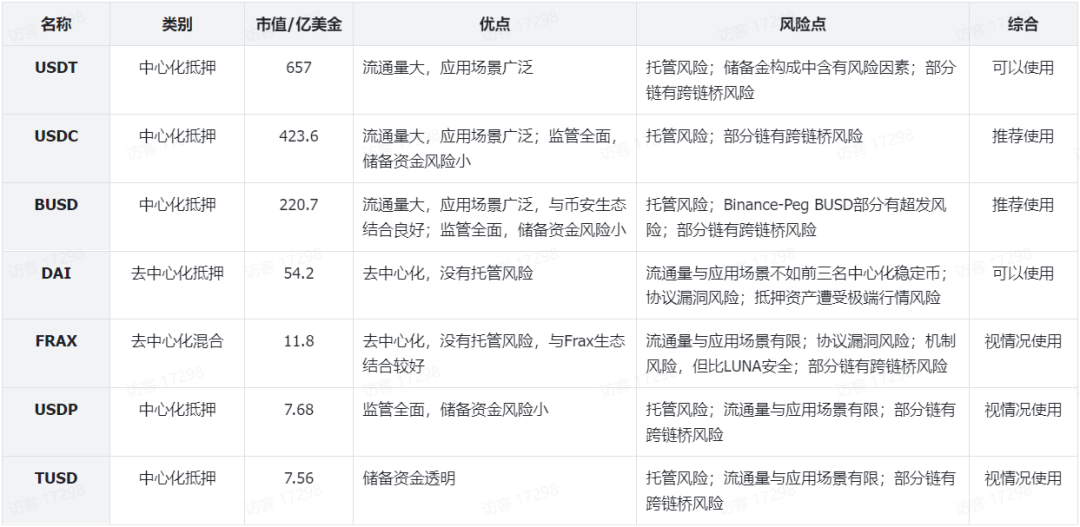
The use of stablecoins needs to consider two indicators: security and ease of use
Security: whether it can guarantee 1: 1 redemption with USD in any situation
Centralized stablecoins need to focus on the reputation of the original issuer, the mortgage rate and risk of reserve assets, and the credibility of third-party supervision and audit institutions to ensure that the issuer has sufficient capital reserves to deal with the run.
Decentralized stablecoins need to examine their casting and destruction mechanisms, whether there is an unlimited issuance mechanism and trigger conditions
reference article
reference article
[ 1 ] "From the USDT five-year audit report, what can we observe? 》https://www.theblockbeats.info/news/31738
[2] "Coinshares Research: Will Tether Bring Systemic Risk to the Cryptocurrency Market?" https://mytokencap.com/news/390380.html
[ 3 ] "MakerDAO's determination to "decentralize": DAI de-anchored from USD and eventually became a world currency" https://www.defidaonews.com/article/6774636
[ 4 ] "From currency agreement to DeFi matrix, multi-angle analysis of Frax.finance" https://mirror.xyz/mintventures.eth/555 rObptbsTSEYHMRBEDI 9 _mEBmrR 1 FHLWJ 1 vWGGosw
[5] "MakerDAO's Predicament and Choice: Loss, Supervision, MetaDAO" https://www.chaincatcher.com/article/2079679