The Ethereum Shanghai upgrade will start the withdrawal function, how will the verifier's ETH be unlocked?


The withdrawal time for ETH pledged on the beacon chain has finally been finalized. On December 8, at the All Core Developers conference, the core developers of Ethereum set the upgrade time of Ethereum Shanghai in March 2023, and confirmed the release of ETH withdrawals pledged by the beacon chain. So, after the redemption path is opened, can the verifier exit immediately? Will the liquidity pressure of staking ETH be released?
After the withdrawal starts, the validator's unlocking efficiency and amount will be limited
The Ethereum Shanghai upgrade will start the withdrawal function, how will the verifier's ETH be unlocked?
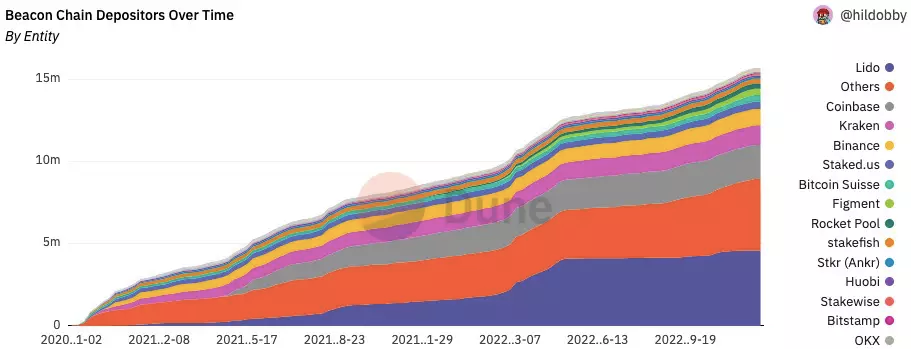
The Ethereum Shanghai upgrade will start the withdrawal function, how will the verifier's ETH be unlocked?
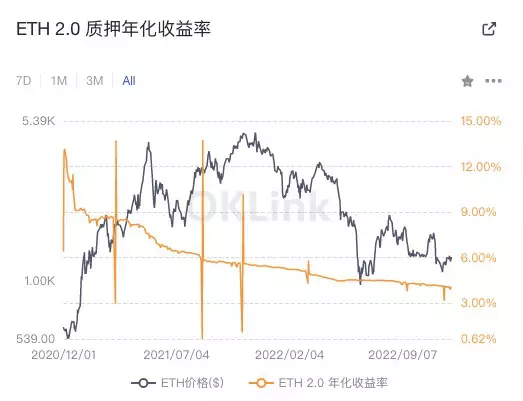
Unlike ordinary users who participate in staking through a third-party platform with flexible access, verifiers can only withdraw funds after upgrading and starting the staking withdrawal plan in Shanghai. According to the latest proposal from the community, validators can make partial withdrawals and full withdrawals, and for security reasons, the withdrawal amount and the withdrawal rate of validators will be limited.
The maximum withdrawal amount per Epoch is set to 512. According to the number of existing verifiers, they can withdraw rewards once in 4 days (the total number of verifiers/(512* 225). According to the current verifiers, nearly 33.9 ETH Based on the average balance of ETH, the average selling pressure that the Ethereum market may face every day is 230,000 ETH, and the accumulated amount in 4 days is 921,000.
Among them, the withdrawal rate in all withdrawals will be limited. The withdrawal mechanism introduces a "Churn Limit Quotient". The ETH withdrawal limit is X/ETH per day, where X is the total number of verifiers/65536. Currently Each Epoch can only activate 7 validators and is allowed to exit, that is, 1575 validators per day (225 Epoch). If each verifier holds 32 ETH, the daily outflow of ETH exceeds 50,000 pieces. Of course, the withdrawal rate will also be adjusted according to the total amount of pledged ETH to prevent large outflows of funds and attackers to carry out slashing attacks. Partial withdrawals do not have a specific limit on the number of withdrawals.
It should be noted that the effective staking balance of the validator must be above 32 ETH. If it is lower than this amount, you will not be able to get all the staking rewards, or you will be expelled from the ranks of the validator if the balance is lower than 16 ETH. Currently, the validator’s undecided withdrawal plan is divided into partial and full withdrawal of the pledge, of which partial withdrawal allows the verifier to withdraw more than 32 ETH, and full withdrawal allows the withdrawal of all pledges before exiting the pledge ranks.
However, the developer Potuz recently proposed a new solution that can cancel the processing of the withdrawal queue, that is, cancel the logic of all and part of the withdrawal queue in the block. It is recommended to use the validator index to solve this problem. The reason is that each validator on Ethereum will be assigned a number when activated on the beacon chain. Without using the above-mentioned queuing exit, the beacon chain can handle the withdrawal limit according to a block. Number to scan the verifiers, and then process each verifier's withdrawal request in ascending order of the verifier's index number. Currently, developers are working on this solution.
Difficult to change the plight of insufficient liquidity, or face regulatory risks
In terms of Ethereum staking, in addition to Lido’s stETH, there are many platforms that can issue liquid staking derivatives to pledgers, such as Coinbase’s cbETH, Kraken’s ETH 2.S, Binance’s BETH and other pledged derivatives.
The Ethereum Shanghai upgrade will start the withdrawal function, how will the verifier's ETH be unlocked?
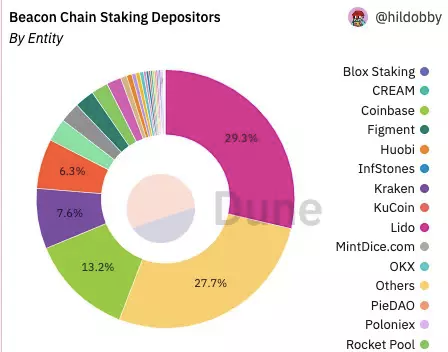
The discount ratio between Ethereum pledged derivatives and ETH represents the demand for liquidity of holders and the demand for purchasing pledged ETH derivatives at a discount. However, from the current point of view, most derivatives have negative premiums to varying degrees due to insufficient liquidity. For example, the faucet stETH/ETH is 0.98, cbETH/ETH is 0.97, etc.
Although these pledged derivatives no longer need to cause liquidity discounts due to the lack of redemption paths after ETH opens withdrawals, the current lack of liquidity is an indisputable fact, and the withdrawal restrictions will not greatly improve this dilemma. Insufficient liquidity of pledged derivatives has become an urgent problem to be solved in Ethereum. However, with the launch of the cash withdrawal function, investors’ arbitrage needs may increase liquidity. For example, when stETH is traded at 0.9 ETH, investors can buy it with 0.9 ETH Redeem 1 ETH after 1 stETH, and get a profit of 0.1 ETH in the process, especially for institutions or whale investors, this is a way to get quite good returns.
In fact, many traditional institutions have considered participating in the economic incentives of Ethereum staking. For example, Sandy Kaul, senior vice president of Franklin Templeton, the world's largest listed fund management company with an asset management scale of about 1.5 trillion U.S. dollars, said , Ethereum staking provides a huge opportunity for institutions concerned about the encryption market, and believes that it will fully meet the needs of institutional investors; the Swiss encryption bank SEBA Bank also announced in September this year that it will launch an Ethereum staking service for its institutional customers. Allow users to obtain ETH pledge rewards on a monthly basis, and different lock-up periods can be set after the merger.
In addition, regulatory risks cannot be ignored. U.S. Securities and Exchange Commission (SEC) Chairman Gary Gensler said after the ethereum merger was completed that cryptocurrencies and intermediaries that allow holders to "stake" their tokens may need to pass the Howey test to determine whether their assets are securities. PoS cryptocurrencies may be subject to federal securities regulations.
According to the latest blockchain report released by CV VC Labs recently, the United States has 45.3% of Ethereum nodes, ranking first in the world. Coinbase CEO Brian Armstrong once revealed that if the supervision is strengthened, we will stop the Ethereum pledge service.
Once the supervision comes, will the main force of pledge in the United States be withdrawn collectively? V God, the founder of Ethereum, once pointed out that if the validator nodes of certain protocols (such as Lido, Coinbase, etc.) are supervised to conduct protocol-level review of Ethereum, how will the Ethereum community react? This censorship was seen as an attack on Ethereum, and a wider consensus was chosen to have these nodes burned.