UBS: Nearly $11 billion in assets managed by GBTC may pose a potential risk in a bear market


This article comes fromThe Blocksecondary title
Odaily translator | Nian Yin Si Tang

Summary:
Summary:
- Greyscale’s GBTC and ETHE have increasingly negative premiums relative to NAV.
- UBS said problems at the sister firms of the two asset managers posed a potential threat.
Grayscale’s GBTC (Bitcoin Trust) size could pose a potential problem for the entire market, according to a report from UBS.
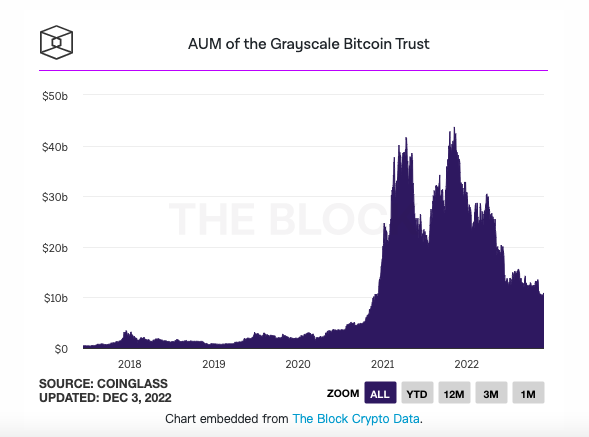
The bank’s analysis comes amid questions about the health of Grayscale’s parent company, Digital Currency Group (DCG). Following the FTX debacle, DCG-owned Genesis Global Capital said it held $175 million in exposure to FTX. Genesis has reportedly been seeking to raise $1 billion, or it could file for Chapter 11 bankruptcy. also havereported thatreported that
, DCG will sell cryptocurrency news site CoinDesk, the New York Times said, DCG hired Moelis & Company to explore various options.
One possible option mentioned by UBS is for DCG to leverage its investment in GBTC.
“These shares are currently worth $600 million, which is 12 times the trust’s three-month average daily trading volume,” he said.
secondary title
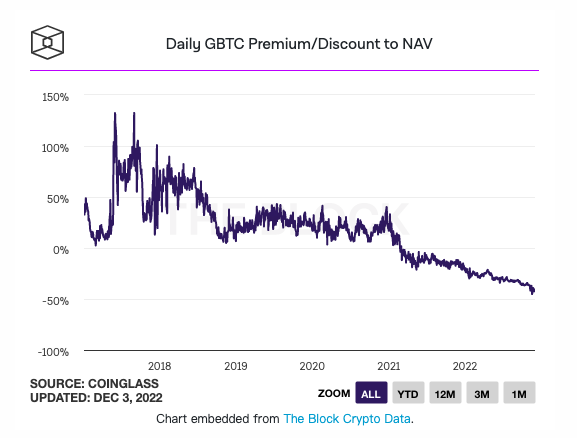
Negative premium continues to expand
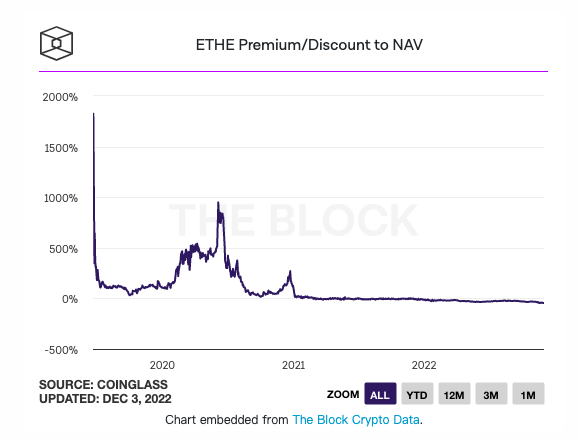
Shares of Grayscale’s Bitcoin and Ethereum products do not give holders direct access to the underlying assets. Hence, there is a gap between the trading price of these products and the net asset value (NAV). This is known as the premium or the difference between the value of the underlying asset and the market price. In 2021, the premium on these products turns into a discount.
This was more recently when crypto prime broker Genesis — Grayscale’s sister firm under the DCG umbrella — admitted to holding a $175 million exposure to the now-bankrupt FTX and suspended withdrawals from its high-yield deposit platform. A negative base was further expanded. The company has also warned it faces bankruptcy unless it secures $1 billion in new funding. "
The NAV discount of ETHE, another structured product of Grayscale, reached an all-time low of -45.66%.
secondary title
The scale of grayscale cannot be underestimated
In a bear market, the size of Grayscale could be extremely problematic, Kachkovski said.
Any sale would further widen the GBTC discount, but not necessarily affect the price of Bitcoin. However, if GBTC itself were liquidated, it could affect Bitcoin - as the fund's rules state that investors must pay in cash.
This is because DCG netted $210 million from GBTC’s management fees. Crucially, the fee is levied independently of performance or NAV discounts. The fund’s other products, including ETHE, bring in another $100 million annually.
secondary title
“There is no need to panic right now”
UBS also noted that the language in the SEC filing does not suggest that a shareholder vote could force the trust to dissolve. “Otherwise, Grayscale can continue to operate the fund as long as it remains liquid and solvent.”
The investment bank’s final point against liquidation is that, while profitable, realizing the discount by receiving the underlying bitcoin would bring in a gain of around $440 million at best.
That equates to a little over two years of recurring annual income from the trust’s management fees, and also assumes all bitcoins are sold at current prices, around $17,000, which Kachkovski said seems unlikely.