


Explain in detail the innovations of the Curve stablecoin crvUSD: LLAMMA, PegKeeper, monetary policy


The decentralized stablecoin track market is vast, but most of them are "not halfway started, but collapsed in the middle." LUNA and UST, which used to have a market value of tens of billions of dollars, also returned to zero in a short period of time. Now, Curve, with a TVL of $3.7 billion, is starting to join the fray.
Recently, Curve released the white paper and code of the stable currency. According to GitHub, the white paper was completed in October and is not the final version. Although the name of the Curve stablecoin is not specified in the white paper, judging from the code, the full name of the stablecoin is "Curve.Fi USD Stablecoin", abbreviated as "crvUSD". The inflation of CRV has been criticized. Through the stability fee of the stable currency and the income of PegKeeper, the problem of insufficient income of Curve can be improved.
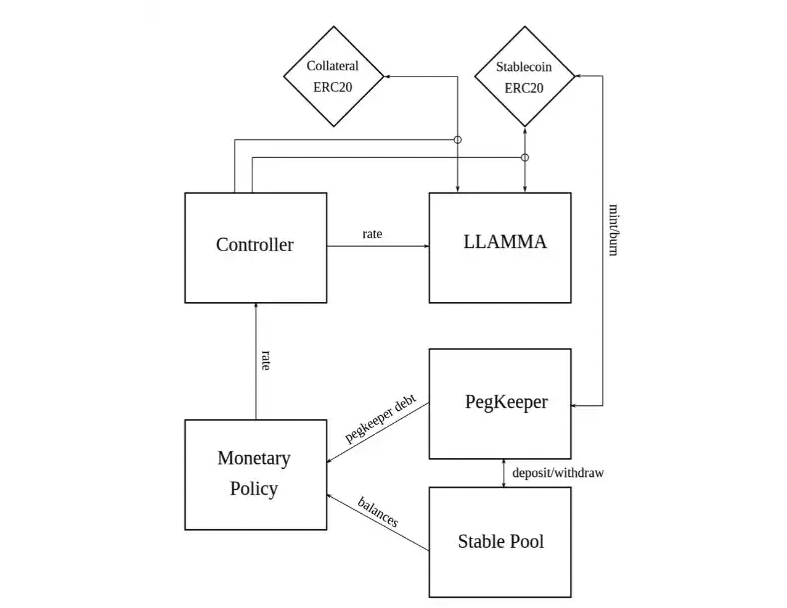
This white paper mainly introduces several innovations of crvUSD: loan-liquidation automatic market maker algorithm (LLAMMA), PegKeeper and monetary policy.
Smoother liquidation algorithm LLAMMA
In the previous CRV long-short battle, the giant whale mortgaged USDC and borrowed CRV from Aave to short. When the value of the CRV debt appreciates to 89% of the USDC collateral, the loan begins to be liquidated. Although the parameter design of each lending agreement is different, the overall idea is not very different. After reserving a certain liquidation penalty ratio (incentivizing the participation of liquidators) and market fluctuation space, increase the utilization rate of funds as much as possible . When there is insufficient liquidity in the market, bad debts will be created like this time Aave.
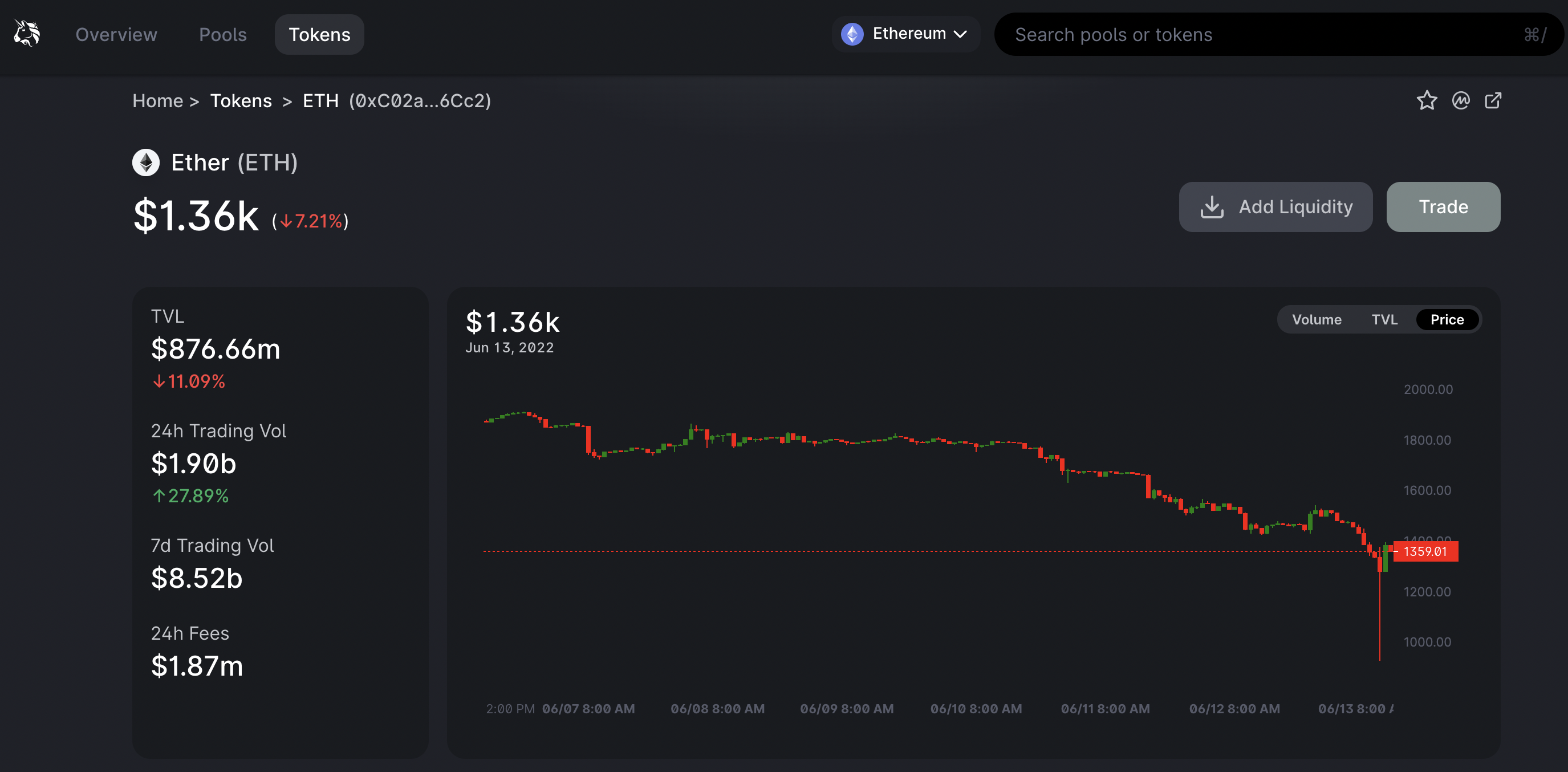
Short-term concentrated huge liquidations will also have a dramatic impact on the market. As shown in the figure below, during the market decline in June, a liquidation/stop loss operation in MakerDAO directly caused the market price of ETH on Uniswap to drop from 1300 The dollar fell below $1,000.
In order to reduce the impact of the liquidation process, crvUSD adopts this smoother liquidation algorithm LLAMMA, which is also the main innovation of crvUSD.
First, crvUSD is still issued over-collateralized, but uses a special-purpose AMM to replace the traditional lending and liquidation process. When the liquidation threshold is reached, the liquidation does not happen all at once, but an ongoing liquidation/de-liquidation process.
For example, borrow crvUSD with ETH as collateral. When the value of ETH is high enough, the collateral will not change, just like traditional mortgage lending. When the price of ETH fell and entered the liquidation range, ETH began to be gradually sold as it fell. After falling below the range, all of them are stable coins, and there will be no change if they continue to fall, which is also the same as other lending agreements. However, in the middle liquidation range, if ETH rises, Curve will use stablecoins to help users buy ETH again. If it fluctuates in the middle liquidation range, then the process of liquidation and de-liquidation will be repeated continuously, and ETH will be sold and bought continuously.
This process is similar to impermanent loss hedging after providing liquidity in AMM, such as providing ETH/USDC liquidity on Uniswap. When ETH rises, ETH is passively sold. To prevent drastic changes in currency-based funds during the process of providing liquidity, you can only buy ETH in the market; similarly, when ETH falls, sell ETH for hedging.
Compared with loan agreements with one-time liquidation such as MakerDAO, if the market rebounds after liquidation, in MakerDAO, users only have a little residual value after liquidation, while in Curve they will re-buy ETH during the rising process.
In the test conducted by the Curve team, when the market price fell 10% below the liquidation threshold and then rose again, within a 3-day time window, the loss of user collateral was only 1%.
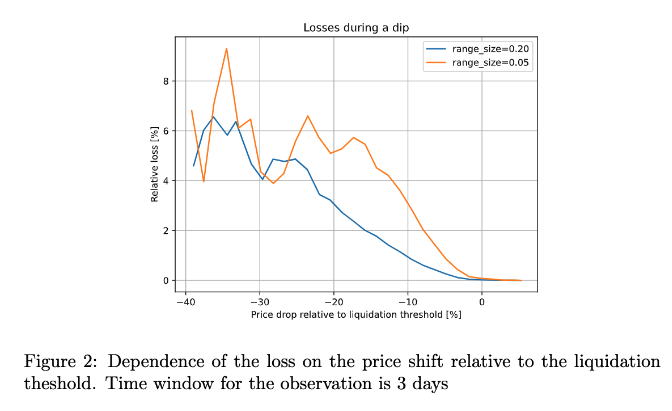
Although this algorithm can indeed reduce the loss of users who are liquidated in extreme market conditions, and even control the loss to a very low range after the price rebounds. But it's not entirely without its downsides, and it might be easier to get into liquidation. For example, mortgage ETH on Aave and Curve to borrow stablecoins under the same conditions. When the price fluctuation is small, the position on Aave may not be liquidated, but the position on Curve may be liquidated and de-liquidated, and users have a small loss .
Automatic Stabilizers and Monetary Policy
With sufficient collateral, the price of crvUSD can be anchored at $1. But the price in the secondary market is fluctuating, and the price of crvUSD will fluctuate slightly around $1.
When the price of crvUSD is above the anchor price (ps>1) due to increased demand, that is, when it is higher than $1, PegKeeper can mint crvUSD without collateral and deposit it in the stable currency exchange pool on one side, making the crvUSD price drop. Even if there is no collateral in the minting process, the liquidity in the liquidity pool can provide implicit collateral support.
When the price of crvUSD falls below $1, PegKeeper can withdraw part of the liquidity of crvUSD to bring the price back to $1.
In this process, PegKeeper is equivalent to selling crvUSD when it is higher than $1, and buying crvUSD when it is lower than $1, which will be profitable and maintain the price stability of crvUSD.
A similar anchoring mechanism is also adopted in Frax’s AMO, which can avoid the impact of the centralized stablecoin of MakerDAO’s PSM mechanism.
Thinking and Summary
Thinking and Summary
While the example of collateral in the white paper is ETH, what is more important on Curve is the assets in the stablecoin pool. If LP tokens from pools such as 3 pool can be used as collateral, the utilization rate of funds can be improved.
The Curve team itself controls a large number of veCRV as voting rights, which can guide the liquidity between crvUSD and 3 pool and other pools, and facilitate the cold start of crvUSD, which is an advantage that other stablecoin projects do not have.
Curve has no plans to issue a new governance token for the stablecoin. Currently Curve is a DEX, and the transaction fee for the main trading pairs is only 0.05% or 0.01%, with limited income. The introduction of stability fees and PegKeeper may improve Curve's revenue situation.
Most lending agreements use Chainlink’s oracle machine, and Curve uses the price oracle machine in its own DEX, so it is possible that only assets already on Curve can be used as collateral, which also saves the cost of the oracle machine. The ETH in the white paper example is already included in the tricrypto pool.
Since Curve lends on a transaction basis, if the upper limit and liquidation threshold that each token can be borrowed and the liquidation threshold are controlled according to liquidity, then in theory, bad debts that are not liquidated in time can be completely eliminated.





