ETH Weekly Report | 8 EIPs are included in the upgrade of Ethereum Shanghai; the IP addresses and ETH addresses of MetaMask trading users will be collected (11.21-11.27)


Author | Qin Xiaofeng
Editor | Hao Fangzhou
Produced | Odaily
1. Overall overview
Author | Qin Xiaofeng
Editor | Hao Fangzhou
Produced | Odaily
However, there is no consensus on the upgrade time of the Shanghai hard fork. Some developers hope to speed up the Shanghai upgrade process sometime in March 2023 and include only the ETH withdrawal EIP along with some other smaller EIPs, then the subsequent fork will include another important upgrade EIP-4844; while others The developers hope that the Shanghai hard fork will be a larger and more comprehensive upgrade, including two major upgrades at a later time.
Second, the secondary market
1. Spot market
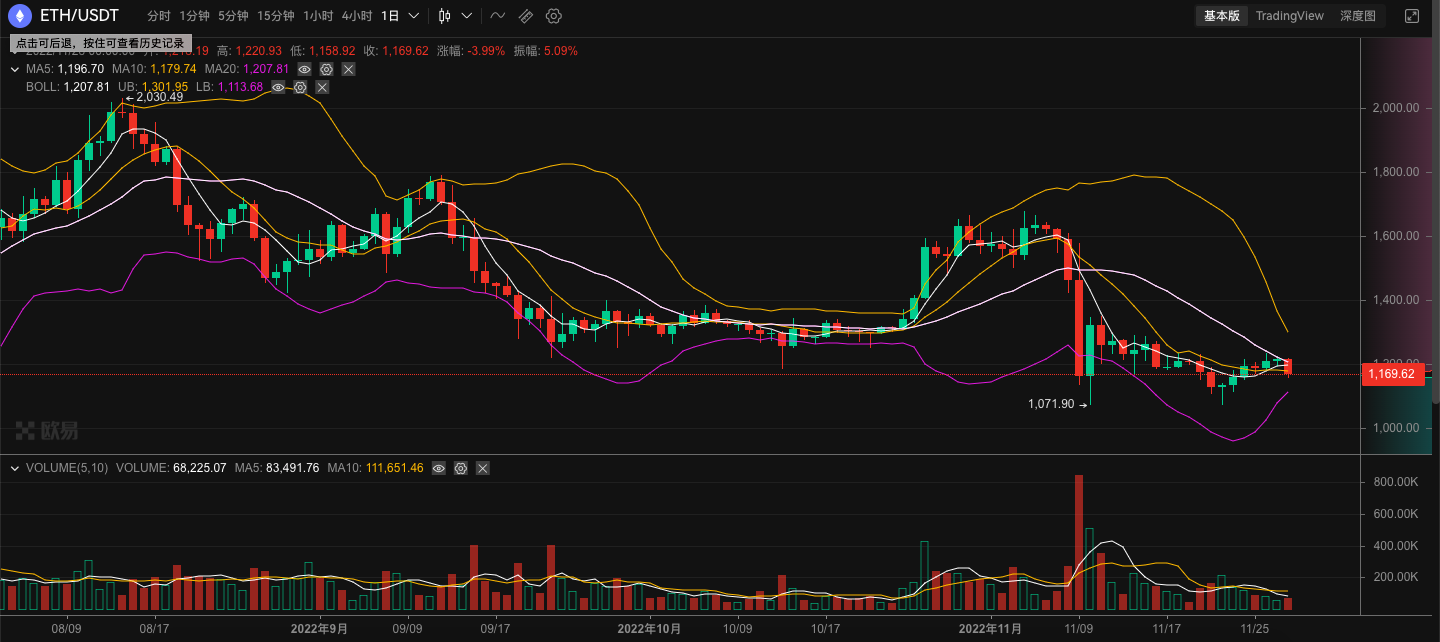
In terms of the secondary market, the current ETH price may continue to consolidate in the short term, with a support level of $1,100 and a resistance level of $1,200.
Second, the secondary market
According to OKX market data, the price of ETH fell to $1,073 last week, and closed at $1,217 during the week, a month-on-month increase of 3.3%.
2. Network operation
etherchain.org(ETH daily chart, picture from OKX)
3. Large transaction
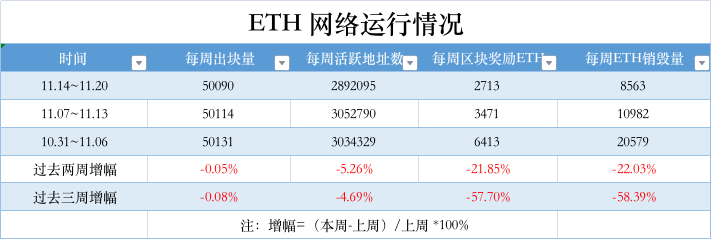
The daily chart shows that the price is currently consolidating between US$1,100 and US$1,200, and may continue to test upwards at US$1,200 in the short term. The upper resistance level is US$1,200, which is the intersection point of the middle rail of the Bollinger Band and the five-day moving average; the lower support level It's $1113.The data shows that in the past week, the Ethereum network produced 50,090 blocks, which was basically the same as last week; the number of active addresses per week was 2,892,095, a decrease of 5.2% from the previous week; the block reward income was 2,713 ETH, a decrease of 22% from the previous week; The weekly ETH burning volume reached 8,593, down 22% from the previous month.
4. Rich list address
3. Large transaction4. Rich list address
3. Ecology and technology
1. Technological progress
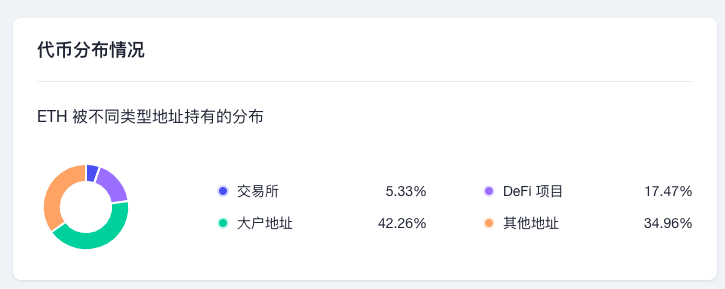
It shows that the total amount of pledged ETH in the entire network is currently 15,391,624 ETH, and the pledge rate is 12.87%, an increase of 230,016 compared to last week; from the perspective of the distribution of holding addresses, exchanges accounted for 5.33%, a month-on-month decrease of 4.27%; DeFi projects accounted for 17.47% %, down 0.31% month-on-month; large addresses (top 1000 addresses and excluding exchanges and DeFi projects) accounted for 42.26%, up 3.99% month-on-month; other addresses accounted for 34.96%, up 0.6% month-on-month.
3. Ecology and technology
1. Technological progress
(1) The Ethereum Shanghai upgrade will open pledged ETH withdrawals, but the upgrade time may be later than the previous roadmap
Earlier rumors claimed that the Ethereum Foundation will delay the timetable for withdrawing pledged ETH from the beacon chain. But Ethereum core developers generally believe that opening up pledged ETH withdrawals has always been part of the "Shanghai upgrade" goal. But no exact date has been set for the withdrawal.
Tim Beiko, lead protocol support at the Ethereum Foundation, said the original forecast was "6 to 12 months is the 'historical average' time between Ethereum upgrades. I don't understand why this upgrade is taking longer time, but we are not yet in the process enough to talk about the mainnet deployment date. Also, there is no change in the status of withdrawals, they are included in the next network upgrade.”
Parithosh Jayanthi, a DevOps engineer at the Ethereum Foundation, stated that they are committed to making withdrawals a priority for the Shanghai upgrade, and it has been and will always be included in that upgrade. (CoinDesk)
(2) 8 EIPs are included in the consideration of Ethereum Shanghai upgrade, including EIP-4844
2. Project trends
2. Project trends
https://twitter.com/ (1) MakerDAO now supports rETH as collateral assets
MakerDAO has newly added support for rETH (derivative tokens generated by staking Ethereum through Rocket Pool) as a mortgage asset. Users can now use the new rETH-A vault to mortgage rETH to generate DAI. In addition, the parameters of the rETH-A vault are set as follows: a minimum mortgage rate of 170%, a stability fee of 1.5%, and a debt ceiling of 5 million DAI.
(2) Celo has reached a cooperation with ConsenSys to integrate Infura infrastructure
Celo has reached a cooperation with ConsenSys, an Ethereum infrastructure development company, and will integrate the infrastructure of Infura, a blockchain development platform owned by ConsenSys. Celo developers will be able to build with Infura, which will help make their blockchain more scalable. Developers will also be able to deploy Ethereum-based DApps built using Truffle. In addition, this cooperation will also allow MetaMask, a browser wallet owned by ConsenSys, to improve compatibility with Celo. (CoinDesk)
According to the official announcement, the v0.1 beta version of the Chainlink pledge agreement is scheduled to go live on the Ethereum mainnet at 01:00 on December 7th, Beijing time. Addresses that meet the conditions for early access will be able to pledge up to 7,000 LINK in the v0.1 pledge pool. In addition, the v 0.1 pledge pool will be open to all ordinary users at 01:00 on December 9th, Beijing time. The pledge limit for each address is 7,000 LINK, and the total pledge pool cap is 25 million LINK.
According to official news, the Ethereum side chain Ronin Network launched the developer test network Saigon, which allows developers to deploy contracts on the test network. Ronin Network will also test the DPoS consensus mechanism on this testnet. In addition, Ronin Network announced that it has open-sourced the smart contracts of Ronin Protocol, Ronin Bridge, and DPoS.
(5) Vendor Finance, a fixed-rate lending agreement, has supported rETH as collateral
Vendor Finance, a fixed-rate lending agreement, announced that it has supported the Ethereum pledge certificate rETH issued by Rocket Pool as collateral and loan tokens. Users can use rETH to set their own parameters and create a permissionless lending market.
(6) The Ethereum client Erigon will no longer support the Rust version of Akula
(7) zCloak and Scroll will cooperate to develop a trusted DID system based on Ethereum L 2
(8) Gnosis core developers: Gnosis pledge service providers must update the node client before November 30
3. Borrowing
DeFiLlama (9) Paradigm is building the Rust-based Ethereum execution layer Reth
4. News
3. Borrowing
4. News
(1) Since the beginning of this year, the daily transfer value of USDC on the Ethereum chain has been higher than that of USDT