Crypto Political Donations Slow Down Significantly Ahead of U.S. Midterm Elections Affected by Bear Market


This article comes fromBloombergBloomberg
Odaily Translator | Nian Yin Si Tang

, Original Author: Allyson Versprille & Bill Allison
Odaily Translator | Nian Yin Si Tang
In the run-up to the Nov. 8 midterm elections, industry executives have noticeably slowed down their political donations as the cryptocurrency market continues to slump.
The industry emerges as a big player in political giving in 2022, outpacing donor groups such as drugmakers and defense contractors for much of the current two-year election cycle. There has been a surge in the number of political action committees (PACs) backed by digital asset firms and executives, including the GMI PAC. GMI PAC is a super political action committee whose key backers include FTX Trading Ltd. CEO Sam Bankman-Fried (SBF), stablecoin issuer Circle Internet Financial, and venture capitalists Marc Andreessen and Ben Horowitz.
Recent campaign finance filings filed with the U.S. Federal Election Commission show that spending has topped $80 million since January 2021, but political donations from the crypto industry have grown significantly as candidates enter the final stretch of their midterm election campaigns. slow down.
There may be more than one reason behind the decline in political giving, which could include donors' tendency to focus on primaries rather than the general election as a way to divert sentiment within the party towards the industry. But Kristin Smith, executive director of the Blockchain Association, said that this may be mainly affected by the general decline in the encryption market and token prices this year. The Blockchain Association recently formed its own cryptocurrency-focused PAC.
“Those who work in crypto usually have a lot of money invested in crypto, and if they work for a company, usually part of their compensation is in crypto. So when the price of crypto goes down, people have less money at their disposal .”
secondary title
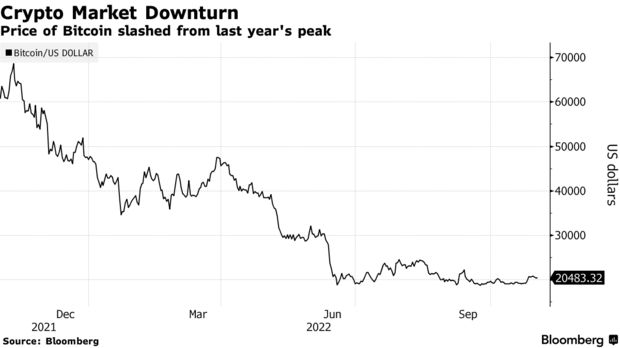
Crypto Bear Market Dilemma
The prices of bitcoin and ethereum, the two largest cryptocurrencies, have plunged more than 50% since the start of the year. The market was hit as the Federal Reserve raised interest rates to curb inflation and as investors moved away from riskier assets. The industry was also hit hard after the collapse of algorithmic stablecoin TerraUSD in May, which triggered a series of bankruptcies of cryptocurrency companies and accelerated the decline in token prices.
Specifically, 13 of the 15 Republican candidates received donations to the American Dream Federal Action in the primaries. It's a super PAC funded by FTX exec Ryan Salame. Donors include U.S. Senator John Boozman, a lead co-sponsor of legislation that would give the U.S. Commodity Futures Trading Commission (CFTC) greater powers to regulate digital assets. It should be noted that the US CFTC is the favored regulator of the cryptocurrency industry.
Additionally, two super PACs primarily funded by the GMI PAC - Web3 Forward and Crypto Innovation PAC - also supported several of the campaign winners. Web3 Forward, which only targets Democratic donations, saw nine of the 11 candidates it backed make it to the Nov. 8 election. Five of the seven candidates funded by Crypto Innovation, which supports the Republican Party, made it to the general election.
Crypto Donations Slow Down Months Ahead of US Election
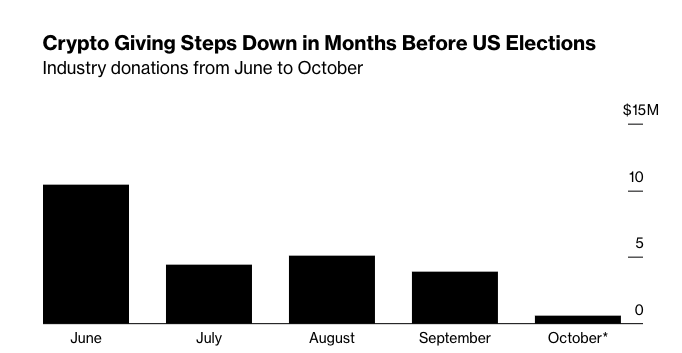
image description
Source: FEC documents compiled by Bloomberg (note: includes data as of Oct. 19)
text
While these PACs donated to U.S. lawmakers such as Boozman and Rep. Patrick McHenry, R-N.C., who is working on legislation regulating stablecoins, they have also donated money to non-incumbents.
On the Democratic side, the industry backed business professor Jonathan Jackson, son of civil rights activist Jesse Jackson, and state representative Jasmine Crockett, a civil rights lawyer, for a seat in the US House of Representatives. As for Republicans, donations have gone to former NC State football player Bo Hines and former Kansas City TV host Mark Alford to help them run for the U.S. Congress.
“Incumbents are setting policy and are likely to be re-elected because they have a 90 to 95 percent chance of winning when they run for re-election,” he added. “These donations are really about paving the way for lobbying.”to reportFurthermore, according to the Wall Street Journal
to report
, OpenSecrets data shows that encryption companies and their employees have invested $73 million in the 2022 midterm elections in the United States, more than the combined contributions of the defense and auto industries for this election, much higher than the $13 million in the same period in 2020. As of the end of September this year, encryption companies have spent $15 million on political lobbying, more than the sum of the past eight years.
Among them, FTX Trading Ltd. has become the third largest donor in this campaign, after George Soros's company (the largest donor to the Democratic Party) and cardboard box maker Uline.