The era of Ethereum staking is coming, what are the opportunities for developers?


It has been several months since the merger and upgrade of the Ethereum execution layer and the consensus layer, and the new consensus mechanism PoS has also replaced the old PoW mechanism for several months. According to new statistics from beaconcha.in, there are currently more than 440,000 verifiers and more than 14.14 million Ether (ETH) verifiers’ rights and interests on Ethereum, and the latest data on the annual rate of return of verifiers in pledge is 4.58%.
In fact, Ethereum launched a PoS blockchain on December 1, 2020, which is now the merged consensus layer beacon chain. It has been running for nearly two years before The Merge upgrade, which is why The reason why the PoS node ecology on Ethereum has begun to take shape.
Now that the PoS ecology and Staking Economy are becoming mainstream, I believe you are not unfamiliar with PoS staking. Under PoS staking, both institutions and individuals can carry out staking, which is an important way to participate in network construction. Also after the node on December 1, 2020, many DeFi developers have heard the news, especially the pledge products and related derivatives in other PoS ecosystems. They have already launched the first services and products related to Ethereum pledge. Everyone is waiting for the Ethereum The milestones of the upgrade of the workshop have been achieved one by one, and for this purpose, they are ready to enter the market.
first level title
Overview of Ethereum Staking Design
Although the PoS mechanism is similar, the PoS (Proof of Stake) mechanism of Ethereum also has its own unique design:
1. Threshold: Each node needs to pledge at least 32 ETH.
2. Punishment: Punishment includes slow work penalty and confiscation penalty. The former mainly reduces the verification reward when the verifier is offline or downtime.
The slashing is mainly a penalty for malicious behavior, for the act of storing the signature key on two different machines at the same time and causing two votes, and running the mainstream client (that is, the client used by more than 2/3 of the users) may lead to chain failure. Forked error.
3. Unlocking: At present, the pledge in Ethereum will always be locked, and together with the potential income obtained, it will not be unfrozen until Ethereum completes the Shanghai upgrade.
first level title
separate pledge
Separate pledge means that an individual/family runs an Ethereum node alone to directly participate in the network consensus. The pledged assets and hardware requirements of the verifier are higher:
Verifiers are required to deposit 32 ETH at a time (depositing more will not increase rewards);
At the same time, the verifier needs to ensure that the hardware running the node is sufficient to keep the client running normally and always online.
Note: Clients are software that help nodes interact with the Ethereum blockchain. Without clients, nodes cannot broadcast and verify transactions, execute smart contracts, or reach consensus on the state of the blockchain. An Ethereum node includes both execution layer (EL) clients and consensus layer (CL) clients.
If you choose to pledge separately, you will not need to establish trust and dependence on third parties, and you will have the greatest control over funds and pledge settings.
Funding: Earn verification rewards directly without any intermediaries.
Network security: save the fund key by yourself, choose the client and hardware combination by yourself, on the one hand, it can avoid some unsafe operations of third-party pledge service providers, on the other hand, the decentralization of network nodes is conducive to strengthening the Ethereum protocol Stability, decentralization and security.
Of course, staking alone also means that you will bear all the responsibilities and risks, and there are certain requirements for the computer knowledge reserve of the verifier.
Responsibility: Mainly lies in the 24h maintenance of the node. The node verifier must ensure that any expected network upgrades of Ethereum or key client upgrades are followed up at any time; at the same time, the nodes also need to participate in the on-chain governance voting in a timely manner.
Risk: the offline penalty and slash penalty mentioned in the first part.
first level title
Staking as a Service
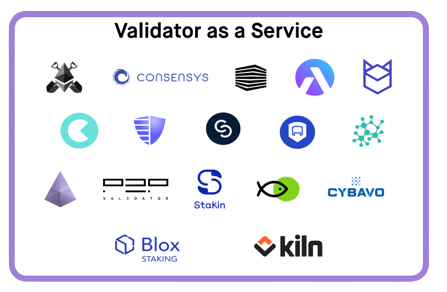
So what if you have more than 32 ETH assets and want to seek pledge opportunities, but do not have suitable hardware equipment, or worry that your hardware knowledge is not enough to cope with the operation and maintenance of the Ethereum network? Staking as a Service (VaaS) is a pledge service created for such high-net-worth individuals or institutions.
image description
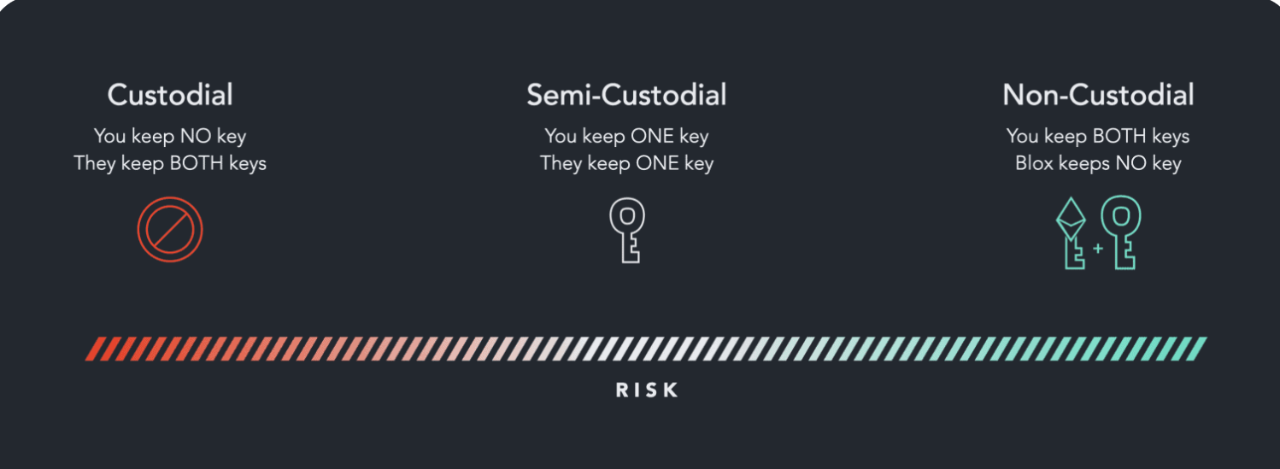
Image source: BloxStaking
As shown above, the difference between these services involves the two sets of keys in the Ethereum account.
Running an Ethereum validator requires 2 separate key pairs: a signing key and a withdrawal key.
Signing keys: In order for validators to attest to the state of the chain, participate in sync committees, and make block proposals, signing keys must be easily accessible to validator clients. Signing keys must be connected to the internet in some form for this, so they are essentially considered "hot" keys.
Withdrawal key: the key used only to transfer or withdraw pledged ETH. This key should be stored securely offline.
In a fully escrowed staking service, both sets of keys are escrowed; but in a more semi-custodial state, only your signing key is uploaded to the operator as a credential for them to run a validator on your behalf , but it does not have the authority to withdraw cash, transfer or spend your funds; the other advocates non-custodial, and the two sets of keys are not kept.
The advantage of the pledge service provider is that you don't need to pay attention to hardware specifications, settings, node maintenance and upgrades during the whole process.
But at the same time, you need to pay the monthly server fee, and you also need to face the risk of offline punishment and confiscation; Risk of Malicious Operations.
image description
first level title
joint pledge
The most common pledge method is joint pledge. After all, there are still a small number of people who own 32 ETH. For most holders, it is more realistic to jointly pledge and divide according to the pledge ratio.
secondary title
decentralized channels
Decentralized staking protocol. Since the Ethereum protocol does not natively support federation, a separate solution was created to meet this need, namely a staking pool, which runs on top of a smart contract into which funds are deposited and managed in a trustless manner and track your stake, and issue you tokens representing that value. Other pools do not involve smart contracts, but are facilitated off-chain.
Decentralized staking protocols have many benefits:
The entry threshold is low, you can pledge as much ETH as you want;
Fast pledge without worrying about hardware setup and node maintenance;
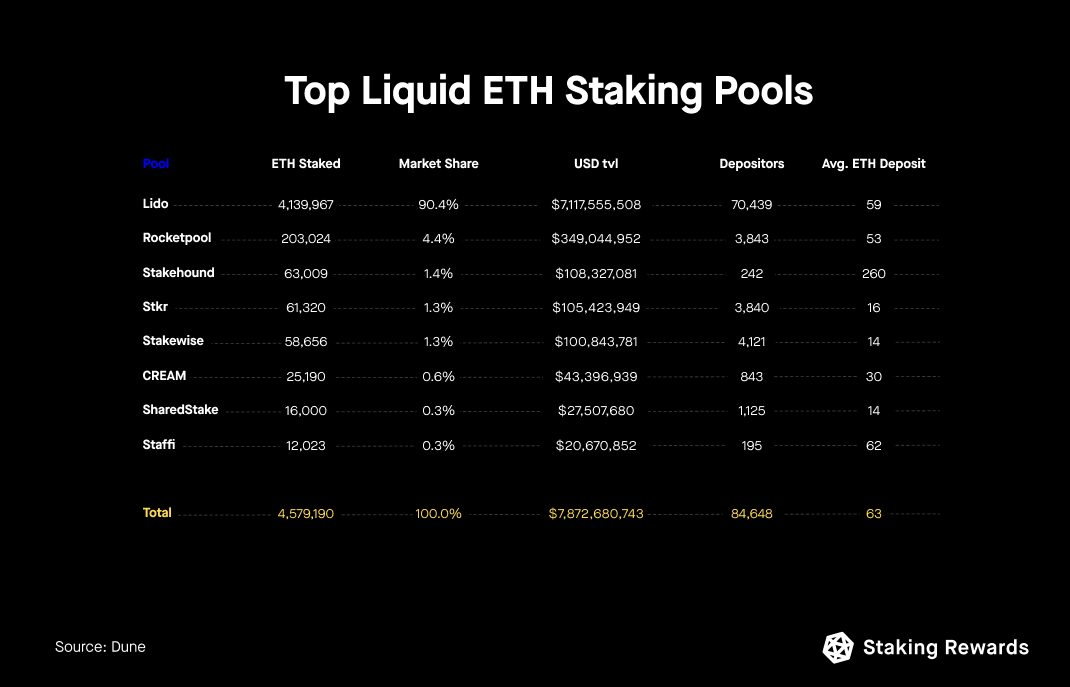
Solve the pain point of the restricted liquidity of ETH locked positions. In most staking pools, staking a certain amount of ETH will provide you with a corresponding amount of tokens as a pledge certificate, such as the current rETH, sETH, etc., so that you can make the most of the ETH in the pledge and trade it. , Lending, used as collateral... This kind of pledge pool is also called liquid pledge.
Similarly, there is also the risk of offline and slashing penalties that every node faces; the security risk of smart contracts; the risk of decoupling the price of ERC20 tokens; the transmission of system risks after liquid pledge service providers are coupled with DeFi projects, such as Lido. ETH and stETH liquidation risk.
image description
Lido Finance(stETH)、RocketPool(rETH)、Ankr Staking(aETHc)、Alluvial Finance、Stakewise(SETH2)、Stafi(rETH)
secondary title
centralized channel
That is, a centralized exchange, which is very easy to access, and the pledge can be withdrawn at any time, allowing you to earn some income from it with very little time and effort.
But the trade-off here is that this channel means that the exchange is the custodian of the user's assets, and the user entrusts the management of the private key to the exchange and is bound by its terms, which requires a large trust assumption and is not conducive to the integrity of the network. Decentralization; in addition, centralized providers are a huge centralization target and prone to failure points, making the network more vulnerable to attacks and vulnerabilities.
first level title
Binance(BETH)、Kraken (ETH2.S)、Coinbase (cbETH)。
developer opportunity
Although the pledge ecology of Ethereum has initially formed a system, but the block explorer shows that the pledged assets of Ethereum only account for about 11% of the circulation, and it is foreseeable that a large amount of growth has not yet come. In addition, on the staking track, Lido, Binance, Kraken, and Coinbase account for half of the Ethereum PoS staking, and they also face certain criticisms in terms of centralization.
Is this complete transformation of Ethereum’s PoS consensus mechanism expected to promote the further prosperity and development of the Staking Economy on Ethereum, thereby promoting the further development of its service providers towards decentralization? It remains to be seen.
However, this also shows that in the face of the huge and prosperous ecology of Ethereum, there is still room for developers on the third-party service provider track. At present, the development facilities of Ethereum have gradually improved. How to take advantage of its technical advantages and ecological Advantages to break through on the pledge track?
Liquidity and DeFi composability may become a breakthrough point for liquid pledge service providers.
Mint Ventures’ analysis and research report on the Staking track pointed out that the liquid staking track has attracted everyone’s attention: brand, security, degree of decentralization, and the liquidity/stability of the staking derivatives it provides and in DeFi Composability in . The research report believes that for users, as long as they can obtain stable and safe income, and the pledged derivatives can have good liquidity and composability, they will not have too much loyalty to the liquid staking platform itself.
When Ethereum completes Shanghai upgrade pledge ETH unfreezing and opens transfer function, some top decentralized pledge agreements will be able to stand out the most important advantage - the importance of ETH derivatives liquidity will be relatively weakened, which is for latecomers Definitely not an opportunity.
On other types of third-party service providers, there is still room for new types of participation.
Summarize
Summarize
As mentioned above, although the staking threshold is relatively high, the diversity of staking services and channels well compensates for this. The huge ecology will inevitably allow more users to join the pledge, and the pledge economy will also lead to a small explosion again. Developers stand in the previous link of pledge users and can discover new opportunities in the Ethereum pledge economy.
references:
references:
https://ethereum.org/zh/staking/
Guide to Staking on Ethereum (Ubuntu/Goerli/Prysm)
Ethereum's Client Diversity Problem
Mapping the Ethereum Staking Ecosystem
Ethereum to PoS is coming soon: in-depth analysis of the Staking track and representative projects