ETH Weekly | Ethereum’s first monthly deflation in history; Fidelity will provide institutional clients with Ethereum trading services this week (10.17-10.23)


Author | Qin Xiaofeng
Editor | Hao Fangzhou
Produced | Odaily

1. Overall overview
Author | Qin Xiaofeng
Editor | Hao Fangzhou
Produced | Odaily
Foreign media The Block quoted a Fidelity spokesperson as reporting that Fidelity Digital Assets will begin to provide its institutional clients with services to buy, sell and transfer Ethereum on October 28. Fidelity Digital Assets is an independent subsidiary of the financial services company Fidelity Investments. The subsidiary, which focuses on digital assets, reported last month in the Wall Street Journal that Fidelity intends to allow individual investors to trade bitcoin.
Second, the secondary market
1. Spot market
In terms of the secondary market, the current ETH price may continue to consolidate in the short term, with a support level of $1,300 and a resistance level of $1,400.
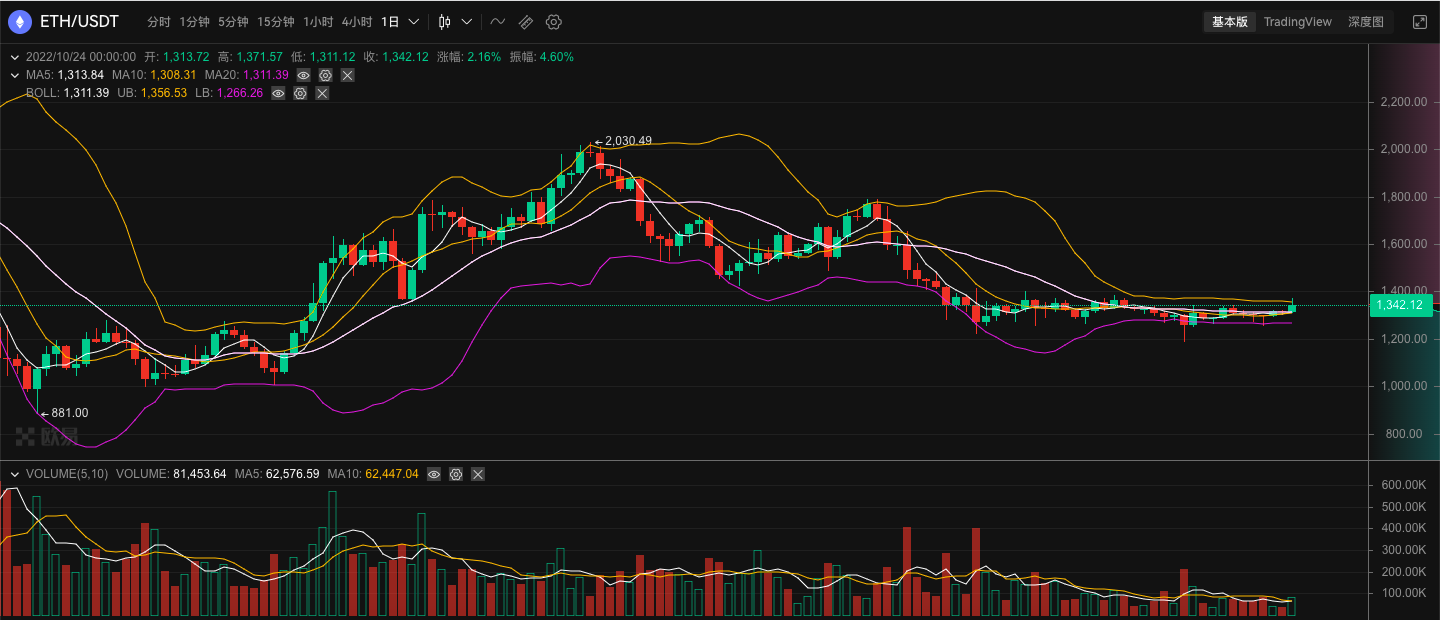
(ETH daily chart, picture from OKX)
Second, the secondary market
1. Spot market
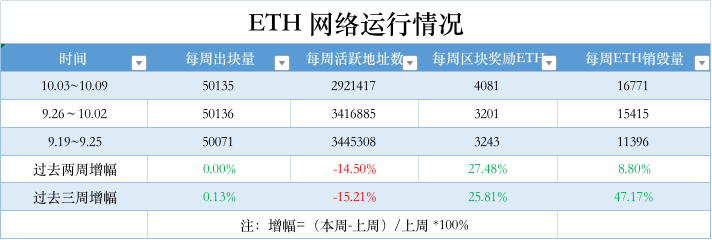
etherchain.orgAccording to OKX market data, the price of ETH closed at $1,313 last week, a month-on-month increase of 2%.
image description
The daily chart shows that the price is currently consolidating at $1,300 and may continue to test $1,400 in the short term. The upper resistance level is $1,400, and the lower support level is $1,260.
OKlink dataAccording to ultrasound.money data, the total monthly deflation of Ethereum has occurred for the first time in history, and in the past 15 days, the total supply has decreased by 11,523 pieces.
4. Rich list address
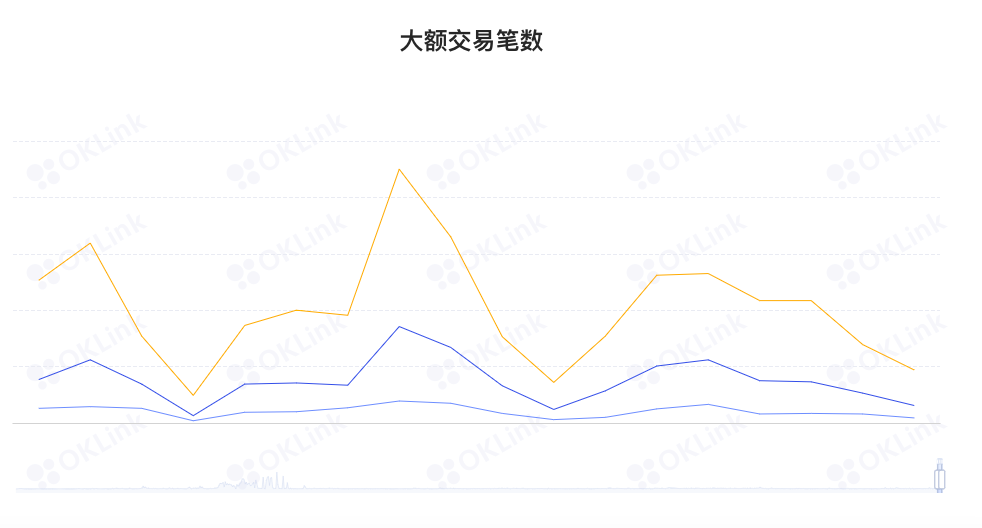
OKlink dataIt shows that the number of on-chain transfers dropped significantly last week, with "above 1,000 ETH", "above 2,000 ETH" and "above 5,000 ETH" falling by 14%, 16.6%, and 22.7% month-on-month respectively. The trading enthusiasm of giant whales has dropped significantly.
3. Ecology and technology
1. Technological progress
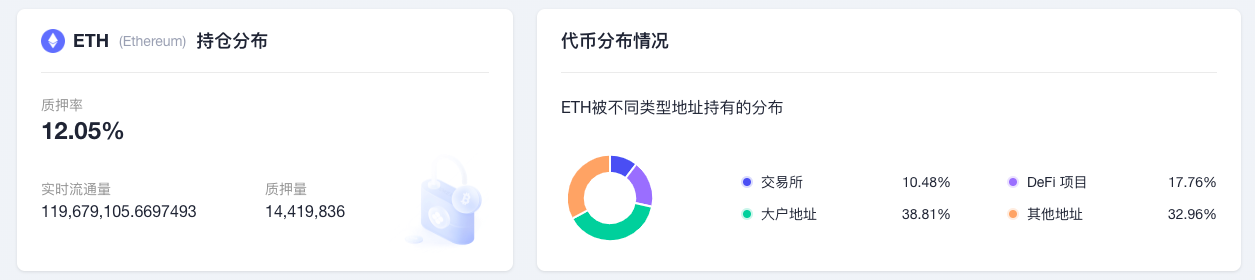
It shows that the total amount of pledged ETH in the entire network is 14,419,836 ETH, and the pledge rate is 12.05%, an increase of 159,413 compared with last week; from the perspective of the distribution of holding addresses, exchanges accounted for 10.48%, a month-on-month increase of 0.03%; DeFi projects accounted for 17.76 %, up 0.16% month-on-month; large addresses (top 1,000 addresses and excluding exchanges and DeFi projects) accounted for 38.81%, down 0.13% month-on-month; other addresses accounted for 32.96%, down 0.13% month-on-month.
2. Voice of the Community
1. Technological progress
The Ethereum client Nimbus released v22.10.1, introducing support for the official light client REST API and improving the stability of Nimbus when paired with external block builders.
3. Project trends
Vitalik: It should be tolerated that individual verifiers do not process certain transactions, and the large-scale PoS service endangers Ethereum
Vitalik believes that this will not affect the decentralization of Ethereum, and "what we should not do" is large-scale and centralized PoS services, because "they are easily censored by the government or other third-party institutions." (Cointelegraph)
3. Project trends
(1) President of StarkWare: StarkWare native tokens will be launched in October
Eli Ben-Sasson, president of StarkWare, an Ethereum Layer 2 development company, said that the StarkWare native token was originally planned to be released in September, but it was delayed by one month due to the need for Solidity contract improvements. The token is therefore expected to be launched in October. But the project will not provide free tokens to users initially, because all tokens will be locked immediately after release to prepare for the long-term development of the team. (Decrypt)
(2) zkSync releases an end-to-end verifier and officially runs zkEVM on the public testnet
Additionally, over the next 11 days, the zkSync team will conduct major tests of its performance and validation to ensure it is fully ready for a mainnet launch on October 28th. After initial testing, Q4 developers can port and develop on the mainnet; once all security checks are passed by the end of the year, it will be open to external users.
(3) Optimism launched the modular open source blueprint OP Stack, which supports the construction of custom chain "op-chains"
Optimism, the second-layer solution of Ethereum, launched the modular component OP Stack, the next evolution of Optimism's scalability architecture, which is suitable for various highly scalable and highly interoperable blockchains, and supports the assembly and construction of custom chains "op-chains ” to suit any use case,
(4) Azuki releases the PBT standard, which supports binding real items to the chain to realize Scan to Own
Azuki released Physical Backed Token (PBT), an open source Token standard that supports binding real items to the Ethereum blockchain. It is characterized by decentralized identity verification and tracking of the lineage of ownership of physical items. The process is completely on the chain and does not require a centralized server.
It is reported that the first PBT application is the BEAN chip, which is a physical encryption chip that can self-generate asymmetric key pairs.
(5) Messari: 1inch’s transaction volume in the third quarter of 2022 will drop by 45.5%, and its revenue will drop by 84% quarter-on-quarter
According to the blockchain analysis company Messari released 1inch 2022 third quarter report.
Among them, in terms of transaction volume, 1inch processed 4.6 million transactions in the third quarter of 2022, the same as in the second quarter; in terms of on-chain transactions, Ethereum accounted for more than 84% of the total transaction volume of the 1inch protocol, and has always remained the dominant Polygon and BNB Chain rank second and third respectively. It is reported that the third quarter is the first time since the fourth quarter of 2021 that the total transaction volume of Polygon has surpassed that of BNB Chain; It grew modestly by 2.4% to 2.2 million users in the previous quarter, and the average daily users was about 23,500 addresses, which was flat from the previous quarter. Most users use the Polygon network, followed by Ethereum and BNB Chain.
On October 19th, according to official news, the game studio Lattice announced that it will cooperate with Optimism to launch the 3D autonomous metaverse game OPCraft. OPCraft runs on a custom Rollup built on the OP Stack, a modular component announced by Optimism yesterday. Every element in the game exists on the chain, and every action is an Ethereum business. Currently, the game's contracts and clients have been open-sourced, allowing players to deploy on other EVM-compatible chains. The OPCraft world will be open for two weeks. At 7:59 on November 1, Beijing time, it will stop running, Rollup will be frozen, and the creations of players in the game will be permanently saved.
In previous news, Optimism published an article introducing OP Stack, the next evolution of its scalability architecture. OP Stack is an open source modular component suitable for various highly scalable and highly interoperable blockchains. In the future, OP Stack will neither be multi-chain nor single-chain, but an emerging structure formed by highly integrated chains, that is, a super chain.
(7) Interoperability protocol LayerZero launches Aptos Bridge
Interoperability protocol LayerZero launches Aptos Bridge, allowing users to transfer USDC, USDT, and ETH from Ethereum, Arbitrum, Optimism, Avalanche, Polygon, and BNB Chain to Aptos. In addition, in order to support most applications, the endpoint and bridge contract of the cross-chain bridge can be upgraded, and the key can be permanently canceled and destroyed in the future. At the same time, the rate limit of the cross-chain bridge will also be increased from $1 million per 24 hours The upper limit starts from , and then increases with the increase of stability and time.
A service called "Ethereum Alarm Clock" has been exploited due to a smart contract flaw that has resulted in approximately $260,000 being stolen so far.
It is reported that the Ethereum alarm clock service allows users to schedule future transactions by pre-determining the recipient address, sending amount and transaction time. According to blockchain security and data analytics firm PeckShield, hackers managed to exploit a loophole in the scheduled transaction process to profit from refunded gas fees for canceled transactions. Web3 security company Supremacy also provided security updates, pointing out that according to Etherscan transaction history, hackers have acquired 204 ETH, worth about $259,800. (Cointelegraph)
(9) Frax Finance has launched the Ethereum liquid pledge token frxETH
(10) Azuki Golden Skateboard Auction Total Exceeds 1900 ETH
4. Borrowing
DeFiLlama Azuki said that the physical skateboards will be distributed in November, and users who win the tokens will be able to connect the physical skateboards to the tokens through the chip he developed. The NFT auction price exceeded the previous highest price of physical skateboard sales.
4. News
It is reported that the first PBT application is the BEAN chip, which is a physical encryption chip that can self-generate asymmetric key pairs. PBT enables hardware to create new experiences, a mode Azuki calls Scan to Own. That is, if a physical item is sold or given to a new owner, the subsequent owner can "Scan to Own" the same physical item, thereby realizing the decentralized transfer of PBT from the previous owner to the new owner.
The data shows that the value of locked collateral on the chain fell from $30.88 billion to $30.59 billion last week, a 1% drop for the week. Specifically, the number of ETH mortgages dropped from 23.63 million to 22.42 million last week, a drop of 5.1%. From the perspective of individual projects, the top three lock-up values are: MakerDAO $7.75 billion; Lido $6.04 billion; Curve $5.35 billion.
4. News
(1) Fidelity will provide institutional clients with Ethereum trading services from October 28
Foreign media The Block quoted a Fidelity spokesperson as reporting that Fidelity Digital Assets will begin to provide its institutional clients with services to buy, sell and transfer Ethereum on October 28. Fidelity Digital Assets is an independent subsidiary of the financial services company Fidelity Investments. The subsidiary, which focuses on digital assets, reported last month in the Wall Street Journal that Fidelity intends to allow individual investors to trade bitcoin. (The Block)
(2) Galaxy Digital: The Ethereum NFT project earned $1.8 billion from NFT royalties, and Yuga Labs earned nearly $150 million in royalties
A new report from Galaxy Digital’s research arm presents key figures for NFT royalties. Ethereum-based NFT projects earned $1.8 billion from NFT royalties, with the top 10 net royalties accounting for 27% of all royalties. While NFT royalties also benefit smaller artists, the main beneficiaries are top NFT projects such as Bored Ape Yacht Club and companies like Nike.