






The Economist: The merger of Ethereum is imminent, and the cryptocurrency ushers in a critical moment


Original title: "The future of crypto is at stake in Ethereum's switch"
Original source: The Economist
Compilation of the original text: Yanyan Wang, Bitui BitpushNews
EthereumEthereumInventor Vitalik Buterin.
A handful of users have adopted panda avatars, cartoon faces bobbing and smiling at their human counterparts. They chose this avatar thanks to Ethereum researcher Hsiao Wei Wang. He created a meme showing two bears, one black and one white, doing the "fusion dance" from the hit anime Dragon Ball Z. During the performance, the two bears dance to merge into a stronger individual. The panda - a combination of two bears - has since become a symbol of "unification".
blockchainblockchainThe nomenclature for the point in time that will transition from using "Proof of Work" as a consensus mechanism to using "Proof of Stake". They call it a merger because for nearly two years a separate proof-of-stake blockchain, called the Beacon Chain, has been running alongside the original Ethereum chain for developers to test, improve, and Test again. This Zoom meeting is all about getting developers to agree on when the two chains will merge. The date and time of the merger will depend on how much computer power is used to maintain the blockchain, but the merger should happen around 1AM UTC on September 15.
cryptocurrency
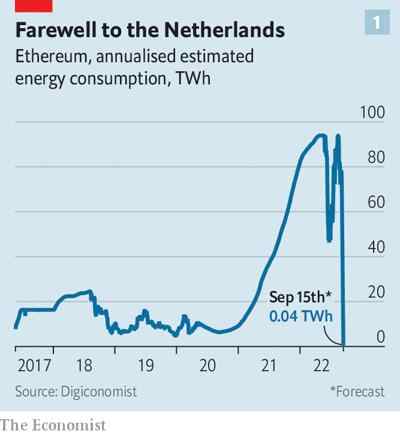
cryptocurrencyGood news is needed because this past year has been a rough one. A handful of dodgy deposit-taking VCs have collapsed; a cryptocurrency hedge fund has gone bankrupt; Stablecoins have been found to be anything but stable. The total market capitalization of cryptocurrencies has fallen to about $1 trillion, about $2 trillion lower than this time last year. Improvements to Ethereum will not eliminate this disruption, but, by reducing its environmental impact and highlighting its potential for future improvements, will show that the future of cryptocurrencies is brighter than people currently believe.
Buterin first announced the idea of the Ethereum blockchain in 2014. Like Bitcoin, it is a large database of all transactions that have ever occurred in this cryptocurrency. But Buterin's key insight is that blockchain can do much more than that -- it can also track lines of code. This allows Ethereum to record the transfer of currency, as well as the transfer of all assets and functions maintained in "smart contracts". A "smart contract" is a self-executing agreement that triggers a series of actions when certain conditions are met. With Ethereum Verification Code, developers can use code to build a large network of financial institutions, such as trading platforms and lending institutions, on the Ethereum blockchain.
The blockchain is maintained by a dozen pieces of software called "clients," which are developed by core developers. Clients are built using a variety of programming languages, including Go, Rust, Java, and C#, and the software is run by "nodes" -- computers that run client software to maintain the history of the Ethereum blockchain. All decisions about what to do, and whether to implement the upgrade, are made by consensus among developers, ether holders, and people building applications on ethereum or listing real-world assets on the blockchain. Any plans and code are published live on GitHub, a repository for programmers. The core developers meet every two weeks to discuss potential upgrades. In theory, anyone can become a core developer by developing software.
The result is that developers are a mob. Some are employed by companies such as ConsenSys, a Brooklyn-based blockchain software company founded by Joe Lubin, one of the few people who helped create ethereum following Buterin's 2014 white paper. Some of them are employed by the Ethereum Foundation, a nonprofit founded in 2014 in Zug, Switzerland. Ethereum is not a company, and Buterin is influential and important as the founder of Ethereum, but he is not the CEO either. It's open source — much like the free operating system Linux and the web browser Firefox — but provides an incentive for developers to participate in maintenance through the ability to buy a stake in it using ether, but its governance isn't really decentralized to the extent that it can. totally clear. At the start of the project in 2015, Buterin said he did a lot of research, thinking about what ethereum should be, and a lot of coding to make it a reality. By 2020, he said he might only be doing a third of his research, little coding but mostly "advanced theory". Over the past two years, he has said, even high-level theory "has slowly but surely slipped away from me".
To implement a change like a merge, there needs to be sufficient consensus among the parties involved. All major clients must agree to update their software, enough nodes must also update their software, and all real-world applications on a blockchain—like a Stablecoin backed by dollars in a bank account—must accept the new merging chains, which will maintain their asset state. Watching it all happen in real time was surreal. It’s as if The Economist started live-streaming its editorial meetings and allowed subscribers to commission articles and choose covers.
Not all stakeholders are in favor of the merger. Miners have invested $5 billion in hardware to run the proof-of-work consensus mechanism. Around September 15th, the hardware will no longer pay them off much. Proof-of-work maintains blockchain security by incentivizing hundreds of thousands of computers to solve a mathematical problem. The computer that first finds a solution alerts other miners, and if they confirm the result, the blockchain is updated and paid. So it pays to have plenty of graphics cards in the lovely, new ethereum environment.
Proof-of-Stake allows cryptocurrency holders to vote on whether to update the blockchain. Voting rights, as well as the share of rewards, depend on how much ether is staked. If stakers misbehave, such as making wrong transactions, their stake is destroyed. So, on September 15th, the advantage of having a large number of graphics cards will disappear. Instead, the advantage will be holding ether.
Miners may try to delay the merger by fighting back. But most of these nodes seem to be cooperating with the update. According to ethernode, a website that tracks ethereum activity, about 75 percent have updated their software in preparation for the merger. Another option is to try to "fork" the blockchain, by still running the old software, and hope that enough people do the same that the old version of the blockchain will continue to exist. A hack in 2016 caused Ethereum to split into two chains: Ethereum (the dominant chain) and "Ethereum Classic" (the much smaller chain).
The Ethereum Foundation's Justin Drake said that for this split, "the world basically needs a miner who decides they want to keep using proof-of-work," meaning there will almost certainly be one. The question is how many miners will persist and how many will give up. Chandler Guo, who supported the ethereum classic fork in 2016, is trying to organize miners around a proof-of-work token called "ETHW". “I forked Ethereum once, and I will fork again!” he said. While miners have reason to stick with the old ways, the economics of trying to fork the chain may not increase. It makes sense to mine ETHW only when the value of Token is high enough.
Institutions like Stablecoin operator Circle have backed the new approach, not any fork. In a statement on Aug. 9, the company said it “intends to fully support Ethereum’s proof-of-stake chain post-merger.” Proof-of-stake chains are also supported by wallet operators and trading platforms.
These dynamics reveal a balance of power inherent in Ethereum. Developers can't make updates that are generally hated because doing so would result in a chaotic fork; miners can't reject an update if everyone else supports it. A decision by those running applications on the blockchain, like Circle, could help settle the dispute between the two camps. This is very different from traditional technology platforms. Apple can roll out updates that iPhone users and app developers don't like, and there's little that either group can do about it other than ditch the iPhone altogether. There is no such thing as a "forked" iPhone.
The way ethereum achieves consensus is “a messy and ad-hoc process,” Drake admitted. But if things go well, there are huge upsides. With Ethereum being mined globally, the impact of its energy needs being wiped out overnight won't be too great. Almost half of Ethereum's nodes are in the US; about a tenth are in Germany. Other countries, such as Singapore, the UK and Finland, are less than 5%. But in some smaller countries, such as Singapore, where mining is very popular, energy prices may fall.
This change also reduces the need for specialized mining hardware. Gaming graphics cards from chipmaker Nvidia can also be used for mining. From May to July, its chip revenue halved from the previous three months, partly due to rumors of an impending merger. Prices for used graphics cards are plummeting on eBay.
Since the network will no longer require as much energy and hardware to maintain, the rewards for validating transactions can be reduced. “Under proof of work, the scarce resource that is provided in return is computing power. It’s very expensive because you have to pay for electricity and hardware costs,” Drake said. With Proof of Stake, the scarce resource is digital currency. "So the maintenance cost is essentially the opportunity cost of the money, maybe 3% or 4%." Therefore, the number of Tokens that Ethereum will pay to stakeholders after the merger will only be the number of Tokens paid to miners before the merger. 10%.
This change in the monetary system may be one of the reasons why the price of ether has surged since the timing of the merger began to be determined in mid-July. Even as bitcoin and other crypto tokens trade sideways, the currency is up nearly 50%. Supporters of ethereum believe that a successful merger could pave the way for a "turnaround," with ethereum's market capitalization surpassing bitcoin's for the first time. It is currently worth about half that of its rival cryptocurrency, close to its highest share since 2017.
Another big benefit is security. Currently, to take control of the bitcoin or ethereum blockchains, an attacker needs 51% of the total computing power required to mine the currency. Rough estimates put the cost of the move at $5 billion to $10 billion. To attack the proof-of-stake of the blockchain, half of all tokens need to be acquired and held, which will cost about 20 billion US dollars.
Some argue that these benefits will come at the cost of centralized power, as under Proof of Stake, large shareholders get more rewards for further accumulating holdings. But Ben Edgington of blockchain software company ConsenSys says that claim is false. Small stakes will earn less than large stakes, but their proportion of total circulating tokens will remain constant over time, meaning their relative power will not increase. In the proof-of-work model, building larger mining rigs that are more efficient also brings returns to scale. But Edgington pointed out: “It’s impossible for people to build a competitive mining rig at home.”
Another risk is that the transition somehow fails, which could weaken public support. Lubin, the co-founder of ethereum, takes this with a grain of salt. “We’ve done a lot of testing, and I think the blockchain element is going to work really well,” he said. Edgington believes the only possible missing link in the transition is the wider community. Given the complexity of installing new components, and the need to master new ways of working, some participants may be lost. But he said the problem would only occur if the churn rate exceeds 40%, which is unlikely. However, applications running on the blockchain, such as trading platforms, may encounter some problems. Major software updates reveal various bugs in code that used to look good. Some important DeFi applications, such as lending platform Aave, are preparing to suspend ether transactions during the merger.
If all goes well, the merger will be a step toward a more useful technology. Many financial applications that run on blockchains are highly efficient, in part because they automate functions of the financial system. Smart contracts automatically match buyers/sellers or borrowers/lenders on the trading platform. A paper by the International Monetary Fund found that the marginal cost of financial intermediation through DeFi applications is roughly one-third that of rich-country banks and one-fifth that of emerging-market banks. However, the speed and cost of using the Ethereum blockchain can hinder user efficiency. When the network is busy, the fees for recording transactions are called "gas fees" and can cost as much as $100 for a single transaction.
The post-merger upgrades are primarily aimed at improving scale and efficiency. In July, at an ethereum conference in Paris, Buterin joked that the blockchain’s path starts with “consolidation,” followed by “surge,” “edge,” “purge,” and “splurge.” By "surge" I mean "sharding," the process of splitting a database into chunks to spread the load. This will allow the blockchain to process more transactions and will reduce the fees required to use it. “Today’s Ethereum can process about 15-20 transactions per second. This Ethereum… will be able to process 100,000 transactions per second,” Buterin declared.
Original link





