






JZL Capital Blockchain Industry Weekly Report No. 36: The merger of Ethereum is imminent, and Cosmos rises against the trend


Overview of the week
-Investors quickly digested the benefits of the increase in the unemployment rate to the market, and the subsequent market suffered a slight decline.
- The overall capacity of the encryption market is insufficient, and the merger of Ethereum is imminent, and Ethereum and its derivative ecology are performing strongly.
1. Summary of Industry Dynamics
1. Summary of Industry Dynamics

This week, the encryption market as a whole showed a situation of insufficient energy, and its performance was particularly obvious on Bitcoin. During the stage of Ethereum and its surrounding ecology rising against the trend, Bitcoin was in a shock range, and on Friday After that, the continuous shrinkage and decline also shows that the market is in a wait-and-see state for Bitcoin. As of writing, Bitcoin closed at 19791.6, a decrease of 1.14% within the week, while Ethereum’s revenue and its derivative ecology have gone out of a completely different trend, closing at 1557.94. It rose by 4.96% during the week; several ecosystems related to Ethereum, such as OP, MATIC, LRC, etc., all had an increase of more than 7% within the week. The strong performance of Ethereum is closely related to The Merge, which is getting closer and closer. It can be seen from the frequent news and notifications sent by the Ethereum Foundation’s blog and twitter recently that the possibility of The Merge bouncing tickets is gradually decreasing. On Tuesday, Ethereum’s official Twitter called on Ethereum PoS node operators to update the consensus layer and the two clients of the execution layer, and prepare for the upcoming upgrade of The Merge.

This upgrade is similar to the previous testnet upgrades. Ethereum will be upgraded in two stages: the first stage is named "Bellatrix" (Orion, and the future consensus layer upgrades will be named after celestial bodies, according to the alphabet. in sequence), at beacon chain Epoch 144869, corresponding to 7:30 pm on September 6, 2022, Beijing time. After the first stage is completed, the "Terminal Total Difficulty" will start to be tracked. When the TDD reaches a certain value, the conversion from PoW to PoS will be completed; the second stage is named " Paris", the phase will be triggered when TDD reaches the threshold, the current projected time frame is 2022/9/10 - 2022/9/20. Total Difficulty is the sum of the difficulty of Ethereum from the genesis block to the current block. The difficulty of Ethereum is closely related to the computing power. According to past experience, once the Ethereum Foundation gives the expected TDD trigger time range, this The scope is controllable, because the foundation can make adjustments by controlling changes in computing power. For example, the latest Goerli testnet upgrade was predicted to be completed on 8/12, and the actual upgrade time was 8/11. Compared with giving a Block Epoch as an upgrade time, this can effectively prevent someone from ambush hacking in a certain Epoch in advance.
Obviously, the current market is bullish on this merger of Ethereum. First of all, after the merger of Ethereum, the issuance will be greatly reduced. Under the current PoW model, Ethereum issues about 13,500 ETH per day, and the annual issuance accounts for 4.3% of the total ETH supply. The PoS issuance model is based on the amount of ETH pledged on the chain. According to the current number of ETH pledges, the issuance rate of Ethereum will be reduced by about 90% after the merger. Years of production reduction, Ethereum will move towards continuous deflation. Secondly, the advantages of security, energy saving and decentralization brought by PoS all bring advantages for Ethereum to be more accepted by the public. In the end, experts from various parties also believe that the merger will be a catalyst for the price of ETH, which will bring extremely high volatility to Ethereum, but they remain optimistic about the long-term price of Ethereum. For example, Bloomberg analysts gave a $6,000 Target price. Of course, the risks brought by the merger should not be underestimated. For example, where will the miners of Ethereum go? Will the merged ETH be regarded as a security, and how should it face possible regulation? Will there be a serious systemic error? But at least for now, the merger of Ethereum has successfully created a sense of optimism in the community, and ETH's attractiveness to institutions and investors may increase.

2. Macro and technical analysis
2. Macro and technical analysis
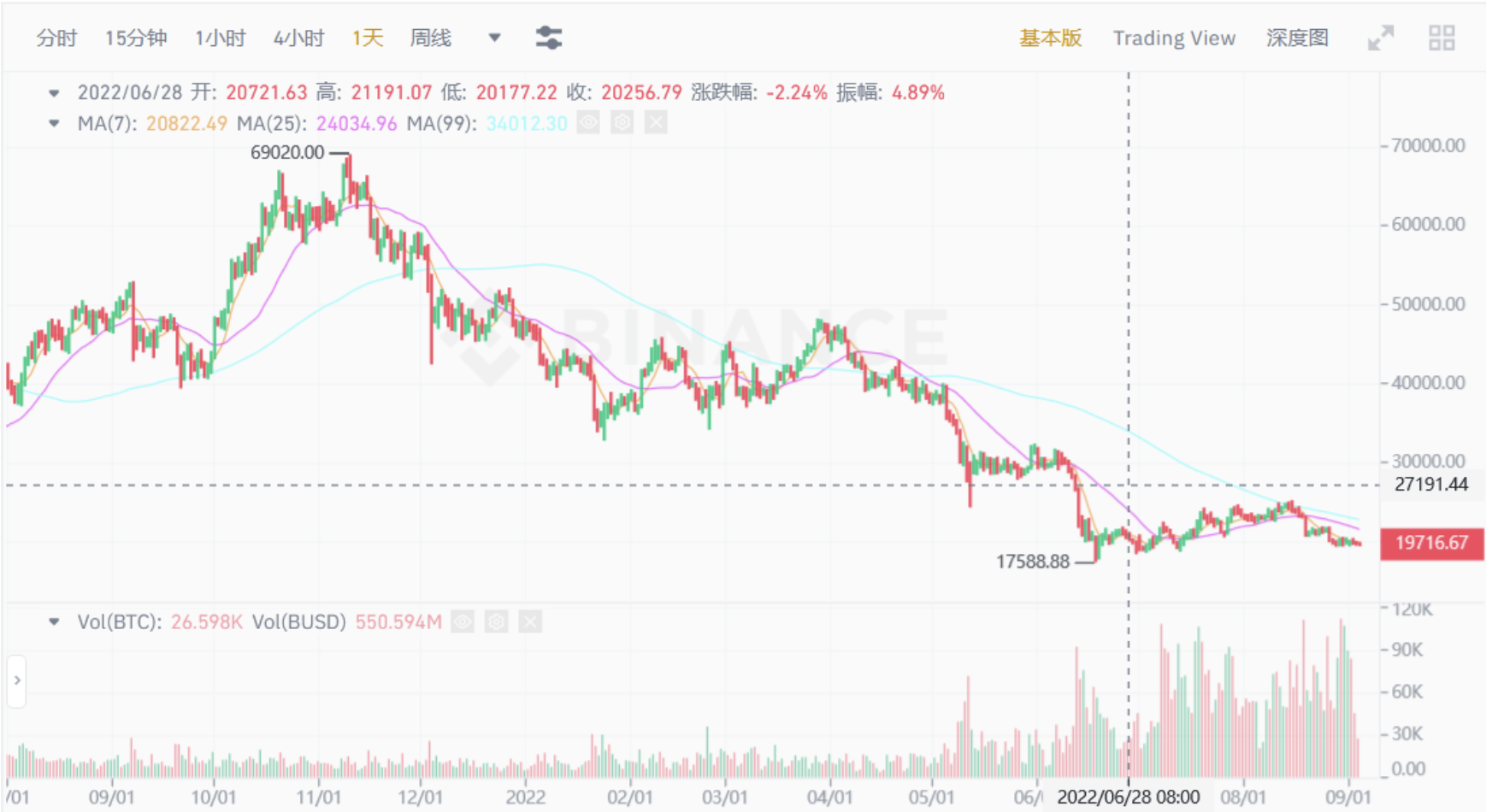
The market has entered a short-term consolidation period after the rebound. The market will rebound slightly in the short term, but the downward trend is basically established. If you are short, you can choose ETH to short.
The current round of BTC rebound is over, and the short-term downward trend has been established.
The two-year U.S. debt remains high and sideways.

The two-year U.S. debt remains high and sideways.

Nasdaq continued to decline after breaking its position, and there is a demand for a rebound in the short term, but it is not recommended to participate.

Arh999: 0.30, the cost performance is already in a relatively good position, and regular investment can be made.
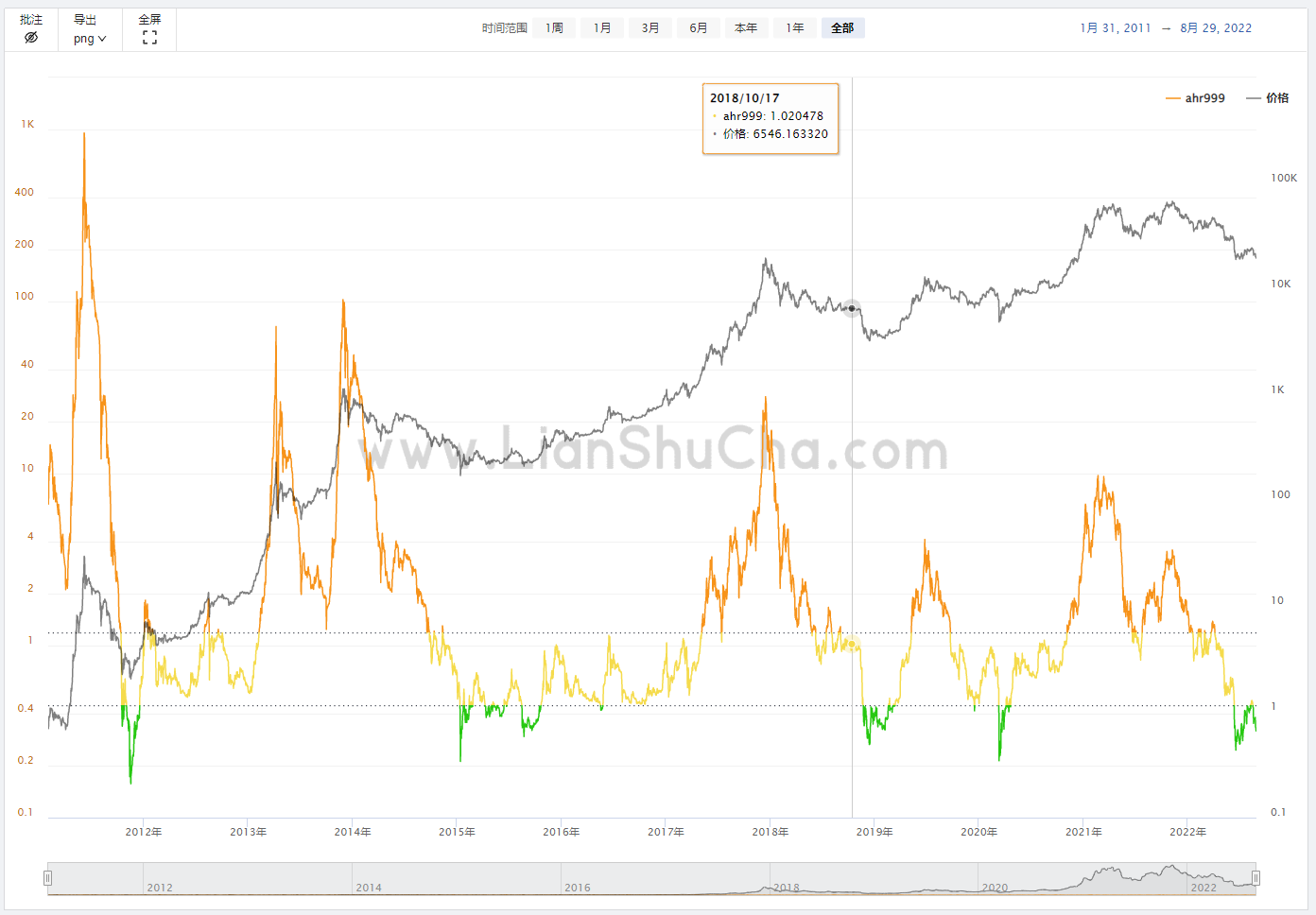
MVRV: 0.919, and the price/performance ratio is relatively high.

Number of BTC addresses: The number of addresses holding less than 10 coins has accelerated, and the number of addresses holding more than 10 coins has decreased slightly.

1. Investment and financing review

3. Summary of investment and financing
1. Investment and financing review
During the reporting period, 14 investment and financing events were disclosed (a decrease of 6% from the previous month), and the financing was about 351 million US dollars (an increase of 21.45% from the previous month).
In terms of specific tracks, there are 7 projects in the Web 3.0 & NFTs track, accounting for 50%, and the total financing scale is 1.9 billion US dollars, accounting for nearly 91%.

In the context of the relatively sluggish crypto asset market, the number and scale of investment and financing have been affected in the past 1-2 months, and there are few bull market blowouts. On the contrary, 0, as a long-term outlet, continues to have new capital inflows. Among them, the attention of the creator economy track and the Web 3.0 infrastructure field has increased significantly, including Stacked, an encrypted live broadcast platform that provides rewards for creators, Thirdweb, a Web 3.0 developer platform, and Spectral, a credit risk assessment infrastructure company. financing.
1) Market overview
4. Encrypted ecological tracking
1. NFT
1) Market overview
2) Dynamic focus

2) Dynamic focus
Jewel Music and Thin Box Mints jointly created the music universe "Jay Chou's limited collection DEMO space". BC", "Sunny Day", "Stranded", and a hidden DEMO track "New York Subway" that has never been published and is highly completed.
On September 1, patent attorney Mike Kondoudis issued a document stating that luxury giant Hermès filed trademark applications related to cryptocurrencies, NFT, and metaverse to the United States Patent and Trademark Office (USPTO) on August 26, claiming that it plans to expand to NFT, Cryptocurrency, NFT trading, virtual goods marketplace, virtual clothing/shoes/fashion shows, etc.

According to CoinDesk, American comedian Bill Murray launched the "Beer With Bill Murray" NFT on Coinbase's NFT market, which was sold at a charity auction for 119.2 Ethereum (approximately US$185,000), and was sold by Coinbase user Brant Boersma.
Fast food restaurant chain Taco Bell has teamed up with metaverse platform Decentraland to provide American newlyweds with a metaverse wedding experience. It is reported that engaged couples can enter the competition between August 25th and September 6th to win the brand's first legitimate Decentraland metaverse wedding package, and get an NFT after the conclusion.
On August 29th, Meta Media hypermedia holding group recently announced that it has purchased 11 plots in Decentraland, the world's most famous metaverse virtual digital platform. The universe virtual auction space Sothebys Metaverse is adjacent. “We will build a Meta Art Base here.” Shao Zhong, founder, chairman of the board and CEO of Meta Media Holdings Group, said. This marks that the Metaverse Art Base built by Meta Media will become the first Metaverse media enterprise in China to be deployed on the Metaverse virtual international platform.
On August 31, according to the official announcement, PROOF, the parent company of the NFT project Moonbirds, completed a US$50 million Series A financing, led by a16z, and participated by Seven SevenSix, True Ventures, Collab+Currency, Flamingo DAO, SV Angel, and Vayner Fund. PROOF released plans for the end of the year, including support for the CC0 series, an update to the upcoming Moonbirds DAO, and PROOF’s third NFT series: Moonbirds Mythics. Moonbirds Mythics is a 20,000 PFP series expected to launch in 2023.
When PROOF was first born, it was a podcast program. In December last year, PROOF Collective was established, a private community of thousands of people with NFT as the threshold. Members can get free NFT, participate in future activities and enjoy various benefits. According to previous news in April, PROOF, the parent company of Moonbirds, received a US$10 million investment from venture capital firm Seven Seven Six.
3) Key investment
3) Key investment
On August 29, Limit Break, the parent company of the NFT project DigiDaigaku, has raised $200 million through two rounds of financing, led by Josh Buckley, Paradigm, and Standard Crypto, with participation from FTX, Coinbase, Positive Sum, Shervinator, and Anthos Capital. The new funds will be used to develop Web 3 MMO games. The founder of Limit Break launched a new model "Free to Own" (F2O), that is, "free to own", which is created based on the free casting of Genesis NFT. These genesis NFTs produce other NFT series through airdrops and more methods, none of which involve fundraising.

The company that issued it is Limit Break, and the two founders of the company are very famous game designers Gabriel Leydon and Halbert Nakagawa.
Before founding Limit Break, he co-founded the famous mobile game company Machine Zone in 2008, and released a number of well-known mobile games, such as "Game of War: Fire Age" (Game of War: Fire Age), "Thunder World" ( Mobile Strike), Final Fantasy XV: A New Empire (Final Fantasy XV: A New Empire), etc. And the company has also become the highest-grossing mobile game maker in the United States by relying on these overseas explosive games, and ranked 36th in the unicorn list of Fortune magazine in 2016 with a valuation of 3.1 billion US dollars.
Digi Daigaku took the form of Stealth Launch and free mint on August 9th. There was no publicity in any form before, but Gabriel released the mint page on his Twitter. As the background of the project was slowly unearthed, it reached Extreme FOMO Level on Nansen, and then sold out quickly.
From the resume of CEO Gabriel, it can be seen that he has worked hard in the game industry for more than 20 years. He also worked at Atari, Tsunami Visual Technologies and Global VR before founding Machine Zone. He is best at making and designing free games (Free to Play), and has never set foot in console games. At the same time, he also attaches great importance to marketing. His company spends a lot of money on marketing every year. For example, in 2014, it spent a total of about 400 million U.S. dollars in advertising budget on "Game of War: Age of Firepower".

Referring to Axie Infinity, Gabriel sees the drawbacks of this model. Play to earn is actually Play to sell, and the rewards obtained in the game (Earn) are cashed out through selling (Sell). If everyone played the game to sell, then in the end, the game would be nothing but a bunch of sellers. For the current P2E mode that is bound to enter a death spiral, the only way to break the situation is to allow players to Play to Buy.
Gabriel pointed out that the reason for these players' consumption is not to become an invincible killer, but to become a ruler. They enjoy the power to make decisions in the game and the sense of dependence of other players on them asking for help. This is not a pay to win, but more like pay to judge.

Free to Own means that a chain game is started by creating NFT through free mint, allowing players to obtain it for free, and will continue to airdrop follow-up game assets and props to NFT holders in the future. Gabriel believes that free to mint can prevent fans from worrying about rugpull. At the same time, through free mint, holders will also become the best advocates for the upcoming game, allowing fans to spontaneously carry out viral promotion of the game.
2. GameFi blockchain games
2. GameFi blockchain games
1) Overall review

This week, mainstream tokens in the Gaming sector continued to rebound slightly following the market, with no outstanding performance relative to ETH. Among them, SAND performed poorly due to the drop in land prices.
2) This week's project – Internet Game
The quiz game Internet Game completed a $7 million seed round of financing. Participating investors include ParaFi Capital, Dragonfly, Dephi Digital, Uniswap Ventures, Collab+Currency, GMoney, Milk Road, Ready Player DAO. Individual investors include HQ Trivia co-founder Rus Yusupov and Magic Eden co-founder Zedd.
Internet Game is a quiz game. Users purchase Game Token NFT as tickets to participate in the competition by paying ETH. These ETH will be accumulated by the project party into the prize pool, and NFT will be purchased as prizes according to the user voting results. After purchasing tickets, users must participate in five games. Players who are not eliminated will receive Metaverse Access Card NFT, and the players with the top 100 points will win the blue-chip NFT in the prize pool.

Internet Game held its first season in March this year, about 8,000+ players participated, and a total of 2.2 million US dollars of NFT tickets were minted. The amount of NFT in the prize pool exceeded 1 million US dollars, including BAYC, MAYC, Doodles, Azuki and other series NFT. The questions in the game have a certain degree of randomness, and the results of some challenges depend on the choices of other players, so players cannot perform targeted exercises.

Game Token reflects the player's ranking in the form of NFT. Players can sell their rankings to other players through OpenSea between games.
The project originated from HQ Trivia, a live-action quiz game that exploded in 2018. It is known as the originator of the webcast quiz business model, with a valuation of US$100 million. However, due to sluggish user growth, insufficient income to pay bonuses, and the death of co-founder and CEO Colin Kroll due to drug overdose, it declared bankruptcy in 2020.
Based on the Web3 model and NFT technology, Internet Game tries to reshape the HQ Trivia model to create sustainable income
1) Market overview
1) Market overview
2) Cosmos ecology

2) Cosmos ecology
Recently, the Cosmos ecology has been relatively prosperous, and the price of ATOM tokens has performed well. Entering August, in the case of a general correction in the market, it still maintains a strong upward trend of shocks, outperforming ETH and most of the market targets.

In addition to the Interchain Security (ICS) function we mentioned earlier that improves the value capture of ATOM, the continuous stream of new projects in the ecosystem is also an important reason. There are not only star projects like dYdX switching to Cosmos self-built application chains, but also Evmos as the ecology Introduce Ethereum assets and promote diversity. In addition, projects such as Canto, Kujira, and Injective also contribute to ecological prosperity.
The following is a brief introduction to the projects worthy of attention in the recent Cosmos ecosystem:
Canto:
Canto is a Layer 1 DeFi public chain (EVM compatible) built based on the Cosmos SDK. During the Genesis phase that started on August 16, it gave airdrops worth about $5,000 per account to testnet participating users. The project focuses on the concept of decentralization and free public infrastructure, and claims to have no Token pre-sale, no official team, and no VC capital.
The main functions of Canto are DEX, LP liquidity mining and lending. Among them, the native token CANTO is used to pay gas fees and serve as LP reward tokens, while NOTE, as a dollar-linked stable currency, is lent out through over-collateralization. In the early stages, the APR offered to LPs was as high as four digits, and this will also lead to CANTO's inflation tendency.
Canto is still in the early stage with a small number of users, and there is no major innovation on the whole. After the short-term hype, whether its tokens can have long-term development depends on the actual usage scenarios. High-yield liquidity mining can only It is a means to attract users in the early stage, and it is difficult to last for a long time.
Kujira:
Kujira is a mortgage settlement protocol on the original Terra blockchain (users can purchase collateral that is about to be liquidated). After the collapse of LUNA, it decided to use the Cosmos SDK to build its own Layer1 blockchain, positioning it as a multi-chain decentralized exchange.
In addition to the clearing application ORCA, Kujira also has Comsos’ first order book-based decentralized exchange FIN, the Kujira blockchain browser FINDER, and the user interface BLUE (including functions such as cross-chain bridge, pledge, and governance). Kujira has launched its ATOM-backed stablecoin USK on the testnet, mainly for bidding on liquidated collateral.
The Kujira team’s restart work in Cosmos has been relatively successful, and its token KUJI has risen from near zero during the LUNA crash to around $1.3 recently. We believe that the project has a good prospect and deserves continuous attention.
Terra Classic:
3) Key investment

3) Key investment
DeFi oracle platform RedStone raised $7 million, and Lemniscap led the seed round with support from Coinbase Ventures, Blockchain Capital, Distributed Global, Lattice, Arweave, Bering Waters, Maven11, and SevenX Ventures. RedStone, which currently provides data feeds for more than 30 blockchains including Ethereum, Avalanche and Polygon, will use the funding to accelerate the launch of its latest product suite to improve connectivity between blockchains and real-world data.

If there are obvious facts, understandings or data errors in the above content, welcome to give us feedback, and we will correct the report.

about Us
JZL Capital is a professional organization registered overseas, focusing on blockchain ecological research and investment. The founder has rich experience in the industry. He has served as the CEO and executive director of many overseas listed companies, and has led and participated in eToro's global investment.
The team members are from top universities such as University of Chicago, Columbia University, University of Washington, Carnegie Mellon University, University of Illinois at Urbana-Champaign and Nanyang Technological University, and have served Morgan Stanley, Barclays Bank, Ernst & Young, KPMG, HNA Group , Bank of America and other well-known international companies.
Website www.jzlcapital.xyz
Twitter @jzlcapital
contact us
We are always looking for creative ideas, business and cooperation opportunities, and we also look forward to your reading feedback, welcome to contact hello@jzlcapital.xyz.
If there are obvious facts, understandings or data errors in the above content, welcome to give us feedback, and we will correct the report.





