






What information is revealed in the USDT five-year audit report?


Original Author: Fu Zhuorui
Original Author: Fu Zhuorui
Compared with the previous review report, these data are not much different. What does the content of these review reports represent? What industry dynamics does each column reveal?
first level title
Tether review report analysis
The review report is a document that some stablecoins invite third-party accounting agencies to review in order to prove the value of the currency. This kind of document is similar to that of an ordinary company hiring an accounting company to issue a third-party review report and the three major report reports. The difference is that the company’s reports basically have uniform standards and requirements in various countries, and companies generally hire reputable and well-known accountants when their financial resources permit. Large listed companies generally only hire the Big Four accounting firms and well-known accounting firm. At the same time, ordinary company reports need to list many items, review reports, statements, etc. are often filled with dozens of pages. At the same time, the company must regularly and regularly release reports of different lengths in accordance with compliance requirements.
The length, time interval, and content of the stablecoin review report are different according to different projects and review companies/accountants, and there is no standard. The content listed in the review report also depends on the stable currency issuance or the management company and the accountant themselves. The stablecoin release review report is mainly to prove that the stablecoin project is really reliable, especially the fiat currency or the stablecoin linked to commodities. The generation of each coin needs to have an equivalent asset in the book. If the company cannot prove There are actual assets behind each of these stablecoins. Investors or stablecoin users can completely question the stablecoins, because stablecoin users have purchased/produced stablecoins, but there is no asset guarantee. A stablecoin company can completely Make money and leave. This is not uncommon in the stablecoin market. Even the central stablecoins of large-scale stablecoins (top 20 stablecoins) regularly issue review reports, and there are cases where anchors are broken or book assets cannot be cashed into stablecoins.
As the world's first stable currency, Tether serves as the base currency for trading other digital currencies for hundreds of millions of users, and its traffic and market value far exceed other stable currencies. Tether is also notoriously censorship opaque. Tether released its first review report in 2017, and then released some reports from time to time. Since 2017, Tether has released a total of 10 review reports in five years. Among them, there was one report in 2017, only two reports in 2018, and no reports in 2019 and 2020. The content of the report is also very opaque. The review report before the report on June 30, 2021 did not list the specific details of Tether's book dollar in detail. The review report only listed having a "dollar value". Such reports are not uncommon in the stablecoin market. Its meaning can only prove that there are indeed so many dollars on the books of the stablecoin company, but users do not know what form the dollars exist in, and if they don’t know what form the dollars exist in, they know that there are a certain number of dollars on the books. The dollar doesn't necessarily mean much. Beginning on June 30, 2021, Tether's review report began to emerge with details, listing how the dollars in Tether's account exist. Subsequent review reports basically follow the framework at that time, and will list the main contents.
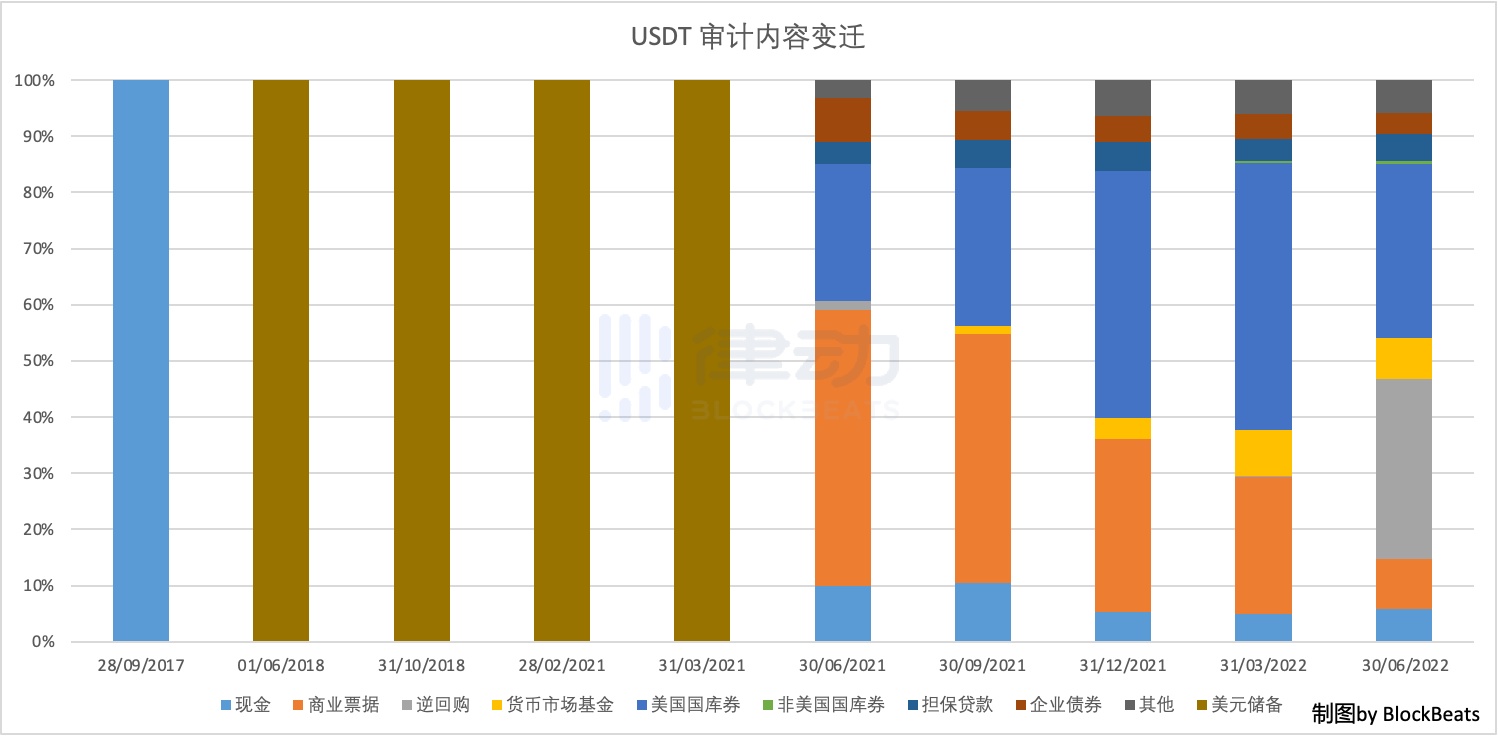
Before March 31, 2021, the Tether audit report did not explain the US dollar form in detail. After that, the detailed disclosure will start. On June 30, 2022, many new reverse repos will be added, which is also a form of becoming a creditor of the US central bank. Note, on September 28, 2017, Tether still had very few euro assets on its books. For the convenience of calculation, this article converted it into US dollars at the exchange rate of the day.
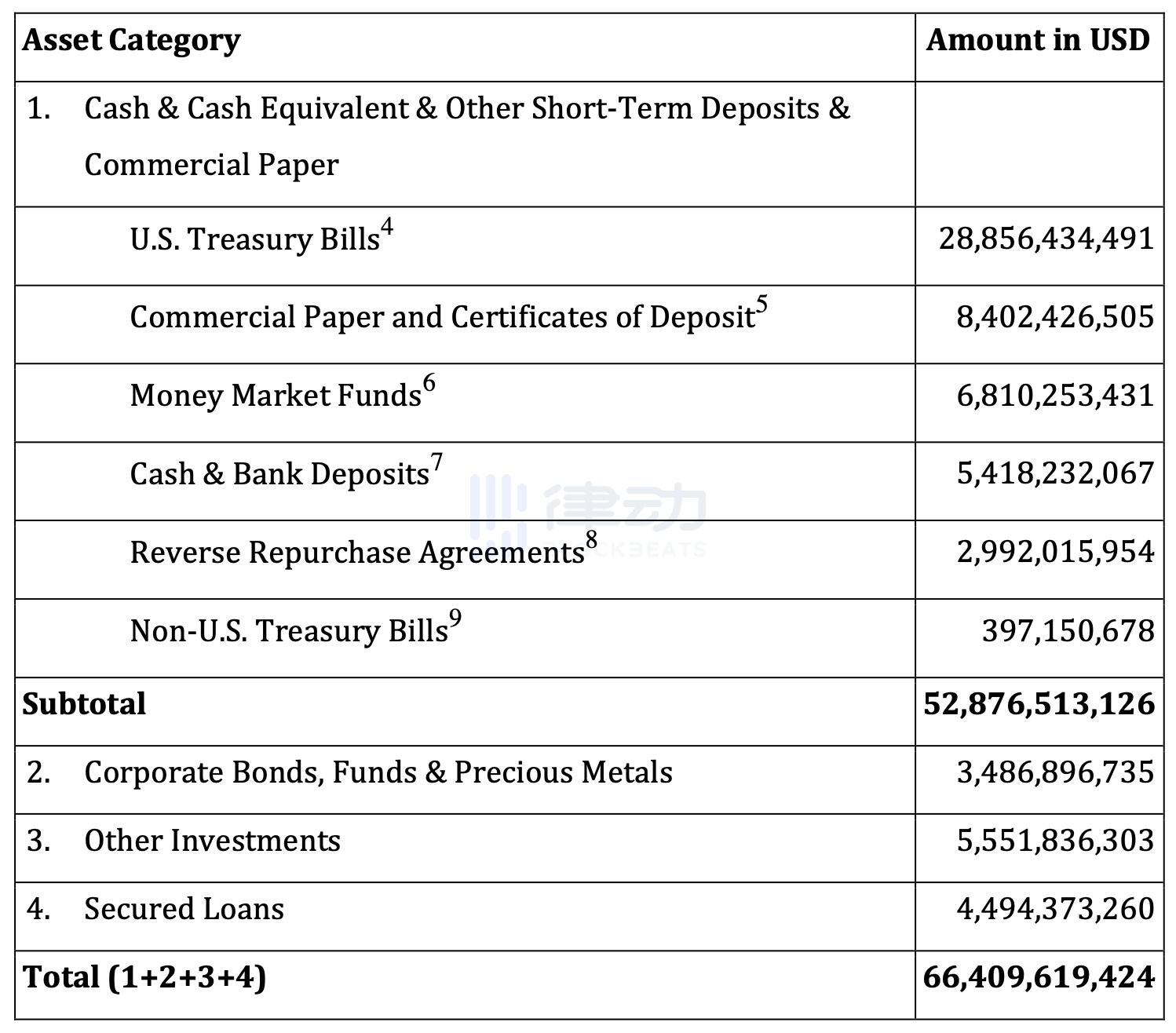
image description
Disclosure of Tether's most recent audit report
The review report on June 30, 2021 shows that the US dollars on Tether's account exist in the form of cash, commercial paper, reverse repurchase, US Treasury bonds, secured loans, corporate bonds, and others (including other digital currencies). Among them, cash has the best liquidity, commercial paper is also a highly liquid and safe asset, and U.S. treasury bonds are a safe and stable dollar investment. Most of the U.S. dollars on Tether's book are U.S. dollar investments with good liquidity and little or no risk. Corporate bonds and other forms of U.S. dollar investments do not account for a major asset allocation of Tether's U.S. dollar holdings. Such an asset allocation can ensure the security of Tether’s book dollars. When Tether is attacked by a run, etc., there will be sufficient stable, safe, and liquid dollar support on the books.
In the subsequent review report, there were some other items with a small proportion on Tether’s books, such as money market funds, other countries’ national debt, and so on. Tether has also gradually reduced the proportion of cash and has greatly increased its holdings of US Treasury bonds since the December 31, 2021 review report. Before that, US national debt accounted for about 25%, and then US national debt accounted for about 45%.
At the same time, with the expansion of Tether's market value, the circulation and asset value of these currencies are also increasing. However, the USDT flow on June 30 this year was approximately 66 billion, which was nearly 15 billion less than the approximately 81.9 billion on March 31.
In addition, Tether's accounting organization is also interesting. The qualifications of accounting institutions can be said to greatly affect users' judgments on stablecoin projects. Although many stablecoins have audits, the auditing company is likely to be an unknown small accounting firm in the Cayman Islands or Bahamas, and may have no more than 10 employees. Therefore, although some stablecoins have audits, the audit qualifications are extremely irregular, and the audit reports may not necessarily show content that can reassure users. If readers want to invest in a company, of course they believe in the audit report of the Big Four rather than the report of an unknown accountant in a certain county.
Tether's audit report on June 30, 2022 came from BDO, the fifth largest accounting firm in the world, headquartered in Brussels; Tether used BDO in Italy. Tether’s previous audit came from an audit company in the Cayman Islands called MHA Cayman, formerly known as Moore Cayman. Its parent company is MHA MacIntyre Hudson, the leading registered accounting firm in the UK. investigation.
*Note: In order to maintain a 1:1 relationship with fiat currency, fiat currency assets generally hold more fiat currency assets than actual stable currency assets, that is, the relationship between fiat currency assets and stable currency assets is greater than 100%, which belongs to overcollateralization (overcollateralisation) Condition.
first level title
USDC, the second largest stable currency, has issued an audit report every month since October 2018, and its audit report has been audited by Grant Thorton, the sixth largest accounting firm in the United States. The audit report of USDC lists the dollar value equivalent of USDC on the books of USDC on the date of the audit report, and releases some details. According to USDC's audit report on July 31, 2022, the stablecoin dollar assets are mainly composed of U.S. treasury bonds, with a small amount of currency in the form of cash. Since the issuer of USDC is Circle, an American technology company, the compliance of Circle will also affect USDC. In general, USDC has made great efforts in terms of compliance.

image description
The stablecoin BUSD has issued an audit report every month since September 2019, and its audit report has been audited by the American accounting firm Withum. Unlike USDC and USTDT, the audit report of BUSD only lists the dollar value equivalent of BUSD on the audit report release date, without details. The audit report shows that BUSD’s U.S. dollar assets exist in the form of “US government guaranteed instruments.” Although the specific asset tools are not shown. However, because the issuer of BUSD is Paxos, a registered company in the United States, Paxos’ compliance is not bad among many stablecoins. It can be guessed that the US dollar on the BUSD book should be in the form of the US dollar mentioned above under normal circumstances. Among other things, Paxos is also the issuer of USDP and commodities stablecoin Pax Gold (PAXG). The audit of USDP is also done by Withum, which is consistent with the audit form of BUSD.

image description
TUSD issued audit reports from March 31, 2018 to March 31, 2020. The audit report was audited by Cohen & Company, an American accounting firm. TUSD's audit report also only lists the dollar value equivalent of BUSD's books on the date of the audit report, without further details. It is indicated in the corner note that the book dollars are legally stored in the United States or/and Hong Kong storage institutions. After March 2020, TUSD converted the audit mode to a real-time checkable audit, the real-time checkable webpage TrustExplorer provided by the American accounting firm Armanino LLP on its official website. Real-time audit content can see two histograms, the left is the circulation and issuance of TUSD, and the right is the amount of TUSD's US dollar account assets, which are displayed in US dollars. But the real-time chart is the same, you can only see how many compliant dollars there are, but you can’t see the specific mode in which these dollars exist.
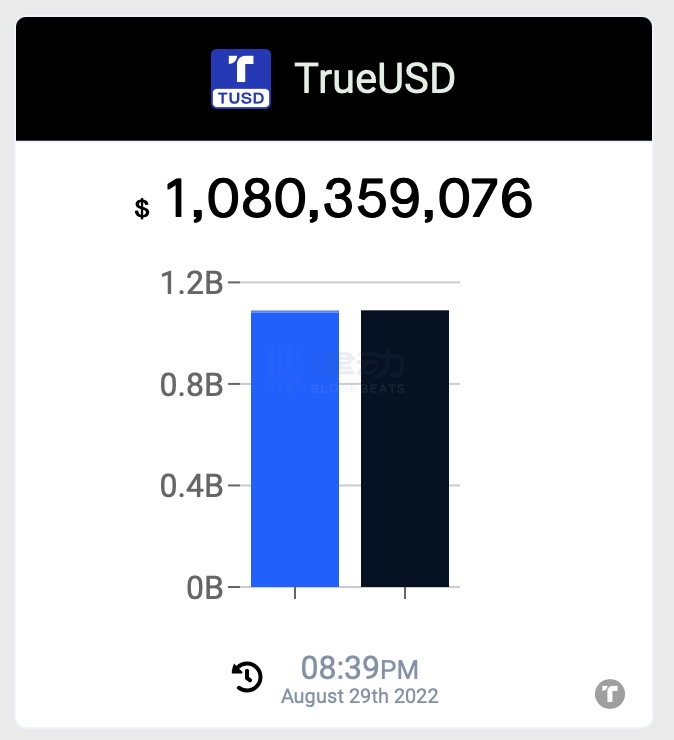
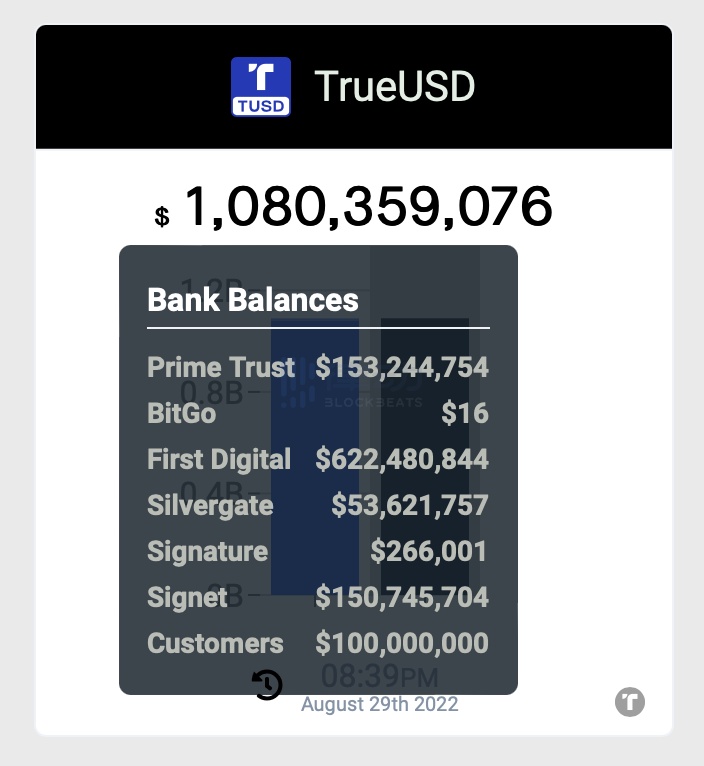
The disclosure of the TUSD real-time audit report (as of August 29, 2022), the blue on the left is the market value of TUSD supply, and the black on the right is the book situation of TUSD. TUSD does not disclose the detailed breakdown of US dollar assets, and can only see all real-time US dollar assets how many.
first level title
The Present and Future of Stablecoin Asset Review
Following the UST crash, global regulation of stablecoins has increased dramatically. The Stablecoin Regulatory Act MiCA introduced by the European Union clearly states that certain reserves of fiat currency stablecoins need to be kept on the books, and the operating model is similar to that of a bank. Afterwards, the requirements for issuing stablecoins in Europe will be very high, and the reserve fund is the first threshold for project issuance.
The world's major stablecoins can be divided into legal currency stablecoins, algorithmic stablecoins, digital currency stablecoins, and commodity (gold) stablecoins. In fact, the leading stable currency is a legal currency stable currency, and the main legal currency is the US dollar. Since the US dollar stablecoin needs to maintain a 1:1 relationship with the US dollar, the stablecoin issuer/operator must ensure that there are high-quality US dollar assets with sufficient liquidity and small enough risk on the books. The U.S.-compliant currency issued by a U.S.-compliant company has natural advantages in compliance and the selection of U.S. dollar assets. For example, Paxos, the parent company of BUSD, has always been proud of issuing "transparent" monthly audits.
Tether, whose parent company is a Hong Kong company, is far inferior to stablecoins in the United States in terms of compliance and audit transparency. However, as Tether has become the leader and expanded, users and regulators have also increased their requirements. Tether's audit has obviously improved the audit quality and audit frequency year by year, and has made a detailed breakdown of assets. These are the responsibilities that Tether needs to bear as the world's number one stable currency.
Reference:
https://real-time-attest.trustexplorer.io/truecurrencies
https://paxos.com/attestations/https://tether.to/en/transparency/





