






Bankless: Is Ethereum Merger Exaggerated From Four Narratives?


Original source: Bankless
Original source: Bankless
Original compilation: AididiaoJP, Foresight News
image description
Graphic by Logan Craig
The future has arrived, and the 5-digit ETH is within reach, coming at supersonic speed. Driven by inflation, the price of ETH has entered a spiral upward cycle. Pledgers will get huge real returns, and Ethereum has become the hegemony of the encryption industry.
Such a script is playing out in the minds of countless people, but before we start preparing funds, or even looking for private money from sofa cushions to buy ETH, let us take a closer look at the following four narratives and think about which one is closer to the actual situation.
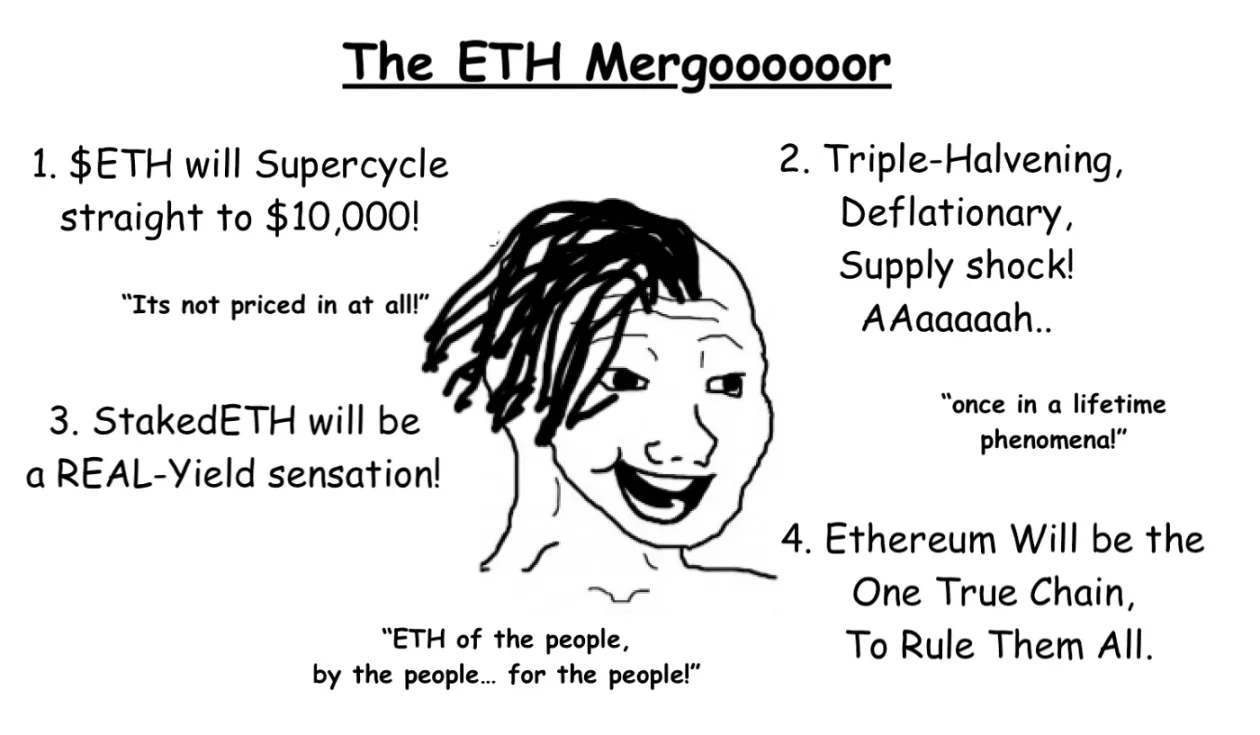
Narrative 1: News and Rumors Abound: Ethereum Price Will Spiral into a Supercycle
Arthur Hayes expressed his opinion in the ETH-flexive post, singing more about the merger of Ethereum. He used Soros' reflexive theory to predict that the benefits brought by the merger would not stop because of the end of the merger, but would accelerate the sharp rebound of ETH prices from the July low of around $1,000.
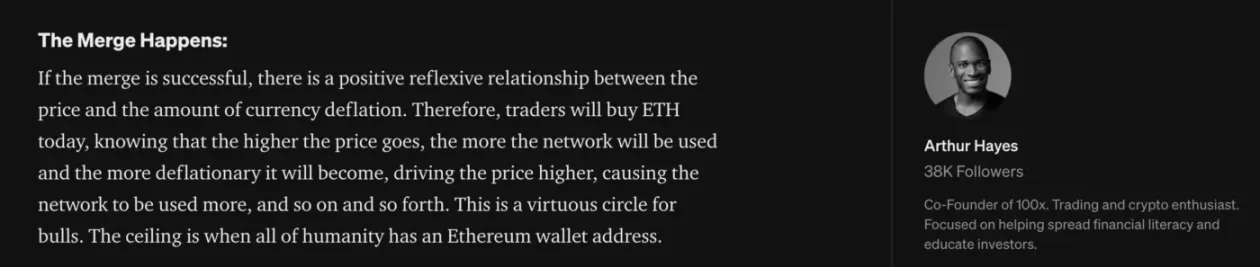
His central thesis is that the merger would lead to a higher price for ETH, while the cryptocurrency pump would draw more attention. Users, developers, and on-chain activities are all related to attention, so Ethereum will enter a virtuous circle on a global scale.
Although this is a seemingly reliable theoretical framework, when we look at this inference from both short-term and long-term perspectives, we will come to different conclusions.
In the short term, as Arthur Hayes said, market expectations and the promotion of good news will lead to a sharp rebound in the market. But in the long run, although the price of ETH has risen sharply, the gas fee burned continues to fall, which makes us rethink the value accumulation of the L1 blockchain.
First let's consider the possible movement of ETH after the merger:
We see the same thing happen time and time again in the crypto market: When there is a big positive news, there will be a large number of participants buying support. Buying on dips is driven by the anticipation of an impending event. Short sellers will be scared away by a sharp rise in the market. When the event occurs, the receivers who are behind in the information chain will make the last buying action.
Yet people’s attention spans are short, especially in crypto, and by the time the shiny new thing hits the headlines, the next upgrade or token economics adjustment has already begun. When the market appears to meet maximum saturation and attention, the market is completely one-sided and extremely prone to reversal every time. There are already crypto funds and whales taking long positions based on this historic event.

When the merger is over and the news dies down, will the short-term players be able to capture their unrealized profits while the music stops? In a macro context that many expect to be extremely challenging, it is extremely difficult to maintain a persistent myth.
Narrative 2 "Triple Halving Effect" Puts ETH in a Deflationary Supply Crisis
In a recent related thousands of reposts, Montana Wong suggested that there would be a catastrophic supply shortage after the merger.
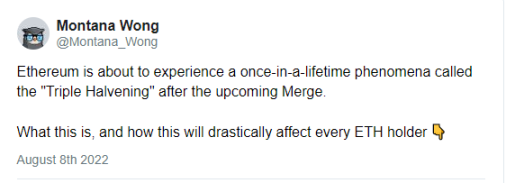
The so-called "triple halving effect" means that the supply of Bitcoin will be halved every four years, and Ethereum will superimpose three powerful effects into a single phenomenon, which will make ETH more scarce.
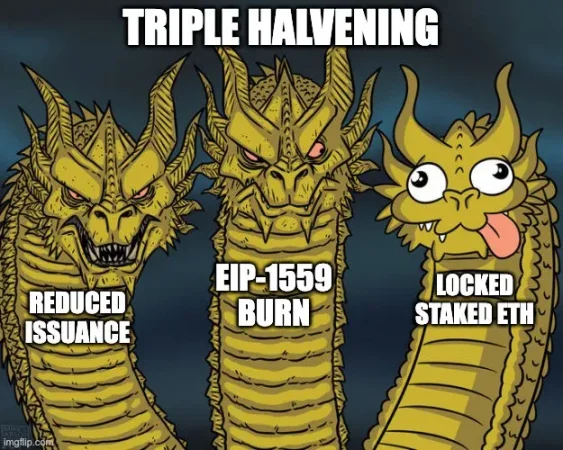
Effect 1: Reduce circulation
After the merger, Ethereum will gradually "fire the highest paid employees", and the Ethereum network will no longer need to pay miners' fees to verify transactions on the network. This will result in savings of almost 13000ETH per day. On the contrary, the security of Ethereum will be guaranteed by the pledgers. The salaries of the pledgers are much lower. The daily budget is only 2,000 ETH initially. As the number of pledgers increases, the budget will increase to 5,000 ETH. Net savings of 8,000-11,000 ETH per day is indeed a major positive, as nearly $20 million of market selling pressure has been removed.
Effect 2: Gas fee consumption increases
The implementation of EIP-1559 in 2021 was a powerful catalyst for the price of ETH to rise at the time, and most of the gas fees paid by users in each block were burned, which helped offset some of the inflation of new tokens issued. However, the inflation offset effect of gas fee burning after the deployment of EIP-1559 may be overestimated.
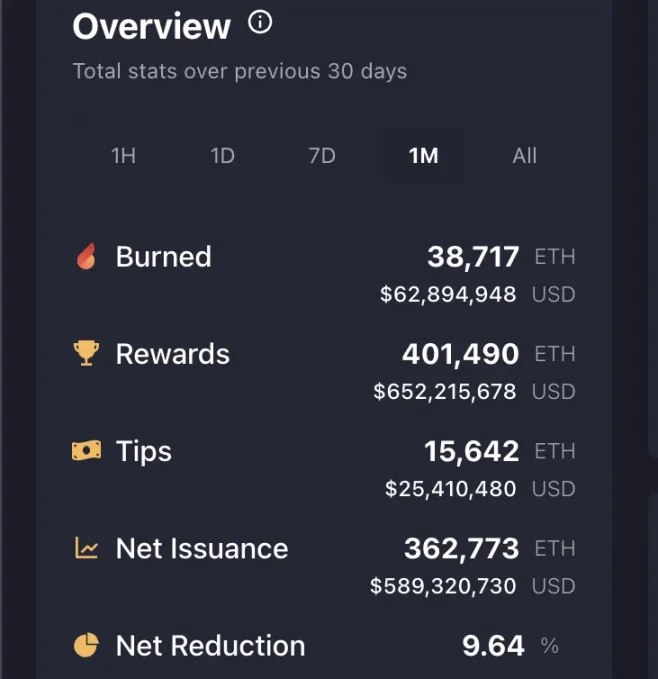
As can be seen from the graph, the days of burning more than 10,000 ETH per day seem to be over, and as technical analysts refer to, there is currently no support line. We also can't be sure where exactly the bottom is. In the past 30 days, the price of ETH has increased by more than 50%, while the gas consumption is only 1300ETH per day.
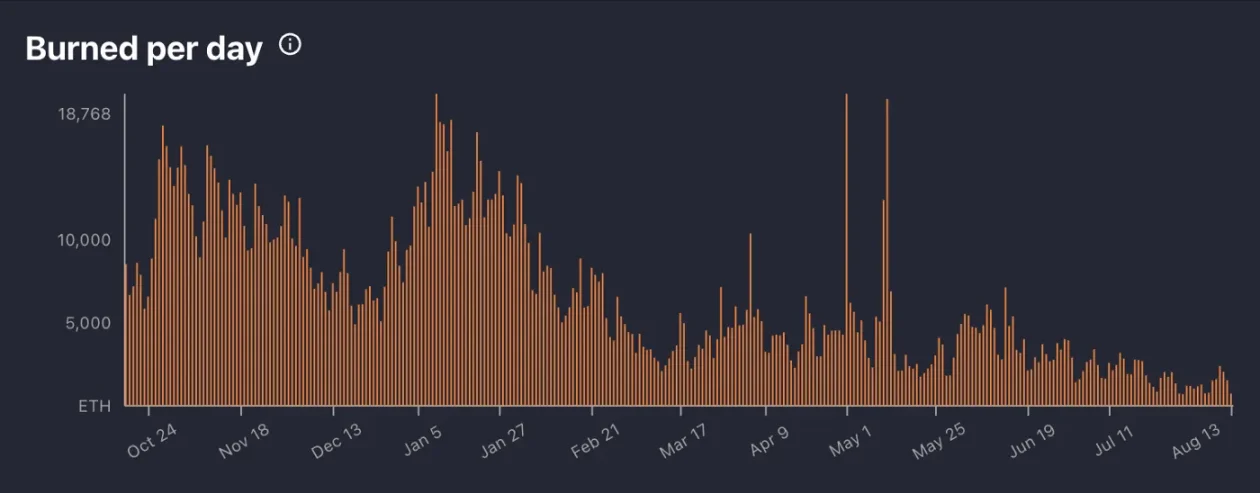
While ETH bulls will claim this is simply due to the cyclical nature of the cryptocurrency and that fees paid will eventually return to high levels, they ignore the one-way structural changes that are underway.
During bull market mania, when there is so much money flowing into the system, participants will still pay exorbitant fees to participate even if they don't want to. The first wave was the early days of DeFi, where creative and legitimate financial innovations leveraged viral marketing tactics like high APY prices to spark a new wave of Ponzi schemes and created a seemingly explosive airdrop and flow Sex mining feast.
The feast won't be over until participants figure out where these free funds come from. If they don't become passive LPs in the AMM, the tokens that fund the liquidity are practically worthless and the project will end up being a loss-making business. With the frequent occurrence of DeFi vulnerabilities in 2021, hackers gaining a lot of income from the agreement, and the price of the second pool falling, the market's enthusiasm for such activities gradually dissipated, and the summer of DeFi also ended.
However, when the gas fee decreased with the decrease of DeFi activities, the NFT craze suddenly hit. Similar to DeFi, what started with legal digital artwork and novel algorithm art quickly became the target of plagiarism by a steady stream of copycat PFP .
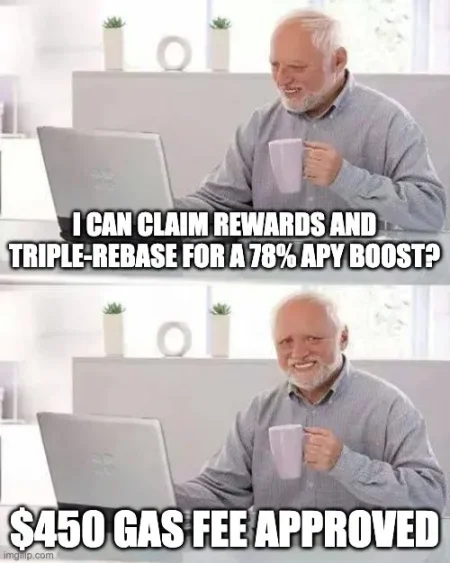
Most of these projects started to satisfy the heat of the market, and most of the projects gradually dissipated from the heat of starting, and finally became unknown. Before the market selects truly valuable NFTs, new project NFTs will be massively oversubscribed, and a large amount of Gas fees will also be consumed.
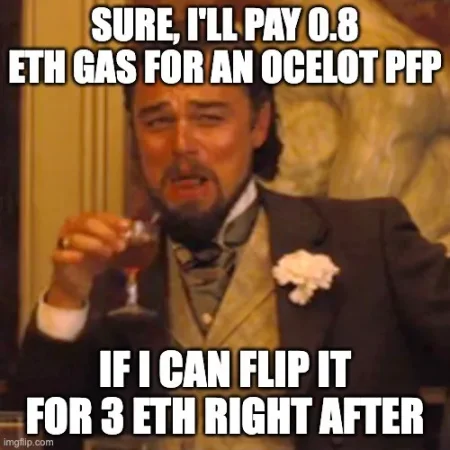
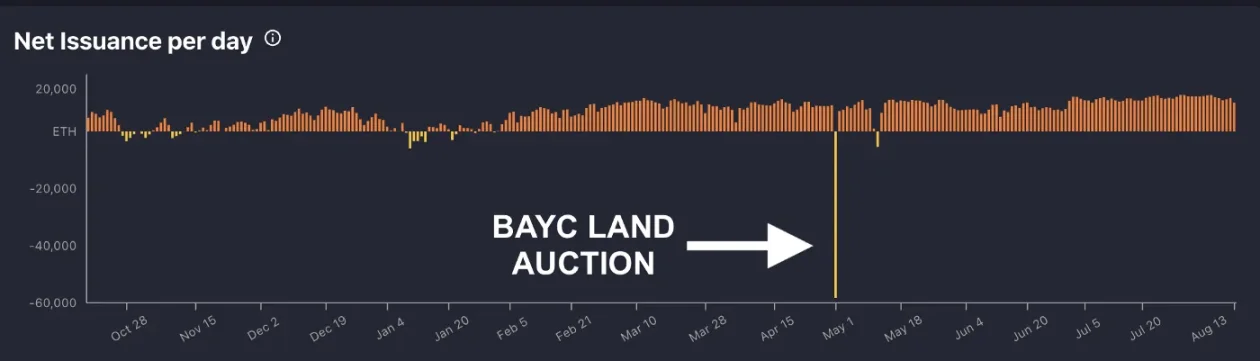
When the few winners in the NFT and GameFi wave managed to attract sticky users, they realized they could accumulate more value themselves instead of wasting it on ETH Gas fees. The phenomenon of gas fee consumption is clearly reflected in the Bored Ape Yacht Club virtual world land sale, where the land sales amounted to 285 million US dollars, while the gas fee was as high as 176 million US dollars. This is great for ETH holders, but brutal for the Yuga community. The sale is a lesson to be learned for Yuga Labs and the rest of the hot NFT community.

Not sure if they will eventually move to the L2 blockchain to avoid this recurring cost, or stay on mainnet and optimize the auction process to eliminate gas fees. What we do know for sure is that the days of high burn rates like the past may not be in the future.
Just imagine that after DeFi and NFT, will there be another new wave one day that will lead to high gas fees again?
In fact, innovations that attract attention at some point are bound to happen. However, if a new popular application needs to consume a large amount of ETH Gas to succeed, the project party will definitely find a way to avoid high Gas fees through technological innovation. Make block space less scarce:
Even in existing high-usage applications, code efficiency is improving rapidly. For example, OpenSea transactions are now 35% more efficient and consume a lot less gas.
With countless L2 and AppChains coming online in the near future for a variety of different use cases, many applications will find a new home outside of the Ethereum mainnet.
For those who stay on L2, writing Ethereum's L1 state at L2 using EIP 4844 (proto-danksharding) will become cheaper over time.
Perhaps L2 blockchains will create new vibrant on-chain ecosystems leading to massive ETH gas burns, but that remains to be seen. Once the L2 blockchain acquires a large and sticky user base, users in the ecosystem will start demanding localized value additions instead of delivering value to the Ethereum network.

Effect 3: The pledged supply will be locked
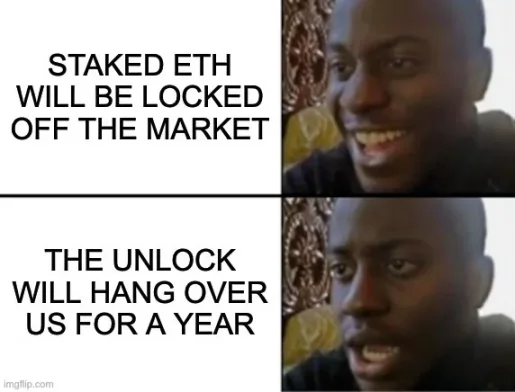
After ETH is pledged, it cannot be sold outside the market. After all speculative participants have completed the fork, participants participating in staking will not be able to withdraw their tokens until the Shanghai fork in 2023.
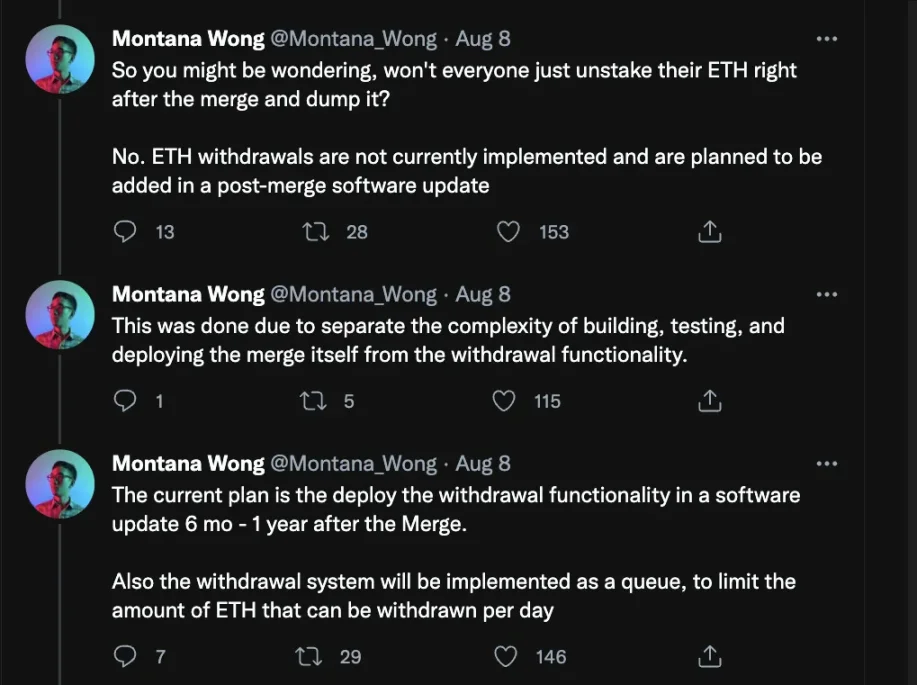
Of all the rosy price narratives, this one is probably the most false. The (over 13M+) ETH on the Beacon Chain has not only been unstaked, but has been earning yield unseen. Both PoW and PoS chains generate rewards, but only rewards on PoW are allowed to be sold. By the time of the Shanghai fork, about 30 million ETH will suddenly be unmortgageable (+ more than 1 million accumulated ETH rewards will flow out at the same time), resulting in the possibility of a considerable imbalance between supply and demand.
The market is always forward-looking, and when the next impending catalyst changes from a highly anticipated merger to a large token unlock with an unknown outcome, it will greatly increase the likelihood of a price break above the floor.
Narrative 3: Staked ETH will become an important bargaining chip for those seeking beneficiaries
image description
Source: Twitter
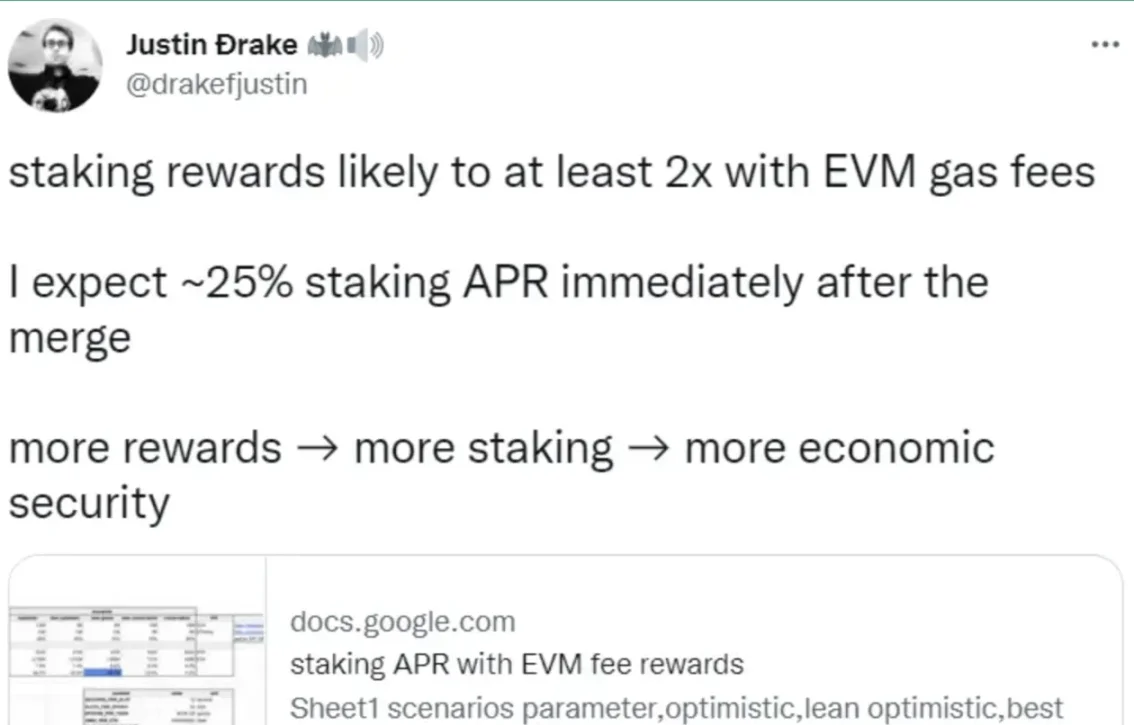
The block rewards that everyone is looking forward to, once only available to the elite miners, will now be safely packaged into risk-free benefits for everyone to enjoy. How will institutional treasurers continue to ignore this hallowed high-yielding asset when their balance sheets earn a measly 3% pa?
First of all, we must quickly put aside the subconscious concept of corporate buyers, and bear the ETH price risk, and the ETH rate of return cannot be risk-free! But even staking transactions for ETH holders aren’t as magical as they represent. Unfortunately, this is probably the most misleading of all Merge narratives, and it quickly turns into disappointment. Internet Bondooors will eventually be forced to remember the most basic rule: there is no such thing as a free lunch.
What do anonymous security guards expect when the risk is gone? They don't seem to be doing any useful work, nor do they have any skills. They just bought tokens and hit the stake button on the website. This only applies in the short term to those bearing the technical risk of the merger and the illiquidity premium of the Shanghai fork. In the past year, the 1-2% APY earned by staking Ethereum after token inflation is even lower than that of US Treasury bonds.

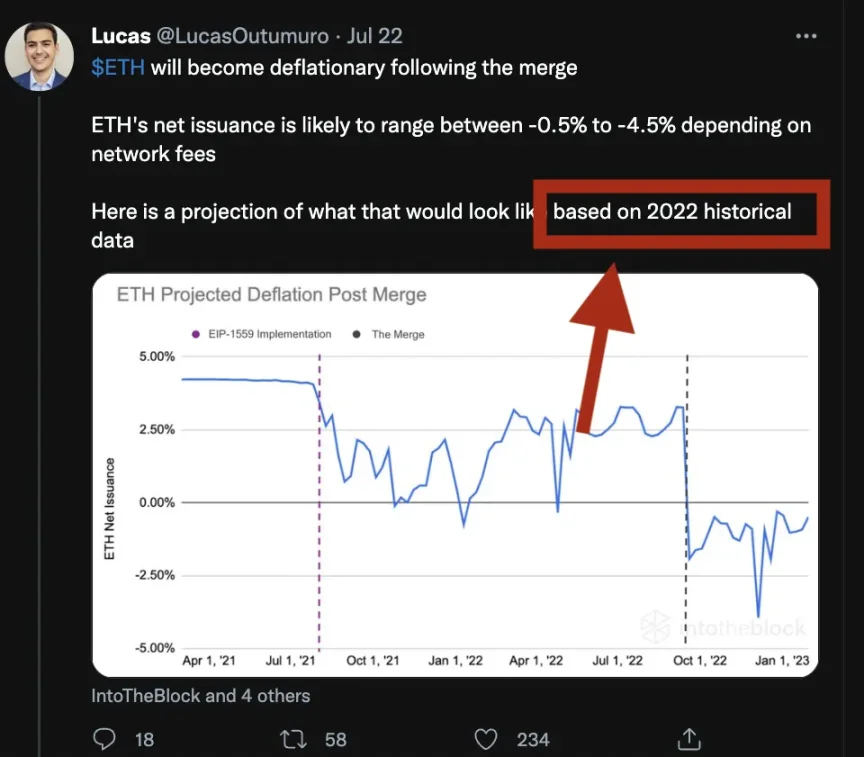
Why is there such a disconnect? Making forecasts based on historical data and assuming that parameters will not change is risky. We've seen that they wrongly predicted deflation due to miscalculation of gas consumption.
Because staking ETH needs to run a validator, it will generate income. There are three sources of headline output:
Block Rewards: New tokens from ETH inflation
Gas tips: from users who want to trade first
MEV Rewards: Bribes to Organize Transactions
Now let's see how they work?
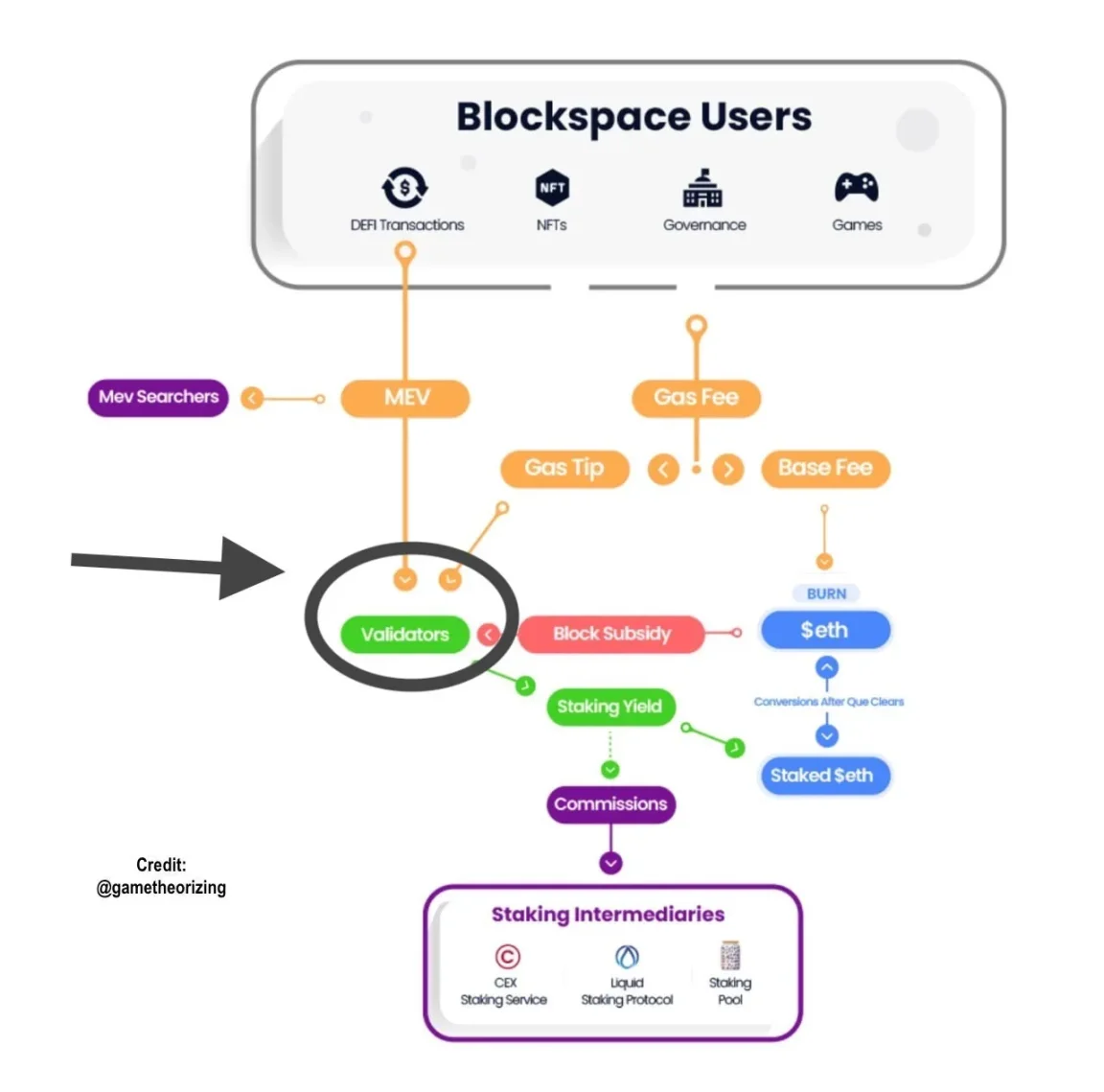
block reward
Only 0.083% of ETH was staked on the Beacon Chain earlier this year due to concerns about all the risks going forward. Even the Ethereum Foundation is not staking their ETH. However, this less than 10% staking participation is much lower than other proof-of-stake chains (~50-80% participation). As the risk of consolidation decreases, more stakers will quickly emerge and enter the staking queue.
This is the main source of dilution in the rate of return, and now that about 14 million tokens have been staked, the reward per validator has been reduced to 4.1%. Needless to say, after posting a successful merge, this number will continue to increase through the maximum allowed by the queue: about 2M/month. It's just a fact that even if someone wanted to cancel their mortgage now, they couldn't.
The impact of more ETH staking is as follows:
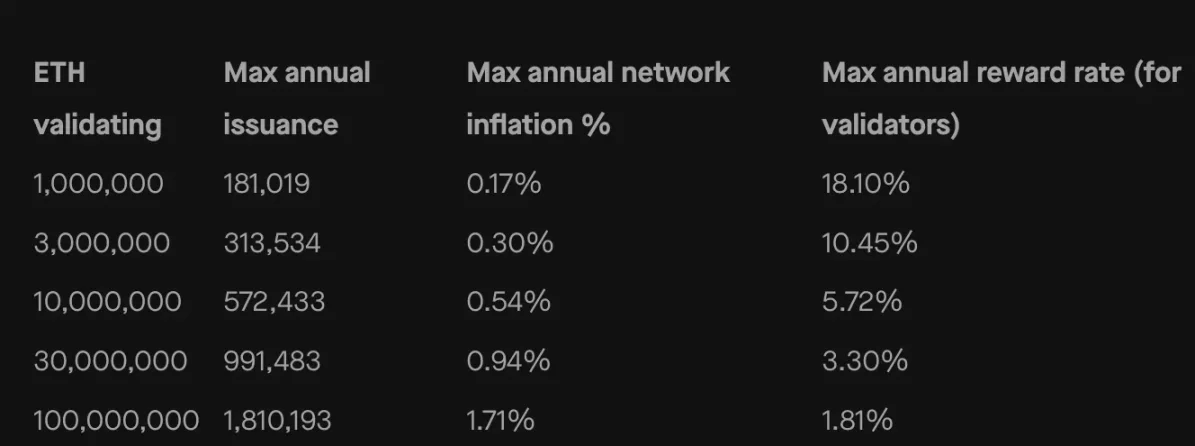
As more and more ETH is staked, not only will the reward rate decrease, but the annual inflation rate will increase, resulting in a lower real rate of return. In extreme cases, if you stake 100~120M, the reward rate minus the inflation rate will be 1.81%-1.71%= 0.1% APY. In some ways, this is good for Ethereum itself, more ETH staked equals higher security, and it costs more to attack the network.
And real (minus inflation) staking rewards are only high when a fraction of the supply is staked. Block rewards are a form of inflation that rewards stakers at the expense of those who have not yet staked. This is their punishment for being lazy, risk-averse, and immature.
Gas tips
In addition to the dwindling block subsidy rewards that validators already receive, a lot of the hype revolves around another part of the equation: Gas Tips and MEV bribes, both of which will only be enabled after the merger.
However, we also found that the hype far exceeded the current status quo. Just as we saw structural changes resulting in burning less Gas, the same is true for Tips and MEV:
Liquidity in AMMs dwindles, arbitrageurs bid to be removed first
Inefficient popular NFT auctions result in less fees to mint
Flashbots Silent Bidding Auction Replaces Public Gas Priority Auction
Starting from more than 50,000 ETH per month in the heyday, Gas tips in recent months have been below 20,000 ETH per month, and may continue to spiral downward.
MEV rewards
Finally, the part of MEV rewards that contributes the least to the equation but is the most discussed is discussed. In Proof-of-Stake, the chosen validators who publish the block act as transaction referees vying for positions within the block. Referees can take bribes to manipulate the competition if more profitable orders are available.
While this sounds like a malicious dynamic, it's actually better than creating an unstable system alternative. Flashbots is creating a product called MEVBoost to make these bribes transparent and available to all referees, meaning ETH stakers are more likely to get their “fair share”.
This may seem like a bullish effect, but MEV is being squeezed in various ways including the dApp layer, such as CowSwap which uses batch auctions.
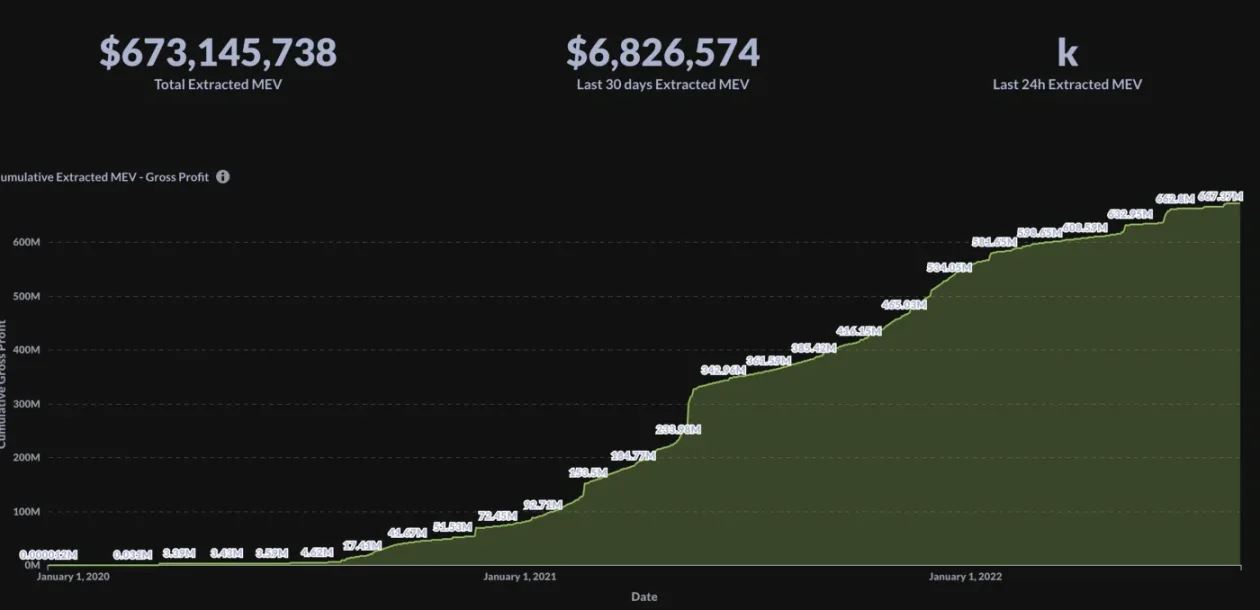
With less than $100 million in annual value extractable from MEVs today, it's a tiny part of the yield equation in the long run.
more real case
By 2023, we will see 30-60 million ETH pledged, which will have a 2.5% APY maximum validator reward, 0.5% Gas tips and a 0.1%-0.2% MEV boost, summing up the reward is about 3.2% APY. This also includes 1.5% token inflation and 0.25%-1% third-party validator operator costs. In the end there really wasn't much left.
A Final Note on Blockchain Revenues and Costs
Token economics and the rules of block subsidy and token burn, these are really important to create proper user incentives. But at the end of the day, they're just PvP games between stakeholders. The first way to see through the essence is to break down the economics of the blockchain into 3 clear parts:
value
Token Ecosystem
loss of value
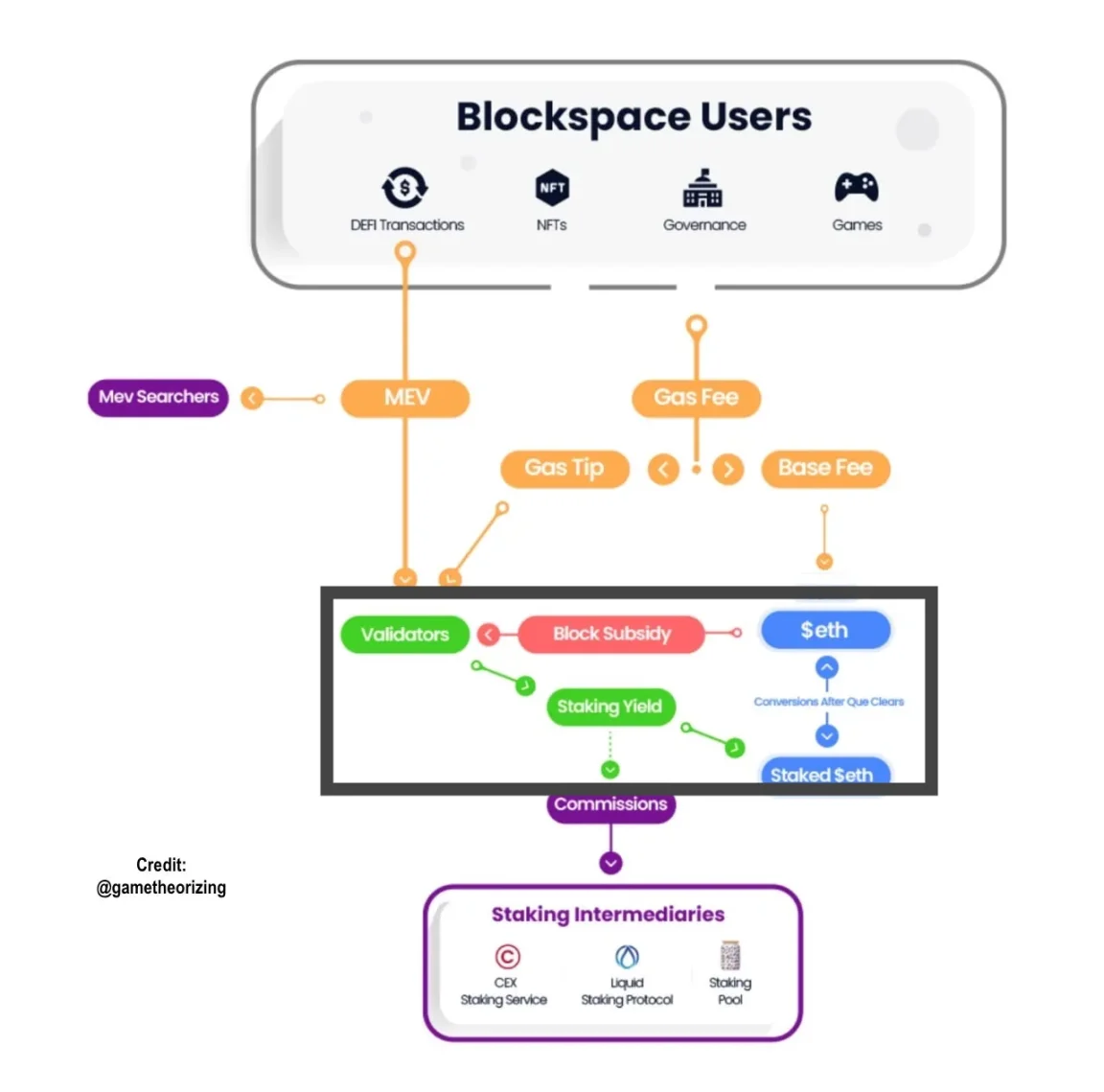
To make the PoS blockchain truly add value, MEV + Gas fee > intermediate payment needs to be met. Common users, staking pools, liquid staking DAOs, centralized exchanges, etc. are all ready to participate, and anything that ends up on the balance sheet is a loss of entropy for the blockchain ecosystem. To be sustainable, users must be provided with utility that exceeds the cost of the block space they consume. Sustained user engagement is the engine that drives the entire economy, and achieving this will have a longer-term impact than any PvP monetization game.
Narrative 4: A true ecological blockchain will be born
The merged Ethereum is expected to have a stronger community and social layer than meme tokens, better technology and more decentralization than Alt-L1s, and its price will rise rapidly and even surpass BTC. All expectations come from a successful merger. For example, after the merger, there will be many users adopting the Ethereum network. Ethereum will also continue to progress towards a roadmap of superior performance, while the supply is greatly reduced, hopefully challenging BTC to become a better reserve asset.

Each of these stories seems highly likely, but when compared side by side, serious conflicts arise.
Technology, meme, and saving value, each has a best story along its own dimension, here are some examples to consider.
Driving technological innovation and maintaining the status quo
As other blockchain ecosystems continue to innovate, Ethereum’s technological leadership is not enough to give us peace of mind. However, technical upgrades and resets will leave greater potential loopholes, which are easy to be hacked and cause losses. The concept of hard money will not have credibility if technology sharing persists.
Added value and good user experience
While users and holders are not disparate groups, combined token holders increasingly have influence over decisions. At that point there could be a myriad of ways to create perverse incentives that allow for short-term value extraction over long-term ecosystem health:
Designed around locked tokens that increase scarcity value
If the strongest incentive is to hoard tokens, then usage and innovation are much less valuable.
Technological improvements aim to lower MEV and reduce gas fees through more efficient code and transaction dApps such as Cowswap.
Token value accumulation requires more MEV and more value auctions.
Efficiency and censorship resistance
PoS improves efficiency in some ways, but also adds additional complexity, thereby expanding the possible attack surface.
Memeing about 99.9% ESG yield is shocking
The roadmap for the scalability vision moving forward
Decentralized currencies will face the ultimate censorship resistance.
Centralized or decentralized?
Centralized or decentralized?
This may be the most important conflict of all, an issue that has received particular attention following the recent Tornado Cash sanctions. If Vitalik's vision of a truly decentralized Ethereum comes to fruition, then Ethereum will have the vitality to maintain censorship, even if it means users may initiate soft forks and lose access to centralized stablecoins like USDC and rebuild oracles machine access.
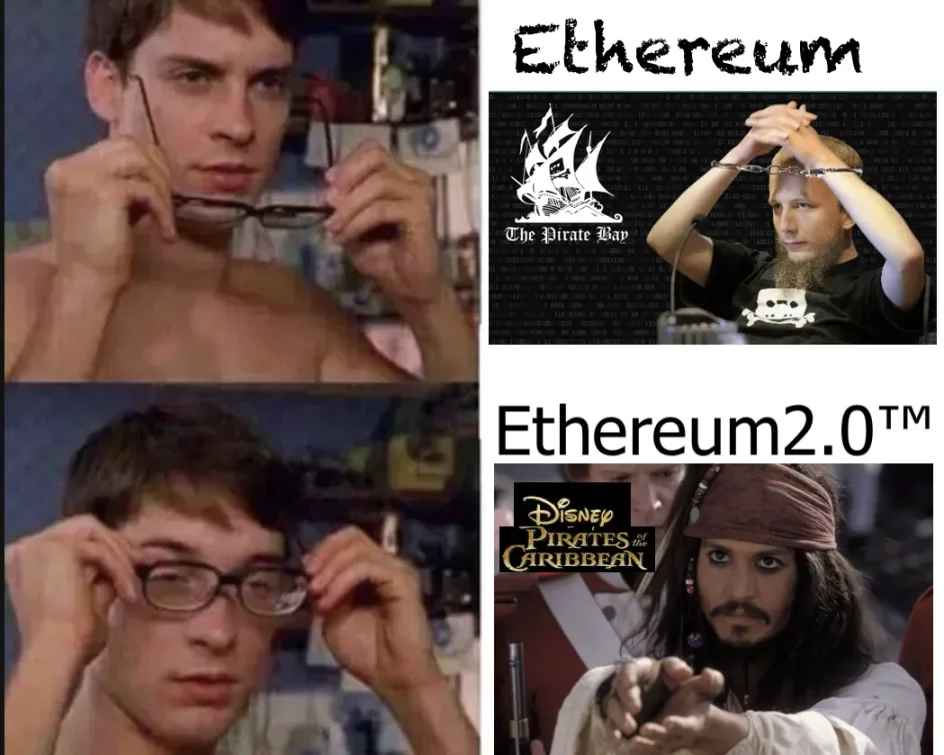
Or ethereum becomes a fully mainstream centralized blockchain, where institutional investment money will pour in, but in exchange, everyone will have to obey when a sovereign government pats the shoulder. Incentives for token holders would flock to the libertarian dream of the cypherpunks.
summary
summary
There may not be enough liquidity during this period to avoid selling pressure from bad news, as many are already in the profit-taking phase. Compared with before, the valuation of ETH that saves miners' selling pressure is about twice as high as before. Due to structural issues, gas fees are dropping dramatically, and eventually ETH as collateralized derivatives does not help. Expectations that Ethereum will turn into a superbond with very attractive yields are somewhat overblown due to deflationary expectations. Rather than price, the end point should be better-designed applications, novel use cases for block space, and a friendlier on-chain user experience.

Original link





