This article explains in detail the design concept of Aave's native stablecoin GHO


Original compilation: PANews
Original compilation: PANews
A few weeks ago, the concept of the GHO stablecoin was proposed on the Aave Governance Forum, which aroused great attention from the entire DeFi industry. Undoubtedly, as the next development plan of the Aave protocol, the idea of launching such a decentralized, collateral-backed, and dollar-pegged Aave DAO native stablecoin is very meaningful. PANews also published an article introducing this proposal.
Before Aave DAO and the team bring GHO to the market and make it a stablecoin as important as DAI, let's take a look at the design concept of this stablecoin. However, since the information currently available is not comprehensive enough, the second part of this article is mainly based on some inferences based on the experience of the DeFi industry.
 1 What is Aave's native stablecoin GHO?
Since Aave is the DeFi lending protocol of choice for most lenders, one of Aave’s initial goals was to attract enough stablecoin deposits. Next, creating a DAO-native stablecoin is also a very natural thing, because it can reduce the cost of borrowers. In addition, by minting stablecoins, depositors do not need to pay additional fees for annualized returns.
secondary title
1.1 Over-collateralized USD-pegged stablecoins
GHO is an over-collateralized stablecoin minted using aTokens as collateral, so in a sense GHO is similar to MakerDAO, but slightly more efficient since all collateral is productive capital and will A certain amount of interest (aTokens) is generated - depending on the borrowing demand.
Interestingly, Aave did not add the word "USD" to the name of this stablecoin. Since U.S. regulators have traditionally been more aggressive, the GHO probably doesn't want to get in too much trouble from a legal standpoint. In addition, Stani, the founder of Aave, also hinted that GHO may undergo anchoring changes in the future, explaining:
secondary title
1.2 Interest Rate Model and Staking Discount
The interest rate model is probably the least brilliant part of GHO so far. Aave's original idea was for Aave DAO to directly determine the interest rate, just like how it works in Maker, but this approach is very inefficient and will add to governance. necessary trouble. It would make more sense to use an algorithmically determined interest rate model that adjusts to market conditions, just like other tokens on Aave, where the interest rate is determined by supply and demand in the pool.
In general, DAOs are absolutely not suitable to participate in the management of system operating parameters, because this will result in a hybrid model with a fixed base rate, which can only be adjusted within a certain range according to market conditions. Therefore, the idea that the Aave community wants DAO to participate in interest rate determination is quite absurd.
In fact, dynamic changes in interest rates can protect GHO’s anchoring by preventing large-scale minting events, just like the baseRate (base rate) on the Liquity protocol can prevent LUSD from being anchored downward. On the Liquity protocol, the initial fee is 0.5%, and as demand surges, the fee will increase, and will gradually trend towards 0.5% when demand stabilizes.
During this governance forum, Aave also mentioned the issue of discounts for GHO lenders to pledge AAVE tokens, which they believe will create further synergies. All interest paid by stakers will eventually go to Aave DAO (most other tokens are 0-10%), which means that once GHO grows to a significant market cap, it may become a cash cow for the DAO. With a market cap similar to DAI and a higher average interest rate of 3.5%, AaveDAO can earn nearly $150,000 per day from GHO.
The following figure shows the interest rates and income reference values corresponding to different GHO market values:
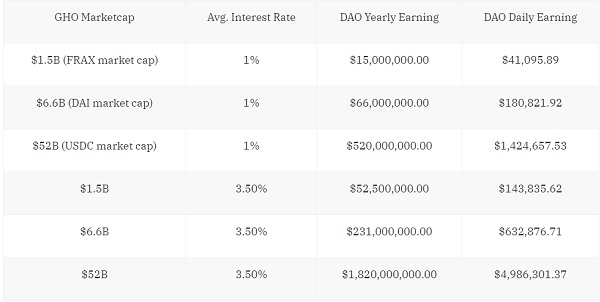
Form description:
1. Market value of GHO: USD 1.5 billion = current market value of FRAX, USD 6.6 billion = current market value of DAI, USD 52 billion = current market value of USDC.
secondary title
1.3 “Facilitators” and risk-weighted assets
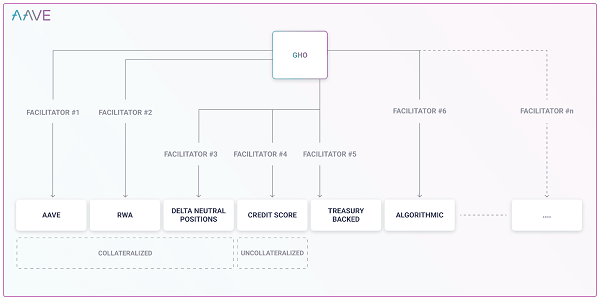
In the process of designing GHO, the team proposed the concept of "Facilitators (facilitators)". This "Facilitator" can mint GHO and is governed by Aave. The first "Facilitator" will be the Aave protocol itself, and then other protocols or entities will follow suit. It can be said that this design has expanded the GHO space at once. It is expected that after its release, many other protocols will apply to become "Facilitators" on Aave and GHO. I feel very excited when I think about it.
secondary title
1.4 "Decentralization" and non-censorship resistance
The Aave team describes GHO as a decentralized stablecoin and even mentions censorship resistance. This doesn't seem to be directly related to GHO though:
Stablecoin adoption will continue to grow as crypto assets further integrate with non-crypto-native user bases. Decentralized stablecoins provide censorship-resistant fiat currencies on the blockchain. GHO, a decentralized multi-collateral native stablecoin fully backed by the Aave protocol.
From the team's description, GHO will be "decentralized" like DAI and less censorship resistant due to the composition of its collateral. In fact, assuming that all aTokens that can be used as collateral for lending on Aave can also be borrowed from GHO, then the collateral of GHO will mainly consist of some reviewable tokens such as USDC:
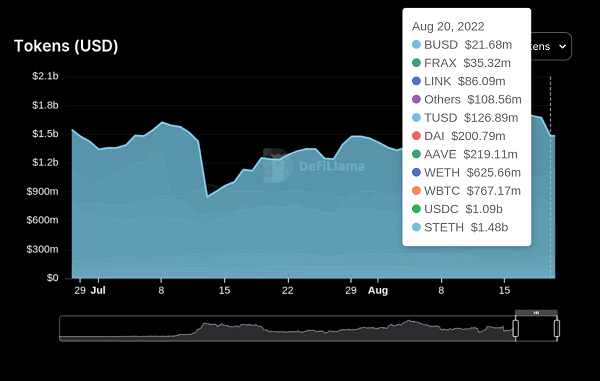
Source of the image above: DeFiLlama
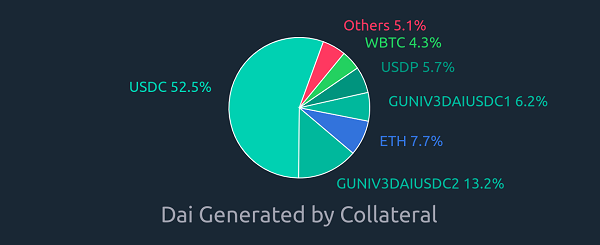
In fact, USDC is the most used type of collateral on Aave, excluding stETH (liquid collateralized ETH on Lido), closely followed by wBTC, another trusted token. Still, the collateral composition on Aave is much better than that of DAI, where over 50% of its collateral composition is pure USDC.
first level title
2 What will Aave and GHO look like after listing?
Now that basically everything is in place, we can move to a more "speculative" phase and consider how the GHO could be applied in practice.
In fact, the interaction between the Aave protocol and GHO is sure to be very exciting: While there was talk of Aave x GHO earlier, as well as enabling eMode trading on GHO — enabling leverage on selected currency pairs like USDC/DAI — — but there are not many details about it, so some assumptions will be briefly explained here.
aGHO should become the most intriguing collateral on the Aave protocol, but there could also be significant reflexive risks if GHO were allowed to be borrowed. So it would be best if GHO could be prevented from minting GHO with aGHO, or you will likely see the problems that are currently happening with DAI.
secondary title
2.1 GHO's liquidity strategy
Another key part of the stablecoin design is the liquidity strategy. On Aave, CRV, CVX and BAL can all be used as collateral. Based on the Reserve Factor (Reserve Factor), these tokens locked in the native protocol will be in the "vault" ”, and then allow Aave DAO to direct incentives to mining pools related to GHO.
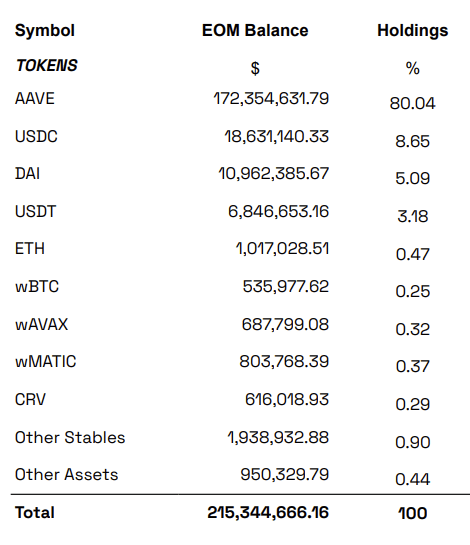
Above: The current state of Aave’s “Vault”, with over 615,000 CRVs. Source: Aave’s “Vault” Report (July 2022)
Now, Frax is trying to "get rid of" USDT and DAI and trying to establish Frax Basepool (FRAX/USDC) to become the base currency for other stablecoin trading pairs on Curve. We can imagine that Aave will take similar moves in the future. In fact, many projects currently exposed to USDC and DAI are seeking to decentralize their own liquidity, and GHO may also be waiting for a "perfect time" to make DeFi less dependent on USDC.
Frankly speaking, Frax previously controlled a considerable amount of governance and regulation voting power in the "confrontation" with Curve, but Aave DAO may not be able to do this, and the CRV/CVX balance in its reserve "vault" is obviously not enough The incentive fund pool has grown to a billion-dollar scale, which means that AaveDAO needs to seek to obtain more liquidity-based incentive-driven tokens. However, since AaveDAO can generate substantial income from GHO interest yields, they should have sufficient means to support some level of liquidity no matter what GHO's market cap ends up being.
The last thing to mention is that the relationship between Aave and Balancer is actually "good". First, since the transition to AAVE tokens, the distribution rule adopted in the Aave security module has been "80% AAVE / 20% wETH Balancer Pool". Secondly, Aave currently holds 200,000 BAL in its reserve treasury, and plans to increase its holdings. Therefore, we can expect the stablecoin GHO to have a wonderful performance on the Balancer protocol. However, compared to Balancer, the potential risk point of Aave stablecoin GHO may be on Cruve, because Curve is both the "king" and "kingmaker", so if you want to increase GHO liquidity on Curve, the difficulty should not be low, even Likely to be forced to choose "against" Curve like Frax.
first level title
3 summary
Hope this article helps you better understand what is at stake in the stablecoin wars, with the GHO launch looming and the Curve stablecoin also supporting overcollateralization and launching within the year, this year’s stablecoin market is sure to be very interesting. For the DeFi market, the expansion of stablecoins may be the next development trend, and most DeFi protocols are exploring the expansion of their own native stablecoins, such as:
1. Frax was initially just a stable currency, but now it has launched DEX FraxSwap, and will also launch FraxLend, a lending platform;
2. Aave was initially just a currency market, but soon had its own native stable currency;
3. Curve was originally just a DEX, but soon added its own stable currency and began to provide effective lending services for liquidity providers.
Original link