


Don't count on CeFi to secure the Ethereum network


Original Author: @0xTodd, Partner at Nothing Research
There is no absolute in everything. The pros and cons of ETH’s PoS vs PoW must be viewed in different dimensions in order to get the pros and cons. If we confuse security and decentralization to talk about it, it becomes a discussion between chickens and ducks, and everyone "talks about each other", then the discussion is meaningless.
Anti-censorship can be viewed from at least two perspectives:
→If you want to review, how long can you keep your transaction from going on the chain;
→ If you want to review, can you guarantee that your transaction can still be on the chain;
Anti-51% attack can also be viewed from two perspectives:
→If an attack is to be made, how much does the attacker need to pay;
→If you want to attack, what is the possibility of "renting" it.
For the transfer of ETH to PoS, decentralization and security cannot be discussed in terms of "higher" and "lower", because their scope is too broad. So, let's talk about them one by one.
Let's talk about security first. There is no doubt that the cost of attack has become higher. This has been discussed many times, so it will be briefly stated here. If you attack a PoW network with powerful computing power, what you actually pay is only the electricity bill, and your computing power will not be damaged by your attack, especially when the proportion of ETH graphics card mining machines is very high, the big deal is that it will be dismantled after the attack Mining machines sell graphics cards.
But PoS is different. If you attack the ETH PoS network, your mortgaged ETH chips will be wiped out. This increases the attack cost hundreds of times. You should know that attacking PoW is a temporary investment, while attacking PoS is a permanent expenditure.
However, from the perspective of "rentable", it is the other way around, and it is slightly worse. It is a "difficult" task to rent 51% of ETH computing power. It's not a question of cost, it's a 1 or 0 question. This is mainly due to the physical properties of PoW, after all, miners are scattered all over the world.
But PoS is different. There are 120 million pieces of ETH in circulation, and the current stake of beaconchain is 13 million+. Theoretically, as long as you "borrow" 5% of the ETH circulation, you can attack the network 51%. Of course, I'm not saying it's easy, it's still "very hard", it's just no longer "difficult".
Moreover, in a centralized world, borrowing things may require mortgages, reputation, or even power, such as supervision, which also introduces our second problem.
Transaction censorship resistance is part of the decentralized nature.
At present, 2/3 of the nodes of ETH beaconchain are under the jurisdiction of the United States, which may bring censorship.
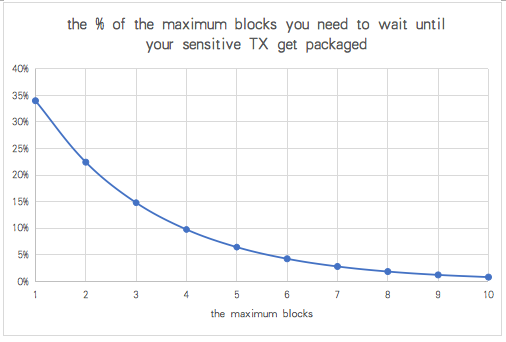
Let’s take Tornado as an example, a tornado transaction, if US regulations require these 2/3 mining pools to ban this transaction, this will significantly increase the transaction on-chain time. In the past, your transaction could go online in 12 seconds, but in the future it may take more than 30 seconds, or even a minute or two if you are lucky.
I calculated a curve (pictured below), the probability of banning you for one minute in a row is about 10%, so it is still quite disgusting.
But in fact, this is not a problem of the consensus of PoS, but a problem of switching between China and the United States. In the past, the proportion of top mining pools in PoW was also very high, and the top 10 accounted for about 78%. If you join forces and want to censor your transaction and prevent you from going to the chain, it is also possible.https://etherscan.io/stat/miner?range=7&blocktype=blocks
However, many of the mining pools with a Chinese background, and many mines are located in Russia and Central Asia. China and Russia can be said to be one of the few regions in the world where it is difficult for the United States to directly supervise. All this has nothing to do with the technology, but with the participants.
Today’s PoS mining pools, whether Lido, Coinbase, or Kraken, are all located in the United States, so they are naturally restricted everywhere. Although they are all making positive statements at present, judging from their tonality, it is still not a small probability event that they will review illegal transactions in the future. Therefore, in terms of review time, PoS is actually inferior to PoW.
However, there is another indicator - it is to discuss the worst case, that is, can you guarantee that your transaction can at least be on the chain. Let's continue to calculate. If you still calculate according to 2/3, then in 98% of the cases, your transaction must be able to be uploaded to the chain within 10 blocks. There will always be mining pools that can ignore the requirements of US regulation, all you have to do is wait.
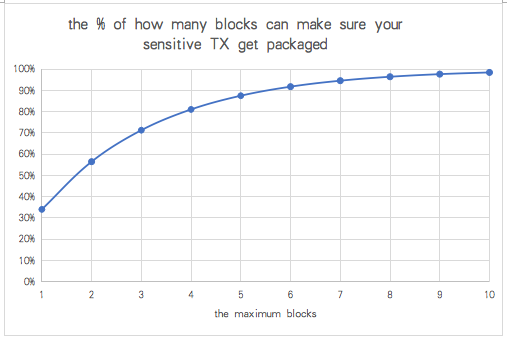
In other words, the United States can suppress your transaction for a few minutes, but it cannot suppress your transaction for a lifetime. This is completely different from AAVE shielding Sun Ge and Shenyu. AAVE is a single point, while the mining pool is multi-point.
In addition, as long as a small number of nodes still adhere to the bottom line and constantly change their mining pools, your transactions can be uploaded to the chain.
Of course, PoW can also switch mining pools at will, but PoS is slightly more concealed. In life now, there will be many people who know that you run a mine, but there will be very few people who know what server you are running a PoS node secretly. From this point of view, PoS is slightly better than PoW, but of course the same.
Many people will continue to deduce in the future, if the supervision finds that your privacy transaction is slow in the end, but you can always evade sanctions, so you decide to roll back directly, what will happen to you?
First of all, this has been out of the scope of transaction review, which can be roughly equivalent to directly attacking the network. The probability of this happening is very small, but it is also a hidden danger.
For example, one of your tornado transactions is finally on the chain through a node that is not regulated by the United States. At this time, the supervision of the large mining pools that controlled 2/3 issued instructions, and they can directly fork through the network to directly delete the block containing your transaction, so that your transaction will never be uploaded to the chain. Since your transaction cannot be deleted, just reject your block directly. Judging from the current PoS, it is possible to realize it in a single echo.
For this situation, some people in the Ethereum community believe that social slashing (social punishment) should be done, and the security deposit of nodes doing this should be directly confiscated. But in this way, it may enter a new totalitarianism. Ethereum should not adopt rules that are not written on the blockchain.
Moreover, the current mining pool nodes will be connected to MEV tools similar to Flashbot, but Flashbot is also subject to supervision, so that it may happen: transactions that do not meet the regulatory requirements will not appear in Flashbot’s transaction list at all. nodes are also affected by it. Therefore, more tools are also needed.
Coinbase came out and stated that it will not compromise with the supervision, and would rather give up the business if it wants to review. But to be honest, staking benefits are huge, and staking APR is expected to reach 8%-10%, including 10%-20% commission. There are only a few million ETHs in the Coinbase cold wallet. If you don’t do staking, you will lose tens of thousands of ETHs a year.
It is impossible not to do this business; but it is also impossible to ignore the supervision.
Therefore, we cannot count on Cefi, whether it is Coinbase, Lido (semi-cefi), or flashbot (centralized tool). We still need to improve and optimize the chain itself at the technical level, and this work is definitely a long way to go.
In this way, we can protect our Ethereum network.





