


ETH Weekly | ETF releases upgrade guidelines and clarifies misunderstandings related to mergers; Ethereum mainnet merger preparations have been completed (8.15-8.21)


Author | Qin Xiaofeng
Editor | Hao Fangzhou
Produced | Odaily
1. Overall overview
Author | Qin Xiaofeng
Editor | Hao Fangzhou
Produced | Odaily
secondary title
1. Overall overview
According to Tim Beiko, the core developer of Ethereum, the mainnet of Ethereum has completed the 11th shadow fork (mainnet-shadow-fork-11), which is also the best performing shadow fork so far. There are currently 34/35 nodes Passed The Merge without a hitch, and 1/35 hasn't synced yet. Tim Beiko added that two problems have been discovered after the merger. One is that Erigon generates bad blocks on the Goerli client, and the other is related to the blocks generated by Nethermind when interacting with certain clients. Both of these issues are being fixed, and the development team will test these issues on subsequent shadow forks.
In addition, the Ethereum Kiln test network will be closed on September 6 when Bellatrix is activated on the main network, and there are almost no transactions on the network at present. In June of this year, the Ethereum Foundation announced the abandonment of test networks such as Ropsten, Rinkeby, and Kiln, and set aside time for users and developers to complete the migration before they were completely closed.
The Ethereum official website ethereum.org launched by the Ethereum Foundation clarifies the misunderstanding about the merger in the Ethereum upgrade guide, as follows:
The statement that "it takes 32 ETH to run a node" is wrong, anyone is free to synchronize their own self-validating copy of Ethereum (i.e. to run a node), no need to use ETH, no matter before or after the merger;
Merger is a change in the consensus mechanism, not an expansion of network capacity, nor will it reduce Gas costs;
The statement that "transactions will be significantly faster after the merger" is false, although there are some minor changes, the transaction speed of L1 will remain basically the same;
When withdrawals are enabled, the rate at which validators/stakers exit is limited for security reasons;
Second, the secondary market
1. Spot market
In terms of the secondary market, the current ETH price may continue to fall in the short term, with support at $1,600, $1,500, and resistance at $1,700.
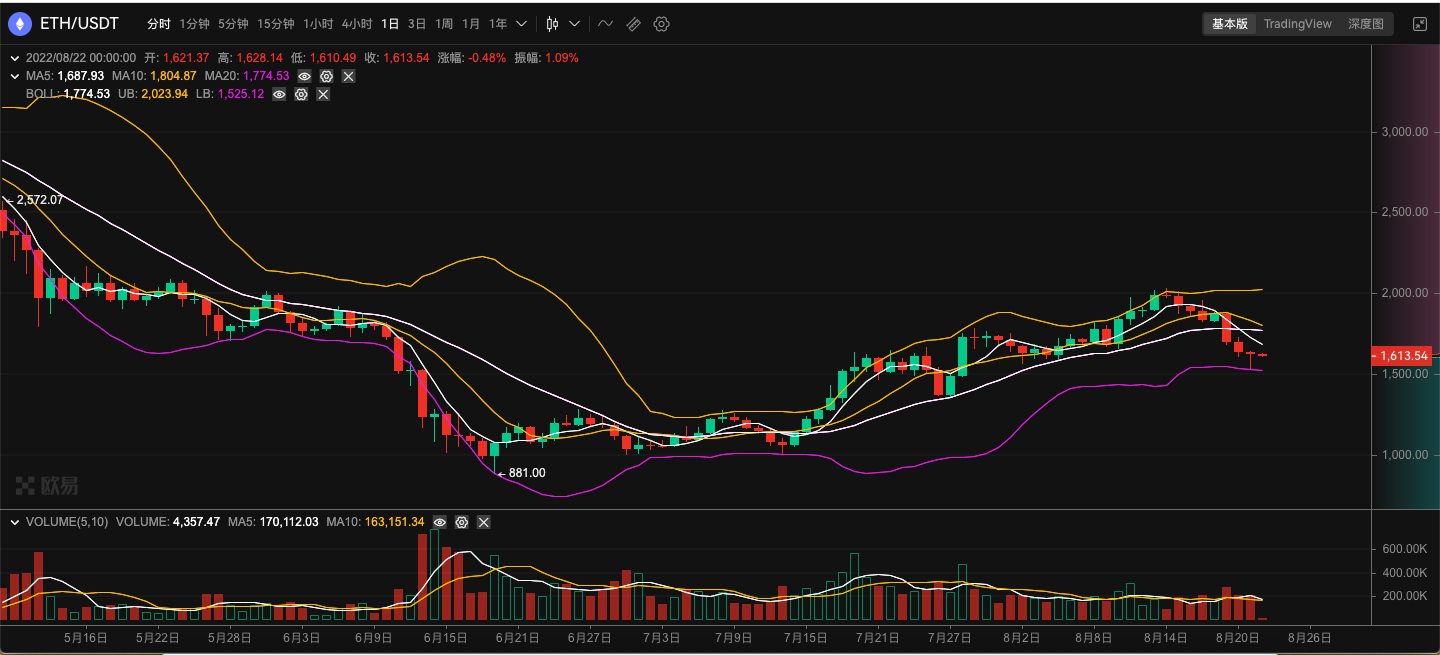
(ETH daily chart, picture from OKX)
Second, the secondary market
According to OKX market data, the price of ETH once fell to US$1,520 last week, and closed at US$1,621 during the week, a month-on-month decrease of 18.2%.
OKlink dataThe daily chart shows that the price is currently consolidating at $1,600, and may step back on the lower Bollinger Band at $1,525 in the short term; the short-term support is $1,600 and $1,500; the upper resistance is the 5-day moving average ($1,687) and the Bollinger middle Rail ($1780).
3. Rich list address
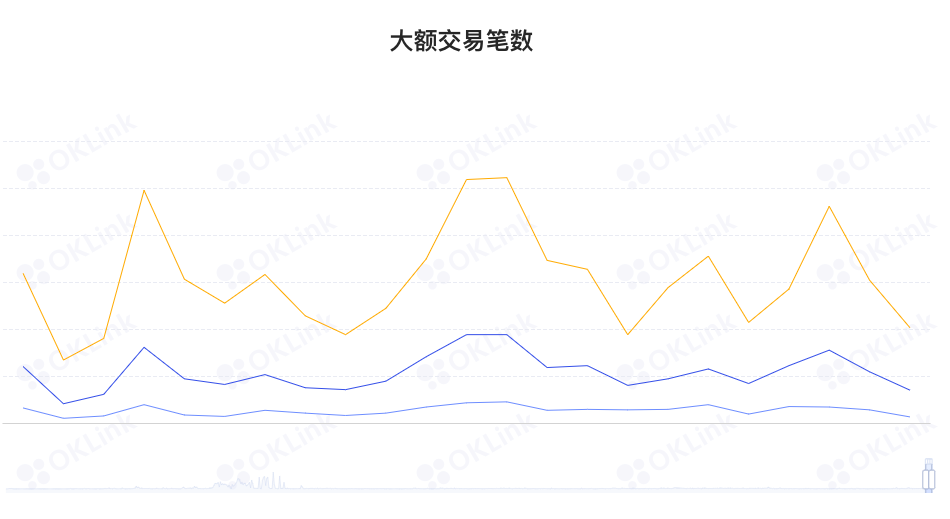
OKlink dataIt shows that the number of on-chain transfers dropped slightly last week, with "above 1000 ETH", "above 2000 ETH" and "above 5000 ETH" decreasing by 15.4%, 17.5% and 8.3% month-on-month respectively, indicating that the trading enthusiasm of giant whales has declined slightly.
3. Ecology and technology
1. Technological progress
3. Rich list address
OKlink data
3. Ecology and technology
1. Technological progress
(1) ETH2.0: Ethereum side chain Gnosis Chain merged test network Chiado has been successfully merged
On August 17, dapplion, the core developer of ETH2.0, posted on social media that Chiado, the main merged test network of the Ethereum side chain Gnosis Chain, has been successfully merged.
(2) Ethereum core developers: The preparations for the mainnet merger have all been completed
Tim Beiko, the core developer of Ethereum, said on his social platform that the preparations for the merger of the Ethereum mainnet have been completed. Previously, the Ethereum Foundation had issued a document stating that the target date for the merger of the Ethereum mainnet is September 15, 2022, but this estimate has an error of at most one week.
At the latest Ethereum core developer meeting, it has been confirmed that the TTD of the merged mainnet of Ethereum is 58750000000000000000000 (will transition to the PoS network), which is the same as previously tentatively scheduled, which means that the merger of Ethereum will be officially launched around September 15 .
(3) Ethereum official website: The merger will not reduce the gas fee, and the pledged withdrawal will be enabled after the upgrade in Shanghai
The Ethereum official website ethereum.org launched by the Ethereum Foundation clarifies the misunderstanding about the merger in the Ethereum upgrade guide, as follows:
1. The statement that "32 ETH is required to run a node" is wrong, anyone is free to synchronize their own self-verifying copy of Ethereum (that is, to run a node) without using ETH, regardless of whether it is merged or not.
2. The merger is a change in the consensus mechanism, not an expansion of network capacity, nor will it reduce Gas costs.
3. The statement that "transactions will be significantly faster after the merger" is wrong, although there are some minor changes, the transaction speed of L1 will remain basically the same.
5. After the Shanghai upgrade, the fee reward/MEV will be credited to the mainnet account controlled by the validator and immediately available.
6. When withdrawals are enabled, the rate at which validators/stakers withdraw is limited for security reasons.
8. The merge upgrade aims to transition to Proof of Stake (PoS) with zero downtime.
2. Voice of the Community
(4) The 11th shadow fork of the Ethereum mainnet has been completed
According to Tim Beiko, the core developer of Ethereum, the mainnet of Ethereum has completed the 11th shadow fork (mainnet-shadow-fork-11), which is also the best performing shadow fork so far. There are currently 34/35 nodes Passed The Merge without a hitch, and 1/35 hasn't synced yet.
Tim Beiko added that two problems have been discovered after the merger. One is that Erigon generates bad blocks on the Goerli client, and the other is related to the blocks generated by Nethermind when interacting with certain clients. Both of these issues are being fixed, and the development team will test these issues on subsequent shadow forks.
In addition, the Ethereum Kiln test network will be closed on September 6 when Bellatrix is activated on the main network, and there are almost no transactions on the network at present. In June of this year, the Ethereum Foundation announced the abandonment of test networks such as Ropsten, Rinkeby, and Kiln, and set aside time for users and developers to complete the migration before they were completely closed.
2. Voice of the Community
On August 16, Vitalik participated in the discussion on the topic of "How will the Ethereum community react if the supervision of verifier nodes of certain protocols (such as Lido, Coinbase, etc.) conducts a protocol-level review of Ethereum?" It said it would view such censorship as an attack on Ethereum and chose to destroy these nodes through a broader consensus (social consensus).
First of all, regarding the review of Ethereum transactions by MEV repeaters (such as Flashbots), a member of the Flashbots team said that after the merger, the MEV-Boost software on Ethereum may be added to the blocks created by third-party block builders New functionality to add new transactions. Additionally, Flashbots this week open-sourced the software it runs relays on, which will encourage more relays that don’t censor block builders and transactions to build and operate on the merged ethereum. Ethereum founder Vitalik Buterin said that as long as there are a few active validators who don't run Flashbots or connect to censorship-resistant relays, even non-compliant transactions can eventually be processed.
3. Project trends
(2) Grayscale: ETHW bifurcation may be difficult to succeed
On its official website, Grayscale discussed the feasibility of the ETHW hard fork and the significance of this event to ETH and ETC. The blog post concluded that due to the complexity of DeFi and the proliferation of asset-backed tokens, ETHW forks will face significant challenges. While the chances of success are expected to be low, there has been some support for the PoW fork from miners and exchanges. So far, speculation on the ETHW token has led to a steady price drop of more than 50% since launch, while ETC’s price has risen by about 9%.
In addition to declining interest in the ETHW token, major Ethereum protocols and players such as Tether and Circle have expressed support for ETH PoS as the canonical chain — an important sign of support, as the two companies responsible for Tokens backed by a large number of on-chain assets. If the protocol finds out that token holders do want to mutate the protocol on a PoW variant, they will likely favor ETC over exploring the complexities of replicating an on-chain ecosystem on ETHW.
3. Project trends
(1) The initial version of the Ethereum fork project ETHW Core is released, including disabling the difficulty bomb, etc.
EthereumPoW (ETHW) advises ETH holders to withdraw assets from LPs such as Uniswap, Sushiswap, Aave, Compound, and other DEXs. ETHW Core plans to introduce Liquidity Pool Freezing Technology (Liquidity Pool Freezing Technology). After the hard fork, they will temporarily freeze ETHW tokens in some LPs of DEX and lending agreements to protect user assets. The ETHW team believes that after the Ethereum PoW hard fork, especially in the first few blocks, the ETHW tokens deposited by users in the liquidity pool may be exchanged or borrowed by hackers and scientists using USDT, USDC and WBTC It said this would "cause enormous disruption to the community".
The idea of freezing user assets without their consent is unacceptable to many in the community. Someone reminded the ETHW Core team that this practice is not in line with the principle of decentralization. Others called it a scam and suggested reporting a Twitter account claiming to be the ETHW core team.
According to previous reports, the initial version of the Ethereum fork project ETHW Core was released, including disabling the difficulty bomb. (Cointelegraph)
(2) StarkWare launches recursive proof, which can bundle tens of millions of NFTs
(3) Coinbase: Facing scrutiny, it will give priority to shutting down the business
In response, LukeYoungblood, the builder of Coinbase’s Ethereum Staking business, replied on Twitter that Coinbase will fight against this before reviewing the transaction and shut down the product. Many people are lobbying in Washington to lift Tornado Cash sanctions. On the other hand, LukeYoungblood mentioned that for tax purposes, all Ethereum validators for Coinbase’s retail business operate outside the United States, so this review has constituted a “long-arm jurisdiction” for U.S. regulators.
(4) Polygon has open-sourced the zero-knowledge proof systems Plonky2 and Starky, which can be used as Ethereum STARK provers
(5) Compound is preparing to launch a new version of the transition to multi-chain, and will first deploy the USDC market on Ethereum
Compound announced that it will soon launch its third version of the multi-chain lending protocol Compound III (Comet). Compound III can be deployed on EVM-compatible blockchains. It will first deploy the USDC market on Ethereum, and it has already been deployed on the main network. Candidate contracts, which will be activated by Compound governance. (The Block)
(6) zkSync: A new gas fee model will be introduced to achieve a dynamic fee mechanism
(7) MakerDAO: Canonical DAI has been launched between Arbitrum Nova and Ethereum
MakerDAO announced that it has launched its cross-chain solution, Canonical DAI, between Arbitrum Nova and Ethereum. Due to the permissionless nature of the bridge, the deployment of the bridge on Arbitrum Nova has been executed by the core team of protocol engineering without the need for an executive vote. This deployment will ensure that users of Arbitrum Nova use Canonical DAI from day one, thereby eliminating the need for any token migration. Canonical DAI is a solution created by MakerDAO as a way to move DAI off-chain, essentially Canonical DAI allows MakerDAO to support a wrapped version of DAI.
(8) Report: Nearly 75% of money laundered on the Ethereum network is sent to Tornado Cash
(9) Bitfly: Ethermine will close the ETH mining pool on September 15, and will not provide a dedicated mining pool for PoW forked coins
4. Borrowing
DeFiLlama The Ethereum message push service EPNS announced the introduction of SNS modules for push delivery nodes, allowing developers to directly receive Web3 communications to the platforms they are building, including wallets, browser extensions, Telegram, Twitter, Discord and any other applications. SNS works by writing all user Web3 wallet communications as a topic to Amazon SNS, and developers simply need to subscribe to that topic to start receiving these notifications. The Managed SNS module is a mid-level solution that removes the heavy load of running a node or synchronizing information, providing webhooks to implement to start receiving notifications, chats, or any other Web3 communication within the software.
5. Mining
(data from etherchain.org)
etherchain.orgThe data shows that the value of locked-up collateral on the chain dropped from US$68.26 billion to US$61.48 billion last week, a week-to-week decrease of 9.9%; the net increase of US$140 million in the previous week was a net decrease of US$6.78 billion last week, a month-on-month decrease of 4940%. Specifically, the number of ETH mortgages rose from 20.22 million to 22.26 million last week, an increase of 10%. From the perspective of individual projects, the top three lock-up values are: MakerDAO $8.09 billion; Lido $7 billion; Uniswap $5.54 billion.
4. News
5. Mining
image description
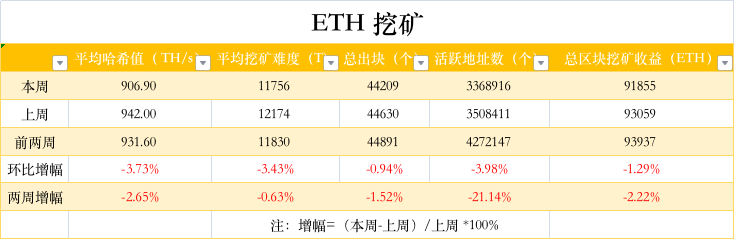
The data shows that last week, the average computing power decreased by 3.7% month-on-month, temporarily reporting 906TH/s; the average mining difficulty decreased by 3.5% month-on-month, temporarily reporting 11756T; the activity on the chain decreased by 4% month-on-month, and the total mining revenue decreased by 1.3% month-on-month.
4. News
(1) An Ethereum giant whale address that has been dormant for nearly 3 years has transferred 145,000 ETH in multiple transactions
According to the OKLink multi-chain browser, a certain Ethereum whale address 0x4bAf012726CB5EC7Dda57Bc2770798A38100C44d, which has been dormant for nearly 3 years, will be transferred out in multiple transactions starting from August 15th. It is reported that this address was created on October 28, 2016, and the last large amount transfer out record was 5,000 ETH on July 31, 2019. The current address balance is worth about 14 ETH.





