


Under heavy regulatory pressure, will Ethereum 2.0 still resist censorship? God V votes like this


Last week, the Ethereum mixing protocol Tornado Cash was sanctioned by the US OFAC, which attracted much attention, and finally ended with the voluntary shutdown of the protocol. However, the aftermath of the Tornado Cash incident is not over, especially as discussions about regulatory scrutiny continue.
On Monday, Ethereum ecosystem developers discussed the topic of Ethereum 2.0 regulation on social platforms.
Chief Investment Officer of Crypto Hedge Fund Arcane AssetsEric Wall Start a discussion called "How would the ethereum community react if there is protocol-level scrutiny on ethereum by regulating validator nodes through certain protocols (like Lido, Coinbase, etc.)". A total of 7363 people participated in the vote, 62% of them chose "will regard this review as an attack on Ethereum, and choose to burn their shares (Stake) through community consensus", and 9.3% of them chose "tolerate review”, another 28.7% chose to abstain.
It is worth noting that V God, the founder of Ethereum, also participated in the vote and directly stated that he chose the former. From the results,The vast majority of users participating in the survey are opposed to regulating Ethereum and want to destroy the regulatory node, but Eric Wall said that this idea is technically unrealistic. A very important reason is that the shares held by regulatory nodes account for more than 50% of the entire Ethereum 2.0 website, and it is difficult for a few people to "slash" the majority by voting, otherwise a new paradox will form.
image description
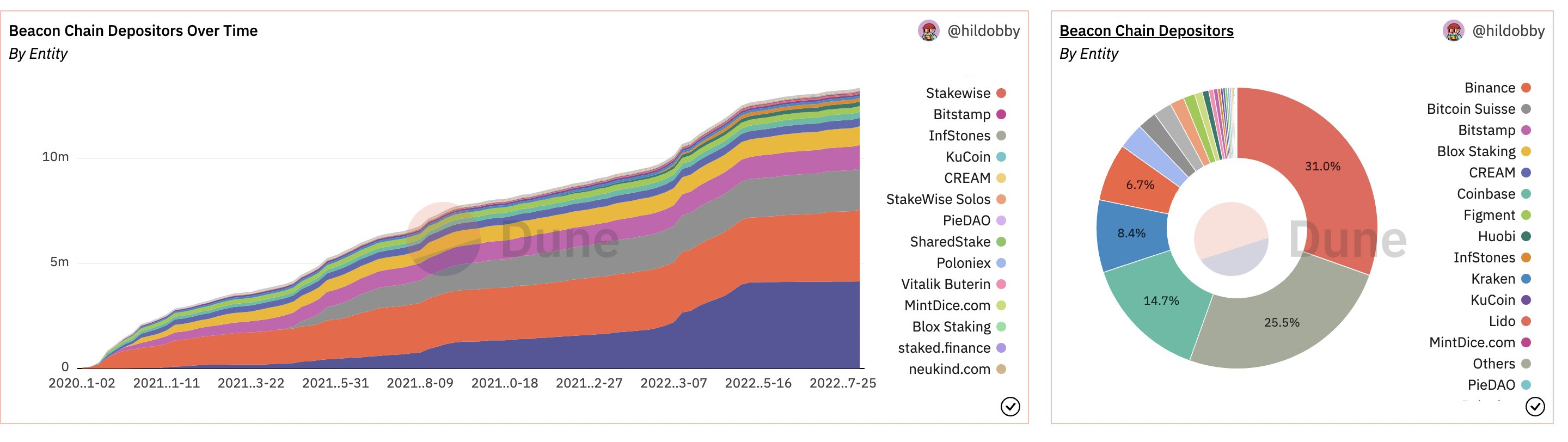
(ETH2.0 deposit data:https://dune.com/hildobby/ETH2-Deposits)
“Currently it appears that over 66% of Beacon Chain validators will be OFAC compliant.” DxDao Contributor @eylonverse XExpressed concern that once these six projects/institutions accept the supervision of the US government, they will directly affect the operation of the Ethereum 2.0 network.
Take the Tornado Cash sanctioned address this time as an example, there are currently only 1,000 of these addresses, but the possibility of expanding the scope of sanctions under OFAC supervision in the future is not ruled out; and, the sanctioned address is prohibited by the US government from interacting. NextEthereum turns to POS and upgrades to Ethereum 2.0. If these 66% of validators accept regulatory review regulations and do not sign specific block Tx and related address transactions, it will have an impact on the stability of the entire network.
"While Ethereum introduced a PBS (Block Proposer/Builder Separation) scheme designed to prevent validators from censoring specific TXs, I'm sure @coinbase will find a way to ensure it doesn't use Tornado TXs to validate blocks (thus avoiding falling into sanctions)." @eylonverse XVery apprehensive about regulatory scrutiny.
Of course, some people think that this situation will not happen, and optimistically believe that the above six projects may "secretly" support the transaction of the sanctioned address, and the node support transfer is not within the scope of sanctions. But on-chain transactions are inherently transparent, and OFAC can easily see which nodes are serving transfers, and "publicly" supporting sanctioned addresses may also be implicated. Adam Vaziri, CEO and co-founder of Blockpass, stated that once a cryptocurrency address/account is publicly sanctioned, nodes are also aware of it; in principle, nodes that continue to verify sanctioned transactions will not benefit from "safe harbor"In principle, there is no immunity from prosecution.
Because of this, the question before these staking institutions is whether to cater to the scrutiny or embrace the Ethereum community when regulation strikes.
"If regulators require you and your validators to review at the Ethereum protocol level, you will: A) comply and review at the protocol level; B) close the pledge service and maintain network integrity." Rotkiapp founder Lefteris Karapetsas also told Several major pledge service providers have raised questions, but have not received a response so far. He added, "The answer to this question is important to all users of these platforms and the entire Ethereum network, and if any of them choose (A) over (B), we should all stay away from them."
In my opinion, it is more likely that Ethereum 2.0 verification nodes will cater to regulation in the future. After all, judging from past cases, confrontation with regulation will only lead the entire Ethereum ecology into the abyss. Moreover, Ethereum has entered the 2.0 stage and will also face the SEC's securities review, which itself adds uncertainty. Regardless of whether people in the community are willing or not, in the face of the general situation, it is obviously more "smart and mellow" to avoid confrontation.





