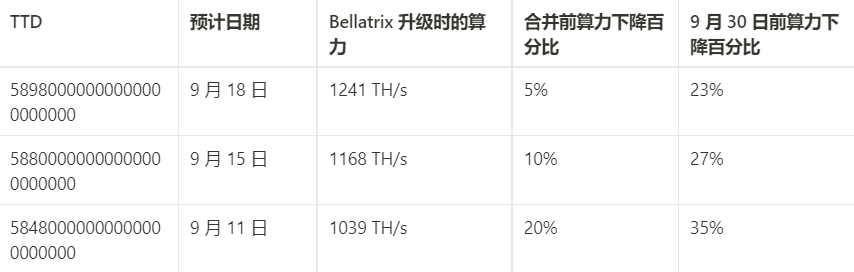
A detailed explanation of how to predict the combined TTD value


Original source: notes.ethereum.org
first level title
Combined TTD values
secondary title
Strategies for Predicting TTD Values
In order to set the total final difficulty value for the merger, we can first predict the TTD value for a given date, and then adjust according to the change in computing power.
To determine when the TTD value is reached, polynomial regression can be used to create an estimate with reasonable precision. These estimates are based on data from the previous four weeks and generated using forecasting tools. However, the accuracy of the forecast depends entirely on future fluctuations in computing power. The TTD date could be pushed back by a few days if the hashrate moves significantly and is moved far enough ahead of the expected date.
Let's take a look at the hashrate of the Ethereum network to establish expectations.
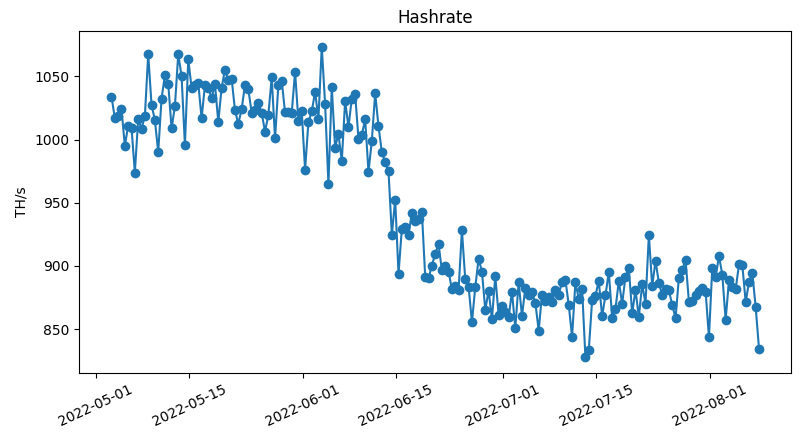
Hashrate trend
In the past few months, the average computing power has been around 1PH/s, and reached a peak of 1.126 PH/s in May. After a sharp drop in June, the hash rate has gradually recovered and now remains around 900TH/s (average, effective hash rate). Last month, the computing power oscillated between 950TH/s and 780TH/s (peak value), and its daily variation was no more than 5%.
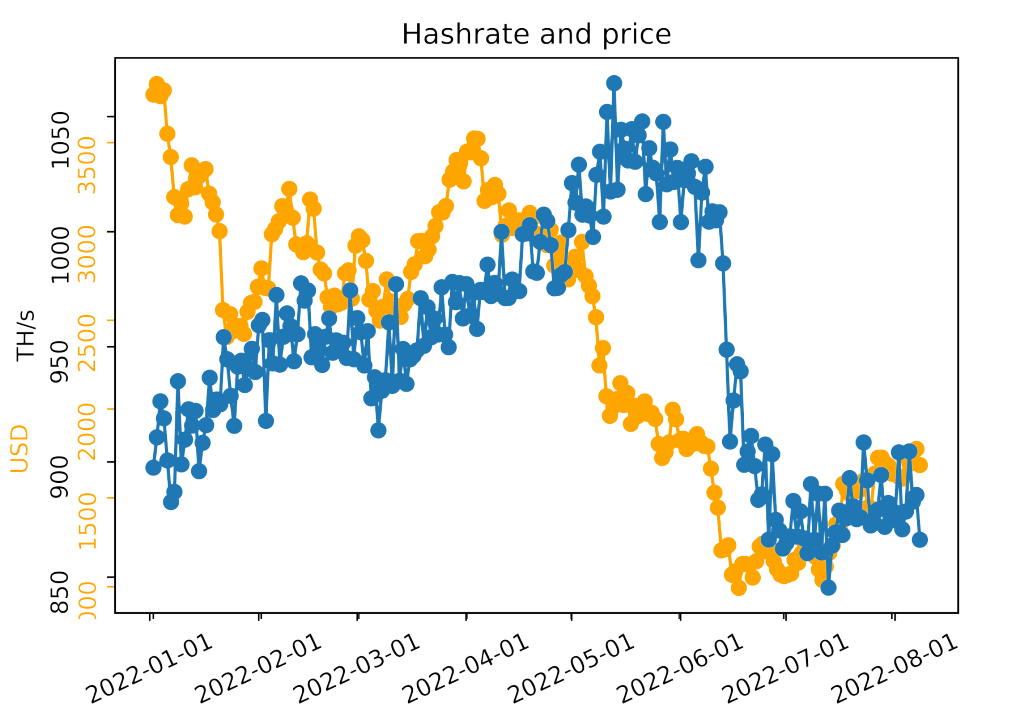
The computing power will fluctuate based on the mining yield, and the mining yield is related to the ETH price. While the hash rate does not depend entirely on price fluctuations, it does respond to it. Here’s ETH price and hashrate projected into one chart from January:
Because hashrate indicates the difficulty of mining that must be overcome over a period of time, we can determine the specific amount of hashrate required to reach TTD in the network at a given time. This script calculates and displays the amount of hashrate needed to achieve a given TTD value over a period of time - during September.
In the following visualization chart, you can see the trend of computing power from a larger time frame. It shows the amount of computing power (x-axis) required to achieve the example's TTD value over time (y-axis). The red portion of the curve represents September, when the merger is likely to occur.
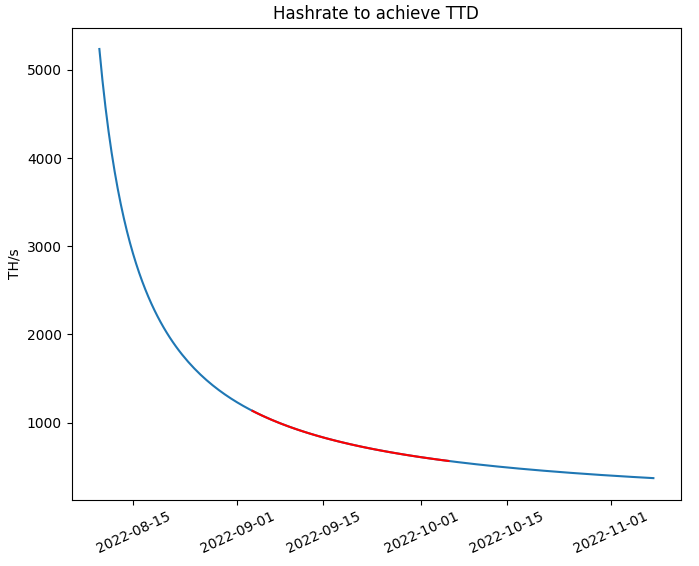
This shape actually shows that the first half of September required significantly more hashrate. This provides more "protection" for hashrate growth early on, but then the necessary hashrate falls more slowly. If the hash rate drops significantly, then the slow decrease in the necessary hash rate makes TTD harder to achieve.
secondary title
Scenario 1 Valuation
Scenario 1, the Bellatrix mainnet upgrade will happen on August 31st.

and5877487756139069440and58834281007084994560000between.
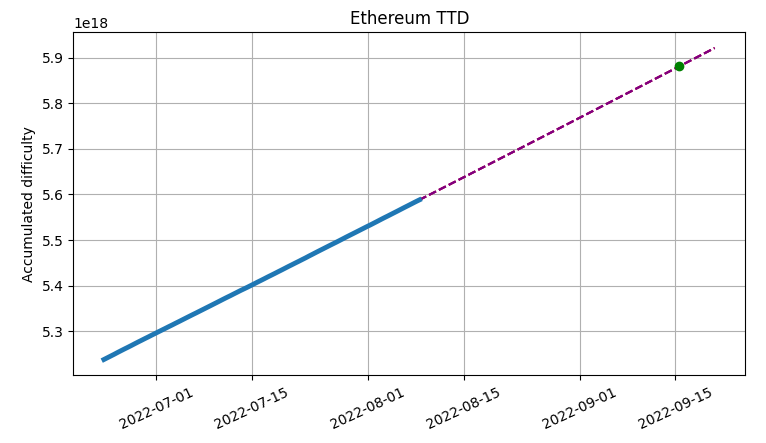
To take out a nicer and slightly lower number, we can round this down to 58750000000000000000000. This figure can be achieved with a difference of only 10 hours. Below is a visualization of the computing power required to reach this TTD value in September.
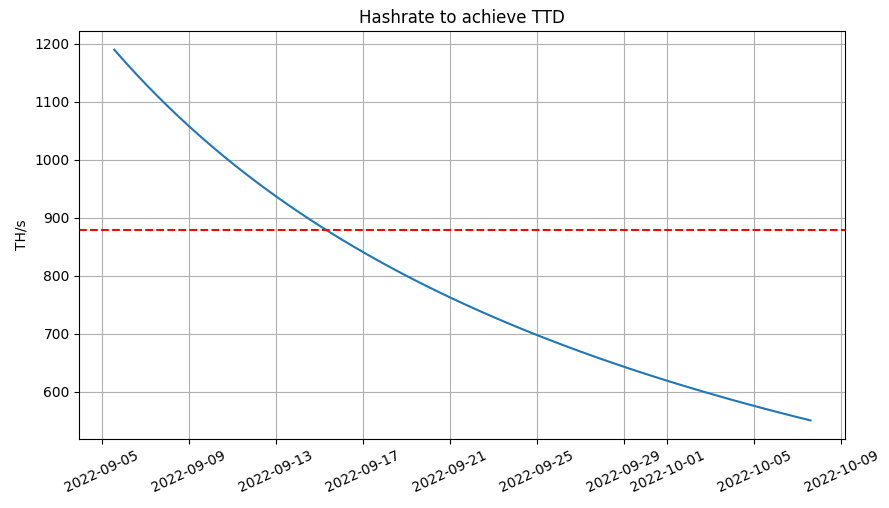
You can see that the required computing power to achieve this TTD value decreased from around 1400TH/s on September 1st to around 623TH/s at the end of September (a drop of 29% from the current computing power). The dashed red line represents the current average hash rate and intersects the blue curve on September 15th, which is the estimated date for TTD values.
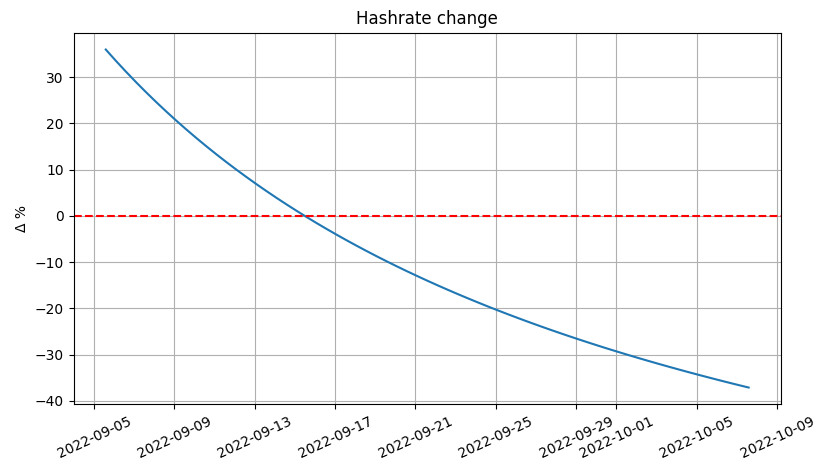
The next graph plots the percentage change in necessary hashrate compared to the current hashrate (marked with a dashed red line at 0).
The chart here summarizes these estimates and compares it to the ATH (all-time high) hashrate and the current hashrate.
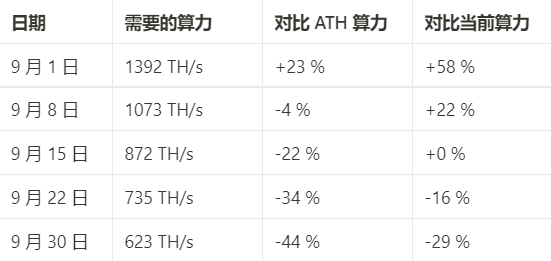
If we estimate that the maximum computing power drop is 30%, then the TTD value will be reached by the end of September. If we want to prepare for a larger drop, we must set the TTD value lower.
secondary title
Scenario 2 Valuation
In Scenario 2, the Bellatrix mainnet upgrade will take place on September 6th.

and5915542925294436352and59227132692074332160000between.
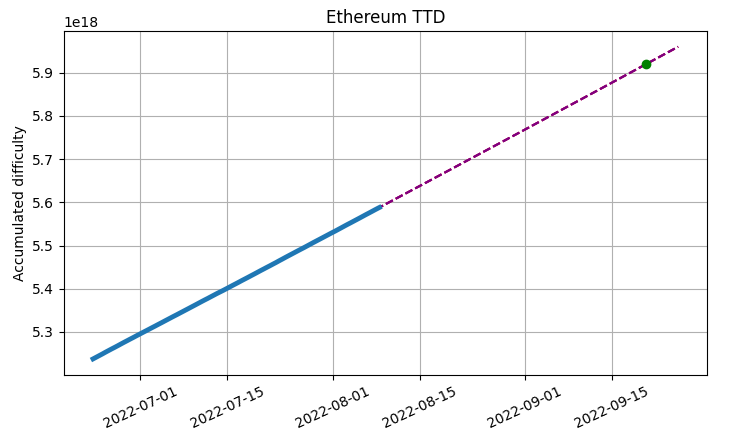
rounds it down to59100000000000000000000, there will be a difference of about 16 hours. The next chart plots the hashrate needed to reach the TTD value between September 6th and 7th.
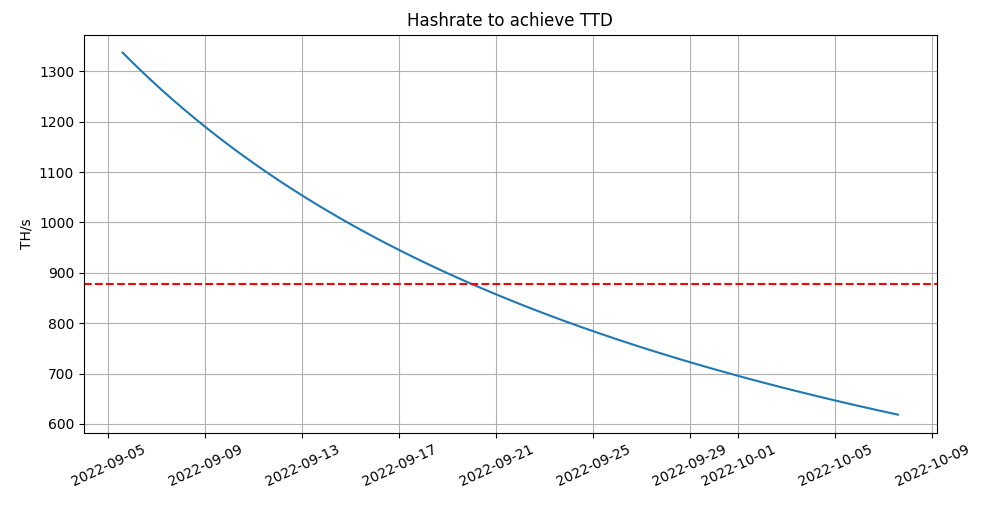
The necessary computing power to achieve this TTD value will drop from 1290TH/s in the Bellatrix upgrade on September 6th to 700TH/s on September 30th (a 20% drop from the current computing power). The dashed red line represents the current average hash rate and intersects the blue curve on September 19-20.
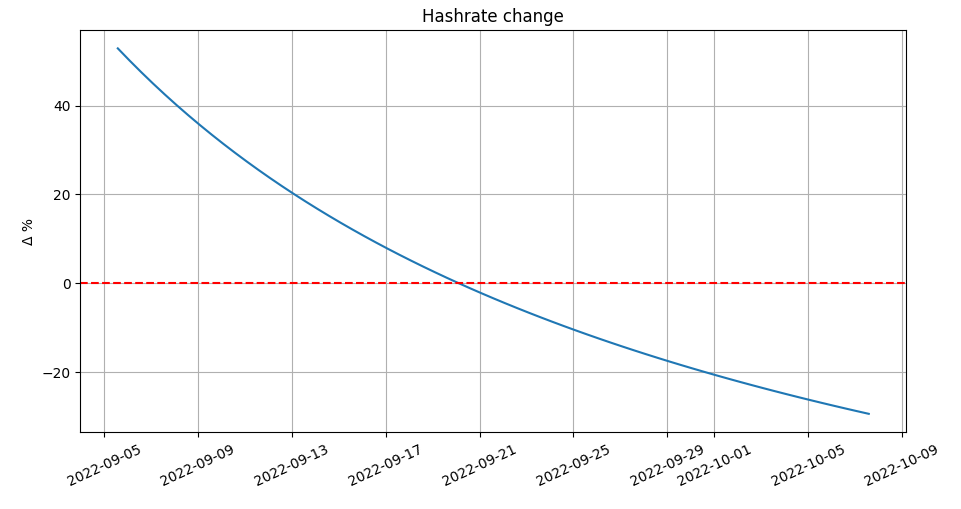
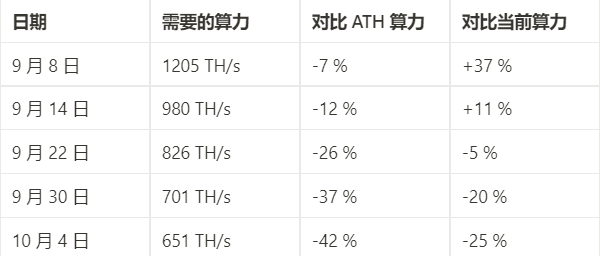
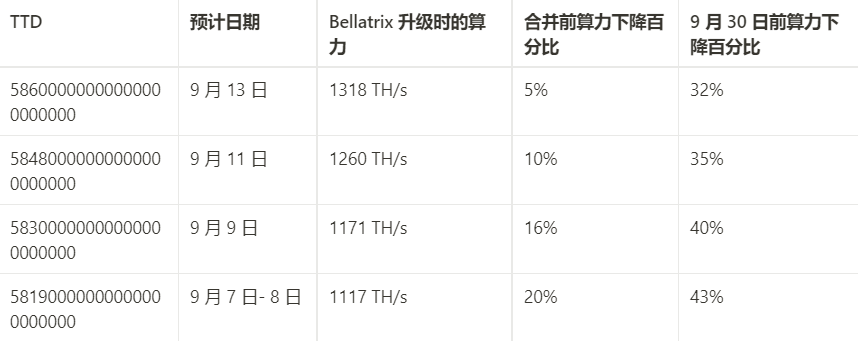
In this case, we have less room to reach TTD before Devcon. But we have more time to adjust the TTD value based on a potential DAG computing power reduction. Here are other TTD values that take into account lower hashrate: