A detailed explanation of AAVE's latest stablecoin GHO proposal


Foreword:
Foreword:The Aave community released a request for comments (ARC) proposal, proposing to its DAO organization "introduce a native dollar-peggedDecentralized, over-collateralized stablecoin GHO
", this proposal was passed on 7.31 with 99% support.This proposal not only has the characteristics of conventional over-collateralized stablecoins, but also additionally proposes the concept of promoters, breaking the original over-collateralization of existing assets (ETH, etc.), and strict screening of "promoters"It will break the "shackles that can only be pledged by existing assets"
, future earnings can be used as stablecoin collateral!
This article will start from the knowledge of the stablecoin itself, sort out the goals and innovations of the GHO proposal, and describe in detail the entire life cycle of the model competing stablecoin DAI (starting from generation, destruction, liquidation, etc.)
This article is quite long, if you have the following curiosity, please read carefully~~
What are stablecoins? What's the value? Where does the income come from?
How will GHO be implemented? What kind of innovation is there?
Summarize the differences and advantages of GHO and DAI
first level title
1. What is a stable currency?The ups and downs of tokens are all wonderful stories every day, but there is a very boring token that pursues no ups and downs (although the stability of stablecoins is also an interesting thing in the industry), of course, the only constant in the world It is the change itself, so the stable currency does not point to absolute stability at the beginning,
For most stablecoins, this is the dollar.
secondary title
1.1. The invisible advantage of currency price stability
A stable currency that can be trusted is that users can convert it into real US dollars under any reasonable circumstances. In short, stable redemption is a necessary factor, and once the token can achieve long-term stability, it is not only a currency but also a platform. Although the feature of currency price stability is boring, it is very useful. Its income is
for platform: a basic platform for financial value interaction without friction and slippage, for a large number of upper-level applications to operate stably.
for investment: Once it becomes the preferred currency for institutional investors to invest in products on the chain, it will gather huge amounts of funds
for service: you can receive risk-free interest for depositing and issuing coins, and earn additional stable usage fees for transferring funds.
At present, only USDT and USDC, the two stablecoins pledged by fiat currency, have issued a total of over 100 billion US dollars!
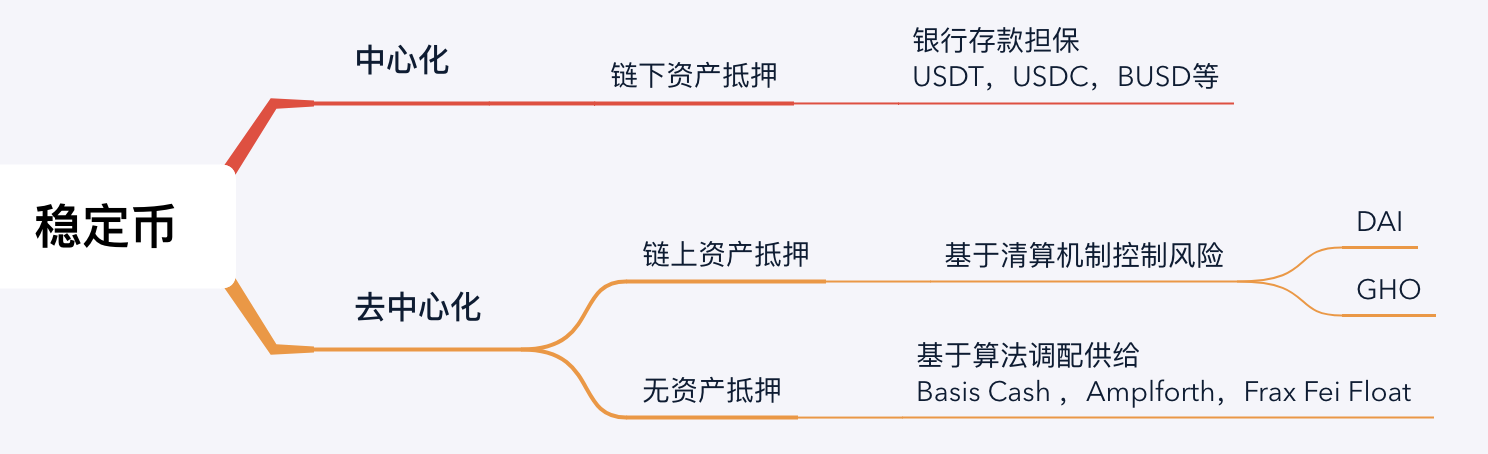
1.2. Classification of StablecoinsBlockchain is a global market, and the total market value of stablecoins is about 150 billion US dollars, based onCentralization, Collateral, Anchors
resulting in a number of categories
No collateral guarantee, provided based on algorithm allocation: Basis Cash, Amplforth.
Off-chain assets as collateral guarantee, based on bank deposit guarantee: USDT, USDC
secondary title
1.3. Where does the income of stable currency come from?
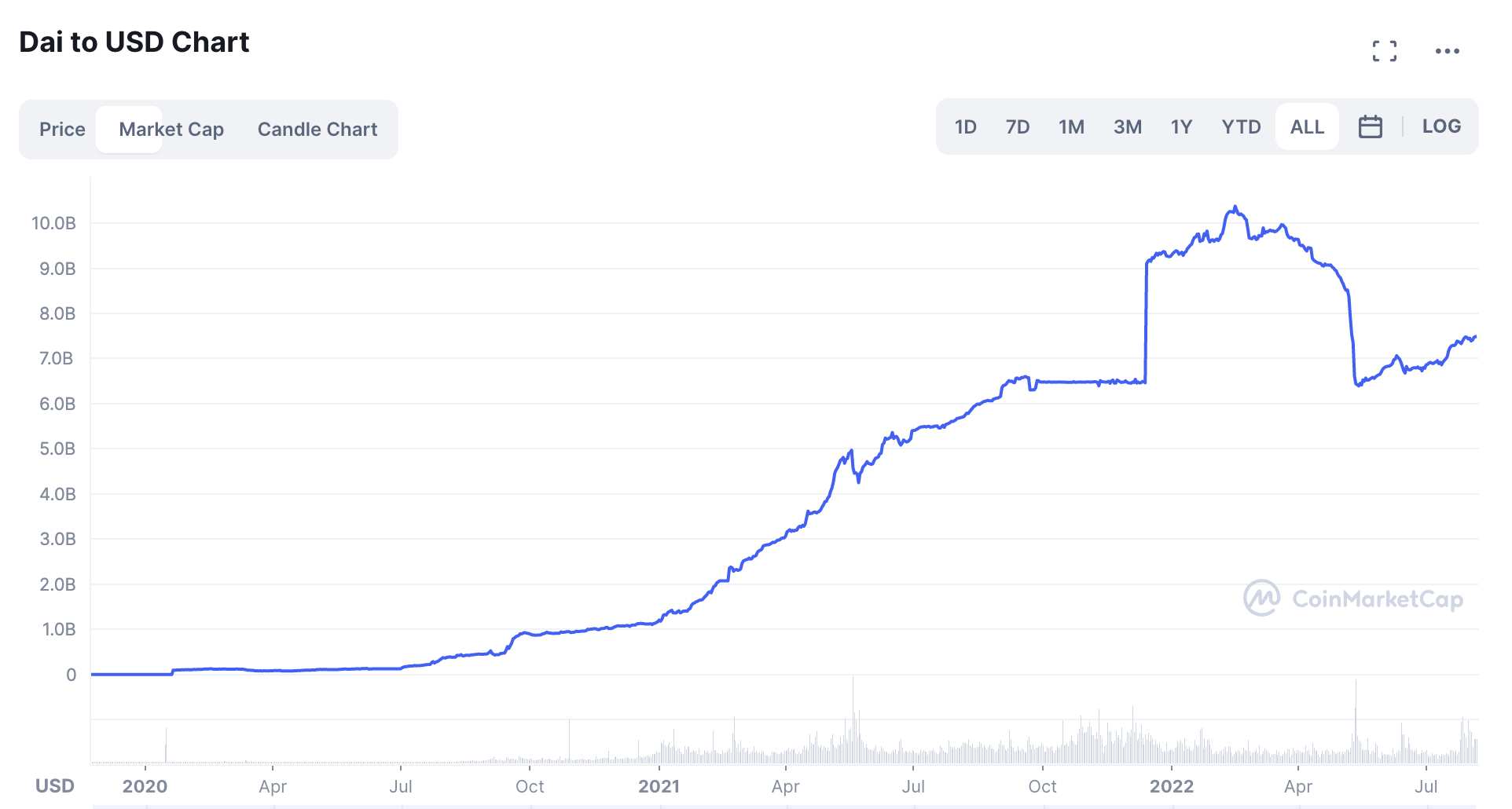
In the huge business of stablecoins, USDC currently has US$54.8 billion, while DAI has issued a total of US$7 billion on Ethereum.Understanding the value of various products requires。

Grasp his money-making model and understand the motivation of issuing coins
Because the price of the currency is stable, it is relatively unlikely to obtain income from the ups and downs, and the use of tokens is a smart contract that operates on the blockchain. The user only consumes gas fees for transfers, and transferring 1W USDC will also account for 1WUSDC. The stable currency with the ERC20 protocol as the core will not be deducted from it.
Type 1: Off-chain fiat currency guarantee
Types of collateral for off-chain assets (USD) in bank deposits
Bank interest income is a big one. For example, USDC has a circulation of 54.8 billion, which means that it holds cash or treasury bonds of the same value through its banks and custody partners. %about.
Secondly, you can charge a handling fee in the currency withdrawal process, such as USDT: check Tether’s official website, the official threshold for converting to US dollars is at least 100,000 US dollars, and the handling fee is 1,000 US dollars or the exchange amount * 0.001, whichever is higher.
There is a problem of trust here. If too many reserves are converted to holding treasury bonds or longer-term treasury bonds, although the rate of return can be increased, the trust in withdrawals will be reduced.The game for this class is:
Whether to keep more reserves and earn less interest income, or choose higher income but sacrifice trust
At present, most options are to increase circulation first, become the consensus of more users, and increase more reserves.
The second type: asset guarantee on the chain
Types of mortgage guarantees in smart contracts for on-chain assets (various mainstream tokens)
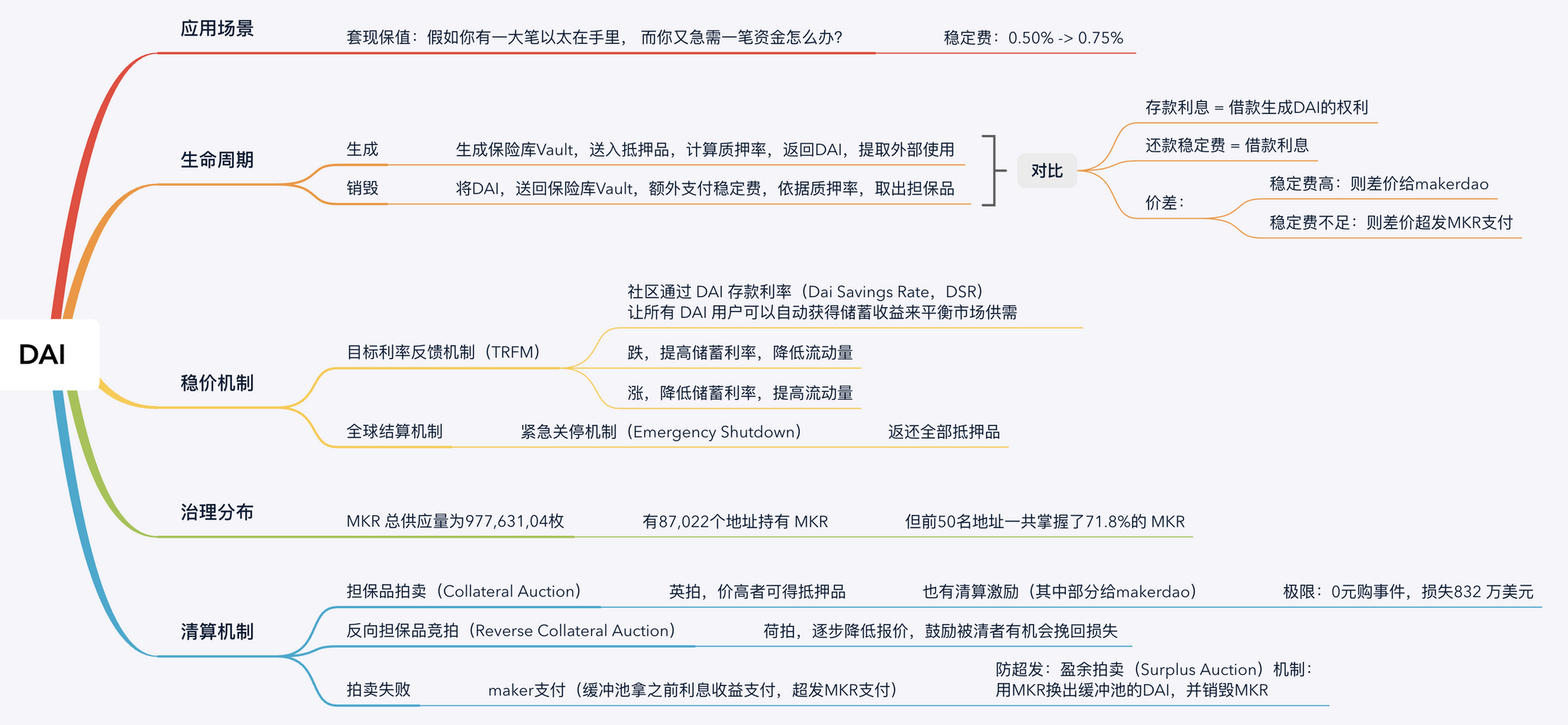
Taking DAI, the fourth largest encrypted stable currency in the world, as an example, the user acquisition process is to pledge assets and exchange DAI, and to get back the original assets is to return DAI+0.5%-0.75% of the stability fee, which we will expand in detail later
1.4. Summary
Each profit model has a corresponding user group, and even if it loses money, it must first seize the market, and various project parties are not limited to making money. Just as Circle, the issuing company of USDC, plans to build a large amount of new infrastructure on the chain, the purpose is to make USDC a practical platform for millions of developers.

However, the current mode of asset guarantee on the chain is far inferior to the fiat currency pledge type. Although DAI ranks fourth, the circulation is actually an order of magnitude worse (65B VS 7B)
No, AAVE, the king of the well-tested DeFI lending protocol, will also enter the stable currency market.
first level title
2. AAVE’s GHO Stablecoin Proposal
What does AAVE do?
Why is it called the king of DeFI lending agreement?
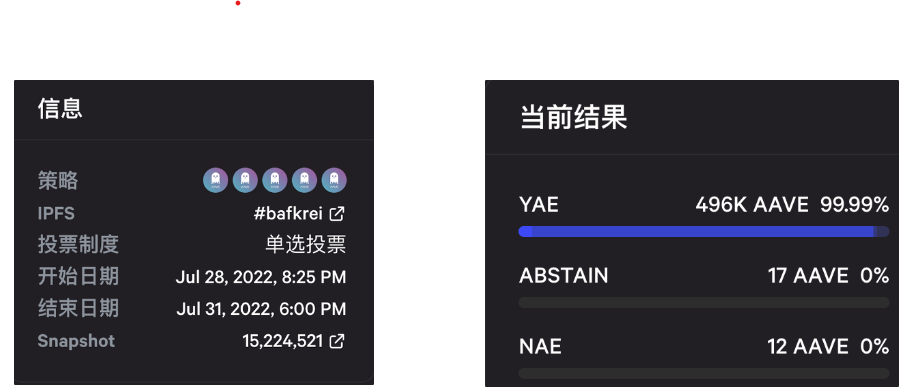
As of 7.31, this proposal has been approved by 99% of the DAO organization.
secondary title
2.1. Important features of GHO
The proposal clarifies the core mechanism: a native decentralized, collateral-backed stablecoin pegged to the U.S. dollar
Therefore, it will be highly similar to DAI under MakerDao. Also based on overcollateralization, there will also be a clearing module to monitor the risk of unequal mortgage and loan.
Let's compare the features and explain them one by one. Indeed, there are a lot of technical terms.
The general characteristics are:
Decentralization - the core mechanism operates entirely on the blockchain.
Over-collateralization—requires assets on the chain to be used as collateral, and ETH worth 1K dollars can only be loaned to GHO with a pledge rate below.
Multiple collateral support—Support multiple token assets on multiple chains as collateral guarantee
Community Governance—Core parameters such as interest rates and handling fees are set by DAO voting, and risks are shared through governance tokens.
Unique features are:introduceThe concept of "facilitator"
: GHO can be generated and destroyed without collateral, similar to the printing of money by the Federal Reserve
Interpretation: GHO can be generated and destroyed without collateral, and the strictly selected "facilitator" will break the "shackles of existing assets to be pledged", and can use future earnings as stablecoin collateral! Not only can the distribution scale be greatly increased, but also many web3 products can be clustered to meet the screening criteria and promote the application of long-term reliable servicescombine:->E-mode of Aave V3
Stablize
Interpretation: The LTV of conventional pledge loans is generally 75%, that is, only 75% of 100 collateral can be loaned, while in E-mode, 98% of the LTV can be used for lending stablecoins with stablecoin pledges, which is an efficient stablecoin A stable mechanism for asset swaps.
For example: GHO down -> mint dai with GHO -> supply decrease -> GHO up
Portal concept for natural cross-chain distribution in a multi-chain network: -> to be evaluated
Case: When DAI can be exchanged for GHO with low slippage loss, it can encourage arbitrageurs to help price stability to make money. Arbitrageurs reap the interest rate spread under leverage, while GHO reaps stability.
For example: GHO up -> mint GHO with dai -> supply increase -> GHO down
Interpretation: There have been a lot of bridge explosions recently. Interpretation depends on the follow-up implementation method. Look forward to the author's sequel.
2.3. GHO's operation process
From the perspective of the entire token life cycle, the usage of GHO that users will be exposed to
Acquisition: Users mint GHO using their collateral in AAVE
Destruction: loss of collateral (repayment or liquidation) and loss of GHO
With reference to Compound’s current interest rate of 0.07% for storing ETH and DAI’s interest rate of 0.6%, the probability of this stablecoin fee will be set between 0.5%→1%.

secondary title
2.4 Summary
GHO is still in the proposal stage. Although contract security audits and other work may have been carried out in the near future, there is still a long time before the official mainnet is available.
Among them, the core issues are still in the stage of hot discussion in the community, and they pay special attention to the following issues
1: The pledge rate and interest mechanism in the lending process, how to combine Emode and dynamic interest rates to bring higher capital utilization
2: The liquidator's reward and the liquidated person's stop loss, both to prevent DAI from buying black swans at 0 yuan and to protect users
4: Defi accumulates tens of billions of assets at every turn, requiring a safe entry and exit mechanism
first level title
3. Extended reading - in-depth understanding of how DAI is stable
Let's take a look at MakerDao's DAI, the benchmark MakerDao's detailed implementation of the decentralized stablecoin, by interpreting the same product.
secondary title
3.1. Significance of over-collateralization
The pain points solved by borrowing are very easy to understand. Everyone has a time when they are short of money.
For the depositors, the currency holding party can play the value of time, that is, maintain the rights and interests of holding Eth and exchange it for cash to use
For the platform side, when the debt is large enough, such as national debt, it will form the most stable interest income with the lowest risk, and become a good control financial tool for dynamically adjusting the amount of market funds. The analogy of the web3 project side is to lock in a large amount of liquidity. Tokens promote the relative stability of the economic system.
so,It is a very meaningful leverage tool for short and long positions.
give a chestnut🌰
give a chestnut
To be long is to be optimistic about its rise and buy, and to be long with leverage is to borrow money to double the purchase.
To be short is to think that it has fallen and sell it, and it can also be sold by others.
If we expect the Ethereum to rise, we can mortgage the previous $1,000 of ETH to generate $750 of DAI, then use DAI to buy ETH for mortgage, and then buy DAI. After multiple operations, the value may increase several times.
The efficiency of its leverage is as follows, although it is not high, it can easily reach 2-3 times,

secondary title
3.2. The life cycle of DAI
In fact, the entire stable system around DAI is very complicated. The following figure is the official system architecture diagram, which can be called a work of art in web3 products.So let's avoid complex code,
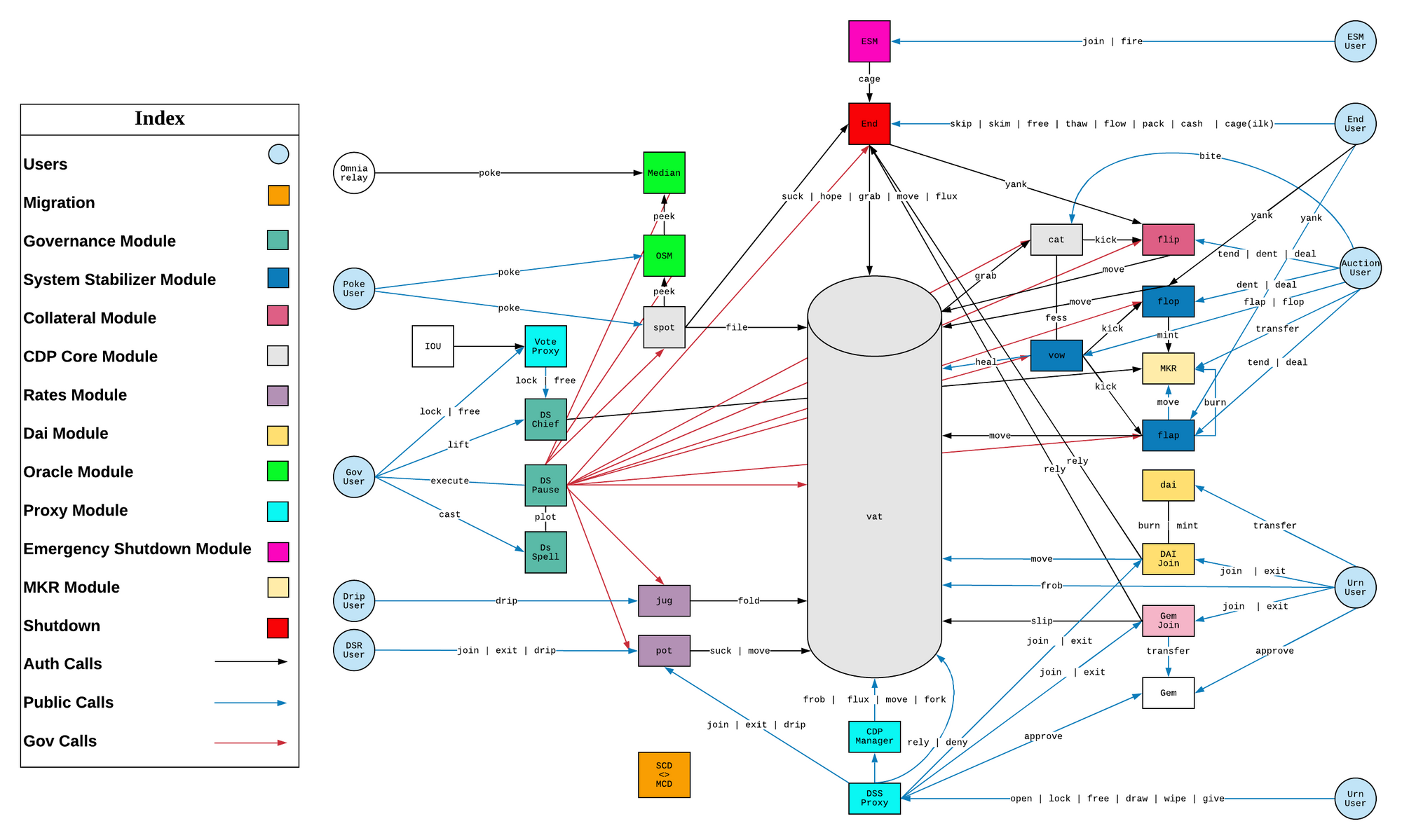
It only focuses on a few links that users will perceive, but in fact they are all in the yellow part of the picture
The entire life cycle of DAI is divided into two major links: acquisition and destruction.
Acquisition: Generate Vault, send in collateral, calculate pledge rate, return DAI, withdraw for external use
Destruction: Send DAI back to the Vault, pay an additional stability fee, and take out the collateral based on the pledge rate
Compare it to:
Suppose I go to the bank for a home loan (low-liquidity assets for high-liquidity stablecoins)
I put my house as collateral (mortgage ETH)
Bank gives me cash as a loan (acquires DAI)
If the value of the house falls (insolvency)
The bank will ask me to repay the loan (supplementary collateral)
If I cannot repay the loan (triggers liquidation)
They'll take my house (triggers a collateral auction)
Something went wrong with the bank and it went bankrupt (triggered the Global Settlement System)
secondary title
3.3. In the dark forest, risk comes first
We all know that even ETH is a highly risky and volatile asset. In MakerDao's DAI coin entry, we can clearly see that
He has several core parameters
Stability Fee: Returning DAI, the additional cost that needs to be paid when redeeming collateral (become MakerDao’s income)
Liquidation Fee: In the event of insolvency, a 13% penalty will be added to my outstanding debt.
Mortgage rate: To lend 100 USD of DAI requires 170 USD in asset pledge.
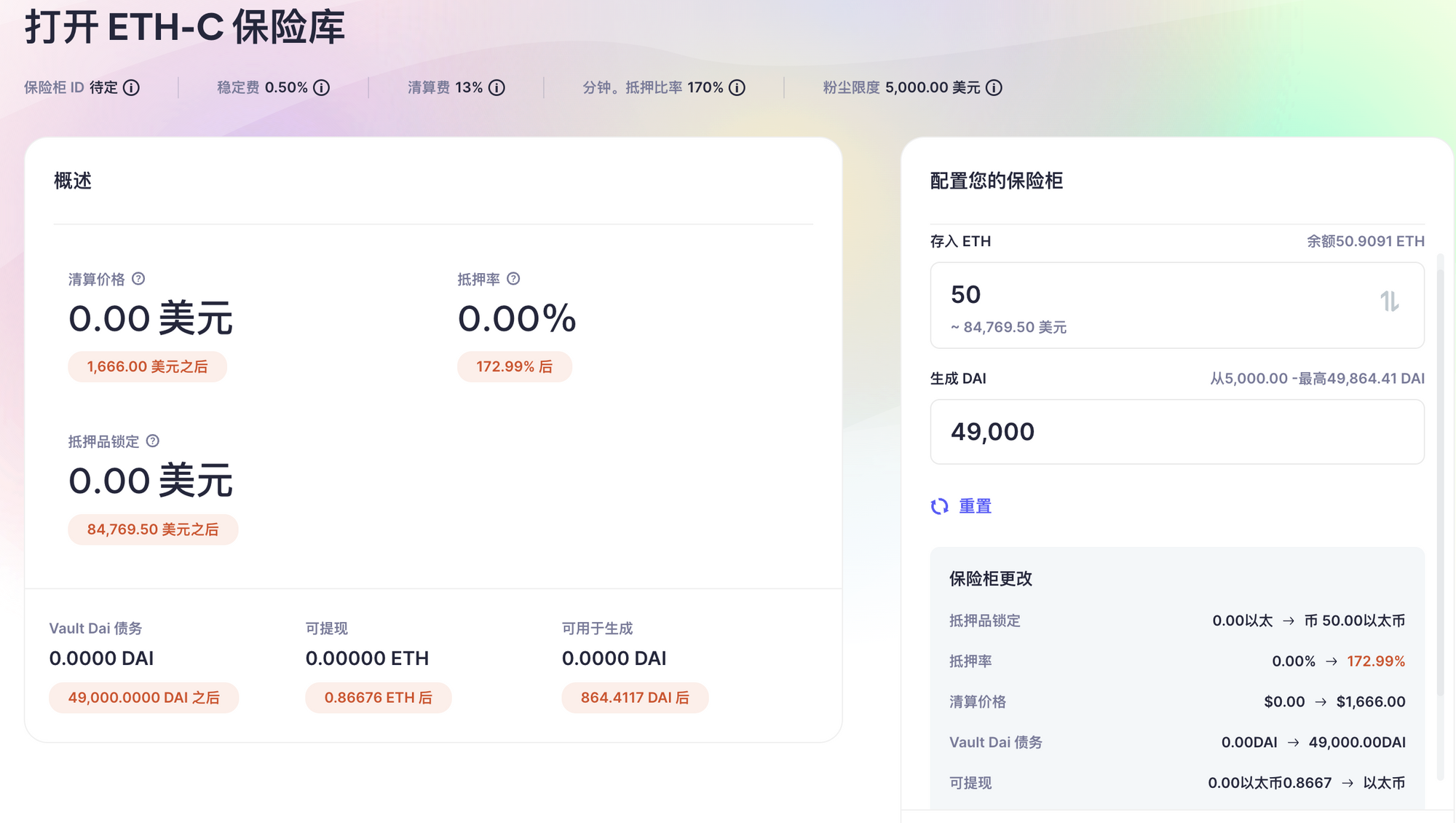
And the lower right corner will tell you that if I generate a vault with 50 ETH and take out 49,000 DAI, once the current ETH price reaches 1666 dollars, it will trigger liquidation (simple machine translation, convenient and intuitive understanding)
3.4 Insolvency, four auctionsOnce the risk crosses the red line, liquidation will occur.It means that users no longer need to return DAI, and the safe (Vault) generated by users will be auctioned as collateral to make up for the DAI owed to the system
, at the same time, the liquidated users also need to pay a liquidation penalty,
The auction process of the Maker agreement has 4 steps,will first trigger,
Collateral Auction Mechanism
Using the British auction model, the one with the highest price can get the collateral, and the DAI paid will be used to compensate the debt and fine.
If the collateral auction process can successfully resolve the debt crisis, and if there are still some unsold collateralthen trigger,
Reverse Collateral Auction Mechanism
The liquidated party can use the lottery auction mode to consume DAI at an acceptable price in the process of gradually reducing the price to exchange part of the collateral. The design of the agreement is to stimulate the liquidated party's willingness to repay.
Careful viewers here can find that, in fact, it is always impossible for funds to perfectly match and eliminate debts.
If there is no one to accept the order at all, the funds in the buffer pool (Maker Buffer) will be used to bear the risk of bad debts. And his funds come from the stability fees and penalties described above.
Of course, if the risk is so great that even the buffer pool cannot save this death spiral,then trigger,
Debt Auction Mechanism
The Maker protocol will overissue MKR (governance token) to start the auction process. Auctioneers can use DAI to obtain MKR through auctions, and the DAI obtained from the auction will enter the buffer pool to repay debts.
In the long run, if the emergency is over-issued by MKR, the governance token itself will become worthless, so controlling the inflation rate is also to protect the safety of the entire system.will pass a
Surplus Auction Mechanism
To reduce the total supply of MKR by selling the DAI in the buffer pool in exchange for and automatically destroying the MKR on the market.
3.5 Summary
Behold, what a beautiful system!There are various liquidation processes to guarantee the entire capital operation process, the risk has been reduced a lot, but the role of the stable currency has to minimize fluctuations, so there is another set ofTarget Rate Feedback Mechanism (TRFM)
, if most of the funds are flowing outside, the project party will adjust by modifying the stability fee liquidation fines and other methods, the overall link will be very long, making it difficult to adjust the token price in real time.
Therefore, he built a deposit platform around DAI. On the one hand, it reduces the flow of DAI, and on the other hand, it dynamically affects arbitrageurs to deposit or withdraw through interest rate adjustment.
I won’t go into details here, I suggest you read the relevant articles at the end of the following article (especially MakerDao’s white paper)
first level title
4. Summary - the difference between GHO and DAI
We start with what a stablecoin is, and discuss its value, classification, and source of income. It is understandable that Aave's fundamental motivation to get involved in the stablecoin field,
In order to facilitate the understanding of why stablecoins can be stable, this grand issue, let’s understand the entire MakerDao mortgage-generated DAI life cycle, liquidation strategy, security measures, etc. one by one.
Although it is impossible to say whether there will be decoupling in the future (don't be crowed), such a beautiful system mechanism is really fascinating.and the proponent himself
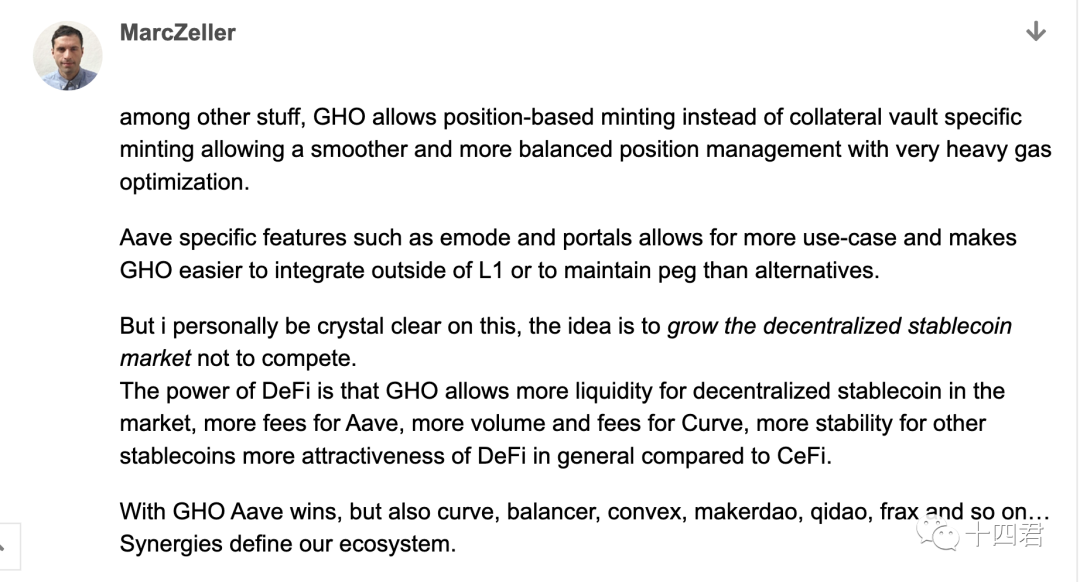
Also tell the difference between GHO and DAI
In my opinion, the most different feature is the concept of "promoter", which breaks the mode that DAI can only use "existing" asset mortgages to obtain stable coins, and uses certain web3 applications in the future under limited rules and reliable platforms. "The proceeds of GHO can also be issued, which is the beginning of trust on the chain, and it is no wonder that under the proposals, the heads of various web3 applications have recommended themselves.
It’s really a long article on Defi, Mr. Fourteen, thank you for reading!
Welcome to like and follow, and forward it to suitable friends for discussion.
Quote:
https://governance.aave.com/t/introducing-gho/8730
https://docs.makerdao.com/
https://makerdao.com/zh-CN/whitepaper/
https://coinmarketcap.com/
Aave’s Stablecoin GHO Proposal Original
https://mp.weixin.qq.com/s/tjy2AWzRFGE6OLDrj9Y6kA
MakerDAO: Ethereum's "Craziest" DAPP
https://mp.weixin.qq.com/s/-7KggzOFXzDPF9T2YcGyww
USDC's ambition: Restructure the financial system!
https://learnblockchain.cn/2019/03/19/understand_dai
Write at the end:
Write at the end:
Like and follow 14, bring you value from a technical perspective