


An article discussing the design of next-generation stablecoins


first level title
Impossible Triangle ArgumentTherefore, before discussing the design of the next-generation stable currency, we need to understand the impossible triangle and establish a connection with the stable currency, so as to grasp the key to the design of the stable currency。
first level title
what is impossible triangle
The impossible triangle was independently proposed by Mundell and Fleming from 1960 to 1963, and has been repeatedly proved in the practice of international finance since then. The Impossible Trinity means that it is impossible for a sovereign country to realize a fixed exchange rate system, free capital flow and independent monetary policy at the same time.
The fixed exchange rate system means that the exchange rate between the domestic currency and a certain currency remains stable, so as to achieve the stability of the currency value of the domestic currency. A fixed exchange rate is conducive to the stability of import and export trade.
Free flow of capital means that there is no control over capital, and capital can enter and exit the country's financial market at any time.
An independent monetary policy means that the central bank of a country can freely decide what kind of monetary policy to implement, freely regulate the issuance of its own currency, and freely determine the level of its own interest rate.Why can't the three elements be achieved at the same time? Simply put, for a sovereign national credit currency,If capital flows freely, then an implicit condition is that when the rate of return provided by the credit currency system of the sovereign country is no longer attractive, since capital is not restricted, then capital will be completely withdrawn.
However, if the central bank of a country implements an independent monetary policy under the condition of free capital flow, and considers the situation of issuing additional currency and lowering interest rates, at this time, due to the decline in interest rates, capital will withdraw from the country's financial market, and the country's currency will Being thrown out, facing depreciation pressure, and if you want to maintain a fixed exchange rate system, you must have a large number of reserve assets to absorb the selling pressure, and compared with international hot money, a country's reserve assets are often unable to support, so it is impossible to maintain Fixed exchange rate system.
The Impossible Trinity of Stablecoins
decentralized。
decentralized
What is decentralization?
What is decentralization?In the context of stablecoins, the meaning of decentralization includes two,。
Decentralization of transactions and decentralization of assetsThe decentralization of transactions means that transactions are not restricted, and no entity can prevent transactions in the system.The less restricted the transaction, the more decentralized the transaction.The decentralization of assets means that reserve assets cannot be controlled by a specific subject and cannot be misappropriated.。
The lower the degree of control of reserve assets by specific entities, the higher the degree of decentralization of assetsThe decentralization of transactions has been achieved at a fairly high level at this stage. Many stablecoin projects will rely on the public chain to achieve the decentralization of transactions, and the highly developed exchanges make the degree of capital flow close to completely free flow.。
In fact, in the scope of digital currency, the free entry and exit of global capital has reached an unprecedented heightThe decentralization of assets is difficult to achieve. The reserve assets of USDT and USDC are completely controlled by the project party. Even with transparent asset publicity and third-party audits,. Even for projects that control liquidity by agreement, there are also examples of project parties misappropriating reserve assets without authorization. When Luna crashed, LFG reserved a large number of high-value reserve assets of UST, such as BTC, AVAX, etc. It is not transparent whether these assets are used to rescue the market. Decentralized solutions for assets remain a difficult problem.
capital efficiency
capital efficiency
what is capital efficiencyCapital efficiency itself includes many factors, the growth rate of the system itself is a part, smaller transaction costs are also a part, and the rate of return of some agreements related to the system is also a part. But these can all be discussed as independent monetary policy, why, becauseCapital efficiency as the constraint of the impossible triangle actually means whether the system itself can independently regulate capital efficiency
. It can be seen from the Luna crash that independent high yields are unsustainable when stability and decentralization are achieved at the same time, because once expectations change, capital can be withdrawn freely, and the selling pressure is very serious. Therefore, if If stability and decentralization are to be achieved, then capital efficiency is unsustainable.
Overcollateralization is not a loss of capital efficiency
A common misunderstanding before is that over-collateralization is a loss of capital efficiency, and the direction of efforts to improve capital efficiency is to reduce the mortgage rate. This is a misunderstanding. Over-collateralization has nothing to do with capital efficiency. Over-collateralization only reflects unreasonable credit expansion, and reflects the reasonable conversion value of a new credit form at a specific stage, rather than the loss of capital efficiency.From a long-term perspective, during the period of crazy credit expansion, people will only feel that the excess mortgage rate is so dazzling, so they pursue higher leverage, but when the cycle reverses, it will eventually usher in a collapse. It is difficult to separate the process of credit enhancement from capital efficiency,. Rapid credit inflation is bad in the long run and leads to rapid redistribution of wealth in the short run. Over-collateralization actually reduces credit risk, and it is an inevitable choice for new credit forms.
Stablize
Stablize
what is stability
The form of credit is not static. The attempt of algorithmic stable currency in the previous stage was to create a new form of credit, but it is impossible to create a new form of credit out of thin air. The new form of credit needs to rely on the old form of credit , gradually changing.
first level title
Next Generation Stablecoin DesignThe issues to be considered in the design of next-generation stablecoins are how to choose between the impossible triangle and how to expand credit at the margin
, this paper proposes a retail model of credit expansion to solve the marginal problem of credit expansion, proposes the dynamic balance of the impossible triangle, makes choices according to the situation, and proposes a monetary policy regulation framework to regulate currency issuance.
There are also some research institutions and scholars who have proposed alternative design ideas, but they are all specific to specific issues such as the selection of reserve assets, the selection of mortgage rates, and the construction of a stable mechanism. How to carry out credit expansion for stablecoins and how to choose the impossible triangle are more difficult to discuss. In the long run, these are the most critical for a stablecoin project. Therefore, this article proposes three improvements for the next-generation stablecoin design from these perspectives.。
The stable currency discussed in this article is a digital currency with the goal of stability, and does not specifically refer to a stable currency or a stable currency with a certain asset as a reserve asset.This article believes that there are three points that need to be paid attention to in the design of the next generation of stablecoins:。
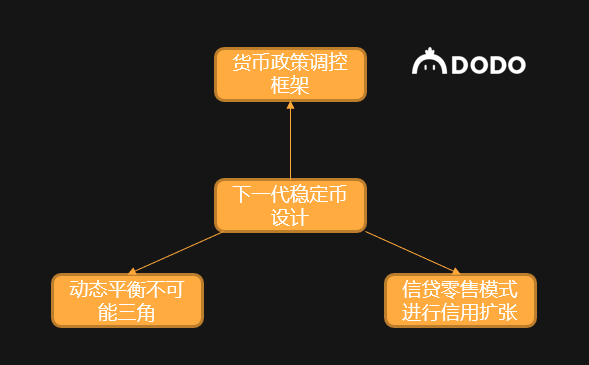
In the choice of the impossible triangle, dynamically balance the impossible triangle, adjust your choice according to the market situation, and make a flexible response; in terms of credit expansion, the retail model should be adopted; in terms of monetary policy, native tokens should be partially absorbed Seigniorage, and build a liquid market
Dynamic Balance Impossible Triangle💡For a stablecoin project, the constraints of the Impossible Triangle are not rigid, that is, the three factors are not rigid constraints of either-or, and each factor can choose a different strength. A more reasonable expression of the Impossible Triangle is three It is impossible to achieve high intensity at the same time.
Stablecoins can choose different levels of the three elements at the same time point, or adjust the strength of the three elements according to different development stages.
At the same point in time, different degrees, each element is non-rigid
For stability, in fact, stability itself is not enough to summarize all options. Stability itself also has strengths and weaknesses. Through the choice of mortgage rate, the choice of reserve assets, and the friction cost control of redemption, a stablecoin project presents different fluctuations The choice of stronger stability is bound to weaken the other two factors.
In the same way, decentralization is the same. The higher the degree of decentralization of assets, the less flexible it is to adjust assets. The higher the degree of decentralization of transactions, the freer the flow of capital, and the more difficult it is to control the loss of assets from inside to outside. , and the more difficult it is to control the influx of assets from outside to inside, the other two factors will be affected.
The stronger the independence of capital efficiency, that is, the more independent the monetary policy is, the need to regulate the rate of return within the system, which requires a more closed system under stable conditions and a more floating exchange rate under open systems.。
In short, the three elements are not rigid, and the relative strength of the three can be adjusted to achieve a balance
However, realizing that none of the three elements are rigid, the choice is actually more flexible. This is reflected in RMB and FRAX. Free flow, but strictly control the KA account (capital financial account). Although the RMB is a fixed exchange rate system, it also has a floating mechanism, and the target price will be adjusted according to the situation. The independent monetary policy is not completely independent. will be taken into account.
dynamic rules
Although the range of choices is more and more flexible, how to adjust according to external conditions is a more critical issue. This paper gives the dynamic rules macroscopically to guide the dynamic balance of the impossible triangle.For the choice of dynamic balance, the basic principle is to obey the big cycle of traditional finance and its own development strategy, but it must be more aggressive during the expansion period, because the entire digital currency market will also have large external absorption.。
There are three macro options: strengthening internal absorption, optimizing internal growth, and speculative products
Strengthen external absorption: high interest rate (capital efficiency), anchoring (stability), restriction of free capital flow (lock-up, etc.)
Optimizing internal growth: low interest rates (capital efficiency), anchoring (stability), liberalization of free capital flow
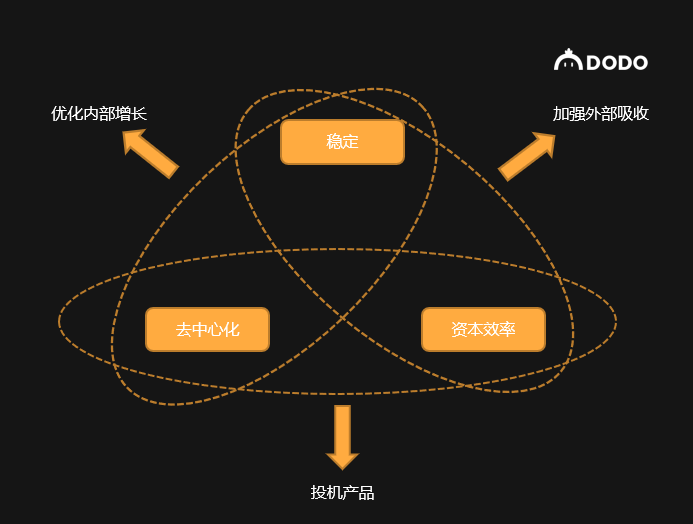
Qualified speculative products: high interest rate (capital efficiency), floating (stable), free flow of capital
Credit expansion with credit retail model
💡 For a stablecoin project, credit expansion is independent of the impossible triangular choice problem, and is more important than the impossible triangular choice problem. Credit expansion is a model system of how stablecoins issue additional currency at the micro level and how to improve their credit level. This paper proposes to use the credit retail model to carry out credit expansion, which has flexibility on the margin.In the traditional credit currency system of sovereign countries, credit expansion relies on the entire expansion system of the central bank and commercial banks, which is microscopically dense bank outlets and a large number of salesmen. For the previous generation of algorithmic stablecoins, it wants to expand credit through a complete set of smart contracts and Internet front-end operation promotion. And this paper proposes,There is a problem with stablecoins completely relying on smart contracts, and there is still a need for a retail model. At the micro level, there are still some people who need to operate
, people have subjective initiative, and more importantly, everyone has asset-specific information, which forms the basis of credit expansion.
There are marginal problems with credit expansionThe interest rate should be variable on the margin and within a certain range, otherwise a series of problems will arise, and when the algorithmic stablecoin relies on smart contracts or some specific agreements for credit expansion, the entry threshold and mortgage rate for everyone are very important. it's the same. thisThere is an adverse selection problem here. When a person is considering borrowing or mortgaging assets to obtain a stable currency, if he feels that the mortgage rate is not suitable, then he will choose the project he thinks is better, and the most likely choice is his think he is taking advantage of the project
, Therefore, if the margins are equal, the users who choose to come to this project will be worse than expected, and the whole project will face a serious adverse selection problem, that is, the probability of default is higher than expected. This is why adjustments are made for individuals at the margin. This has also been repeatedly verified in both traditional finance and decentralized finance. To solve this problem, it is necessary to introduce a credit retail model.
credit retail modelThis model requires a complete credit system on the chain. The overall credit expansion depends on the credit issuance of the salesman at the micro level. The salesman works for himself and at the same time plays a certain role in guaranteeing the credit. Historical performance superimposes its own mortgage on the stablecoin project to determine its own level and credit quota, and the project party is only responsible for ensuring payment settlement and credit settlement and maintaining a fixed income market.The salesman forms initial credit through historical performance and collateral, obtains the amount and interest rate range, and then the salesman lends money according to the loan demand in the market. The lender needs to provide credit records and mortgage some assets
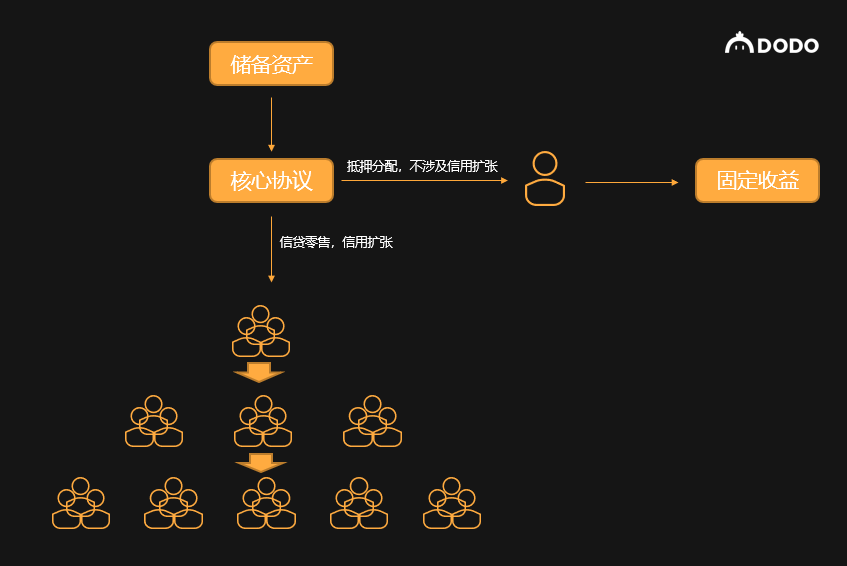
. In this way, the currency is issued microscopically to achieve credit expansion.Currency creates incremental value in this process. Liquidity is not allocated to arbitrageurs, but to people who really need to borrow money, and these needs are commercial credit. When commercial credit is continuously realized, the entire system will have internal growth drivers。
first level title
Build a framework for monetary policy regulation
Native Token DesignIn previous projects, most stable projects that issued native tokens had to take all the seigniorage. The motivation was to encourage people to buy native tokens in anticipation of currency issuance, which in turn supported stablecoins.。
But this form of credit proves to be fragile, and the reason for taking all seigniorage is that seigniorage should not be controlled by a small number of entities, nor should a small number of people be incentivized to buy native tokens in large quantitiesThe formation of the entire credit system cannot be achieved by a single team, it relies on all participants in the system, and the unreasonable distribution of native tokens will lead to unbalanced benefits brought about by system expansion, and a few people will The rapid accumulation of large amounts of wealth within the system is a failure of the incentive system.
The income should be distributed evenly, and the rules should be clarified to promote the slowdown of wealth distribution, which is suitable for the development of the whole system. Therefore, this paper proposes that native tokens should absorb part of the seigniorage.
Therefore, it is necessary to issue native tokens as part of the reserve assets to absorb part of the seigniorage, and increase the proportion with credit expansion. The ratio of native assets as reserve assets reflects the degree to which the form of credit is accepted by the public. The native token design should follow the following points.
Native tokens only take part of the seigniorage, a small proportion. At this stage, we must choose stability and decentralization.
When the income in the system increases, it will gradually change to using the future income of native tokens as reserve assets to support the issuance of currency, and the proportion will gradually increase.
Choose the cycle flexibly, and increase the proportion of native tokens appropriately when accelerating expansion.
Volume and Price Regulation of Monetary Policy
Quantity refers to the money supply, while price refers to the rate of return, which means the rate of return of the entire system and directly reflects the marginal liquidity price. ** Direct regulation of money supply is the most direct monetary policy. Mechanisms such as rebase of the monetary policy regulation mechanism of the previous generation are consistent at the margin, and there is no so-called precise delivery. However, if the credit retail model is used to release money, the money will be released directly on the margin by directly adjusting the salesman's quota.
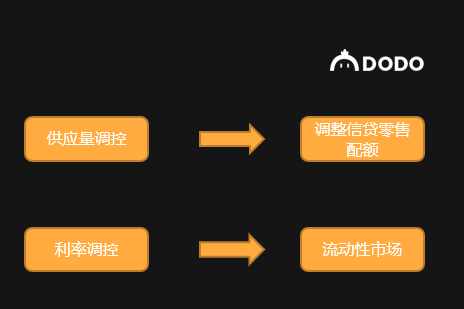
Compared with directly regulating the money supply, price regulation is more precise, which requires a perfect liquidity trading market to form a rate of return, and the project party itself has a controllable interest rate as the benchmark interest rate to influence the whole market. For projects that adopt the credit retail model for expansion, the benchmark interest rate can use the mortgage rate.In price regulation,。
The counter-cyclical adjustment mechanism can be used to guide price regulation
Accelerated expansion period, large demand for money, more money issued, increasing interest rate (mortgage rate)
first level title
Summarize
Summarize
In the long run, stablecoin projects are restricted by the impossible triangle, so it is necessary to have a clear understanding of the impossible triangle and perform dynamic balance according to dynamic rules.
It is a long-term process for the credit form of native tokens to be fully accepted. Therefore, native tokens can only absorb part of the seigniorage. In terms of volume and price regulation, according to the credit retail model, one is to directly adjust the salesman's share to regulate the money supply. , one is to adjust the liquidity price through the adjustment of the mortgage rate, and then affect the liquidity market.
disclaimer
"DODO Research Institute" led by the dean "Dr.DODO" led a group of DODO researchers to dive into the Web 3.0 world, doing reliable and in-depth research, aiming at decoding the encrypted world, outputting clear opinions, and discovering the future value of the encrypted world. "DODO" is a decentralized trading platform driven by the Proactive Market Maker (PMM) algorithm, which aims to provide efficient on-chain liquidity for Web3 assets, allowing everyone to issue and trade easily.
Copyright Notice
Without the authorization of DODO Research Institute, no one may use without authorization (including but not limited to copy, disseminate, display, mirror, upload, download, reprint, excerpt, etc.) or allow others to use the above intellectual property rights. If the work has been authorized to be used, it shall be used within the scope of authorization, and the source of the author shall be indicated. Otherwise, its legal responsibility will be investigated according to law.
about Us
"DODO Research Institute" led by the dean "Dr.DODO" led a group of DODO researchers to dive into the Web 3.0 world, doing reliable and in-depth research, aiming at decoding the encrypted world, outputting clear opinions, and discovering the future value of the encrypted world. "DODO" is a decentralized trading platform driven by the Proactive Market Maker (PMM) algorithm, which aims to provide efficient on-chain liquidity for Web3 assets, allowing everyone to issue and trade easily.
More information
Official Website: https://dodoex.io/
GitHub: https://github.com/DODOEX
Telegram: t.me/dodoex_official
Discord: https://discord.gg/tyKReUK
Twitter: https://twitter.com/DodoResearch
Notion: https://dodotopia.notion.site/Dr-DODO-is-Researching-6c18bbca8ea0465ab94a61ff5d2d7682
Mirror:https://mirror.xyz/0x70562F91075eea0f87728733b4bbe00F7e779788





