


Arthur Hayes, Founder of BitMEX: Is the Cryptocurrency Bear Market Bottom?


Original Author: BitMEX Founder Arthur Hayes
first level title
real inflation problem
The prerequisite for a bull market to start is that the Federal Reserve and the central bank pause interest rate hikes and keep the size of their balance sheets unchanged. Under the current interest rate hike cycle, the CPI has been pulled back, but the income of ordinary American workers is also reduced. Given that this is a midterm election year in the United States, this will become a growing problem as we head into November, and the ruling Democrats will need to do something to correct it.
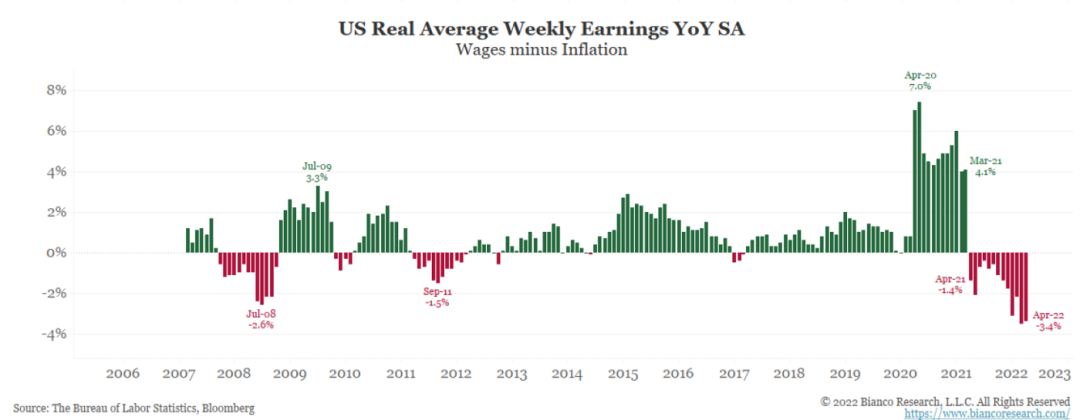
As voters pay more and more for less and less money, inflation becomes extremely important to them. Those red bars in the above picture mean that no matter which political party comes to power, it will face the current problems.
The Fed has done such a good job of depressing asset prices that the U.S. 10-year Treasury yield is the worst since 1788 so far in 2022. However, the average person is more concerned about the price of energy and food. It can materially slow the rise in energy and food prices by destroying demand through a negative wealth effect. The theory holds that the rich consume far more of these resources than the poor. Thus, raising interest rates can force the rich to consume less, curbing energy and food price inflation in the process.
In a recent speech, Governor Waller had this to say:"I support an additional 50 basis point tightening in several meetings. In particular, I would not put a 50 basis point hike on the table until I see inflation falling closer to our 2% objective. And, by the end of the year, I support keeping the policy rate above neutral so that it reduces demand for goods and labor and brings it more in line with supply, thereby helping to control inflation."
The above would probably work if the world wasn't in a world war. Today, however, the U.S. and NATO are openly supplying Ukraine with sophisticated weapons so that its armed forces can engage Russia directly. While there is no direct kinetic confrontation between the West and Russia, the West is at war with Russia economically through various sanctions.
Together, Russia and Ukraine produce vast amounts of energy and food, and the longer this conflict drags on, the less access the rest of the world will have to these critical resources. And what's really scary is that even when the war is over, complex systems don't restore previous output in a linear fashion. Due to current disruptions, we could lose significant amounts of global agricultural and energy output within decades. To make matters worse, Russia and Ukraine provide a large share of the world's fertilizers, and without these exports agricultural production in other countries would likely drop significantly as well. And if Russia has to shut in oil and gas wells because it lacks a buyer who can logistically take them, it will take decades to restore current daily production.
The Fed will continue to seek to reduce demand for energy and food, but unless full trade with Russia and Ukraine resumes, prices for both will continue to rise. If trade cannot be restored, then the U.S. has to resort to another usual solution to the problem.
That is to provide energy and food subsidies, which will keep these necessities at affordable prices. Subsidies come in many forms. right"price gouging"Windfall profits taxes for private companies, price controls on various items, and direct checks (aka food stamps) sent by the government are all potential forms of subsidies.
But either way, the government needs to generate more cash, that is, to widen the fiscal deficit by issuing more government debt. But who is going to buy these bonds?
In a war economy, the central bank loses its independence and merges with the treasury. This happened after World War II, and it will happen again now. The central bank will push the button and immediately begin buying all debt issued by the Treasury at politically appropriate rates.
The external effect of this policy is to accelerate global inflation and famine. Worst affected will be countries in the Global South that cannot afford to print money to solve their macroeconomic problems. The US issues the global reserve currency, has the strongest military, so it will be fine, it will get all the things it needs at the expense of everyone else. The EU bloc would be in a similar position, as the euro is the second-largest currency used in trade. Europeans are experts at subsidies that distort demand and ensure that domestic entities receive preferential treatment compared with the rest of the world. But if the world's wealthiest citizens don't rein in their consumption as global output shrinks, it will be everyone else who will starve.
I bet the Fed will tighten even more aggressively in the third quarter, even with the S&P 500 and Nasdaq 100 below 3,000 and 10,000 respectively. Because they have to keep energy and food prices down, not just risky assets. But if energy and food inflation are also not meaningfully adjusted by then, politicians will have to offer subsidies to appease agitated voters.
These subsidies will be paid for by the printed money provided by the Federal Reserve, at which point we will have a renewed bull market in risky assets. If the all-knowing hedge fund expert Felix Zulauf is to be believed (according to his recent newsletter), a financial market crash will ensue as fiat currencies collapse themselves under the weight of the greatest money printing machine in human history.
first level title
bargain hunting
Given that cryptocurrencies are the last free market in the world and will sooner be included in the ranks of recovery risks, it is reasonable to think that the recent waterfall of TerraUSD and LUNA can smash the bottom of the market.
I want to connect the two theories.
1. Most tech VCs are vehicles with expensive betas to the overall market in terms of fee-adjusted performance. So as inflation crushes bellwethers like Netflix as users choose to eat rather than pay for the privilege of watching more mediocre Netflix originals, some of the most successful tech companies in the world, like Facebook, are seeing user growth flat or even negative, the general funding and IPO environment deteriorated rapidly in 1Q22. Add that to rising nominal interest rates, and you can imagine the misery of the Patagonia-clad, khaki-wearing bros in Silicon Valley, Zhongguancun, and Mayfair.
2. The theory below is from one of the smartest cryptocurrency traders I know, I haven't done the work to verify his theory, but logically, it makes sense. He speculates that the event that burst the TerraUSD bubble stemmed from off-exchange trading by VCs who needed to cash out their LUNA positions with minimal market impact.
Due to the openness of the blockchain, it will be easy to find out if early VCs sell a large amount of LUNA positions. The agreement allows holders of LUNA to exchange 1 USD of LUNA for 1 UST at the current market price of LUNA/UST. This LUNA will be burned and an equivalent amount of UST will be created without any market impact on the broader LUNA value. Using over-the-counter transactions (OTC), venture capital firms have exchanged a large amount of UST for other stablecoins, such as USDT, USDC, and even USD fiat currency, so that the market will not be affected. The end result is a massive increase in the supply of UST, which ultimately affects the de-anchoring of its price.
This liquidity is close to $5 billion. The start of TerraUSD’s breakdown occurred when the peg’s curve broke slightly. This is because the supply of UST is too large relative to other stable currencies such as USDT and USDC. Once the peg starts to break slightly, and confidence in a quick recovery wanes, the negative convexity of the algorithmic stablecoin design takes over and creates an unstoppable downward force.
Putting these two events together, the inflation-driven shrinkage of VC balance sheets and the bursting of the Luna bubble, my theory is that the broader risk-averse environment prompted them to cash out their successful LUNA investments at the same time. The global risk aversion movement was created by the Fed. Therefore, the collapse of TerraUSD is an indirect result of global central banks tightening liquidity. So, I believe that this event has created pain that will in any case come a few months later as the Fed and others continue to tighten liquidity conditions.
For the record, I am not blaming the Fed for TerraUSD's debacle. Its collapse is doomed, as anyone who has read the white paper or studied algorithmic stablecoins can understand. My point is that the Fed provided the catalyst for what would eventually happen. Thankfully, since there are no government bailouts for cryptocurrencies, we quickly found our true liquidation price and can now heal and move on to our goal.
I firmly believe that cryptocurrencies lead the broader market. The data backs this up, as the correlation between Bitcoin/Ether and the Nasdaq 100 broke down during the recent cryptocurrency market crash. Next, let's revisit the correlation chart and see how they all turned sharply lower.
In chronological order, below are charts of the rolling 10-day, 30-day, and 90-day correlations between Bitcoin and the front-month Nasdaq-100 futures contract.


The following are the 10-day, 30-day and 90-day rolling correlation charts of Ether and the previous month Nasdaq 100 index futures contract, arranged in order.


As you can see, cryptocurrencies have decoupled from the broader risk asset universe during this latest crash. This is good on a macro level, but there are other crypto market indicators pointing to a local low as well.
secondary title
BTC

secondary title

ETH

Ethereum has gone through two cycles. The first cycle started when the coin was freely traded for the first time after the ICO launch, and the second cycle started after ETH bottomed out after the ICO boom of 2017/2018.

Don't take these as exact science, we can roughly come up with a range that corresponds to what we think is the local bottom. For bitcoin, it's $25,000 to $27,000.For ether, that's $1,700 to $1,800. (His forecast in May was $20,000 and $1,300)
If I had a natural language processor crawling all the articles about cryptocurrencies in the mainstream financial media, I could plot a language sentiment indicator. Even without a strong model, a cursory search of highly hit articles published by Bloomberg, Financial Times, Wall Street Journal, etc., can give a sense of the market pain felt by cryptocurrency traders around the world.
My bottom checklist:
1. BTC/ETH moves less and less correlated with Nasdaq 100.
2. The current price level is very close to the historical high of the previous cycle.
3. Mainstream financial media gloats about how stupid and greedy those who invest in cryptocurrencies for temporary wealth are.
A typical feature of bottoms is that the most determined bulls are forced to sell assets, and LFG is such a character. Spitting out 80,000 BTC makes me even more convinced that the $25,000-27,000 region for Bitcoin is the bottom of this cycle.
Politics has to align with the macroeconomic environment, and while the bottom is in (I hope), that doesn't mean prices will automatically return to rapid increases.
The market will stage an impressive bear market rally, allowing traders who have lost a lot of money to sell on the rally. Now, many traders are sitting on a 50% to 90% drop and they are not willing to get out at the bottom price. Therefore, any rebound will usher in selling pressure, and only by absorbing all these selling pressures can we usher in a bull market.
In a previous article, I made an argument that I thought Ether could reach $10,000 by the end of the year. In light of the recent massacre, many readers wonder if I still believe in this goal. In short, have confidence in price, but not in time.
My political theory rests on the assumption that the core tenets of inflation that American voters care about are energy and food, not risky assets. So voters won't be happy, even though risky asset prices have fallen a lot with rate hikes.
Original link





