


Founder of BitMEX: Ethereum as a "bond" will break through $10,000 by the end of the year


Original author: Arthur Hayes, founder of BitMEX
Original title: "Five Ducking Digits"
Original compilation: Gary Ma, Wu said blockchain
I don't really like the so-called "financial consultants" in the traditional financial field. Their purpose may not be to provide you with financial advice sincerely, but to maximize their own management fees and performance fees, even if the final financial performance is not good. How, they can also get that part of the income.
And most of the "financial advisors" I've met have a general antipathy towards cryptocurrencies and tell their clients not to invest in cryptocurrencies.
first level title
What is ETH?
This is a simple but profound question.
If you say it's a commodity, there's one class of investors that'll be interested.
If you say it's a currency, another class of investors is interested.
But what if you could convince the world that ETH is just an indefinite bond?
The merged Ethereum will transition to PoS, and the validator's pledge rewards and network fees make ETH a bond.
first level title
Calculate the pledge account of ETH
According to the prediction data of Ethereum researcher Justin Drake, in the early stage after the merger, the annualized return of pledge is about 8–11.5%.
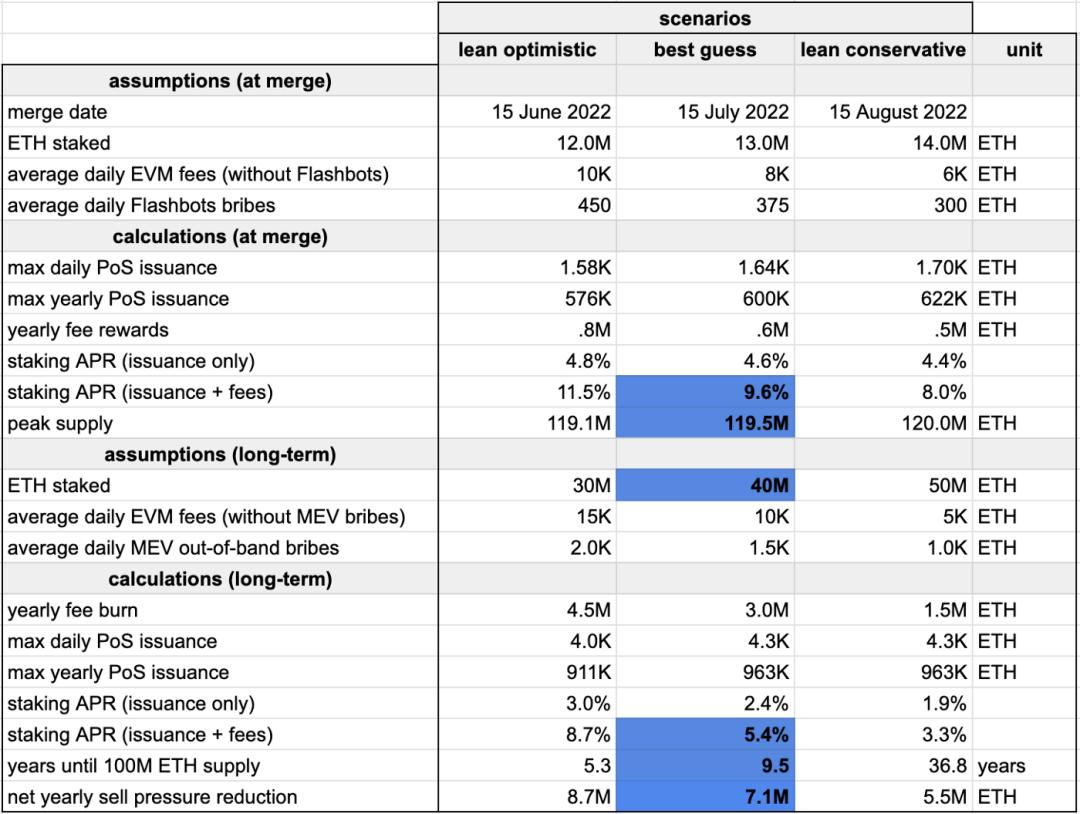
If you're a diehard ETH fan, you might agree or disagree with these numbers. But I'll take them as "facts" for now. The point of this article is not to delve into whether the yield is 5% or 10%, but to use scenario analysis to value ETH as a bond.
In this analysis, we will assume that you are selling an equivalent amount of USD to buy 32 ETH. This is extremely important, and I look at this valuation from the perspective of someone who invested in fiat currency first. Therefore, as with any carry trade, the cost of USD funding is extremely important.
For this analysis to have maximum impact, we must convince larger allocators of capital that ETH is a bond. Once this concept is successfully established, the follow-up will follow suit.
step:
step:
Borrow USD for a period of time, then buy ETH at the current exchange rate.
Stake 32 ETH to earn ETH currency standard rewards.
After a certain number of years, sell 32 ETH and get rewarded in USD.
Repay the dollar loan.
The table below shows the current value of ETH bonds in ETH.
Remember, we started with 32 ETH. This is the value of the bond in ETH, which includes an initial principal of 32 ETH. Market convention is to quote bonds as a percentage of face value, which would be 32 ETH. But to highlight the amount, I used the notional amount of ETH. I also did not reinvest the proceeds of ETH through staking. If we used continuous compounding as we received ETH yields, the bond would be worth more. Obviously, continuous compounding is possible and financially prudent, but for the sake of mathematical simplicity, I'm not doing it.
The table below reflects the breakeven price for ETH/USD. This is the price at which the loan matures, and the transaction breaks even from a dollar perspective. I assume all ETH cash flows are converted to USD at a constant ETH/USD price so I can calculate the price at which this transaction becomes uneconomical.
first level title
local currency bonds
A local currency bond is one in which the issuer's domestic currency is the same as the borrowing currency. If you are a dollar-based investor, these bonds carry currency risk. Some investors like these bonds because they usually have high yields. However, if investors hedge their currency exposure, the effective rate of return typically decreases.
Typically, non-deliverable forward (NDF) points in emerging markets are positive. This is because of interest rate parity. However, take a look at the following example of a Malaysian ringgit NDF.
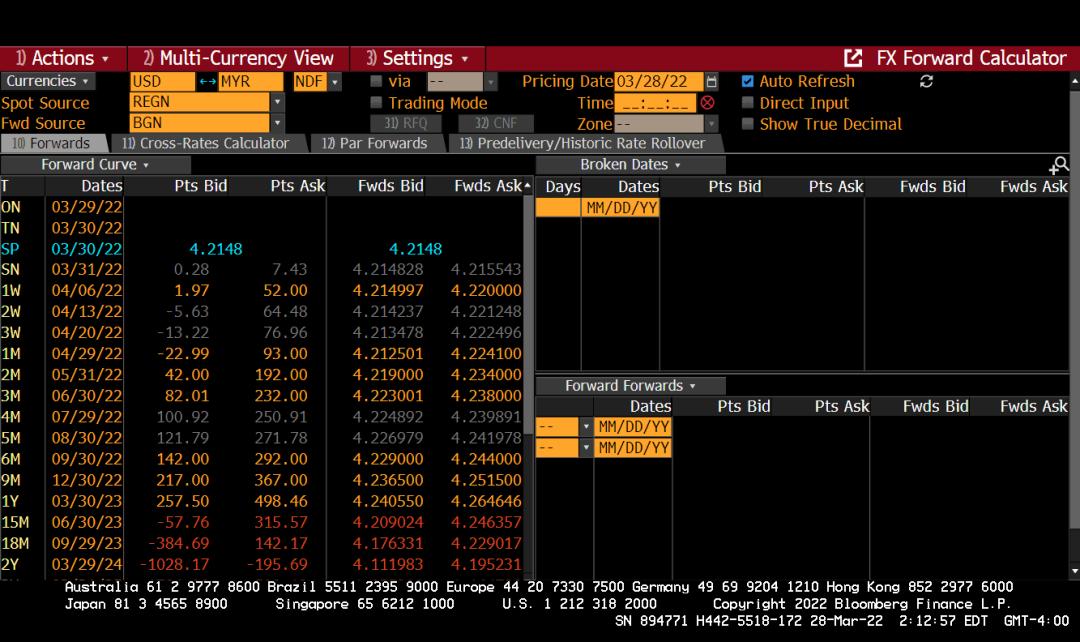
The spot USD/MYR is at 4.2148, while the 1-year NDF is at 4.24/4.26, meaning it is trading at a premium to the spot price. If I bought a MYR local currency bond and needed to sell MYR and buy USD in the future, I would trade on the right side (RHS) and effectively pay forward points. This means I need to spend money to hedge my position.
Some investors are happy to take currency risk, others are not. As a good financial advisor, you are contradictory and you will just be offering two different products. One is hedged and one is not. And in both cases, you will be charged a fee.
In the case of the 5-year ETH local currency bond, if we assume an annual yield of 11.50%, the price of ETH/USD would have to fall by 29.35% for the investor to lose money in USD after 5 years.
But if investors want to hedge currency risk, they need at least forward transactions to hedge their expected aggregate cash flows. Right now, ETH/USD listed futures have had very little liquidity over the past 3 months. I contacted a reputable broker on March 28, 2022 and asked what their median price was for a premium or discount for a 1-year ETH/USD forward.
If I'm long on ETH Bond and get a quote for ETH/USD forward, I'm trading on the left side (LHS), selling ETH and buying USD. The broker quoted me a premium of +6.90% in the middle of the market. This means that in order to hedge my local currency ETH bond, I actually receive income. I sell ETH/USD forwards at a premium to the spot price. This is an aggressive carry trade.
There are very few deals where you can get higher yields investing in foreign currency bonds where the act of hedging back to your home currency actually earns you money.
As a final part of this analysis, I valued a perpetual bond using the validator revenue earned from staking ETH.
In the beginning, I thought ETH was similar to perpetual bonds. That is a bond with no maturity date. Before being delisted in late 2016, UK concerns had one of the longest continuous price histories of any government bond ever issued.
Over the centuries-old history of this debt instrument, nominal long-term yields in the UK have essentially been 5% or less. So let's assume a long-term return of 5% from here on out, and ETH returns at the low end of our forecast of 8%. We find that the final present value of the ETH cash flow is 51.20 ETH. The required input for this ETH cash flow is 32 ETH.
If we use this to determine the bond implied value of ETH, we arrive at the following graph. These values are simply multiplications of [spot * present value of ETH rewards].
This should not be viewed as a price prediction, but as a guide to a new way of thinking. If you think ETH can or should be valued as a bond, then as an investor, given your long-term interest rate and ETH return assumptions, you should be willing to buy ETH at today's price as long as it trades at a lower price than its perpetual bond derivative The price is discounted.
first level title
capital efficiency
To take advantage of ETH bonds, capital needs to be locked indefinitely. This is because currently, once ETH is staked on the Beacon Chain, it cannot be unstaked. After the merger, when POS verification starts, the ETH yield will rise, but the stakers will still be frozen.
There are various validating pools that allow traders to easily contribute ETH and start earning. In order to provide liquidity to those who are locked, these pools have issued their own tokens, which are anchored 1:1 to the ETH invested.
For example, if you deposit 1 ETH into the Lido pool, you will get 1 stETH, whose trading price is determined by the market. The three largest pools are Lido, Binance, and Rocketpool.
This graph shows the daily premium or discount percentage for a certain pool token traded against ETH.
Pool Token Price Premium = Rug Risk + Implied ETH Return + Liquidity Preference
Let's illustrate with an example:
Rug Risk: This is the risk of having some bugs in the validator code. If, for whatever reason, this smart contract is compromised, the staker's funds may not be withdrawn.
Implicit ETH Rewards: Tokens in these pools receive ETH rewards. Therefore, the market discounts future rewards received by token holders into the present.
Liquidity Preference: This is a quantification of the desire of coin holders who want liquidity today. The higher the preference, the higher the discount of tokens in a pool to ETH. On the other hand, if a pool limits the amount of ETH deposits it can accept, liquidity preference may actually increase the price of the pool token, as was the case with Rocketpool.
My analysts delved into the details of what each of the Lido, Binance, and Rocketpool tokens represented, trying to understand why they trade at different premiums to ETH.
Lido: This pool has the largest market share (about 85%) and transactions are very much in line with the price of ETH. When you stake ETH, you will get stETH at a ratio of 1:1. ETH staking rewards will accrue to stETH minus fees charged by Lido for providing services. This token can be used as collateral in other DeFi applications without affecting the accumulation of ETH rewards.
Binance: This is the pool with the second largest market share, trading at a lower price than ETH. When you stake ETH, you will get bETH at a ratio of 1:1. ETH staking rewards will be earned by bETH, minus Binance’s fees for providing services. This token can be used as collateral in other DeFi applications, but you will not be rewarded with ETH when bETH is staked outside of your Binance wallet. My analyst believes this is a big reason why bETH is trading at a much lower price than ETH. In the DeFi ecosystem, it is not a good auxiliary tool like stETH or rETH.
Rocketpool: This pool has the smallest market share of the three pools. It is consistently trading at a higher price than ETH. When you stake ETH, you will get rETH at a ratio of 1:1. ETH staking rewards accrue to rETH minus Rocketpool's fees for providing services. Rocketpool is decentralized, unlike the other two pools, and severely limits the amount of ETH deposits it can accept. Only after more operators come online will more deposits be accepted. This token can be used as collateral in other DeFi applications without affecting the accumulation of ETH rewards.
stETH is the best approximation of the present value of the ETH bond. I put forward a theoretical hypothesis about present value, and stETH is concrete market performance.
StETH is trading at roughly the same price as ETH, which is puzzling.
Liquidity preference: According to Coingecko data, the market value of stETH is 9.8 billion US dollars, and the daily trading volume is 100 million US dollars, accounting for about 1% of its market value. Ethereum’s daily transaction volume to market capitalization ratio is about 3%. If holders of stETH really cared about the liquidity of their unavailable lido-invested ETH balances, stETH's trading volume relative to its market cap would be higher. Therefore, investors' liquidity preference appears to be close to zero. As more and more DeFi platforms accept stETH as collateral, the need to liquidate stETH into ETH decreases.
Implied ETH Reward: If we consider the combined ETH annualized reward to be 8%, then the implied reward is 8% multiplied by the time the staked ETH is released. We don't know how long this is. If the market believes that it will take 6 months after the merger to release the held ETH balance, then the premium should be 4%.
Rug Risk: It is almost impossible to estimate what this risk really is. We can only prove by assuming the other three variables. However, it is safe to assume that if you stake your ETH on Lido and do not trust the integrity of the technology, you will sell your stETH. But considering that stETH has the same transaction value as ETH, and has a lower average daily transaction volume, the market must believe in Lido's technology.
first level title
Collateral utilization
Now that these pledged tokens exist, they should be used as collateral in the DeFi ecosystem, essentially unlocking trapped collateral. AAVE is a decentralized lending protocol that allows traders to stake stETH as collateral. Currently, the LTV of stETH as collateral is 70%. MakerDAO also allows users to create DAI, its dollar-pegged stablecoin, using wrapped stETH (WSTETH) as collateral. The current guarantee ratio is 160%.
It's huge. The cornerstone of the global fiat credit market is the ability to create a debt asset, which is simply a loan to some entity, and then use this debt asset as collateral to borrow more money. This is how the leveraged flywheel drives the global economy.
Despite the obvious benefits of this behavior, it does introduce systemic credit risk to the system. If the protocol allows increasing utilization of pool tokens as underlying collateral, and there is a matchmaking event that renders staked tokens worthless, all value built on top of that will suffer as well. We must be mindful of this risk as these tokens become more widely accepted. The great thing about DeFi is that all activity is completely transparent because it is on-chain. Therefore, we can build very precise monitoring systems to measure the instant DeFi system credit risk attributable to pledged tokens.
first level title
What would Michael Saylor do?
Saylor is a "rogue" because he used Microstrategy to use the institutional corporate bond market as a financing vehicle to acquire Bitcoin. This is indeed a strategy, but Bitcoin is pure currency and inherently has no income. ETH is the commodity that powers the world's largest decentralized computer. The merged ETH will have intrinsic benefits.
What Saylor or any other high yield issuer should do is issue debt and buy ETH. This is an aggressive carry trade.
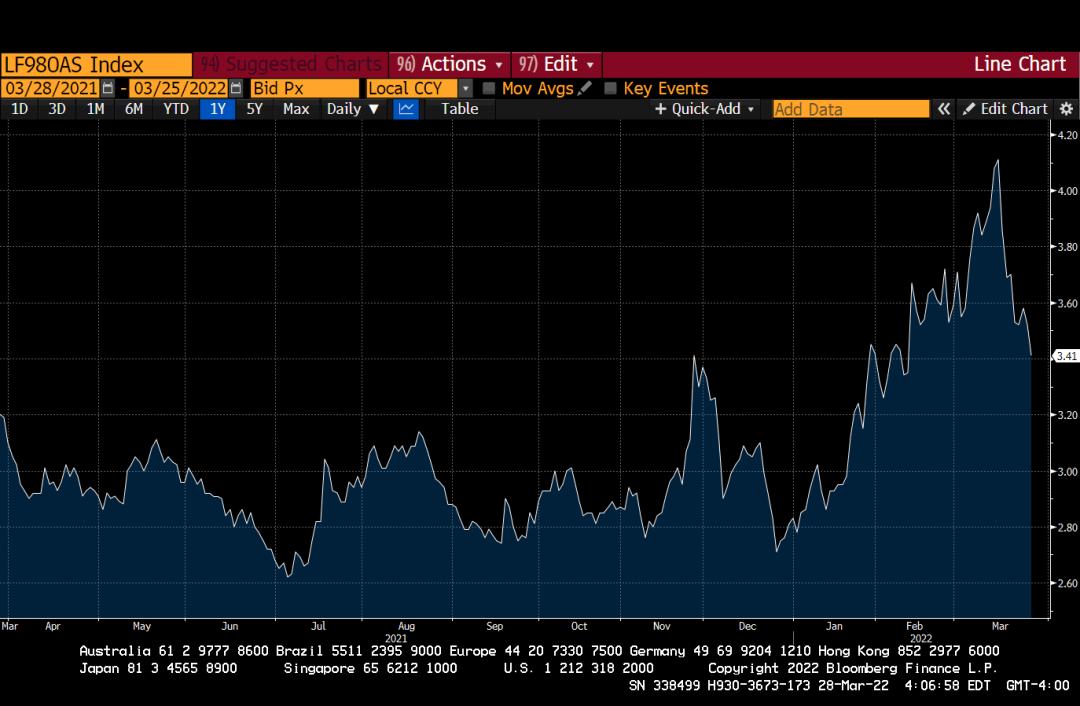
The picture above shows the average OAS of high-yield U.S. companies by Bloomberg. What this shows is that US corporate junk bond issuers are currently paying an average of 3.41%.
Using the model above, let's imagine you're the CEO of a brick and mortar company and want to meme to get a high stock price. Never mind what your business is supposed to do, your purpose is to achieve financial optimization.
enter:
3.41% cost of capital
5 years due
8% ETH rewards
3,output:
output:
The present value of this bond is 41.28 ETH.
The breakeven price of ETH is $2573, or a drop of 22.48%.
Assuming no price movement in the ETH/USD exchange rate, the return in USD terms is 29%.
Would a spendthrift CEO really hedge currency risk? Absolutely not!
For any public CEO, announcing debt and buying ETH bonds in large quantities can create twice the value. First, because your stock is now a"DeFi"、"web3.0"、"metaverse"first level title
ESG: Green investment theme
ethereum killer
ethereum killer
Ethereum's performance issues are always a point of criticism from competitors, the prices of these Ethereum killers have soared in the last year, the valuation has been greatly improved, and now Ethereum is on the cusp of a merger, which may or may not be Bringing performance improvements, will ETH perform better compared to other L1 tokens?
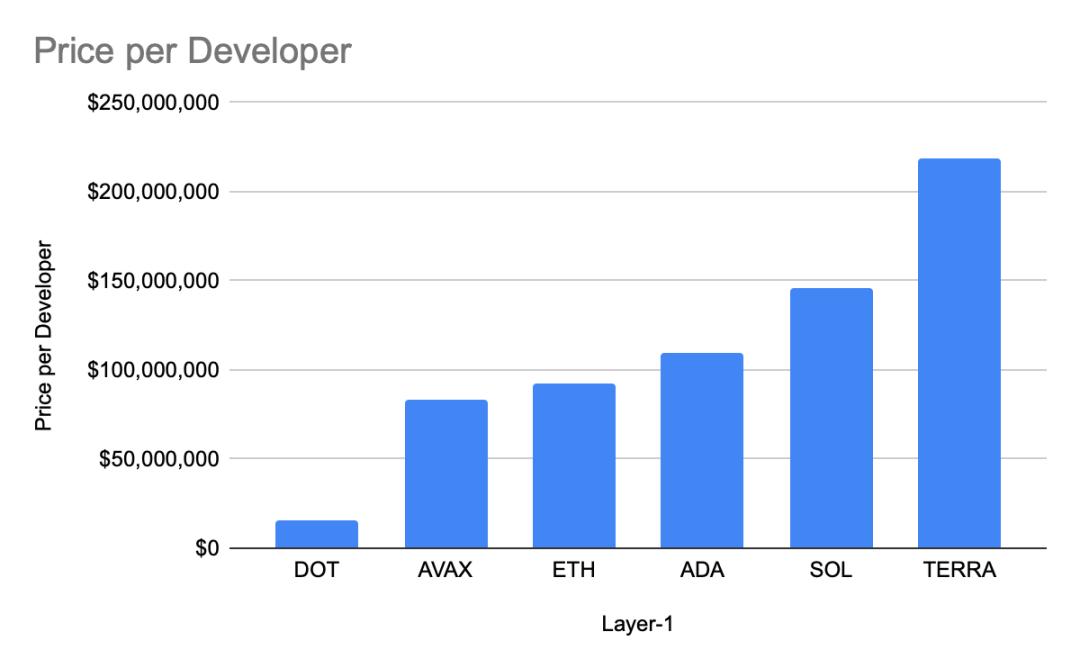
This "price/developer" ratio graph reflects the market capitalization of part of L1 divided by the number of active developers.
Electric Capital published a very important and insightful research article estimating the number of active developers on each major public chain. A public chain is built to be used. If only a few developers create new projects on a chain, the chain will never become valuable.
Most Ethereum killers have much higher multiples as they hope to attract talent to develop on their chain.
According to the report, Ethereum has about 4,000 developers, which is 3 times larger than Polkadot on the chain with the second largest developer base.
This “price/address” ratio graph reflects the market capitalization of selected major L1 protocols divided by the number of addresses.
The number of addresses on a chain is another rough but useful metric that can be used to assess the health of a public blockchain. Ethereum has 16 times as many addresses as second place Solana, but is still cheaper on a price/address basis.
This is another good indicator of hype. Blockchains that exist only to take market share from ETH have much higher multiples.
"Price/TVL" is the market cap divided by the total value locked in dApps on the protocol.
This ratio is the easiest way to identify the extent to which DeFi is gaining traction. ETH is the third cheapest, after TERRA and AVAX. I'm not even sure if ADA should be included, if there's a coin that trades purely on hope, it's Cardano.
If you compare these basic ratios, ETH may be the cheapest L1. Ethereum's success has spawned a contingent of competitors who trade on hopeful futures rather than concrete performance. Nothing wrong with that, but when ETH is about to feel the love of bond and ESG investors, can these other coins keep up?
If you were a capital allocator and either already held some of these coins or had to choose which L1 token to invest in, wouldn't you want to buy the cheapest one? While ETH's market cap is several orders of magnitude larger than its competing chains, it's still cheap based on valuations based on network fundamentals.
As the year progresses and mergers arrive, I expect ETH to significantly outperform any L1 chain built. This narrative is valid from 2020 to the end of 2021, but now, Ethereum supports extremely positive price fundamentals from a capital flow and return perspective.
first level title
Three ways to configure ETH
There are three ways to consider how to configure ETH: fiat currency & bitcoin & other L1.
French currency
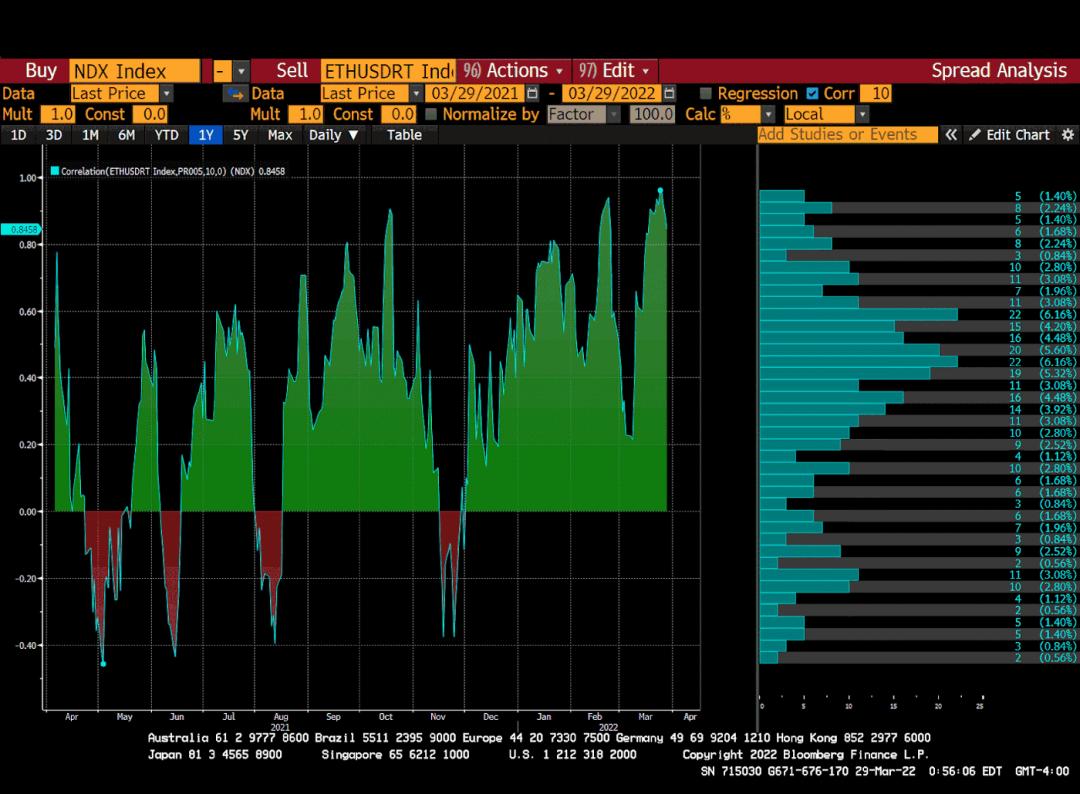
Here is a rolling 10-day correlation chart of ETH and the Nasdaq 100, with a whopping 84% correlation.
ETH (and Bitcoin) are risk assets, just like the big US tech stocks.
As the Fed continues its path of raising nominal rates, and the inversion of the 2s/10s curve points to a future US recession, stocks will be crushed (meaning a 30% to 50% drop) until credit markets go awry and the Fed restarts money printing machine.
If I believe this with all my heart, then I also have to believe that ETH can drop 30% to 50% in USD terms. Unless the broad risk asset market crashes, or ETH's short-term correlation with the Nasdaq 100 or S&P 500 starts to decline, I would not sell fiat and buy ETH.
No matter what I think about ETH's strong fundamentals, it doesn't exist macroscopically.
BTC vs ETH
My cryptocurrency portfolio for early 2022 is 50% Bitcoin and 50% Ethereum. I firmly believe that ETH is cheap relative to the rest of the crypto world.Therefore, my target allocation is 25% Bitcoin and 75% Ethereum.
Bitcoin becoming the "worst rock star" again requires a change in the narrative. Similar to Ethereum, Bitcoin is considered another risk asset, but a huge one because it trades 24/7 and is the only remaining free market in the world.
Bitcoin must once again be considered a store of value and an inflation hedge because it is the hardest form of money ever created. Ethereum is not a currency, it is a commodity that powers the world's largest decentralized computer. The Ethereum community has clearly decided that ETH is a commodity used to power this computer, not a purely monetary instrument.
At the protocol level, Bitcoin does not have an implied rate of return, but the merged Ethereum does. So Bitcoin is the currency and ETH is the commodity-linked bond.
With negative real interest rates worldwide, I would like to own an asset that returns positive in its currency. Right now, that's ETH, and Bitcoin itself doesn't generate yield. So, from a pure spread standpoint, I should have more ETH than Bitcoin. Thanks to the new reward and validation system, this will change when the price of ETH rises sufficiently to contain future ETH cash flows.
Finally, funds from environmentally friendly investment theories such as ESG will also "safely" invest in ETH after the merger, instead of Bitcoin.
ETH vs L1s
I hope the charts posted earlier make it clear that the perception that ETH is undervalued is based on network fundamentals, while its competitors are based more on a brighter future. Likewise, other L1s may realize their dream of overthrowing ETH, but it's hard for them to do so. With the impending implicit yield of ETH, and the ability of ESG investors to allocate ETH, the hope of surpassing ETH will become increasingly remote. They're better off trading something they can prove to be undervalued on network fundamentals.
secondary title
ETH Price Breaks Five Figures
A few years ago, I wrote an article predicting that ETH price would break double digits, which happened very quickly.
Then, when I saw a chart showing that the total value of DApps built on Ethereum was greater than the market value of Ethereum itself, I further allocated ETH, which was a strong buy signal.
I've lived through the current ups and downs and feel very comfortable with the relative size of the ETH allocation in my crypto portfolio. The remainder of 2022 will be show time for ETH.
When the dust settles at the end of the year, I believe ETH will be trading above $10,000.





