


One article to understand the mainstream encryption project Ethereum


What is Ethereum?
What is Ethereum?
blockchainblockchainapplication platform.
Putting aside the technical terms such as decentralization, open source, and smart contracts in the definition, in a nutshell, Ethereum is a blockchain platform on which anyone can create applications according to their own wishes. Just like Windows and Android systems on the Internet, Ethereum can provide a set of specialized scripting languages for everyone to freely develop programs. But at the same time, there is a big difference between Ethereum and Internet system platforms such as Windows and Android. Ethereum adopts blockchain technology, and its essence realizes strong decentralization. On Ethereum, changes to the entire system protocol are jointly decided by users on the platform rather than by a certain entity or individual. At the same time, all programs developed on Ethereum, whether permissions or data, belong entirely to the individual user, and program modifications must be approved by the community.
secondary title
How did Ethereum come about?
Ethereum (Ethereum) is a concept proposed by Vitalik Buterin (V God) in 2013. Before that, V God was a programmer who participated in the construction of the Bitcoin community. In the process of participating in the development of the Bitcoin community, Vitalik discovered that there are some limitations in the Bitcoin scripting language, and hopes to expand these limited scripts into a Turing-complete programming environment for people to develop programs. But that claim has not been embraced by the Bitcoin development community. Therefore, Vitalik decided to start researching a new generation of blocks, with the goal of creating a new blockchain platform to run decentralized applications.
secondary title
Main features of Ethereum
Different from Bitcoin as a currency, Ethereum is more focused on platform attributes, and its positioning is more similar to the blockchain version of the operating system. Therefore, if the development of Bitcoin may subvert PayPal and centralized banks, the development of Ethereum may replace third parties on the Internet with blockchains, such as those who execute stored data.
smart contractsmart contractEthereum
Ethereum
Ether (Ether) is the original token of the Ethereum blockchain, and it is also the settlement token of the Ethereum blockchain, that is, the smart contract operating fees on the Ethereum, transaction fees on the chain, and miners’ mining rewards are all used Ethereum settlement.
Currency name: Ether
Currency code: ETH
Release date: July 30, 2015
Total Supply: Uncapped
Compared
Compared
Ethereum (ETH)
Bitcoin (BTC)
consensus mechanism
2014
2009
founder
Vitalik Buterin
Satoshi Nakamoto
consensus mechanism
PoW+PoS
PoW
Total amount of tokens
unlimited
about 21 million
block generation time
Average 12~14 seconds
average 10 minutes
initial block reward
5 ETH
50 BTC
Current block reward
2 ETH
6.25 BTC
halving time
No halving mechanism
Every 21 million blocks (about 4 years)
Ethereum Development History
According to the Ethereum development plan, the entire project is gradually advanced in four stages. They are: Frontier, Homestead, Metropolis and Serenity. Among them, the first three stages can be called Ethereum 1.0, and the last stage of tranquility can be called Ethereum 2.0.
As of now, the development history of the Ethereum blockchain is as follows:
· 2013——White Paper Released
As early as November 27, 2013, Ethereum founder Vitalik Buterin published an introductory article on the Ethereum blockchain, that is, the Ethereum white paper came out.
· 2014——The Yellow Book was released
On April 1, Gavin Wood, the co-founder of Ethereum, released the Ethereum Yellow Paper, which introduced the technical definition of the Ethereum protocol.
2014 - Ethereum Public Fundraising
From July 22nd to September 2nd, Ethereum will conduct public fundraising, and the pre-sale of Ethereum will last for 42 days.
2015 - Olympic Testnet
On May 9, Ethereum opened the Olympic test network for developers to explore in advance how the Ethereum blockchain will work after it is opened. Prior to this, Ethereum has opened 8 versions of the open test network for proof of concept, Olympic (Olympic) is the ninth version, and it is also the last version of the test network before the launch of the Ethereum public main network.
|Phase 1| - Frontiers
· 2015 - Frontier upgrade
On July 30, the Ethereum blockchain completed the frontier upgrade (also translated as border, frontier) at block height 0. Frontier is the initial version of the Ethereum protocol. In terms of practical utility, it can support very few functions. This version is mainly for technical users, especially some professional developers. At this stage, miners can start to install the client to run the network. After successful mining and confirmation, miners can get a block reward of 5 ETH. The upper limit of gas per block in this version is 5000, and the protocol introduces Canary Contracts.
2015 - Frontier Thawing upgrade
On September 7, Ethereum completed the Frontier Thawing upgrade at block height 200,000. This upgrade introduces a difficulty adjustment mechanism, the difficulty bomb. At the same time, this upgrade removes the gas limit of 5000 per block and sets the default gas price to 51 gwei. This move opened the transaction function for Ethereum - the transaction requires 21000 gas.
|Second Stage|—Homeland
· 2016 - Homestead upgrade
On March 14, Ethereum completed the Homestead upgrade at block height 1150,000. This upgrade mainly involves three major updates: 1. Cancel the canary contract function and remove the centralized components in the Ethereum network; 2. Introduce new codes for the Ethereum programming language Solidity; 3. Launch the Mist wallet, which users can hold Yes, trade ETH, write or deploy smart contracts.
2016 - DAO fork
On July 20, in order to solve the The DAO contract hacking incident that occurred on the Ethereum chain in June, Ethereum forked the DAO at block height 1920000. The community was divided around the fork, and the Ethereum chain has since split into Ethereum Classic and Ethereum.
· 2016 - Tangerine Whistle upgrade
On October 18, the Ethereum protocol underwent an upgrade of Tangerine Whistle at block height 2463000. This upgrade is to solve the DoS attack problem, which increases the cost of the Ethereum virtual machine opcode.
2016 - Spurious Dragon upgrade
On November 22, Ethereum underwent a Tangerine Whistle upgrade at block height 2675000. This upgrade is the second upgrade measure designed to completely solve DoS attacks after Tangerine Whistle. Four major measures were deployed in this upgrade: increasing heavy defense attack protection, increasing the cost of EXP opcodes, cleaning up the state tree, and adjusting the maximum byte limit of smart contracts.
|Phase III| - Metropolis
2017 - Byzantium upgrade
On October 16, Ethereum underwent a Byzantium upgrade at block height 4370000, announcing that Ethereum has officially entered the third stage of development. The main updates of this upgrade include: 1. Reduce the block reward from 5 ETH to 3 ETH; 2. Postpone the difficulty bomb upgrade for one year; 3. Increase the ability to call other contracts; 4. Add some cryptographic methods to allow 2 layers expand.
2019 - Upgrade of Constantinople
On February 28, Ethereum upgraded Constantinople at block height 7280000. The upgrade again postponed the difficulty bomb by a year and lowered the block reward from 3 ETH to 2 ETH. Other updates include optimizing Gas consumption metering for EVM data storage operations.
· 2019 - Istanbul (Istanbul) upgrade
On December 8, Ethereum underwent an Istanbul upgrade at block height 9069000. The main content of the upgrade includes continuing to optimize the Gas consumption measurement method for EVM data storage operations, optimizing the performance of the second-layer solution based on SNARK and STARK, etc.
2020 - Muir Glacier upgrade
On June 2, Ethereum carried out the Muir Glacier (Muir Glacier) upgrade at block height 9200000. The main update of this upgrade is to postpone the difficulty bomb.
|Fourth Stage|——Serenity
2020 - Deployment of staking contracts
On October 14, Ethereum officially introduced the pledge deposit contract into the Ethereum ecosystem at block height 11052984, laying an important foundation for the upgrade of Eth2.
2020 - Beacon Chain
On December 1st, Ethereum officially launched the beacon chain.
2021 - Berlin upgrade
On April 15th, Ethereum performed a Berlin upgrade at block height 12244000, which optimized the Gas cost of some EVM operations and added support for multiple transaction types.
· 2021 - London (London) upgrade
On August 15, Ethereum underwent a London upgrade at block height 12965000. This upgrade introduces EIP-1559 to reconstruct the network fee market.
2021 - Altair upgrade
On October 27th, the Ethereum beacon chain was activated at Epoch 74240
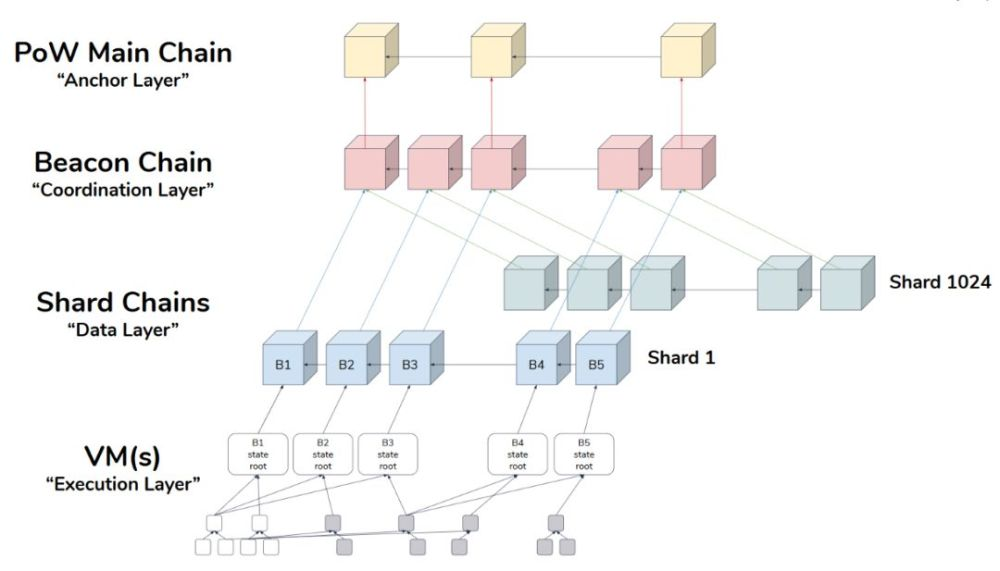
beacon chainbeacon chainThe first scheduled upgrade of , which adds support for synchronous committees, supports launching light clients, and increases inactivity and slash penalties to their full value.
2021 - Arrow Glacier upgrade
On December 9, Ethereum carried out the Arrow Glacier upgrade at block height 13773000, which postponed the difficulty bomb of the Ethereum mainnet to June 2022.
Finally, the development of Ethereum has entered the final quiet stage (the specific progress is in the stage of merging the beacon chain with the current mainnet). The entire security stage is divided into four stages of beacon chain, shard chain, eWASM and continuous improvement for continuous development. Ethereum has upgraded from 1.0 using the PoW mechanism to 2.0 using the PoS mechanism and has very complete functions. The project may take several years.





