






The conversion of Ethereum to PoS is coming soon, comprehensive analysis of the Staking track and representative projects


Research Institution: Mint Ventures
Research Institution: Mint Ventures
Researcher: Li Yuxuan
Before officially starting the content of this article, let us clarify the main concepts involved in this article:
Node Operator: Specifically refers to the operator who runs the node on the blockchain. They need to use the device to run the client side of the chain, stay online, and maintain the consensus of the blockchain.
Liquid Staking Provider (Liquid Staking Provider): After the user pledges, the service provider will give the user a pledge derivative to solve the problem of PoS pledge liquidity. They may or may not specifically run nodes (such as Kraken and Binance) (such as Lido, Rocket Pool, and Stader).
In this article, the main entities that appear in the above concepts are classified as follows:
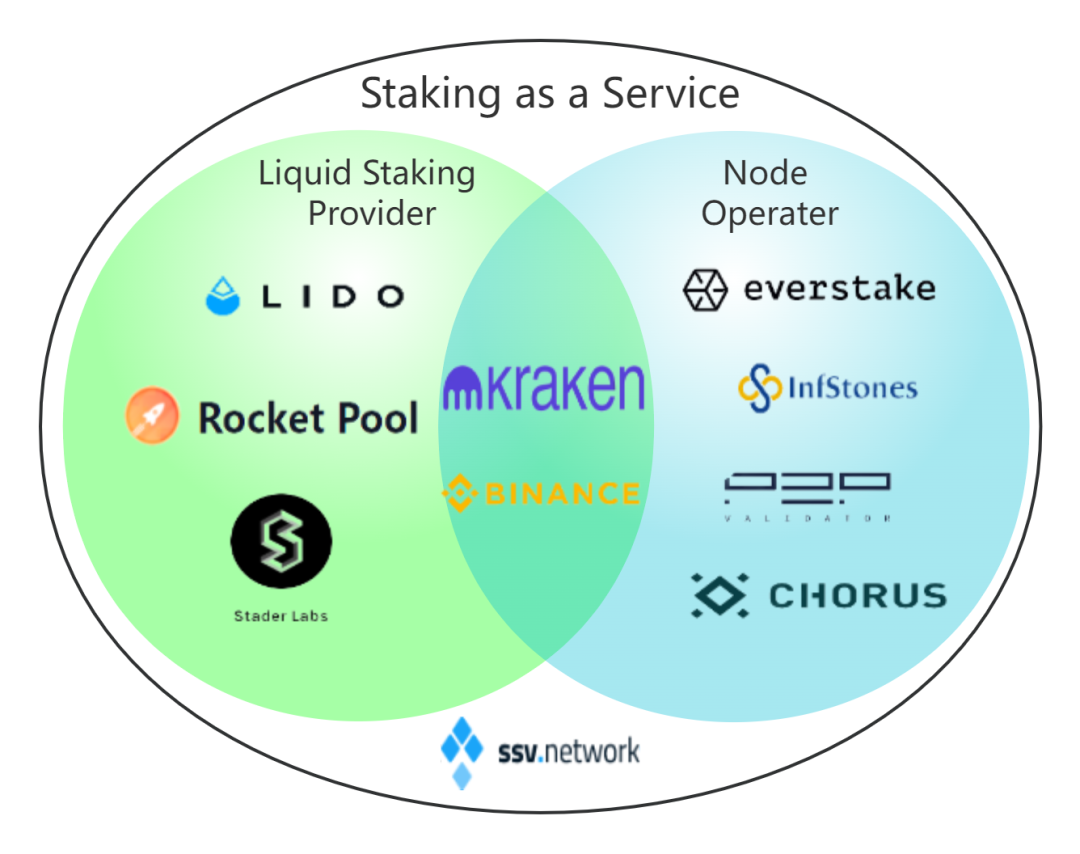
MappingMint Ventures
first level title
The consensus layer of the blockchain is obviously shifting from PoW (Proof of Work) to PoS (Proof of Stake, Proof of Stake or Proof of Pledge) in recent years. With Ethereum shifting from PoW to PoS in the next six months (high probability), among the top 15 public chains by market capitalization, only BTC, DOGE, and LTC will still adopt the PoW consensus, and most of the rest of the public chains will adopt the PoS consensus. At present, the top ten PoS public chains with pledge amount have accumulated more than 180 billion US dollars pledged, and can obtain an average pledge rate of more than 7%.
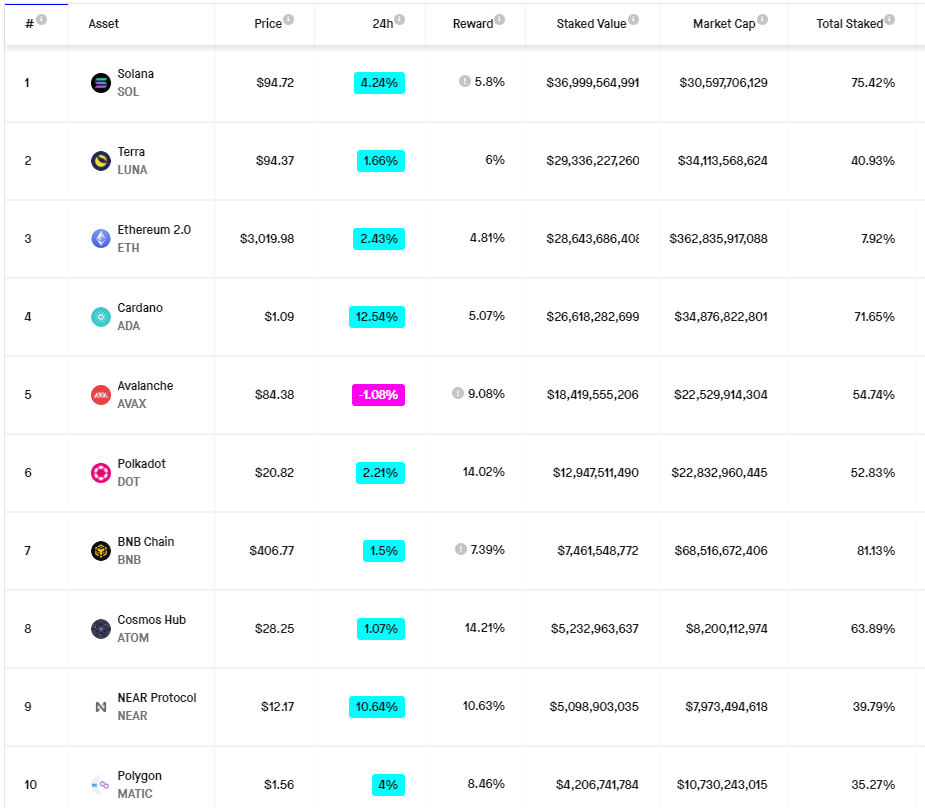
image description
The top ten blockchains according to the pledge amount and their pledge yield source: https://www.stakingrewards.com/
For a blockchain that adopts the PoS mechanism, maintaining a stable Stake ratio is the healthiest for the protocol, because when the Stake ratio is too low, the attacker needs to pay a lower cost for a 51% attack, which will It endangers the security of the protocol; and if the Stake ratio is too high, it will reduce the (actual) circulation rate of tokens, which is not conducive to the construction of the public chain ecology.
Regardless of which PoS public chain, independently becoming a node to stake is a relatively complicated thing that is not easy for ordinary investors to do. Becoming a node usually requires relatively high equipment and network requirements, knowledge reserve requirements for the operation mechanism of the chain itself, and requirements for the number of tokens held in the public chain (Terra only rewards the top 130 nodes, BNB chain only rewards the top 21 nodes ) and operation and maintenance capability requirements, which make it difficult for ordinary users to directly participate in Staking, which is not conducive to the overall security and decentralization of the chain.
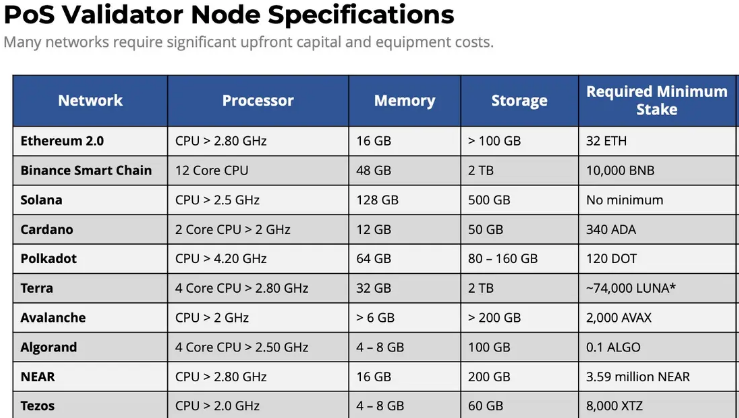
image description
Source of staking equipment and minimum staking amount requirements for some PoS chains https://messari.io/article/what-s-at-stake-in-staking-as-a-service
Naturally, as some institutions with professional operation and maintenance equipment, knowledge, experience and sufficient funds, they began to provide proxy pledge services, or STaaS services, to ordinary users. They typically charge 5%-15% of user staking rewards as compensation for the services they provide. Below are node operators with more than $1 billion in collateral:
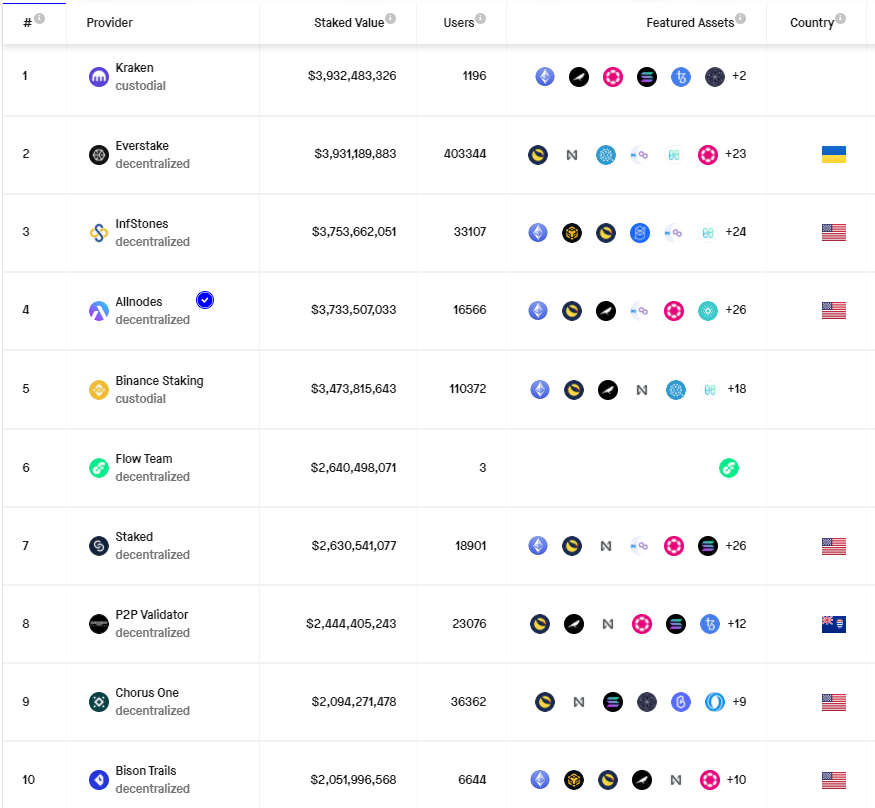
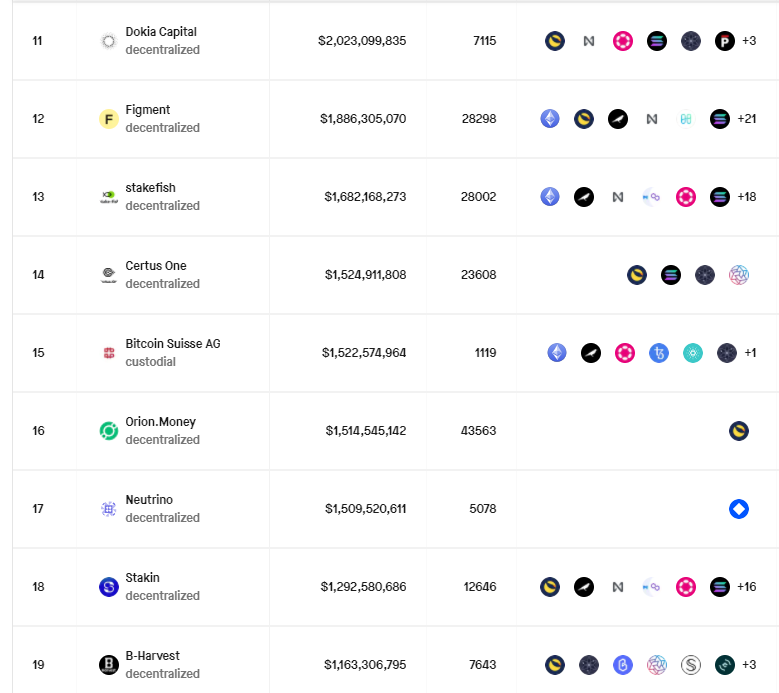
image description
Source: https://www.stakingrewards.com/providers/?page=1&sort=balance_DESC
It can be clearly seen that, except for Neutrino and Flow Team, which only serve the Waves chain, and Orion.money, which only serve the Terra chain, most node operators provide services to each PoS network. The requirements for node operation are relatively high, but the difference between different chains is not great. As a node operator with equipment, manpower and professional knowledge, the marginal cost of serving one more network is not high, but because it can meet The demand for interest-bearing diversified tokens in the hands of its users makes its marginal income higher.
In addition, we can also see that node operators are roughly divided into two categories: one is the centralized exchange represented by Kraken, Binance and Bitcoin Suisse AG, because in the context of the exchange business, there are naturally various PoS chain assets It is very reasonable for them to provide users with PoS staking services after precipitation:
From the demand side, there is a solid and stable demand: users' idle assets in the exchange have a safe and stable place to earn interest. The inflationary rewards provided by PoS chains to keep the network up and running can almost be considered the risk-free rate in the crypto space. Compared with other investment types, its capital requirements are low, the risk is relatively small, and the annualized rate of return is usually between 5% and 15% (not particularly low).
It is also relatively easy in terms of operation, because the exchange itself has relatively professional knowledge reserves and equipment resources, and has a relatively good understanding of various public chains. User assets are originally stored in the wallet of the exchange in custody, and user-side interaction is also very easy;
Although the stake track is a blue ocean track, due to the almost completely homogeneous services provided by node operators, the price competition among different unmanaged STaaS service providers is fierce. From the rate table in the figure below, we can see that the charges of non-custodial STaaS service providers are much lower than those of centralized exchanges.
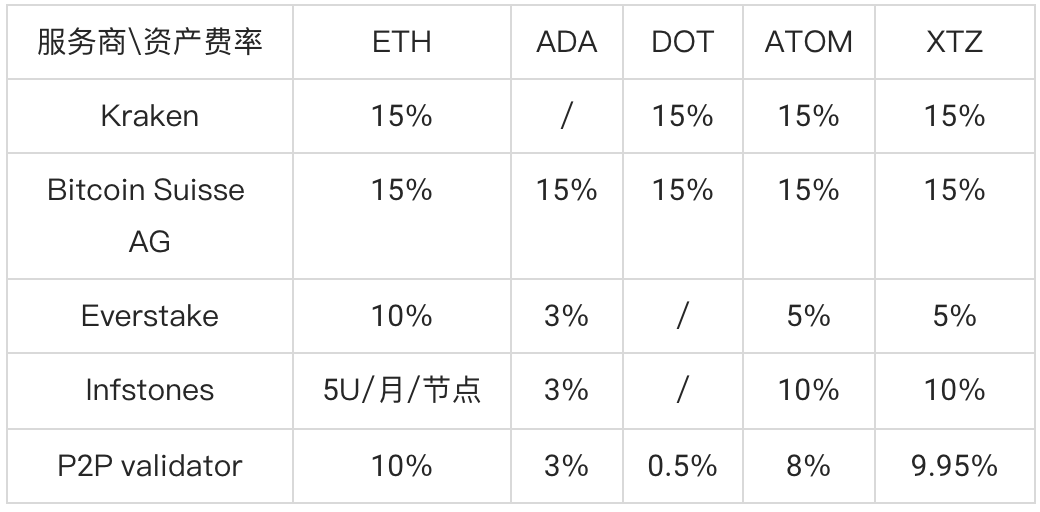
image description
Data source: Stakingrewards
In addition, node operators are also occupying the market through differentiated pricing methods. For example, Allinnodes, which currently ranks third in total pledge amount, has won a lot of big stakers by changing the charging method of some assets to monthly. When the market needs to occupy the market through a differentiated pricing strategy, it may indicate that the market has become saturated).
The reason behind this is not difficult to understand. Due to the simple business model, the services provided by different STaaS service providers are standardized and homogeneous, and even the user operations are exactly the same (users manually fill in the address of the node operator As a delegated pledge node), among node operators, users have no loyalty at all, and the convenience of delegated pledge also makes the switching cost of users extremely low. The vast majority of users who are not sensitive to fees are divided up by centralized exchanges or later liquidity staking service providers.
In addition, perhaps because the business and cash flow are too clear, or because of legal reasons, most of the financing of node operators is in the form of equity (for example, Staked received Pantera as early as 2019, Coinbase Ventures and DCG and others followed up with an investment of US$4.5 million, and was acquired by Kraken at the end of 2021), which also prevented them from using Token to better motivate the further development of their business.
We believe that in this context, STaaS is likely to eventually evolve into a delicate competition of brand, user experience and cost control capabilities, similar to web 2 consumer credit services. As a result, the rate that users need to pay will gradually decrease, and the proportion of revenue that node operators can earn will gradually decrease. At the same time, liquidity staking service providers will further erode the profit margins of node operators in the long run (we will analyze in detail in the Lido section).
In addition, the PoS mechanism of Ethereum is quite different from other chains, and most of the targets we can invest in the staking track come from the subdivision track of ETH staking, so it is necessary for us to briefly introduce the PoS of Ethereum .
1.1. Introduction to Ethereum Consensus Layer Pledge
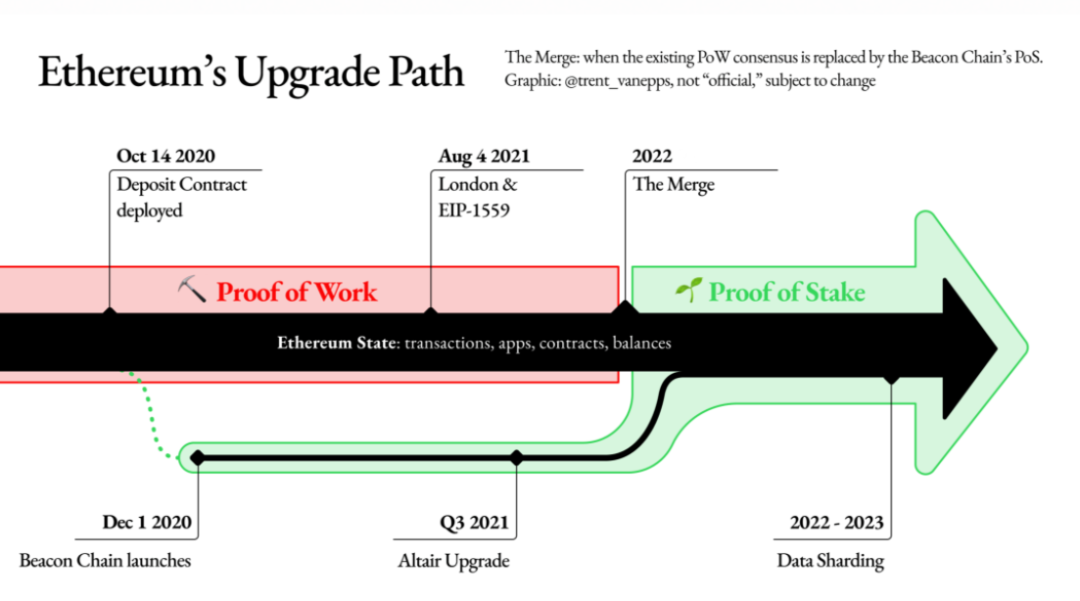
On December 1, 2020, Ethereum officially began the transition from PoW to PoS by launching the Beacon Chain.
In the road map of Ethereum, we can see that the London upgrade and the altair upgrade have been completed. The next "Merge" is the merger of the PoS chain and the PoW chain. completed within. After the "Merge" is completed, Ethereum will switch to PoS consensus. But compared to other PoS public chains, the difference between Ethereum is——
1. Does not support chain-native proxy entrustment
2. The maximum pledge size of a node is 32 ETH
3. Since the PoS chain and the PoW chain have not yet merged, the current ETH can only be stored one-way from the PoW chain to the PoS chain (beacon chain), and cannot be retrieved, which means that the users who deposited earlier will lose Liquidity (in fact, if users deposit ETH on the day the beacon chain opens on December 1, 2020, they have lost the liquidity of this part of ETH for 16 months)
The difference between the first two points is mainly due to Ethereum’s insistence on decentralization. Ethereum does not want a large single entity to directly control the development of Ethereum by controlling a huge node. The third point is an inevitable part of the historical process from PoW to PoS.
In this context, a series of liquid staking (liquid staking) service providers represented by Lido Finance and Rocket Pool emerged rapidly, and they issued ETH derivatives to the ETH deposited in their contracts (such as Lido’s stETH, Rocket Pool’s rETH, Ankr’s ankrETH, etc.), meet the liquidity needs of users after staking by incentivizing the liquidity between ETH derivatives and ETH; satisfy users’ demand for ETH derivatives through the integration of ETH derivatives and other DeFi protocols interest-bearing needs. Centralized exchanges Kraken and Binance have also adopted similar solutions, and both have set up "ETH pledge certificates"-ETH trading pairs to meet the liquidity needs of users.
At present, Lido, Kraken, and Binance, which rank among the top three in the amount of ETH pledged, all provide users with liquidity staking services.
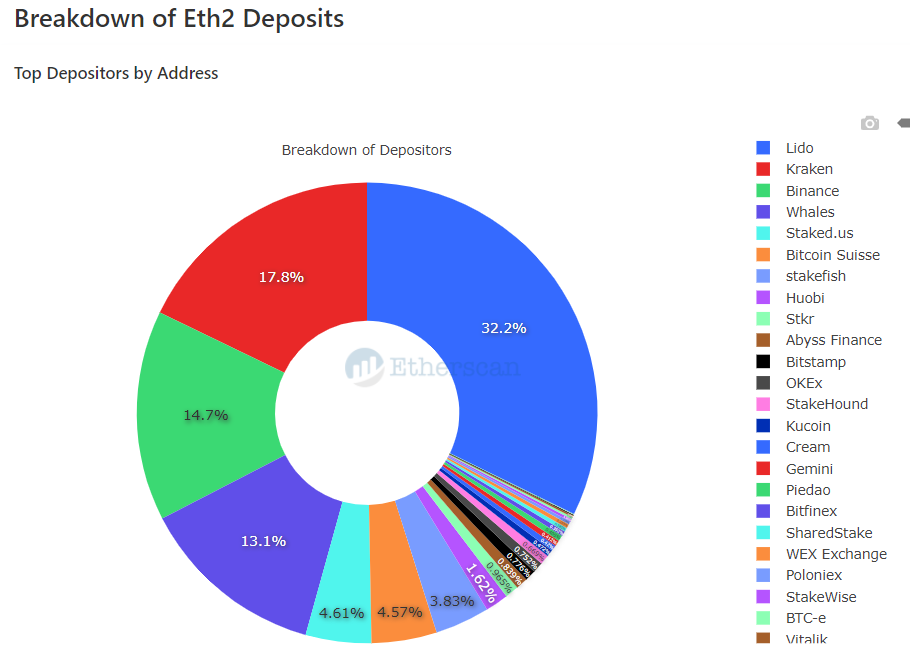
image description
At present, from the perspective of user deposit balance, the top two liquidity staking service providers for ETH are Lido Finance and Rocket Pool, among which Lido occupies an absolute dominant position.
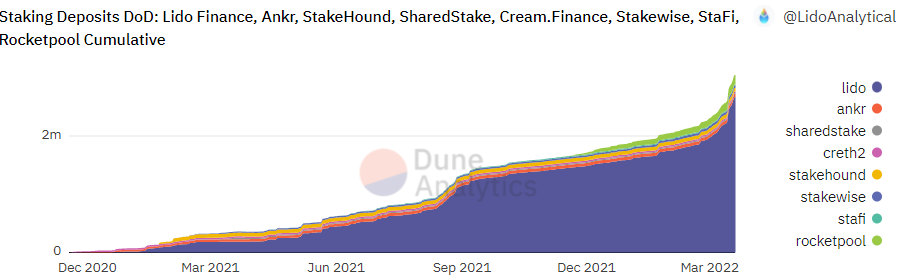
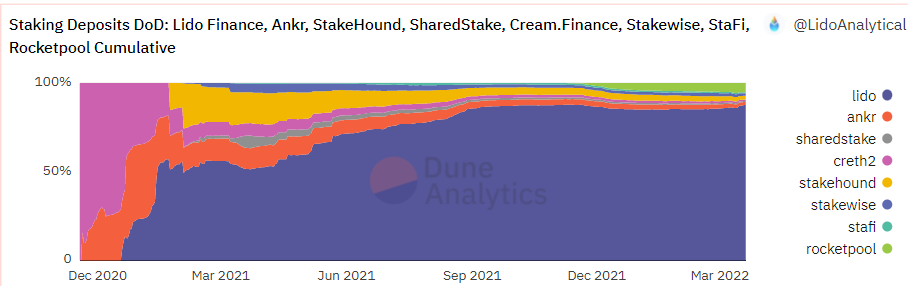
image description
Source https://dune.xyz/LidoAnalytical/Lido-Finance-Extended
Regarding the PoS of Ethereum, it is also worth mentioning about MEV (Miner Extractable Value).
After EIP-1559 goes online, the Gas fee paid by users is divided into two parts: Base fee and Priority fee, of which Base fee will be destroyed directly, and Priority fee will be obtained by miners. After converting to PoS, the Priority fee paid by the user will be obtained by the pledger, that is to say, the ETH pledger will benefit from the user's transaction.
Flashbots has established the "ETH2 Working Group". According to their research article published 8 months ago, when there are 8 million ETH pledged, MEV will increase the pledge reward by 60% on the original basis (the current pledged amount of ETH is 10.78 million piecessource )
In addition, there are also speculations that when 13 million ETH is pledged, MEV will increase the pledged income of Ethereum from 4.6% to 9.6% (source )
In short, after switching to PoS, ETH pledgers can not only continue to obtain ETH issued by the network, but also get a part of the user payment fee, which will increase the current pledge income by a lot.
Project Introduction
Project Introduction
Staking track projects are sorted by TVL as follows:
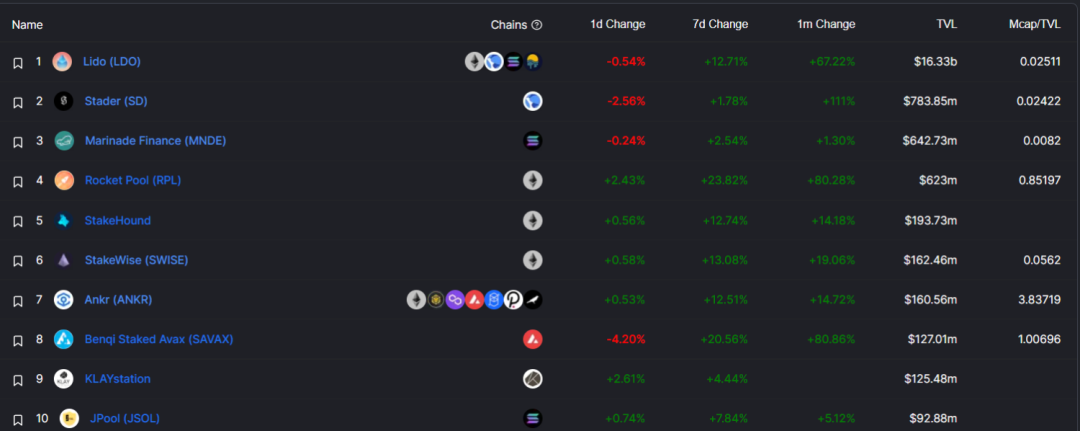
image description
In this article, we will introduce four projects with relatively good business development at present: Lido Finance, the king of liquid staking pools, Rocket Pool, an ETH liquid staking pool that insists on decentralization, and a project that provides security redundancy for the Ethereum staking network. SSV Network, and the cutting-edge Stader on the Staking track.
Lido Finance
first level title
Regarding Lido Finance, Mint Ventures had a research report in August 2021 that introduced "Lido Finance: ETH 2.0 Decentralized Guardian" in detail. Interested readers can read it first.
2.1. Product introduction
Lido Finance is a service provider of the Liquid Staking solution. It initially only provided pledge services for ETH, and currently supports users to pledge ETH, LUNA, SOL, KSM, and MATIC 5 assets. At present, Lido has a TVL of more than 16.5 billion US dollars, ranking third among all DeFi protocols.
We use Lido's pledge process at the ETH consensus layer to briefly explain Lido's workflow:
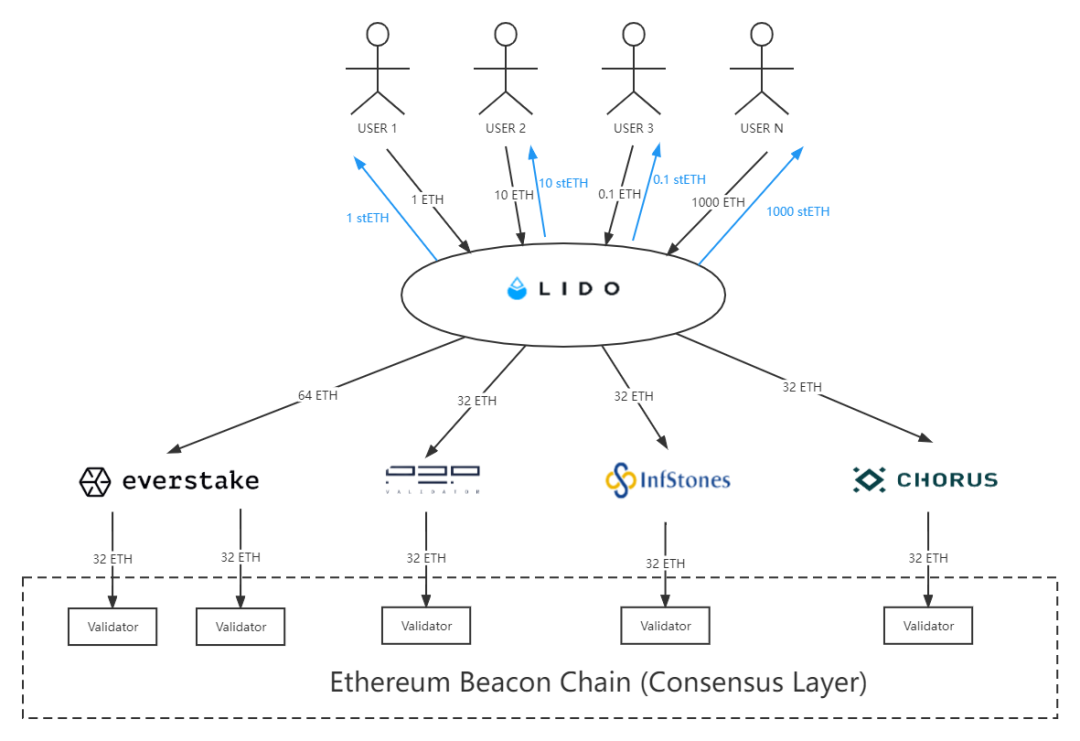
image description
MappingMint Ventures
1. The user deposits any amount of ETH into the Lido contract, and Lido distributes the corresponding amount of stETH to the user
2. According to certain rules, Lido distributes every 32 ETH to each node operator approved by lido DAO
3. The service provider deposits ETH into the Ethereum beacon chain, runs the node and obtains income. The income will be calculated every day, which is reflected in the growth of the user's stETH balance
We can see that Lido does not directly participate in the operation of nodes, but only needs to review, manage and allocate funds to nodes, so Lido is not in direct competition with node operators. Of course, although the review and selection of nodes are all governed by DAO, there must still be a certain degree of centralization, which is why many people think that Lido is not decentralized enough.Lido's business process is not complicated, and the business process of other liquidity staking service providers is similar to Lido's. The main reason why Lido has been able to achieve such success is that Lido's staking derivative - stETH has a stable anchor and a strong use case. Regarding these two aspects, we haveLido Finance: Guardian of ETH 2.0 Decentralization
" has already had a very detailed introduction. At that time, among the mainstream DeFi protocols, only three lending giants, Aave, Compound, and Maker, did not support stETH.
So far, Maker and Aave have successively started to support stETH as collateral. Among the DeFi protocols, the risk control of the top lending protocol is the most prudent. StETH can gain their trust, which also shows the success of stETH.
On February 28 of this year, Aave supported stETH as collateral for the protocol. Since holding stETH itself will obtain an annualized return of about 4% of the ETH standard, a leverage cycle such as "deposit stETH-borrow ETH-ETH to exchange stETH" immediately appears, so that the scale of Aave's stETH deposits is less than It quickly reached 1.3 billion US dollars in one month, becoming the fourth largest source of deposits on the Ethereum mainnet, and successfully raised the borrowing rate of ETH from about 0.2% to about 2.25%.
For a specific node operator, becoming a Lido-approved service provider means more business volume and more revenue. Therefore, each node operator is actively striving to become a Lido service provider. At present, more than 20 staking service providers are on Lido's list of qualified operators.
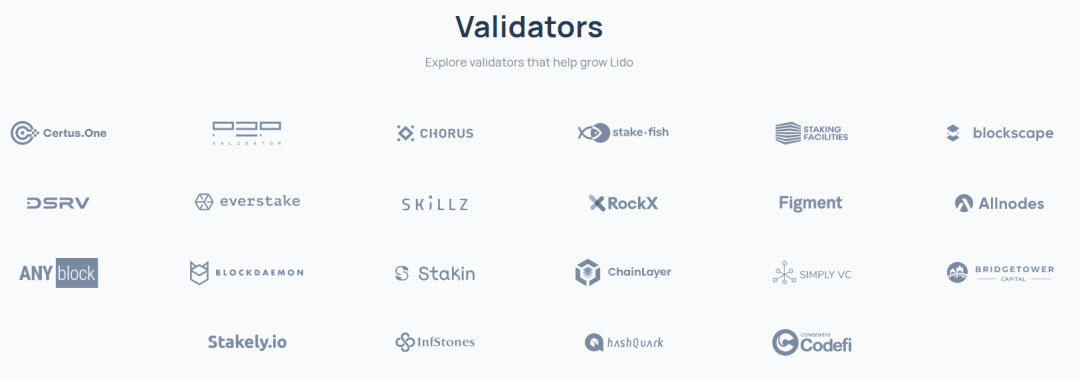
image description
The source of the node operator currently responsible for the pledge of Lido assets: https://lido.fi/
After the success of Ethereum, Lido also began to expand its business to other PoS chains. At present, Lido’s TVL in Terra has exceeded 8 billion U.S. dollars (accounting for about 23% of LUNA’s market value), and it also has a TVL of nearly 300 million U.S. dollars in Solana . In addition, Lido has also started to provide services in Kusama and Polygon, and the pledge services of Avalanche and Polkadot are also in preparation. On these chains, Lido also conducts liquid staking business.
Overall, in terms of ETH staking, with the current brand and resources owned by Lido Finance, as well as the strong stability and use cases of its staking derivative stETH, it will be relatively easy to maintain its competitive advantage. However, this advantage is to some extent exchanged for subsidies. Although it seems very stable at present, it is not unbreakable (especially after Ethereum turns to PoS and the cake becomes bigger, it will attract more powerful opponents). In addition, when Ethereum is officially converted to PoS, allowing users to retrieve the pledged ETH from the beacon chain (consensus layer) (the specific time has not yet been determined, but it is not allowed to be retrieved when it is converted to PoS), currently Lido The biggest advantage of Finance - the anchoring stability of stETH, its significance will also be reduced to a certain extent. Whether Lido can continue to maintain its leading position in the liquid staking track depends on whether Lido can make good use of its first-mover advantages in time and resources.
2.2. Team and partners
The founding team of Lido Finance is mainly from STaaS service provider p2p.org, including CEO Konstantin Lomashuk, CTO Vasiliy Shapovalov and Kasper Rasmussen.
In addition, Georgios Konstantopoulos, Hasu and Arjun Balaji from Paradigm conducted in-depth research on Lido Finance and contributed to Paradigm's investment in Lido, and the three of them also influenced and even guided Lido Finance on the key decentralization issues of Lido Finance development route.
In terms of investment, Lido Finance officially announced three rounds of financing:
In December 2020, Lido Finance completed a financing of US$2 million. Investors include: Semantic Ventures, ParaFi Capital, Terra, KR1, Stakefish, and Staking Facilities, as well as Rune Christensen from MakerDAO, Stani Kulechov from Aave, and Kain from Synthetix Warwick et al.
In April 2021, Lido DAO passed a proposal to finance LDO tokens reserved by the Ministry of Finance. A total of 100 million LDOs were sold in this round, and a total of 21,600 ETHs were raised, which is equivalent to 0.000216ETH/LDO. The investment was officially concluded on May 5, 21. According to the ETH price on that day, it was about 0.75U/LDO, which means that 75 million US dollars was raised. This part of the tokens will be released linearly in 12 months after the 1-year lock-up period, but its governance rights are given to these investors from the date of investment.
The investment lineup of this round is relatively luxurious, in which Paradigm obtained 70 million LDOs, and the remaining 26 million LDOs were funded by Three Arrows Capital, DeFiance Capital, Jump Trading, Alameda Research, iFinex, Dragonfly Capital, Delphi Digital, Robot Ventures, Coinbase Ventures , Digital Currency Group, The LAO and other institutions, and another 4 million LDOs were allocated to a series of individuals (partially anonymous), including Sushiswap's 0xmaki and Optimism's Jinglan Wang and others.
In March 2022, Andreessen Horowitz (a16z) announced that it had invested $70 million in Lido Finance.
Overall, Lido Finance's investment background is strong.
2.3. Token Model
The total number of LDO tokens is 1 billion, and the initial distribution is as follows——
a. Seed round investors received 221.8 million pieces (22.18%), which will be unlocked linearly in 12 months starting from December 2021
b. Team members get a total of 350 million pieces (35% of the initial Lido developers get 200 million pieces (20%), this part will be unlocked linearly in 12 months starting from December 2021
Founders and future team members will receive 150 million (15%), which will be unlocked linearly in 12 months starting from December 2021
c. Verification nodes and multi-signature members get 65 million pieces (6.5%), which will be unlocked linearly in 12 months starting from December 2021
d. DAO Treasury controls 363.2 million (36.32%), of which:
100 million (10%) will be sold to investors such as Paradigm and Three Arrows Capital between April and May 2021 with the consent of DAO. This part will be unlocked linearly in 12 months starting from May 2022.
Most of the daily and Curve’s ETH-stETH stability incentives, as well as the LDO needed for other Defi expansions, come from the part controlled by the Treasury
In addition, a16z’s investment did not disclose the number of LDO tokens obtained and the investment price. Unlike Paradigm’s round, this round of financing has not been voted by the DAO, indicating that it is not financing from the DAO treasury, it may be through OTC obtained in form.
In terms of system revenue, Lido collects 10% of user pledge rewards, and DAO decides its specific distribution among node operators, insurance funds and DAO treasury. Since Lido was launched, its distribution has been: 5% for node operators and 5% for insurance funds. The insurance fund is mainly used to compensate users when ETH pledges are reduced or fined. At present, Lido’s insurance fund has accumulated a total of 3,139 stETHs. Although the absolute value is already considerable, it is still only about 0.11% compared with the more than 2.7 million ETHs that have been pledged in Lido. A certain scale of ETH pledge reduction insurance (such as the pledge reduction insurance for 200,000 stETH through UPslashed), but it still cannot completely cover the potential pledge reduction risk of ETH pledge (even if the more than 20,000 ETH raised by DAO may not enough). In this context, Lido has always adopted a prudent attitude towards income distribution, which is a responsible attitude in line with the long-term development of the project.
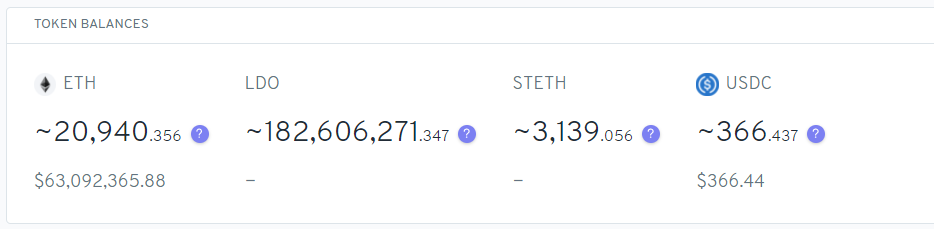
image description
But as mentioned above, after Ethereum turns to PoS, the MEV originally captured by PoW miners will be captured by PoS "miners". As Lido is the largest provider of liquidity staking on Ethereum, is there some way to capture MEV? way (Lido joined the Ethereum consensus layer MEV research group created by Flashbot, source: https://snapshot.org/#/lido-snapshot.eth/proPoSal/0x12d75092ac4eb3037e321b00a4fa165726aad8d03540fa1cd1305a5eb70f79aa ), also caused LDO to hold coins fantasies .
Rocket Pool
first level title
3.1. Product introduction
Rocket Pool is the earliest Ethereum staking protocol, which was conceived at the end of 2016 and has undergone 5 successful tests. And in November 2021, the Ethereum mainnet was successfully launched. At present, more than 150,000 Ethereum have been pledged, and 973 node operators have been introduced.
Similar to Lido, Rocket Pool also provides liquid staking services (users will get ETH derivatives rETH after staking), and does not directly operate nodes, but encourages node operators through effective incentives to give ordinary staking users Provide services.
Rocket Pool splits the maximum amount of 32 ETH pledged by Ethereum into two: 16 are provided by ordinary pledgers, and the other 16 are provided by users (enterprises) who are willing to run nodes. Ordinary users can simply stake, and at the same time pay a part of the proceeds to the node operator; the node operator provides another 16 ETH, and needs to carry out node operation.
With this design, Rocket Pool realizes a micro-level asset management product: the priority is the 16 ETH provided by ordinary pledge users, and the inferior level is the responsibility of the manager-node operator: node pledge In the process, if there is a situation where the income or principal is punished, it will be covered by the inferior class. And logically, the proportion of Ethereum that ordinary pledgers and node operators need to pay can also be modified (equivalent to adjusting the proportion of inferior priority levels), so as to obtain higher capital efficiency or higher security. At the same time, compared with Lido's review of nodes, Rocket Pool is more decentralized by requiring node operators to over-collateralize, but correspondingly, its requirements for node operators' capital scale will be relatively higher.
In terms of commissions, due to the mismatch between the supply and demand of ordinary users and node operators, Rocket Pool has designed a dynamic commission mechanism to balance the funds at both ends.
In terms of development path, Rocket Pool insists on decentralization. In addition to the above-mentioned selection of trustless node operators, it is also reflected in the fact that Rocket Pool must allow smart contracts as private keys for withdrawals after the Ethereum consensus layer (actually online The time will be in July 2021, we will introduce the withdrawal private key in detail below), this is because before the Ethereum consensus layer allows smart contracts to be used as the withdrawal private key, the withdrawal private key can only be issued by the EOA (which can be understood as Ordinary address) control, and EOA control must have a series of man-made risks such as private key leakage or malicious attacks by the holder. The actual mainnet launch time of Rocket Pool is November 7, 2021, and at this time Lido has pledged more than 1.4 million Ethereum.
In response to the above problems, Lido also gave a decentralization choice based on business first: Before Ethereum allowed smart contracts to be used as private keys for withdrawals, they chose 11 people who were closely related to the interests of ETH and had a good reputation (including Rune) Christensen (MakerDAO), Michael Egorov (Curve), Banteg (Yearn), Alex Svanevik (Nansen), Anton Bukov (1inch), etc.) to control and store the Ethereum withdrawal private keys of all Lido pledged users, and in July the Ethereum After Fang supports smart contracts as withdrawal private keys, it was upgraded immediately, and the subsequent ETH withdrawal private keys deposited into Lido are controlled by the contract.
3.2. Team and partners
Rokcet Pool's team members include their founder and CTO-David Rugendyke, general manager-Darren Langley, Kane Wallmann, Nick Doherty and other developers.
In addition, Rocket Pool has designed an oracle machine DAO. The oracle machine DAO is responsible for periodically calling the oracle machine to meet the needs of the normal operation of the protocol: such as reporting the verifier balance from the beacon chain, and the RPL:ETH ratio, etc.
Rocket Pool's oracle machine DAO members include many Ethereum consensus layer clients such as Prysm, Lighthouse, Nimbus, and Consensys codefi, Etherscan, Beaconchain.in, Bankless, etc.
In terms of investors, the only available investors are ConsenSys Ventures.
3.3. Token Model
Rocket Pool's native token is RPL, which was issued in 2017. Since then, the token economics has been adjusted many times as the business model evolves. After Rocket Pool's official mainnet launch, its token economics has been basically determined. RPL plays multiple roles within the Rocket Pool ecosystem:
a. Final collateral: Node operators need to pledge a certain amount of RPL as the final collateral after their ETH is slashed
b. Reward Booster: Node operators can get more RPL rewards by mortgaging a certain percentage of RPL
c. Bonds of oracle DAO: members of oracle DAO can buy RPL at a certain discount and get RPL incentives from good behavior
The total amount of RPL tokens is 18 million, and the current circulation is close to 16.2 million. The uncirculated part is the team part. In the future, RPL will maintain an annual inflation rate of 5%, and the inflation part will be allocated according to the following ratio:
70% allocated to node operators
15% allocated to oracle DAO members
In general, Rocket Pool, as a very early ETH staking project, still insists on the premise that Ethereum’s PoS keeps skipping votes, and has designed a set of effective mechanisms to connect pledgers, node operators and RPL delegates. Coins are well combined, and at the same time, decentralization is greatly maintained in the process, which is admirable.
SSV Network
first level title
4.1. Product introduction
Users who want to pledge at the Ethereum consensus layer need to master two private keys in total, one is the withdrawal private key (Withdrawing keys) and the other is the validator signature private key (Validator signing keys), among which the withdrawal private key can be stored offline by the user , you need to use the withdrawal private key when withdrawing income or principal. The validator private key needs to be continuously signed, and offline or malicious behavior will result in fines. Therefore, the validator private key needs to be given to the operation and maintenance operator of the specific operating node, otherwise the validator will not be able to work normally, not only will not be able to earn income, but will be fined instead. (About these two private keysmore detailsmore details
, interested readers can understand)
When the user pledges by himself, the withdrawal private key is mastered by himself, and the validator private key needs to be imported into the nodes of the ETH consensus layer. When the user chooses to outsource the verification work, the private key of the validator needs to be given to the node operator, whether the outsourcer is Lido or Rocket Pool, or a service provider such as Everstake/staked that directly runs the node, or a centralized node such as Kraken. exchange. In this way, whether the pledger can obtain income normally depends entirely on the working status of the validator stored in his ETH, and there is a serious single-point risk.
The core of SSV technology is to allow users to encrypt the validator key into multiple shares and distribute them to different node operators, and SSV technology can guarantee that even if one or several operators (within a certain threshold) are offline Or there is malicious behavior, which will still not affect the verification result of the entire verifier (signatures can still be effectively executed). For example, the verifier key is divided into 4 parts and handed over to different node operators, then when one node operator is offline, the other 3 operators holding the verifier key can also promote the verification work normally.
In the SSV network, the ETH generated by all beacon chains does not go through the node operator at all, and is directly obtained by the demand side of the validator (individual or Lido, Rocket Pool, etc.), and they need to pay two parts of the fee: to the node operator The service fee and the "network usage fee" for the SSV network, currently all network usage fees go into SSVDAO (same as Lido's insurance fund retention, this part may be distributed to token holders in the long run), therefore, For the SSV network, its income depends on the prosperity of the entire network.
In the specific process, each node operator pre-sets the service quotation (annual payment mode), and the validator demander chooses the node operator according to his own needs. When the SSV balance in the account is sufficient, the validator can continue to work .
In addition, since the payment of fees uses SSV tokens (like other ToB infrastructure projects such as LINK and GRT), SSV has designed a set of rules to reduce the impact of SSV token price fluctuations on the validator demand side. Interested friends can go to https://SSV.network/tokenomics/ to check.
The SSV network is currently in beta, and as of this writing, the testnet already has more than 15,000 validators and more than 3,000 node operators working. It is worth mentioning that SSV Network is not the only protocol that is currently researching DVT. Another Obol network is also researching DVT. It has also obtained ConsenSys, Coinbase Ventures, IOSG Ventures, Blockdaemon, Delphi Digital, Stakefish, Chorus One , Staking Facilities, The LAO and other institutions, but the test network has not yet been released, and the progress is behind SSV Network.
For node operators, accessing the SSV network will not have a higher cost than running a beacon chain node alone, but entering the SSV network may obtain more SSV token incentives. For example, the current test The "ONEinfraTEST" operator in the network is currently working for 2002 validators, which means that he can collect SSV fees paid by 2002 validators at the same time, so node operators also have sufficient motivation to access the SSV network.
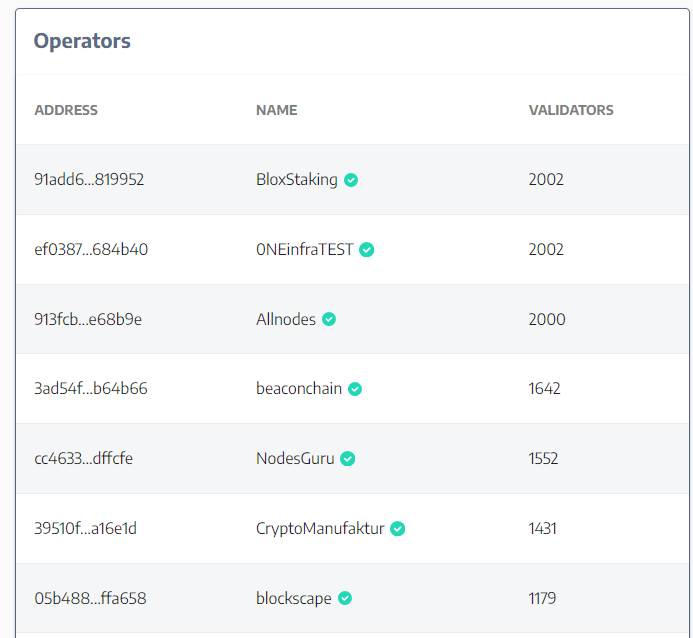
image description
Source: https://explorer.ssv.network/
Finally, for Ethereum, SSV technology is also of great significance. SSV's technology is essentially a complement to Ethereum's validator system (also originally proposed by the Ethereum Foundation). Assuming that all node operators access the beacon chain through the SSV network, then the entire Ethereum pledge network will get better security and robustness without sacrificing decentralization, and can resist certain thresholds. (eg 25%) machine failure/malicious behavior across the network. For Ethereum, which has a market value of more than 340 billion U.S. dollars and a TVL of more than 140 billion U.S. dollars on the chain, any small loophole in the underlying mechanism of PoS may cause a major blow to the entire system, so any underlying security Redundancy is precious.
In this case, the SSV network hopes to become a new layer between node operators and the beacon chain (Ethereum consensus layer). By incorporating more node operators and pledge demanders into the SSV network, while making the node operators, pledge demanders, and Ethereum all benefit together, the SSV network can also capture more revenue and at the same time Become an important infrastructure of Ethereum. Therefore, SSV is not in a competitive relationship with the above-mentioned Lido and Rocket Pool, but can be regarded as the most upstream and downstream of the ETH pledge track: Lido and Rocket pool are oriented to users, while SSV is oriented to the beacon chain (Ethereum consensus layer ). And Lido has also donated funds to SSV to support its technical work.
Regarding the scalability of SSV technology, although logically, SSV technology can be extended to all PoS public chains (such as Atom) with separate withdrawal private keys and operation keys, but because other PoS chains are not as decentralized as Ethereum The same persistence as Fangfang, so in the short term, it is unlikely that SSV technology (and the SSV Network project) will be extended to other public chains.
4.2. Teams and partners
The predecessor of SSV is the asset management platform CoinDash, which conducted an ICO in 2017, and later transformed and researched SSV technology in 2020. The core team is from Israel.
In addition to ICO investors, starting from October 2021, SSV decided to conduct DAO partner financing with a maximum of 3 million SSV. SSV tokens from DAO financing are locked for 1 year, then half is released immediately, and half is released linearly over the next year. Institutions that have already participated in financing include:
Digital Currency Group, Coinbase, Lukka, Stakewith.us, RockX 5, Stakin.com, Chainlayer.io, DSRV, Infstones, Skillz5, Shardlabs, Stakedus, Amber Group, XT, Lead Capital, Valid Blocks, AU 21, Gate ventures, OKEx Blockdream Ventures, NGC Ventures, Delta Blockchain Fund, etc., have raised more than $10 million in total.
Funding is still ongoing.
In addition, SSV has received US$188,000 Grants from the Ethereum Foundation. The Ethereum Foundation and Consensys have provided a lot of help in the development of SSV.
4.3. Token Model
SSV Network's native token is SSV, and its main use cases are governance and payment as described above.
Since SSV is required for payment in the business logic, institutions whose business includes ETH pledges may have demand for SSV, which may be the reason why SSV has received so many centralized exchanges and large institutional investment in previous financing.
Stader
SSV tokens are exchanged from the original CDT tokens at a ratio of 100:1. The total amount of CDT is 1 billion, so the initial total amount of SSV is 10 million. A total of more than 1 million SSVs have been given out in the financing of DAO partners starting from October 2021, so the current total amount of SSV tokens is more than 11 million.
5.1. Product introduction
Stader was established in May 2021, and the product will be officially launched in December 2021. It currently supports common staking and liquid staking services on Terra. The current TVL exceeds 800 million US dollars, of which the TVL of liquid staking services is 160 million US dollars. The rest are ordinary pledge services. Ordinary staking service users just regard Stader as an ordinary node. Compared with other node operators, Stader's main advantage is that it can automatically compound interest and receive airdrops.
The team plans to expand the pledge service to the Solana, Fantom, Polygon and Hedera chains in April. In the future, the team also plans to launch the pledge service of the Near, Cosmos and ETH chains.
On the Terra chain, after staking LUNA, you need a 21-day unlocking period to release the staking. In this context, the liquid staking service comes into play. Similar to other liquid staking service providers, Stader does not run nodes itself, but matches the needs between node operators and staking users. After staking LUNA on Stader, users can obtain LUNA derivatives LUNAX. Holding LUNAX will continue to obtain LUNA pledge income. When users need liquidity, they can also directly exchange LUNAX for LUNA through DEX without waiting for the 21-day unlocking period. In addition, the liquid staking service provided by Stader also retains the automatic compound interest and airdrop claim functions to help users maximize their profits from holding Luna.
At present, the Stader business has been launched less than 3 months ago, and already has a TVL of more than 800 million US dollars, ranking fourth in the TVL of the terra ecosystem. Its development is not rapid. Of course, this is also related to its strategies such as low fees and token subsidies. Follow-up Whether this growth trend can continue remains to be seen.
5.2. Teams and partners
Stader's core team is from India. The three co-founders Amitej, Sidhartha and Dheeraj have years of strategic experience, encryption industry experience and technical experience respectively.
Stader has currently disclosed 2 rounds of financing:
In October 2021, Stader completed a $4 million seed round led by Pantera. Other investors include: Coinbase Ventures, True Ventures, Jump Capital, Proof Group, Hypersphere, Huobi Ventures, Solidity Ventures, Ledgerprime, Double Peak Group. This round of Stader also received support from Terraform Labs, Solana Foundation, and Near Foundation, as well as angel investors from Coinbase, Polygon, Biconomy, and Staked.
In January 2021, Stader completed a US$12.5 million strategic private equity round of financing led by Three Arrows Capital. Other investment institutions include: Blockchain.com, Accomplice, DACM, GoldenTree, Accel, Amber, 4RC, and Figment.
Stader's financing is relatively good, not only including well-known VC and angel investors, but also introducing the public chain foundation, which is a crucial related party to the Staking project, which is of great help to its subsequent business development.
5.3. Token Model
Stader's native token is SD, and its use cases include the following:
As a reward for users to participate in the Stader ecosystem, such as incentivizing the LP pool of LUNA-LUNAX, etc.
Pledge to obtain priority entrustment rights: the proportion of pledge funds that node operators can obtain is determined according to their proportion in the SD pledge pool
The last collateral: Node operators need to mortgage a part of SD tokens to compensate the pledger when the pledge loss occurs due to improper operation
SD tokens can reduce or exempt the amount charged in the Stader ecosystem
governance
governance
It can be seen that, as a relatively new DeFi protocol, SD’s token use case is closely integrated with its business, and to some extent it is a collection of LDO and RPL use cases.
Stader's token SD just completed the TGE (Token Generation Event) on March 15. The total amount of SD is 150 million pieces, of which:
36% reserved for liquidity rewards
17% is allocated to team members and advisors, and these tokens will be released linearly in 36 months after being locked for 6 months
17% is allocated to two rounds of private equity investors, of which 5% of the tokens in the private equity round will be released in TGE, there will be no TGE in the seed round, and the remaining part will be released linearly in 36 months
15% is allocated to DAO funds, and the usage is determined by community governance
4% is publicly raised on CoinList, of which - 2% is priced at $4.5, which is divided into 6 months of linear release, 2% is priced at $3.33, and this part is released linearly over 12 months
Summary & thanks
Summarize
Summarize
In the Staking track, traditional players are node operators. With the lock-up of the pledge liquidity at the Ethereum consensus layer, service providers for liquidity pledges have emerged. Compared with traditional service providers who only provide node operations, liquidity staking service providers provide staking users with more liquid and composable options than ordinary node operators. At the same time, for public chains, staking derivatives The existence of tokens enhances the security of the entire public chain network (see Paradigm's argument https://research.paradigm.xyz/staking). Under the above factors, liquidity staking service providers have quickly become a new layer between users and node operators, and are constantly encroaching on the profits of the node operator layer. In the past 15 months, Lido Finance has quickly become the number one pledge track in terms of pledge amount, we can also prove the above point of view.
From the previous competition of liquid staking service providers, the points that have attracted everyone's attention are: brand, security, degree of decentralization, liquidity/stability of the staking derivatives it provides, and composability in DeFi. It is precisely because of the good combination of these aspects that Lido Finance has obtained its current leading position.
In the future, as the industry gradually matures, old players continue to develop and new players continue to enter the market, brand, security, and decentralization will become the threshold of the industry (but it does not mean that these points are easy), and the focus of competition will be It falls on the liquidity and composability of staking derivatives, both of which are essentially built through subsidies. For users, as long as they can obtain stable and safe income, and the pledged derivatives can have good liquidity and composability, they will not have too much loyalty to the liquidity staking platform itself. In this context, the liquidity staking track may fall into a subsidy war for users’ pledges—just like the liquidity subsidy war between DEX in the summer of DeFi (in this war, there is also a16z Invested in and strongly backed by Paradigm, they took the lead early on, but then fell into competition, at least at the business data level).
In addition, when Ethereum successfully turned to PoS and opened the ETH transfer function of the beacon chain, Lido was able to stand out from the most important advantage-the importance of ETH derivatives liquidity will be relatively weakened (although it is still important). Therefore, although Lido currently has a very obvious first-mover advantage in the Staking track, it still faces considerable potential competitive pressure in the medium and long term.
In the future, the staking track, as the bottom layer of the public chain network ecology, is likely to be derived along with the development of the industry, in addition to simply obtaining income from proxy pledges and the general expectations for MEV. provide more income.
*Disclaimer: None of the above is intended as financial advice!
References
https://launchpad.ethereum.org/
Messari:https://messari.io/article/what-s-at-stake-in-staking-as-a-service
IOSG:https://mp.weixin.qq.com/s/YaD9D-pNNCtRKaaok1qIPQ
A Brief Analysis of the Intrinsic Value of SSV
And official websites of Lido Finance, Rocket Pool, SSV Network, and Stader





