


Seize the L2 Gold Rush, In-depth Analysis of L2 Token Economics


Original source:Layer 2 Tokens Are Coming - Bankless
Original author:John Wang、RyanSAdams
Original compilation:@gm365
foreword
Original source:
Arbitrum, Optimism, zkSync,Original author:
Original compilation:
foreword
foreword
Layer 2 tokens are coming.
Starkware - All of these currently hot Layer 2 networks don't have tokens yet!
But these second-tier networks are growing fast, have locked billions of dollars in TVL, and are attracting more on-chain activity every day. The future of Ethereum is in the hands of the Layer 2 network.
Here comes the question, "When will the coin be issued¹"?
/zkSync/ has confirmed that it will be "community owned".
/Arbitrum/ and /Starkware/ have not yet responded.
/Optimism/ said in the Bankless podcast that they have no plans to issue coins in the near future.
It doesn't matter at all whether they publicly confirm the coin issuance plan. They all have shareholding structure tables², which are filled with investors and team members. They also all need to stimulate growth and improve liquidity.
In the words of Charlie Munger: "I will sing to whoever gives me bread."
Now that the bread is there, the result looks obvious too.
In order to preempt the L2 gold rush, the following questions still need to be answered:
What does L2 token economics look like?
What kind of incentives will there be when issuing coins?
What do they use to govern?
—— RSA
Will rollup's second-tier tokens be parasitic on ETH?
author:John WangWe asked the man who helped launch Immutable’s IMX token to share his thoughts on all of this.
Let's get ready for the L2 gold rush.Rollup tokens are coming
author:
, independent analyst and Buider
This article is based on an article by John Wang
Twitter long text
image description
The second-tier network (L2) tokens are coming soon, and will soon usher in a big explosion, but there is little information on the economics of L2 tokens, and more importantly, "when will the tokens be issued"?
This article intends to discuss in depth.
Here is a little background information. I contributed to the issuance of IMX, GODS on the Immutable chain, and GOG on the StarkEx chain. With that in mind, I'm going to share my experience in the nascent field of cryptocurrencies.
Although I work with the Starkware team, I don't have any inside knowledge about these L2 tokens. The following is mostly based on what I think good rollup token economics look like and how they would be distributed. All of these are just educated guesses.
issue
issue
Vampire attacks on other L1 networks through aggressive airdrops or incentive strategies
Token Pledge Economic System and Governance System
Rollup cost subsidy
Cross-chain bridge, fiat currency deposit entrance and /Tokemak/ cooperation
EVM compatibleDCBuilder’s great articleAcquisition or prevention of MEV
Is the rollup token parasitic on ETH
Rollup overview
If you know little about Rollup, please refer to this
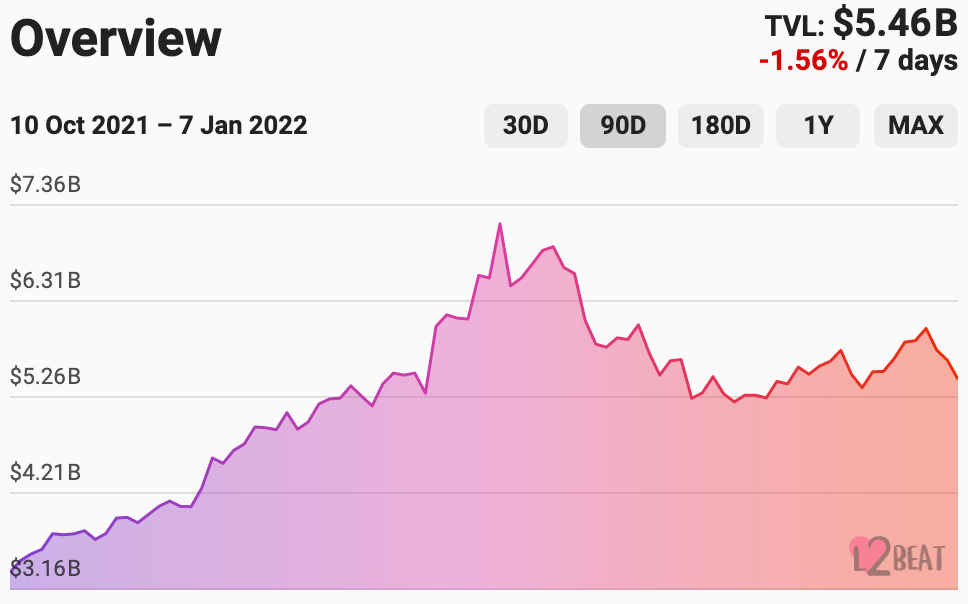
The Big Four of Rollup: Arbitrum, Optimism, zkSync, and StarkNet have currently opened whitelist dApp applications, and/or have centralized sequencers and verifiers, but plan to build a decentralized sequencer in 2022. At the same time Facilitate permissionless access. It is worth mentioning that recently Arbitrum was down for ten hours because of a centralized sequencer issue³.
image description
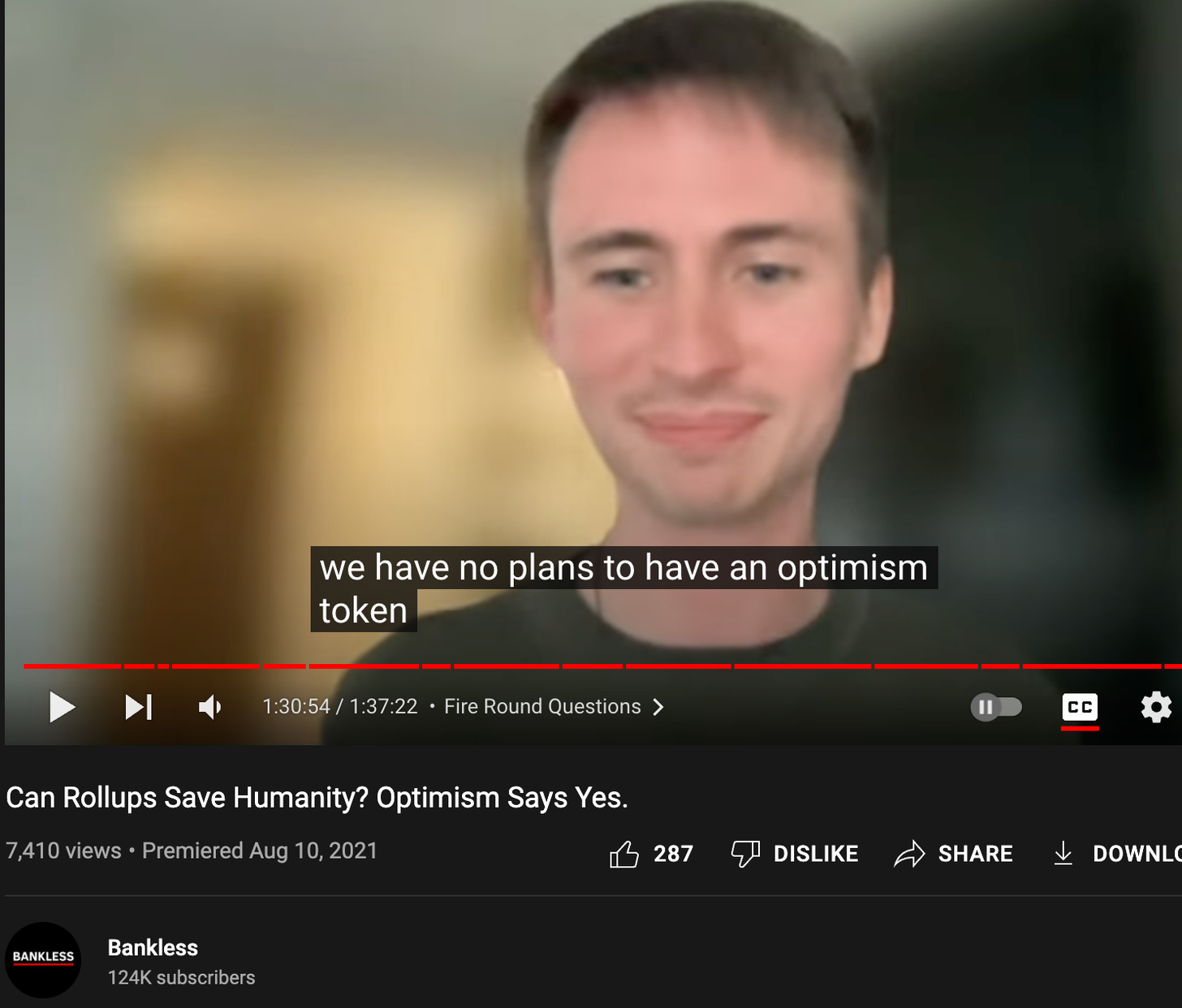
Image copyright attribution: L2Beat
When will the coins be issued?
Decentralized Sequencer
I think rollup tokens will be launched in the following order in late 2022-early 2023: zkSync (/confirmed/) → StarkNet (/no news/) → Arbitrum (/no news/) → Optimism (/publicly denied/) .
image description
Source: Bankless Interview with Optimism
—— @QiaoWang
In other words, any project - including Layer 2 networks - should only issue coins when they have reached a "product-market fit⁴". I think rollups can only achieve product market fit if they address the following issues:
Cross-chain bridge/deposit
EVM Compatibility/Equivalent
Incentive programs are a marketing expense and can be very expensive. You always need to prove that users love your product first, otherwise you are wasting your marketing budget.
We'll come back to these issues later.
aggressive incentives
aggressive incentives
In comparison, SushiSwap's vampire attack on Uniswap can only be regarded as insignificant. In order to compete with other L1 public chains⁶, rollups tokens should vigorously promote user migration to L2 through aggressive airdrops, pledges, liquidity mining, and ecosystem funds. The cross-chain bridge between L2 networks will allow the rollups system to catch up with other centralized L1 public chains.
Rollups should be strategically airdropped to those early adopters of rollups or ETH users, as well as other active users of the L1 public chain, and at the same time be able to filter out those cross-chain hairy troops. Incentives for developers can also be quantified proportionally based on the active usage of their deployed contracts. Rollups can also cooperate with DeFi 2.0 protocols like Olympus Pro to common liquidity incentive pools or L2 bond pools.
However, in order to attract more TVL, the industry needs better cross-chain bridge infrastructure between L1 and L2. The Rollups team⁷ members also understand this, and it is likely that coins will not be released until then.
But what would tokenomics⁸ look like?
The pledge mechanism of l2 tokens
Staking Mechanism of L2 Tokens
Incentives can be weighed against the need for a slashable staking mechanism as follows:
Sequencer and prover for zkRollups (hinted)
Originators and validators of fraud proofs for Optimistic Rollups (hinted)
Member of the Data Availability Committee at Validiums/zkPorter
$METIS mode: Provide incentives for Rangers (verifiers) to cheat-challenge sequencers (the winning party keeps the forfeited $METIS)
For reference, Immutable's IMX deposits a certain percentage of transaction fees into the pledge reward pool, and this model can be used for reference by other rollup tokens.
Once the tokens participate in the pledge, they lose their liquidity (Annotation: These tokens cannot be bought from the market), so the pledge mechanism itself can greatly improve the security of rollups. Matter Labs stated that "to make the data in zkPorter unusable, an attacker would need to raise 2/3 of the total market capitalization of all staked tokens".
METIS is a forked token of the Optimism mechanism, which has a dynamic bond threshold pledge mechanism. For sequencers, if the value of their pledged tokens is lower than the value of the block to be sequenced, they will not be able to participate in the sequence of this block. Until a qualified sequencer is found, the transaction cannot be packaged, which limits the value of the transaction.
cost subsidy
cost subsidy
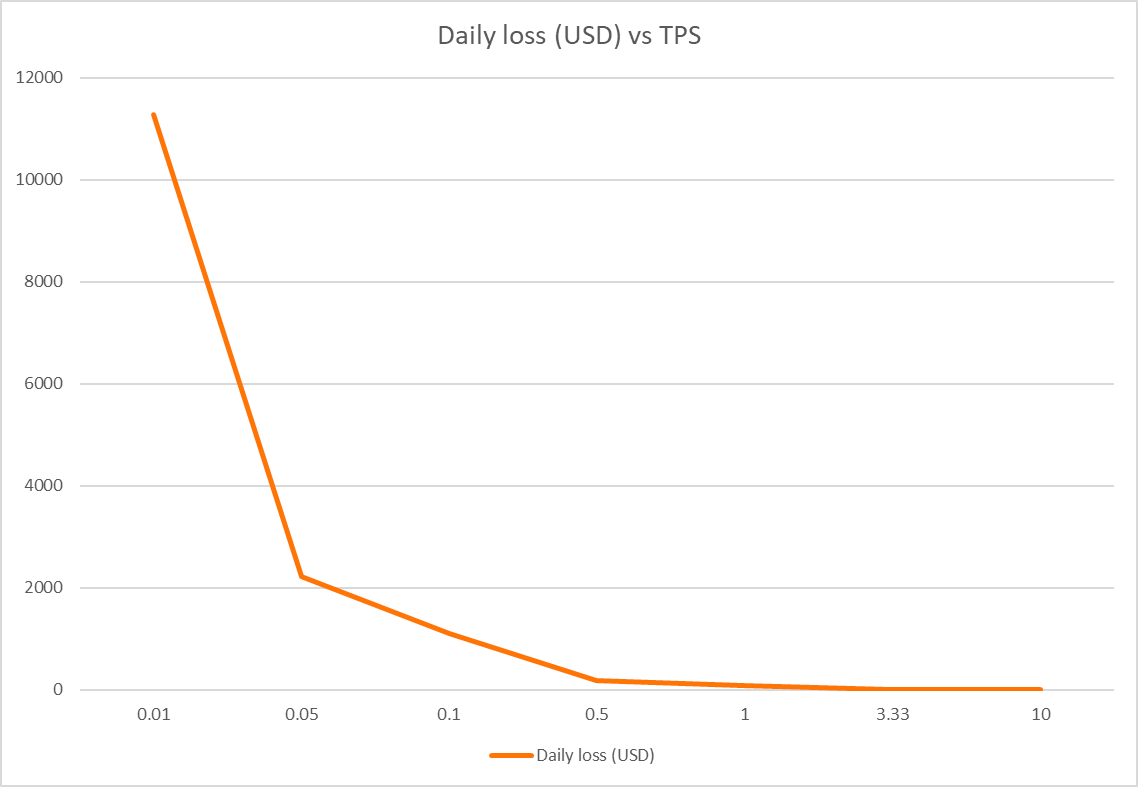
The ZK Rollup system should pursue a user growth strategy of loss-making sales by subsidizing the cost of early users.
—— @polynya
This can be achieved through spending on marketing budgets, or token inflation. Compared with the tens of millions of dollars spent every day to protect the security of SOL, DOT, AVAX, NEAR's Aurora and other networks, the subsidy cost of thousands of dollars per day is not worth mentioning.
For reference, Solana spends $18 million per day in security costs, but only sells $225,000 in transaction-packed blocks. On Immutable, we directly subsidize the transaction gas fee in full (translation note: no gas fee is charged for sending transactions), and hope that the transaction fee can subsidize one or two.
In contrast, Optimism Rollups…
ORs (Annotation: Optimism Rollups) follow another way to reduce transaction costs: compressing calldata. Their package handling commitments are low enough, although I know some ORs have some room for optimization.
—— @JohnWang
governance design
governance design
All rollups currently have multi-sig smart contracts deployed on L1.
Rollups is a new thing, so it needs to be upgraded and bug fixed on the L1 side in the early stage. What is more important at the moment is that we have detailed transparency reports and emergency exit mechanisms like escape pods.
—— @polynya
As the DAO matures, Rollup's smart contracts on L1 should be voted on by governance tokens and eventually become immutable. For now, multi-signature smart contracts on L1 definitely mean a trusted initial setup, but because of the time lock, you can withdraw your funds at any time, so it's not really a security risk.
Other governance issues include a MEV reduction mechanism designed for sequencers, a fee model, implementing fraud proofs on Optimism, treasury spending such as ecosystem funds and DAO partnerships, a data availability layer, and funding public goods through MEV auctions .
As you can see, there are tons of issues for the L2 DAO to vote on.
Although there are many innovative solutions, the first step towards the feasibility of a decentralized ordering mechanism should be for the rollup team to appoint a small number of high-reputation teams around the world and rotate between them. A better solution is to have a governance token and decide through governance voting (Lido?)
—— @polynya
token distribution
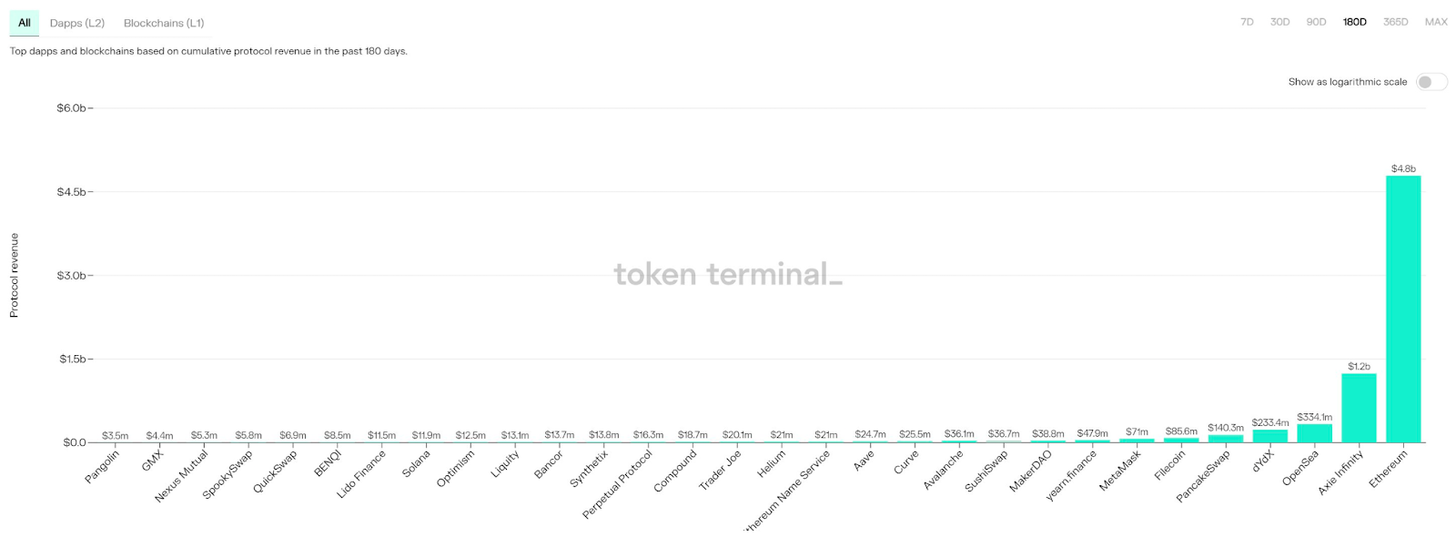
token distributionI am in awe of zkSync's public statement that they are going to distribute 67% of their tokens to the community. This sets a competitive bottom line for others to follow. This sets a benchmark for others to follow.The FDV⁹ of some existing L2 dApps protocol tokens has reached an astonishing tens of billions of dollars, while the rollup tokens of L2 smart contracts are at least ten times that. In terms of market value, it is easy to rank among the TOP 30.
Taking it a step further, IMX and DYDX have $9 billion in FDV, and the tokens of StarkNet and zkSync will only go higher. At an inflation rate of 8%, it is enough to subsidize the gas fee to $0.01 at the level of 500 TPS. TPS greater than 5000 is also possible if the inflation rate is as high as SOL
Starkware recently raised funding at a $2 billion valuation, and zkSync at $1.25 billion.
If we take
Cooper's data
[image:9EBB32A3-9E1E-4659-9437-998B038AB397-60073-00000E5152EA628D/FISKPmAVcAQovOK.png]
—— @Coopahtroopa.eth
To deduce the industry average level of the token distribution plan, 35% of which is reserved for the team or insiders, and reverse the ultra-low discounts of early VCs, then the minimum initial market value of these tokens is 7 billion US dollars.
Allocated to investors who bought equity early on and converted to tokens later or bought tokens outright.
Compared with L1, one of the major disadvantages of L2 tokens is the lack of token distribution. Even if the airdrop and incentive programs work well, other L1 public chain tokens have a certain time advantage due to their poor performance in recent years. If the L2 token is strong in the early stage, it may be further increased by giant whales.
Cross-chain bridge
We can solve this by subsidizing transaction fees with continuously inflating L2 token rewards (like Bitcoin does), attracting users and ensuring a wider distribution to maintain long-term security.
first level title
Barriers to Issuing L2 Tokens
Cross-chain bridge"Cross-chain bridge"。
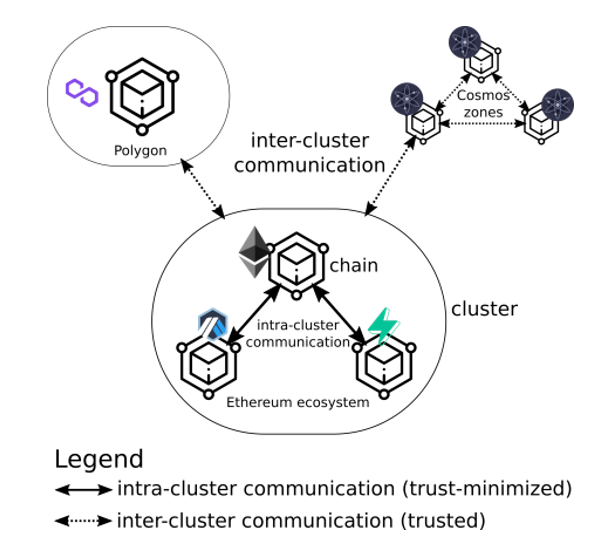
Cross-chain bridges and coin-issuing and deposit channels for L2 are critical to attracting TVL and solving liquidity fragmentation issues.
There are already some cross-chain bridges that shorten the 7-day withdrawal period of Optimistic rollup, such as Hop Protocol, Connext Network, Argent, Celer Network, Maker, PolyNetwork, Layerswap, MultiChain, etc.
At present, the TVL of L2 native cross-chain bridges only accounts for 17.7% of the TVL of all cross-chain bridges in Ethereum. Compared with other L1 chains, ZKRs cross-chain bridges have unparalleled advantages, because you can verify the state transition on the L1 target chain through cross-chain bridges that minimize trust. In the long run, rollups will have the best composable execution layer even when executed across multiple shards or external DA sources.
Celestia founder Mustafa Al-Bassam said sharply,
Starkware and Loopring collaborated to develop dAMM, a cross-ZKL2 AMM that allows asynchronous liquidity sharing with other L2 and L1 liquidity pools (such as Uniswap).
Layer 2 network technology requires a lot of manual integration from existing infrastructure. Centralized exchanges, oracles such as CoinList and Chainlink, and data indexes such as Graph Protocol must be customized for integration. As far as I know, BitGo/institutional custodians don't even have specific plans for this, limiting institutional access to L2.
Incentivizing liquidity through inflation or centralized market makers in the cross-chain bridge will make the L2 ecosystem vulnerable due to the highly volatile characteristics of hot money or the dependence on centralization. In order to incentivize the liquidity in the fund pool, the Hop project and Polygon jointly launched a liquidity mining plan to issue MATIC rewards to those liquidity providers. As expected, liquidity in those pools plummeted once the liquidity mining program ended.
It can be seen that there is still a lot of work to be done in terms of cross-chain bridges.
evm compatibility equivalence
EVM compatibility/equivalence
Software composability is extremely important.
EVM compatibility/equivalence will appear in all four major Layer 2 networks¹⁰ in the coming months.
What matters for true composability is EVM equivalence, not just EVM compatibility.
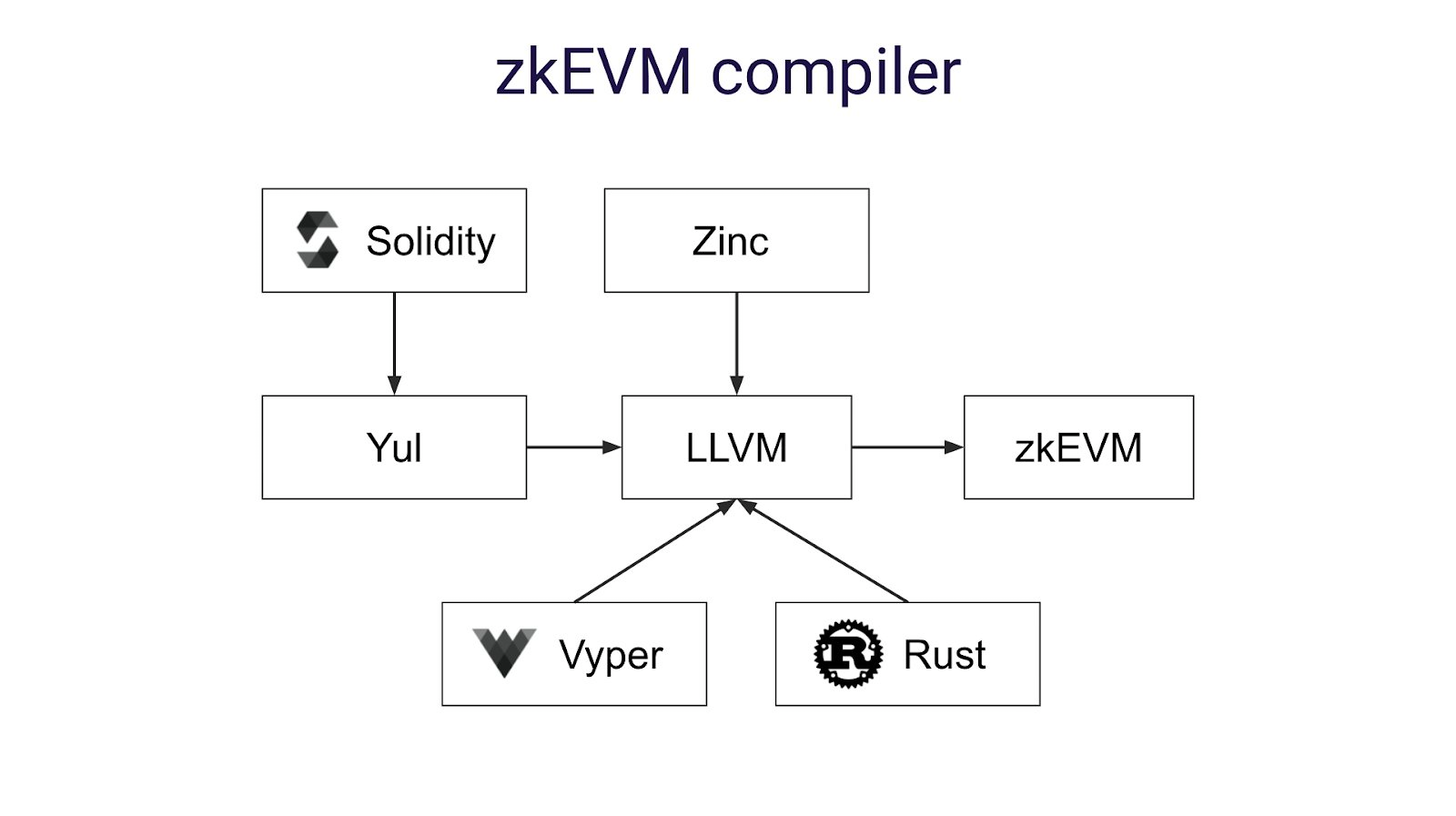
Developer tools like DappTools (smart contract libraries, command-line tools, format validation, symbolic execution, project management, etc.), Hardhat, Solidity, Vyper, and everything else will work seamlessly on native OVM 2.0, while Developers of these tools also don't have to worry about supporting fragmented codebases.
In contrast, Arbitrum One (formerly Nitro), zkSync 2.0, and StarkNet are all only compatible with the EVM. Simple syntax differences between Cairo and Solidity hurt code interoperability. In view of this, zkSync admits that they are not yet fully compatible with the EVM.
zkEVMs are extremely complex, and developers are still sparing no effort to solve some problems, such as denial of service attacks due to the inability of validators to process reversed transactions.
In fact, according toIs rollup-coin parasitic-eth?Is the Rollup token parasitic on ETH?"How the rollups of the second layer verify and execute the contract, while L1 is dedicated to storing unchangeable transaction data. In the current situation, the tokens of the L1 chain capture little value. Take a look at Solana and Avalanche."!
Value capture occurs primarily at the protocol layer. This also means that the settlement layer, execution layer, and consensus layer are competing for the store of value of MEV ¹¹ and currency.
In fact, according to
, in Eth 2.0,
MEV can increase validator rewards by 75.3%
As more liquidity floods into the Layer 2 network, L2 tokens are essentially parasitic on the MEV value capture of L1 tokens. L2 diverts the revenue of miners who provide security for L1, reducing the security budget and thus reducing the cost of launching a 51% attack."。
This is a serious issue that the ETH community has not taken seriously."Why does -l2- capture -mev?"
Layer 2 networks may see more complex MEV and coordination mechanisms between sequencers and miners. The backgrounds of those running PoS validators are closer to those of those who actually understand MEV than current PoW miners.
Under the interaction between different ordering mechanisms, cross-rollups will contribute to the MEV combinatorial explosion effect. Flashbots has a great paper in which they suggest that orderers "accumulate votes on chains with the most value in MEV...thus reducing their cross-domain MEV costs", "Mechanisms like Flashbots or SGX-based DAOs can reduce The cost of cross-chain collusion
However, as Flashbots founder Stephane Gosselin puts it,
Settling rollups on mainnet, there really isn't much MEV - the only thing miners can do is delay settlement for a few blocks, but that doesn't really affect the rollups experience and is quite costly.
Ethereum net gain
Ethereum net gain
Although the second-tier network may be parasitic on ETH in the short term, the long-term relationship between the two is a positive-sum game¹². Indeed, as more activity gradually migrates to the Layer 2 network, more MEVs will be captured than L1. At the same time, this may put downward pressure on earnings in the short term compared to a world without rollups.
Because rollups batch submit tens of thousands of transactions to the L1 chain at one time, the transaction fees of rollups scale logarithmically. This is almost like the dilemma of "small profits but high sales" and "high profits but low sales" in the sales field. On the scale of the data availability provided, L1 transactions from rollups will pay higher transaction fees than normal transactions.
Another thorny issue is that miners may leave the network, reducing the security of L1. Worse, more L2 transactions will lead to more state inflation and higher storage requirements for full nodes, thus reducing decentralization.
At the end of the day, what we should be asking is: Are there any rollups that would make the price of ETH go up even higher?
Due to the block size limit and the high gas fee that makes most users lose, there will be an upper demand limit for the interaction directly on the Ethereum L1. In a world of rollups, recursion, and layered L3, the potential user size¹³ would be in the billions."moneyness"。 @TaschaLabsIn the same fixed L1 block space, rollup packs into a larger network effect.
The scaling of Ethereum to global use means that the block space on L1 will always be filled. The sorters on L2 earn L2 transaction fees and pay their L1 transaction fees at the same time, earning the price difference between the two, and everyone is happy.
Also, I don't think MEV and transaction fees are drivers of ETH's value. Solana's transaction fee income is extremely low, but it still has an $80 billion market cap."moneyness"The value of ETH should be calculated using a fusion of commodity pricing and quantity theory of money (Ethereum is a country and ETH is its currency). The value capture of the security layer comes from the economic activities that occur on it, and the "monetity" of ETH. Although it has higher TPS and lower transaction fees, L2 still significantly increases the speed of currency circulation.
Many skeptics say that L2 reduces ETH's
claim:
You can buy directly on a centralized exchange, such as /ZKTOKEN/, transfer it to your ZK wallet, and then spend your /ZKTOKEN/ on ZK’s L2 without ETH."moneyness"The reality is that ETH's
far from weakened. Compared with fluctuations in tx demand due to unstable demand of specific dApps or use cases on a specific L2, the sum of all rollups’ tx demand will be more stable. In a rollup world, ETH will become the universal currency."Everyone buys ETH not only to pay the gas fee, but also because many things are priced on the ETH standard. ETH will be the main utility token to pay for gas (even on rollups). NFTs are denominated in ETH. The largest liquidity pools on Uniswap are paired with ETH."
ETH is widely distributed
There is a first-mover advantage in terms of network effects.
Deflationary token economics contribute to the monetary narrative. As @epolynya said,
Rollups have the great advantage that they spend almost nothing in the inflationary budget, or a very small fraction of other competing L1s.
l2-tokens are coming





