


Ethereum co-founder Joe Lubin: Ethereum 2.0 will be launched in the second quarter of this year


Original Author: Amy Liu
Original source: BitpushNews
ConsenSys CEO and Ethereum co-founder Joe Lubin believes that the next era of Ethereum will arrive in the coming months.

In an interview in Miami last December, Lubin predicted that ethereum 2.0 would launch in the “second or possibly third quarter” of this year. Last week, at the Camp Ethereal crypto event in Wyoming, Lubin stuck to that prediction.
"My estimates remain the same, and we have a strong team that has put a lot of effort into it," Lubin said.
The next step will be to transform the current Ethereum mainnet (which we call Ethereum 1.0) into a kind of ghost network that is currently running in parallel (technically called the Beacon Chain, which will evolve into Ethereum 2.0).
Instead of executing real transactions, the beacon chain now creates a space for validators (computers that verify encrypted transactions) to lock up their hard-earned ether. It laid the groundwork for Ethereum to move from the proof-of-work (PoW) mechanism it currently uses to proof-of-stake (PoS).
Bitcoin also uses a PoW mechanism and has been criticized globally for its huge energy consumption. There are currently no plans to change this.
Under the new mechanism, Ethereum validators are rewarded for ensuring that transactions are processed correctly by the network. Currently, the reward pays out 5.54% of ETH to stakers, according to data pulled from Staking Rewards.
However, validators can be penalized if they are caught adding fraudulent transactions to the ethereum blockchain.
On Tuesday, ethereum developers announced that the new ethereum testnet had successfully merged and transitioned to a proof-of-stake consensus mechanism. A testnet is essentially a cryptographic sandbox where developers can test new upgrades or protocol changes without causing serious damage to the actual blockchain network. Core developer Tim Beiko tweeted, "It seems to be working, validators are producing merged blocks that contain transactions!"

secondary title
What will Ethereum 2.0 bring?
Aside from all the speculation surrounding the exact launch date, threads on Crypto Twitter explain and debate what the upgrade means for the network and its users.
Ethereum 2.0 will bring about several key changes, namely, the creation of an environment where shard chains and rollup technologies can theoretically increase transaction speed and reduce costs.
Ethereum 2.0 will indeed lead to lower energy usage and lower gas fees, although many in the crypto community are skeptical of the latter.
Lubin said, “The merger will end proof of work, it will end the carbon footprint of Ethereum, everything will disappear. In terms of energy, the cost will be orders of magnitude lower. Another exciting fact about the move to proof of stake institutions is that , the proof-of-work mechanism needs to issue a lot of ETH to incentivize those who have a lot of infrastructure to lend their resources and verify transactions on the network. So if you have very little infrastructure, then you can build issued less ETH in blocks."
After making ethereum cheaper and greener, Lubin added that the upgrade would also turn ethereum, the world's second-largest cryptocurrency, into a "super-sound currency."
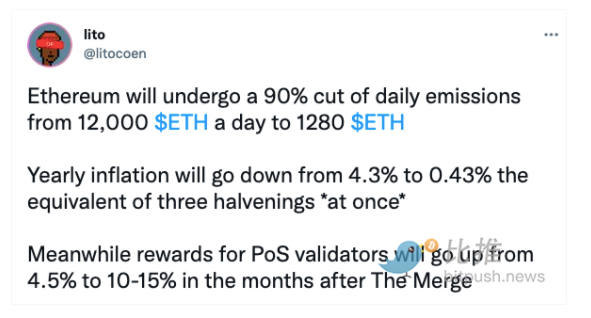
Moving to Ethereum 2.0 will result in a lower emission rate, meaning less ETH will be given to validators to secure the network as they are much less expensive to operate. For example, running traditional PoW mining rigs comes with a huge overhead. Without this overhead, validators would still have an incentive to do their job well even if rewards are slashed. In turn, this means that there will be less new ETH supply entering the market.
Meanwhile, Ethereum’s latest EIP-1559 improvement introduces a burn mechanism that burns a certain amount of ETH with every transaction.
These two changes create an environment where a lot of ETH is being destroyed on the one hand and less ETH is being created on the other. In an instant, huge deflationary pressure appeared.
Lubin said, “When the merger happens, we will be burning more ETH per day than we are issuing, because less ETH will be issued to secure the network, and ultra-sound money is coming.”





