


In-depth analysis of the intrinsic value of SSV: cost, positioning and service objects


Original author:
Original author:Blockchain Two-fork Knife
first level title
The cost of running an ETH validator
image description
secondary title
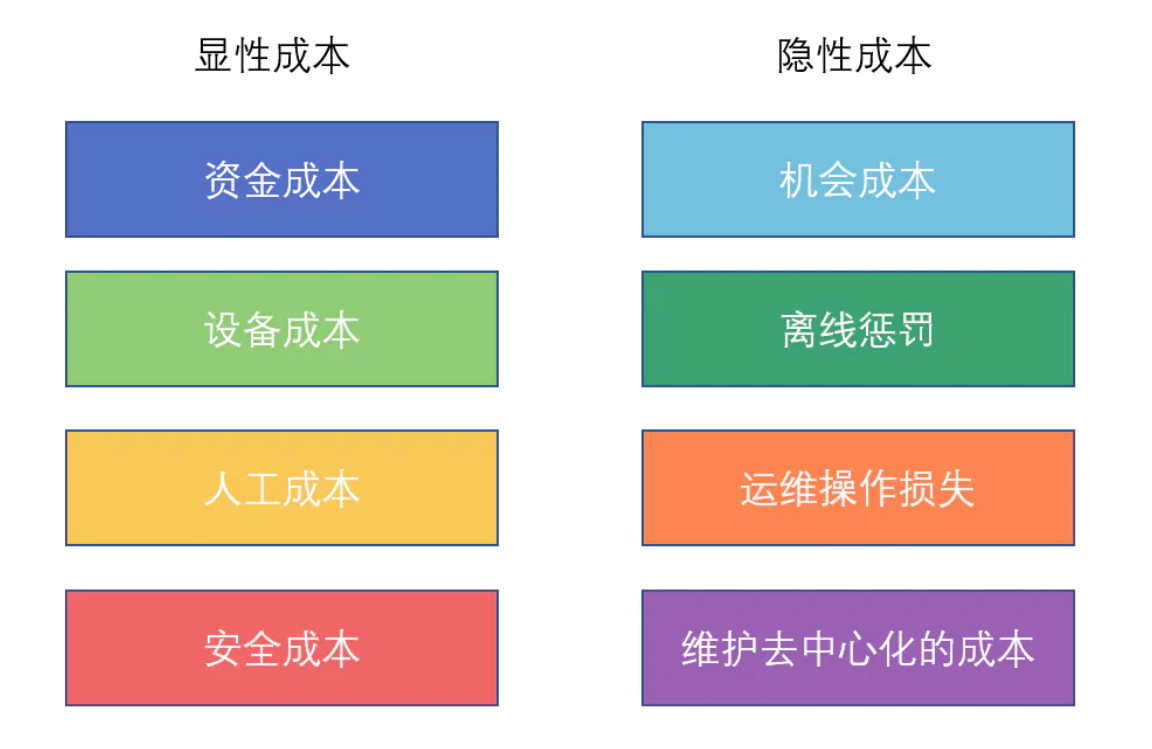
explicit cost
Funding cost: 32 integral multiples of ETH pledge
Equipment cost: cloud server running validator nodes
Labor cost: server operation and maintenance personnel
secondary title
Hidden costs
Opportunity cost: The opportunity cost caused by staking ETH
Offline penalty: Offline penalty caused by node downtime or offline
Operation and maintenance loss: cheating penalty loss caused by operational errors
secondary title
Let's analyze the above costs one by one:
capital cost
The Ethereum consensus layer requires each validator to pledge 32 ETH as a deposit (not divisible), and one account can run multiple validators, so users need to prepare 32*N (N is the number of validators, an integer) ETH for For staking, the current cost of 32 ETH is about 90,000 US dollars, which is an unaffordable cost for most retail investors.
Therefore, Lido and other staking pledgers have started the asset management intermediary business. Users provide their scattered ETH (less than 32) to Lido, and Lido sends stETH pledge certificates to users, and then combines the scattered ETH collected from each user. A portfolio of 32 ETHs is formed, and each portfolio is created as a validator, which is operated by Lido itself. Users can obtain the benefits of staking, which is also a way for many retail investors to participate in ETH Staking.
equipment cost
Validators need to submit network blocks and vote on blocks, and need to stay online 24 hours a day. Renting a cloud server is the most reasonable choice.
Labor cost
It is necessary to hire operation and maintenance personnel to manage a huge server cluster and deal with various emergencies.
security cost
secondary title
Hidden cost analysis:
opportunity cost
The pledged ETH needs to be locked. To retrieve the pledge, it takes 2048 epochs (about 9 days) before you can apply for redemption. After redemption, it takes about 27 hours to unlock. Therefore, when the market fluctuates sharply or there is a demand for funds, the lack of liquidity will cause a certain opportunity cost.
Lido's way of issuing stETH solves some liquidity problems, and users who pledge can exchange stETH back to ETH on curve.
offline penalty
Validators need to vote (attest) on the transactions of their slots. If the validators do not respond immediately, they will be fined and confiscated part of the pledged ETH.
O&M operation loss
From the introduction, the penalties caused by operation and maintenance errors are mainly divided into two types: double signing and surrounding voting. These two acts will be regarded as malicious cheating and will be subject to a larger penalty. Click here for details
Intangible Assets: The Consensus Value of Web Decentralization
At present, the TVL of Ethereum exceeds 120 billion US dollars, which is more than the sum of the 2nd to 10th places combined. On the one hand, Ethereum has a first-mover advantage. It has the most DeFi protocols and stable currency assets, as well as countless whales. On the other hand, Ethereum is also currently recognized as one of the longest-running and most decentralized public chains. This consensus makes more stablecoins and financial protocols more willing to deploy on Ethereum, and the wealth effect created by a large amount of funds attracts more users and funds, forming a positive cycle. This is also the brand premium brought about by the decentralization of the network.
image description
first level title
The difference between SSV and Lido and other node service providers
Before talking about the value capture of SSV, many friends are not sure what the difference is between SSV and Lido, which are also on the Eth staking track. Here I will summarize the difference between the two: their positioning is different.
- SSV itself is an infrastructure serving verifiers, but SSV does not do asset management, that is, SSV does not absorb users' ETH for recombination.
image description
first level title
Who SSV Serves
At this point, we can actually find that SSV actually serves two types of people
- For long-term positions, large investors who need to ensure the safety of funds (do not entrust assets to a third party), but do not want to do it themselves
- Value capture of SSV by a group of ETH pledge service providers led by Lido, Rocketpool, and Binance
Through the previous article, we learned about the cost of running an ETH validator, and what SSV has to do is to outsource these costs from the original validator and pledge service provider. All these costs are borne by the SSV Operator, so SSV will Become a huge node operation and maintenance service provider - Operator crowdsourcing network.
Professionals do professional things. For service providers like Lido, outsourcing operation and maintenance services has the following advantages:
1. Reduce the pressure of operation and maintenance, no need to hire and form a node operation team, all can be outsourced to SSV
2. Reduce equipment server expenditure and its management cost
3. Reduce security risks. Under the original self-operation mode, if it is broken by hackers, it will cause a large number of nodes on its own platform to go down, causing losses to users
image description
SSV Value Capture
first level title
Can this technology be used on other PoS chains
**First of all, it is technically feasible. **Theoretically speaking, as long as the consensus mechanism is a public chain with PoS, and the verifier's operation secret key and account private key are independent, SSV can be integrated, such as the Cosmos ecosystem.
However, in terms of mechanism, there are big differences between Ethereum and other PoS public chains:
1. Ethereum pursues decentralization as much as possible, so its design idea is that all validators pledge the same amount of ETH, the rewards that a validator can receive have nothing to do with the amount of their pledge, and ordinary users cannot entrust ETH to Verifiers, so that more people can build nodes, making Ethereum nodes sufficiently decentralized and decentralized.
image description
The top 10 nodes in the Cosmos network votes account for nearly 50% of the voting rights
Summarize
Summarize
SSV is currently conducting V1 incentive testnet activities, and the test will continue until April. The V2 testnet is also under development and is expected to be tested in April. SSV is expected to be officially launched on the mainnet this year.
Original link





