


Composability VS Modularity, who will win in a multi-chain world?


Original Author: Overnight Porridge
Original Source: Tao of the Metaverse
Original Author: Overnight Porridge
Original Source: Tao of the Metaverse
Recently, some research reports released by encryption institutions such as Messari, Delphi Digital, and IOSG all mentioned the word Modular Chain, so what does this word mean? Does it represent a trend in the future of the industry, or is it just a hype?
In this article, we try to answer this question.
First of all, before explaining the meaning of the word Modular Chain, we need to understand the Monolithic (monolithic architecture) chain. The original Ethereum and the very hot Solana in 2021 are all adopting this architecture. The biggest advantage of the familiar blockchain, Monolithic (single architecture) chain is that it can have composability, which has always been considered the holy grail of public chains in the past. However, the congestion of the Ethereum main chain has demonstrated some disadvantages of Monolithic (single architecture): poor scalability, non-customization, and prominent cost issues.

Solana optimizes its execution environment through its unique PoH to process tx in parallel, which enables Solana to achieve scalability gains that cannot be achieved by large block competition chains such as BSC. Of course, this is also achieved by sacrificing some decentralization properties of.
In a blockchain environment such as Ethereum 1.0 and Solana, various blockchain modules such as transaction execution, blockchain security, data availability (DA), Defi interaction, and NFT interaction are all carried out in one chain , imagine that 5 people live in the same house, it may be relatively comfortable, and their communication is very easy, but if 10 more people want to live in the same house, then the house will become It is very crowded, and if one of them takes up too much space, the others will become very uncomfortable, so the need of these people is to expand the house, or be forced to move to other houses.
Ethereum's Modular Design
In the case of Ethereum, it has a history of expanding the block gas limit many times. This is the easiest way to expand capacity, but it comes at the expense of some decentralization properties.
The solution that is really considered to be able to solve the expansion problem of Ethereum is the Layer 2 solution represented by Rollup, and the sharding that Ethereum 2.0 will adopt.
The idea of Layer 2 is to separate the execution layer module from the Ethereum main network, allowing many applications to run on Layer 2, and ensure security through the consensus security layer of the Ethereum main network.
This can effectively expand the throughput of the entire system, but the problem is that various Layer 2 solutions have appeared on the market, which will reduce the composability of the system and decentralize liquidity.
The sharding scheme can further achieve expansion, which uses a new primitive called DA proof to achieve higher scalability. Using DA proof, each node only needs to download a small part of the shard chain data, and knowing a small part of it can jointly reconstruct all the shard chain blocks. For example, Polkadot and Near have implemented DA proofs in their sharding designs, and this will also be adopted by ETH 2.0.
There is no doubt that sharding can further improve the scalability of the entire system, but the complexity of sharding implementation is undoubtedly very high, which may take several years.
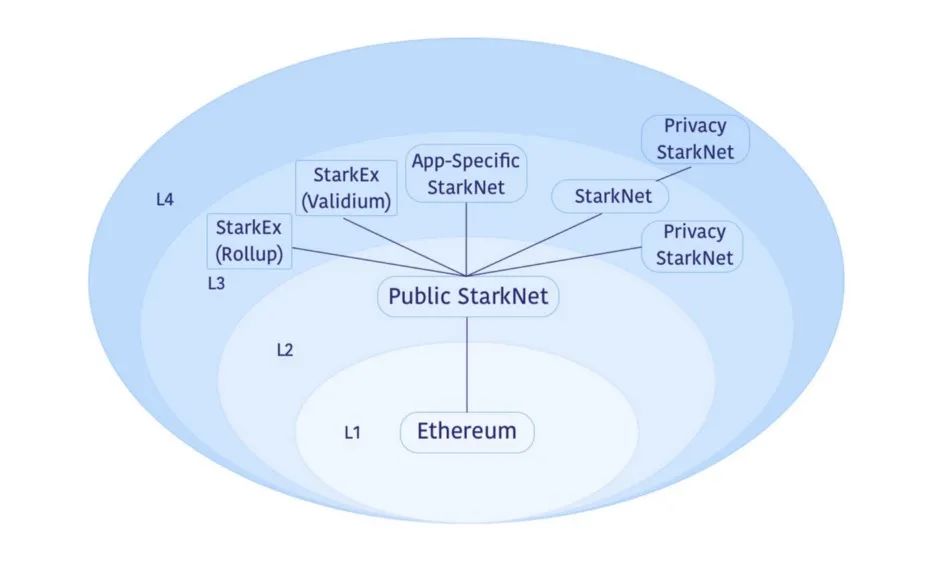
Recently, StarkWare also proposed the concept of Layer 3, which is further subdivided into several modules, which is also an interesting development.
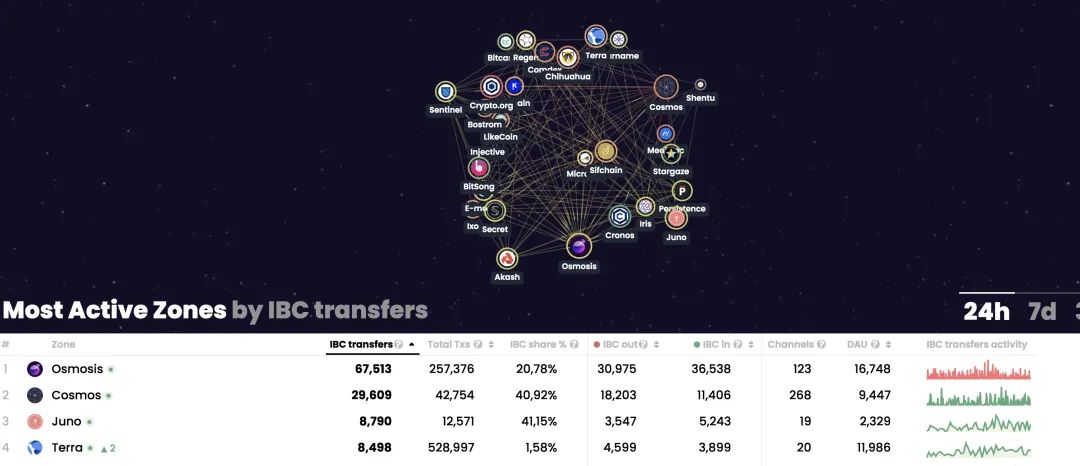
Multi-chain Hub module design represented by Cosmos
Multi-chain Hub is the simplest modular design, which refers to multiple blockchains that communicate with each other through standard protocols. In the example of Cosmos, we have seen 29 such as Terra, Osmosis, Cosmos hub, and Crypto.Org through IBC These blockchains are usually optimized and customized for a certain use case. Here, Osmosis, which has the largest usage of IBC, is used as an example.
Osmosis is a blockchain optimized and customized for DEX (decentralized exchange) use cases. Note that it is a public chain first, and then a DEX.
Compared with DEXs such as uniswap, Sushi, and curve, which rely on general-purpose public chains, Osmosis has many advantages, which can be clearly felt in user experience.
When users want to transfer assets from other hub chains (such as terra and Cosmos) to Osmosis, they only need to click deposit on the asset page of Osmosis, without having to know complicated knowledge such as IBC.

In addition, users do not need to worry about front-running and expensive transaction fees, which are common problems on blockchains such as Ethereum.
The next development plans of Osmosis are expected to bring more users and TVL.
Of course, this modular design also has some disadvantages, such as reducing composability, and these module chains need to be responsible for their own security (this will have to wait for the Cosmos hub to implement the Interchain Stake mechanism to share security).
It can be said that Terra and Osmosis have opened up the imagination of application chains for us, and their market performance tells us that modular application chains do have great advantages.
Similarly, Algorand and Avalanche also adopt the modular design of multi-chain Hub.
Celestia's dedicated DA layer modular design
Celestia is a new L1 design that has been mentioned in several research reports recently.
Similar to the DA layer of Ethereum 2.0, Celestia also uses the data availability (DA) proof scheme, but it does not support the verification of smart contract transactions, and its design only provides a data availability layer and a consensus security layer for rollup.
For a DA layer like Ethereum, once the block limit is approached or reached, the fee market will appear. In contrast, Celestia does not need to worry about this problem because it only supports rollup tx.
In addition, Celestia's DA layer solution can be implemented more easily than sharding, but such a nascent solution may face some problems in value capture, and it has not yet been verified by the market. Most importantly, Celestia's consensus security layer cannot be compared with on a par with Ethereum.
Now, we give a vague definition to the modularization of the public chain: decompose the system into multiple module components, each module is a blockchain, and they will be responsible for different functions (such as execution layer, consensus security layer, data Usability layer, DEX application chain, stable currency application chain, NFT application chain, derivatives application chain, etc.), these modules can be separated out at will, or reassembled together.
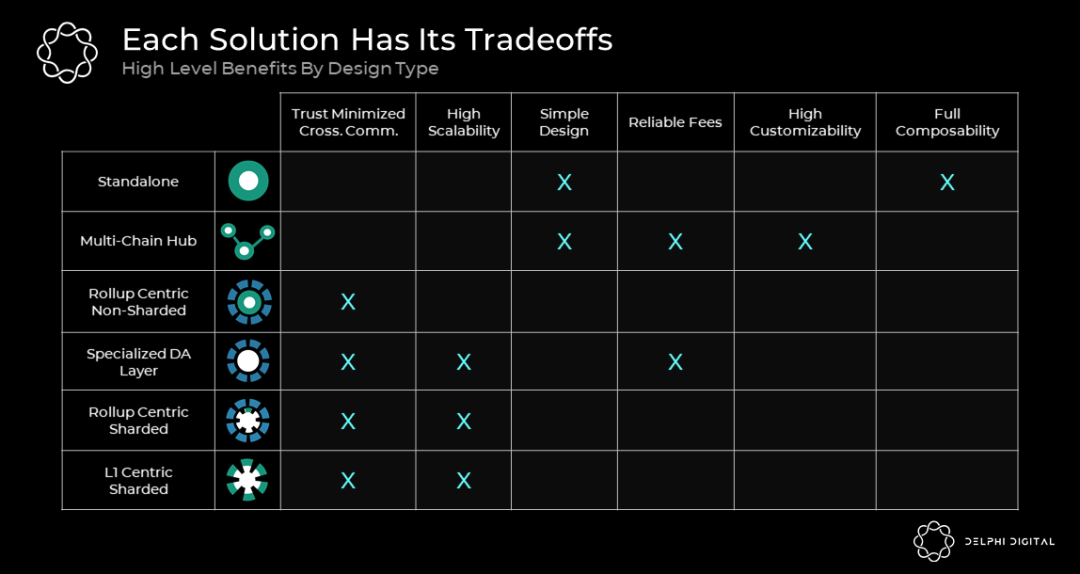
There are many benefits of modularization, but different trade-offs will also face different challenges.
image description





