


BitMex CEO: Predicting the Encryption Market in 2022 under the Sino-US Economic Policy Game


Author: Arthur Hayes
Author: Arthur Hayes
As a society, we use forms of money as an abstraction of the energy it takes to produce the things that sustain us. Prices tell us how much energy is available to balance supply and demand for a given good or service. When society distorts pricing signals, supply and demand become unbalanced, resulting in wasted energy. Waste enough energy and civilization falls; hopefully replaced by a new social structure that is organized to save energy in a better way. With all the current and future exciting developments in cryptocurrencies, we must not lose sight of the most important element of current excitement... BOOLMARKET (the market).
Yes, the technique has to work and it does... sometimes. But if we are moving towards a tokenized world, the price of a token representing a particular crypto technology or community is the easiest way for a layman to know whether it is successful or not. However, if the unit of account is tied to a central bank/government that prints money, then the PRICE = SUCCESS indication can easily be misrepresented.
If the quantum of scale is increasing every year, how can we judge the true energy value of a thing? Or worse, if the metrics are just political drama based on the whims of fallible people who care only about surviving in office. While many crypto natives benchmark their wealth against bitcoin (and increasingly ether), the vast majority of humans see their net worth as some sort of derivative fiat currency pegged to the dollar.
The astonishing growth of all cryptocurrencies since their demise in March 2020 will lead some to think that superior technology is winning. This technology is so amazing and transformative that adoption will not only increase but accelerate. With this success, the prices of many assets will continue to rise exponentially. You think to yourself, "This shit is so bright, I'm only looking at graphs on a logarithmic scale."
But the easiest way to generate buzz and clickbait news articles and draw eyeballs to a particular project is the token price. The $69 million purchase of an NFT artwork at a Christie’s auction earlier this year set the stage for an explosion of interest in the tech-enabled art form. The talent and technology have always been there, but getting the world's attention to all things NFT is spent on big purchases.
Any token price is a combination of technical and monetary conditions. The hard part is determining the percentage weights for each factor. As 2021 draws to a close, the world's two major economies, the United States and China, are standing on the precipice of a market maelstrom. In the US, the Fed is now under intense political pressure to fight inflation. In China, a decision must be made whether to continue to reform the economy deeply, or to continue the current approach to support the current growth model. The decisions taken by these two economies in the next quarter will determine to what extent the monetary landscape supports further price appreciation of the cryptocurrency complex.
The technological improvements offered by encryption become irrelevant at this point because the current expectations are so high. Many TradFi research analysts who previously pooh-poohed aspects of the crypto market are now full of praise for crypto, hailing it as a transformative advance. Many politicians around the world recognize the inevitable imminent transformation in the way companies, governments and individual actors interact thanks to cryptocurrencies. A bright future has arrived, and only disappointment awaits. That doesn't mean I'm not bullish on cryptocurrencies in the short term, but it does mean that adding users at the expected rate won't yield huge returns.
There are three types of cryptocurrency allocators, each of which will change its portfolio based on its outlook for the first quarter of 2022.
1. Someone has to decide whether to allocate more fiat to crypto.
They are primarily concerned with the amount of currency depreciation that will or will not occur. "Sell USD to buy Bitcoin or Ethereum?" Their benchmark outperforms growth in fiat money supply.
2. Someone has to decide whether to allocate more bitcoin or ether among other types of tokens.
Their main focus is to find projects whose technical impact or user adoption will grow rapidly, so that the price exceeds Bitcoin/Ether. "Would I sell Bitcoin/Ether to buy Solana, Cosmos, Terra, etc?"
3. Finally, someone has to decide if it's time to liquidate their crypto holdings and return to fiat/government bonds.
They have to determine if this is part of a cycle where the cryptocurrency complex is down 75% - 90%. They want to protect the value of their wealth in units of commonly used hydrocarbons like oil and gas.
This may sound repetitive, but this iterative process of dilemma is in line with the cyclical nature of human society. Our collective actions follow predictable wave-like progressions. It's as if human society exists purely in carnival. A known set of baselines adds to the melodic progression, leading us from the introduction to the breakdown, then the descent, leading to Nirvana, then death and rebirth into new tracks. After doing this hoops millions of times, we want the general trajectory to be progress, but stagnation and decline cannot be dismissed as impossible.
secondary title
i can handle it
The continuous decline of Evergrande and China's real estate market in general is an active choice. Beginning with market reforms in the late 1970s and early 1980s, China decided to urbanize rapidly, moving hundreds of millions of poor peasants from the countryside to areas that would soon become prosperous metropolises such as Beijing, Shanghai, Shenzhen, and Guangzhou.
Major private real estate developers bought land from local governments and built the housing needed for the mass migration of people from farms to cities. At some point, instead of providing people with much-needed new homes, real estate development became a speculative tool. With capital accounts still closed in China and the domestic stock market depressed, people tend to protect their wealth through property ownership.
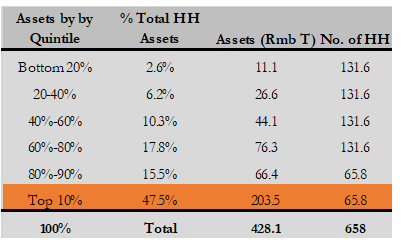
Andrew Collier provides excellent bottom-up data on the Chinese economy. The chart below illustrates the proportion of China's wealthy in financial assets and importantly, they invest heavily in real estate.
Top 10% of households own nearly half of China's wealth
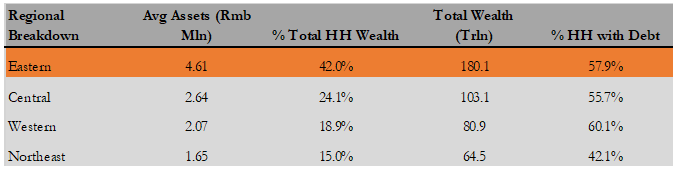
The eastern provinces, including the wealthy coastal cities of Shanghai, Shenzhen and Guangzhou, are by far the wealthiest in China
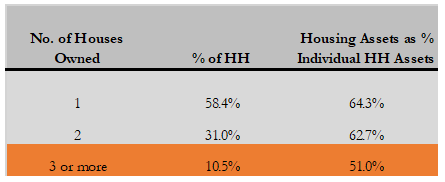
More than 40% of households own two or more properties
The central government supports developers and homebuyers with low-interest loans. Large state-owned banks (commonly known as state-owned enterprises, or SOEs) are happy to lend to developers and homebuyers to develop projects, acquire land and buy physical units. Borrowing money to engage in activities not sanctioned by the state is difficult and extremely expensive. As a result, China consumed more raw materials in a shorter period of time than any country in human history. Much cement, steel, and other industrial commodities are used to build new condominiums and skyscrapers.
While China's rapid urbanization has benefited many Chinese and global businesses, at some point the payoff of building more apartment buildings did not outweigh the cost of the debt. Beginning last year, the government began implementing policies to limit credit to the most unscrupulous borrowers, the worst of which was Evergrande.
It is foreseeable that after less than a year of implementation of the so-called "three red lines" policy, Evergrande's bond default at home and abroad is imminent. It appears that Evergrande will “restructure” its entire foreign dollar debt. The default is here. Evergrande is just the worst of a bunch of companies that have long relied on cheap credit, failing to add real economic value to China after a certain point.
However, if the government allows Evergrande and companies like it to fail, the entire model of rapid urbanization will be called into question. By announcing "common prosperity" and "socialism with Chinese characteristics," the Chinese government is signaling to the world that it believes the Chinese economy can handle its first real credit cycle since the 1990s, non-performing loans and inflation.
Then the PBOC cannot save China's capital markets by lowering the price of credit or allowing banks to lend freely again for real estate related activities. It seems likely that the government will draw this conclusion, which means that China will not provide more fiat liquidity to the global market. That basically puts the task of maintaining global risk asset markets on the Fed. With $120 billion in monthly bond purchases, the Federal Reserve appears willing to provide the capital global financial asset markets need to continue rising.
It is undeniable that the rapid economic growth experienced by most developed countries in the first half of 2021 will slow down significantly in the third and fourth quarters. China continues to export record volumes to the world, but even if exports are strong, something must be wrong - because over the weekend, the People's Bank of China cut the reserve requirement ratio by 0.50%.
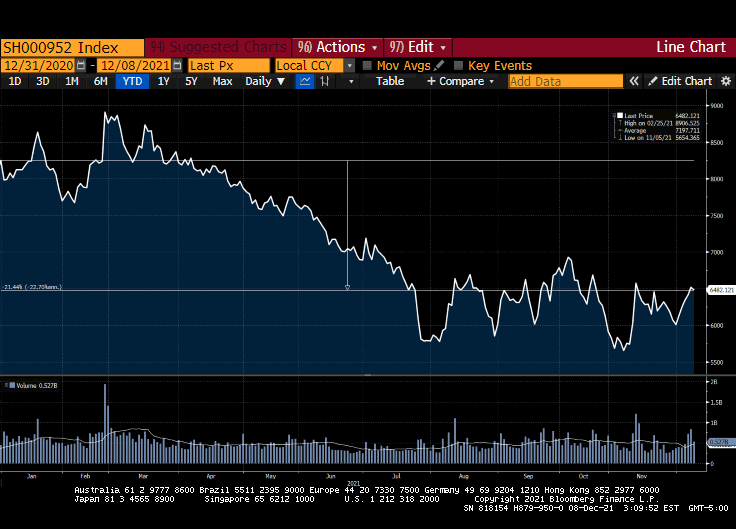
The Shanghai and Shenzhen 300 Real Estate Index (SH000952 INDEX) has fallen 20% year-to-date.
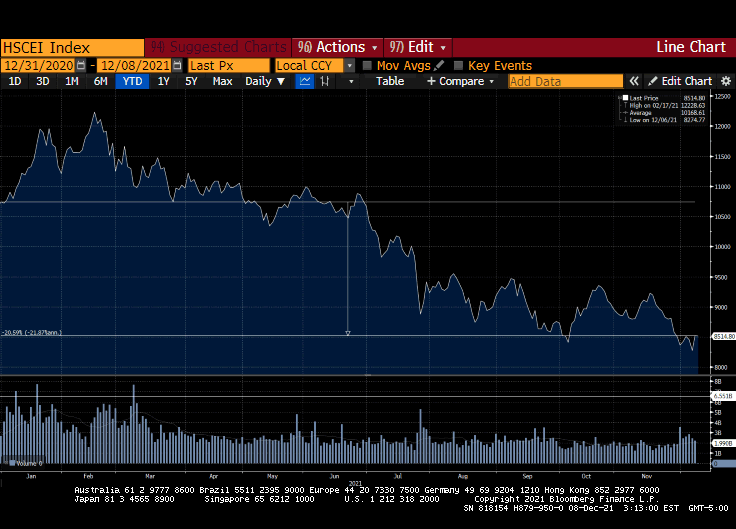
HSCEI, Hang Seng China Enterprises Index (HSCEI INDEX) fell 20% year-to-date. There are Chinese companies listed in Hong Kong, and given Hong Kong's open capital account, it is much easier for foreigners to do transactions in Hong Kong. The index includes Evergrande and many other property and technology names.
The weakness in China's stock market and the surge in yields on China's low-quality bonds suggest that China is accepting the consequences of its policy choices of managing big tech companies and clamping down on domestic real estate developers. I don't know what's actually changed, but the PBOC's reduction in RRR requirements and lower cost of credit - which should be increased to free the country from easy currency addiction - suggests that something is happening to the way China calculates Variety.
It will illustrate how big the discount is to holders of Evergrande's dollar offshore bonds. Will China suddenly step in and provide a lifeline to overseas bondholders, cutting their losses to delay the impact of a negative credit cycle for a while? If they back away from their stated willingness to allow a painful economic contraction, then we can interpret that as a signal that the flow of cheap credit into China (and subsequently the world) will boost prices of various risky assets.
China cannot maintain a strong yuan, aggressive domestic monetary stimulus and a closed capital account. I will keep a close eye on the USD/CNY exchange rate, if China does print a lot of money again, the CNY will definitely weaken. Watch the trinity of policy moves and tell us where China wants its economy to go, given that the PBOC maintains a strong RMB policy post-COVID.
Bloomberg has an excellent summary of the state of development in China and the possible contagion effects of Evergrande's implosion.
It would be a positive development for the Fed if China reeled in its hands again and joined the monetary easing frenzy. Because, as I'll explain in the next section, the political heat the Fed feels about the need to control inflation could force it to raise rates in the first quarter of next year. If China remains aggressively loose to maintain its economic growth model, the Fed can tighten monetary policy without negatively impacting U.S. and global risk asset prices. It could start working more aggressively to curb inflation and address the related concerns of some voters without hurting the wallets of the wealthy.
I have 99 problems and deflation is not a problem
You know, it sucks when you have to overhaul your "inflation is temporary" statement on a dime - because the government realizes it can't fool the populace into believing the highest inflation reading in almost 40 years is benign and temporary.
Jerome Powell says it's time to stop describing inflation as 'transient'
As I mentioned in Ripple, I believe the Democrats have a two-step path to the 2022 midterm elections thanks to fiscal and monetary fueled inflation. Like a good government employee, the Fed chairman always does what the big shots tell him, regardless of his political party. The president now needs to whip up inflation, and he has called on the respected Fed board to change their tune.
Now, the chairman of the Federal Reserve is horrified to announce that the pace of "debt shrinkage" will accelerate.
Markets fall as Powell vows faster debt reduction
Many market participants naively assumed that the fundamentals of stocks — and risk assets in general — were underpinned by real economic strength, not wanton money printing. Whenever the Fed hinted that it would slow down the pace of its indiscriminate bond purchases, the market reacted negatively over time.
One could argue that the more than 20% drop in value of Bitcoin and Ethereum on Dec. 4 is a signal from the crypto market that risky assets have fallen sharply in price. Given that crypto capital markets are the last remaining free markets in the world, they are the only smoke alarms that work. The S&P 500 also fell, but over the five-day period from its close on Nov. 29 to Dec. 6, it was down about 1.55% (while bitcoin fell 16%).
To put these returns in context, I counted the number of times the 5-day return (assuming it was negative) was greater than the 5-day negative return, starting on November 29th and using 2021 data. For the S&P 500, 31% of the 5-day negative returns were higher, while for Bitcoin, it was only 5% higher.
I believe Bitcoin has more predictive value for future monetary conditions than any other asset. That's because bitcoin isn't directly manipulated by global central bank purchases like stonenks and government/corporate bonds. Any financial asset that exists on a central bank's balance sheet is suitable for politically motivated price targeting. Given that the Fed is still buying more than $100 billion a month in bonds, the negative impact on prices from the cessation of bond purchases and possible rate hikes will only be felt in the coming months.
One could argue — and many already do — that a surge in leveraged positions in crypto contributed to the weekend plunge. Admittedly, this is a contributing factor, but you cannot ignore the forward-looking value of how Bitcoin predicts changes in the global fiat liquidity regime. The fact that both retail and institutional market participants around the world can gather in a free market bitcoin and express their beliefs about whether fiat currencies will become more expensive or cheaper suggests that bitcoin provides a good signal, Explain how the market interprets changes in Bitcoin. Comments from the Federal Reserve and its forward-looking monetary policy.
The Fed's not-so-secret mission is to make global investors feel rich by backing the S&P 500 Index. But they can only do so up to a point - the politics of inflation demand something must be done. Something is changing the narrative, acknowledging that inflation is not going to dissipate quickly, but will be with us for a while, and signaling to markets that the Fed is seriously considering a change in strategy to keep inflation in check over the medium term. Let's hope the Democrats have some time before they lose their Congressional and Senate seats in November 2022.
If the Fed follows up on their rhetoric at the December meeting and increases the pace of tapering from $15 billion to $30 billion a month, then the March 2022 meeting will suddenly become an opportunity for a possible rate hike. While a small rate hike might not seem to do that much damage, when you start at zero interest rates, bond prices react violently in ways that are very unfavorable to long-term holders. It's just the frustrating nature of bond math at zero bounds. Likewise, I can't understand why anyone would continue to hold government bonds with negative real yields. It must be because most asset managers are good at having the necessary pedigree and respect for orthodoxy, which is more conducive to success than protecting investors' capital.
Things were just as bad for stoneks. Likewise, plug a discount rate of 0% or very low into any terminal value calculations in a discounted cash flow model, and your crappy nonprofit looks like it should be owned by Berkshire Hathaway. However, even small changes in rates (based on percentage changes) can reduce the "fair value" of your steam appliance company.
We all thought the meme stonek crowd couldn't do math, yet they responded to negative real rates with as much conscientiousness as any trained market professional. They buy, buy, and buy some more.
Moving on to encryption, it's the same story. Easy monetary conditions have contributed to the already phenomenal growth in adoption across all facets of the ecosystem after March 2020. By March 2022, the technology won't change significantly, but monetary conditions and the general inclination of the market to any risky assets - lest they get caught up in rapidly depreciating fiat currencies - will deteriorate rapidly.
Politically, America cannot continue to stimulate the economy with free money. High gas prices and empty shelves provide voters with concrete evidence that stimulus checks and the Fed's money printing press have gone horribly wrong...policies directly hurting their wallets. Most of them don't have enough stoneks to benefit from the cheap money flowing into the market. Their wages are stagnant and their costs are rising; a toxic concoction that leads to outrage at the ballot box. So the Feds got a new hymn book and they sang spirituals like Mahalia Jackson.
In the room upstairs at [POTUS]
sitting at his blessed feet
Confess my sins there every day
sweetly begging for his mercy
squid game
On the one hand, China - in an effort to soften the blow that has deliberately damaged its housing market - has begun to ease monetary conditions. On the other side is the US, which needs to show an anti-inflationary attitude due to the electoral politics of 2022, so that the ruling party has a chance to stay in power.
Chi-Merica is the Janus of the world economy. The economic models of the two sides depend on each other. China needs the U.S. consumer market to sell its exports. America needs cheap Chinese labor so that its corporations and ruling class can continue to earn above-average returns, keep labor's share of income low, and keep its asset markets prosperous.
The Fed will continue to tighten monetary conditions until the stonks fall (I think the Fed sold 20% below the S&P 500's all-time high), or some part of the US Treasury market stops functioning normally. It allowed the Fed to reverse the effects of the largest expansion of the money supply and fiscal deficit since World War II while the central bank eased policy at the same time.
As we head into the end of the year and the first quarter of 2022, I don't know how we can buy Bitcoin at $69,000 or Ethereum at $5,000. However, I can imagine a chaotic, sideways, boring market with small downside swings followed by a modest recovery. So here's how I feel when I go back to the three types of cryptocurrency investors.
1. For those deciding whether to allocate more fiat to crypto, it will be worth the wait. I don't think money is ever freer or easier. Therefore, one should stay on the sidelines until the dust settles after the Fed raises interest rates in March or June 2022. If the Fed raises rates and then quickly returns to zero interest rate policy and aggressive bond purchases, watch out for a spike in risky asset prices. When the Fed signals a return to business as usual, it's time to back up the truck.
2. For those who will maintain macro cryptocurrency exposure but must allocate among various tokens, the tokens that perform well may be Metaverse, Play-2-Earn or NFT related. The success of these themes does not depend on global monetary conditions, but on actual changes in the behavior of actors whose lives can be significantly improved by adopting new forms of technology.
3. For those who like to trade around their crypto and fiat currency positions, I would be wrong to think that a strong dollar and long-term bonds do well in the medium term. Likewise, monetary conditions will be stagnant at best and tightened at worst.





