


The attitude of Three Arrows Capital has changed drastically. How should the future of Ethereum go?


Original title: "From Abandonment to True Fragrance, the Puzzle of Ethereum Development Behind the Great Reversal of Sanjian Capital's Attitude"
Original Author: Liang Wenhui

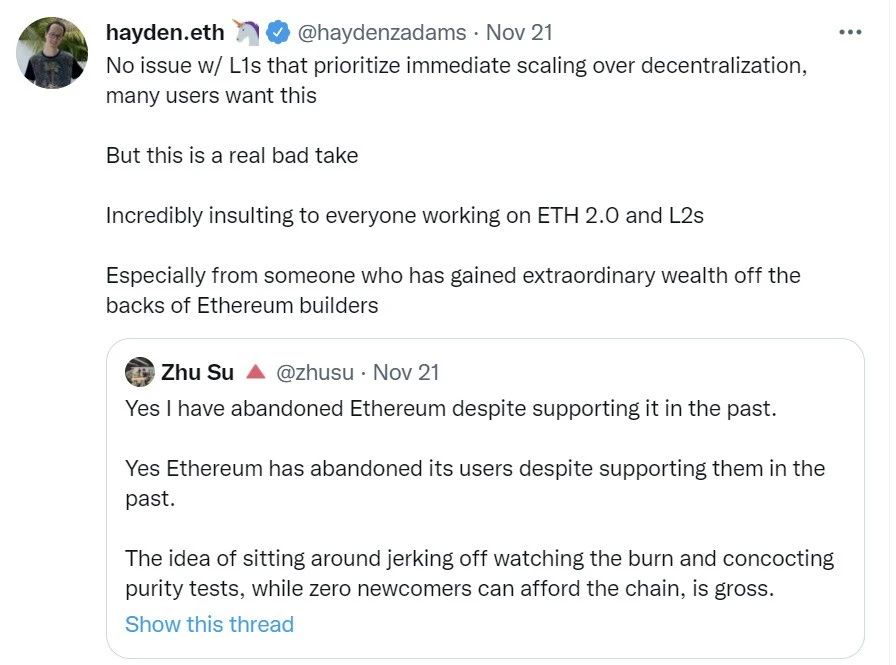
On November 20, Zhu Su, the co-founder of Three Arrows Capital, tweeted that he would abandon Ethereum because he was dissatisfied with the high gas fee of Ethereum.They believe that the high fees of Ethereum are no longer suitable for new users to join.
However, on December 7th, Three Arrows Capital transferred 91,477 ETH (worth about 400 million U.S. dollars) from major trading platforms. Zhu Su said that his previous words were too radical, and he will buy more in the future Ethereum.
The two extreme speeches within a month are confusing, but it is worth noting that the Three Arrows Capital team has indeed begun to deploy other public chains. Zhu Su believes that there are more public chain solutions with better performance than Ethereum, such as Solana, Avalanche (AVAX), etc.
first level title
01
How expensive is Ethereum GAS?
In August 2020, a transaction on the Uniswap platform consumed approximately $3 to $10 in gas fees, while some time ago,The average handling fee is as high as 90 US dollars, an increase of nearly 10 times.
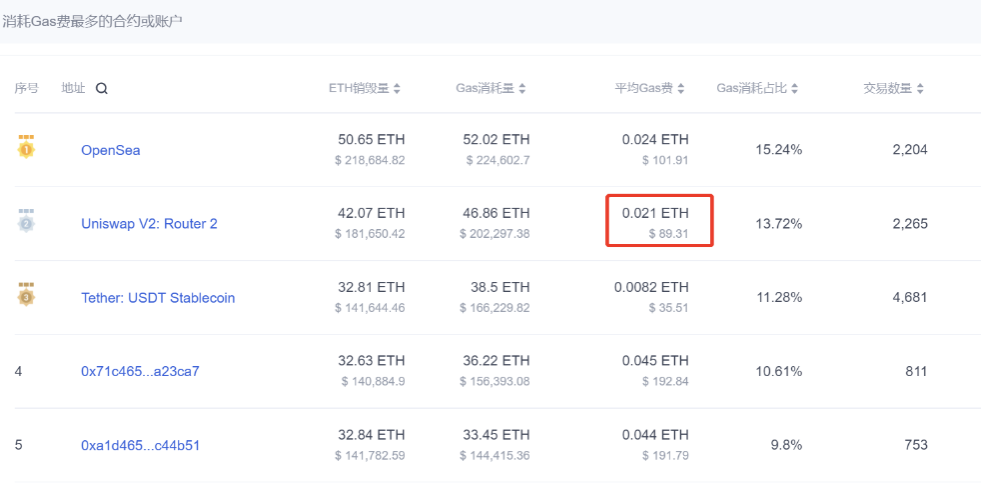
The increase in GAS fees is mainly due to the increase in the unit price of GAS and the continuous rise in the price of Ethereum.
This year, the average daily Gas unit price of Ethereum has continued to increase. On November 26, the average daily Gas price surged to 600 Gwei, setting a new high for the year. (Gwei is the pricing unit of Gas fee, 1 ETH = 10⁹ Gwei)
Usually, in a single transfer on Ethereum, a fixed amount of 21,000 GAS is required, plus a floating amount (depending on the length of the transaction information). That is to say, even if the floating amount of GAS is not included, in the face of such a high gas unit price, based on the author's observation time, the transaction value of one transaction can reach about 55 US dollars.
The high gas fee of Ethereum is not only caused by the large demand leading to network congestion, but also related to the increase in the price of Ethereum.
At the beginning of September last year, the average daily gas fee of Ethereum reached 514 Gwei, although it also hit the highest point since 2017, but considering that the price of ETH at that time was only $480, the gas fee was not as high as it is now.
first level title
02
Layer 2: Short-term optimal solutions to efficiency problems and rate problems
Layer 2 is an expansion solution to realize Ethereum 2.0. It is equivalent to creating a second layer of Ethereum network to handle excess transactions on the Ethereum main network in a supplementary layer.
Through Layer 2, it is possible to allow some transactions to be processed at Layer 2. On the one hand, it reduces the pressure on the main network and indirectly speeds up the processing speed. 4000 strokes.
On the other hand, it is natural to reduce the handling fee for a single transaction. The lower renewal rate is expected to attract more transactions from other main networks to Ethereum, so as to ensure that the income of the entire network after the upgrade is higher than the current level.
Among the solutions to achieve the expansion goal, there are not only Layer 2 routes, but also multi-chain and side chain routes. However, considering the comprehensive security and degree of decentralization, Layer 2 is the more mainstream implementation route.
V God
V GodHe also stated in an AMA earlier this year that ZK-rollup is a more reasonable choice in the long run because it is more reliable in ensuring asset and application security.
first level title
03
Is there a specific timetable for PoW to PoS?
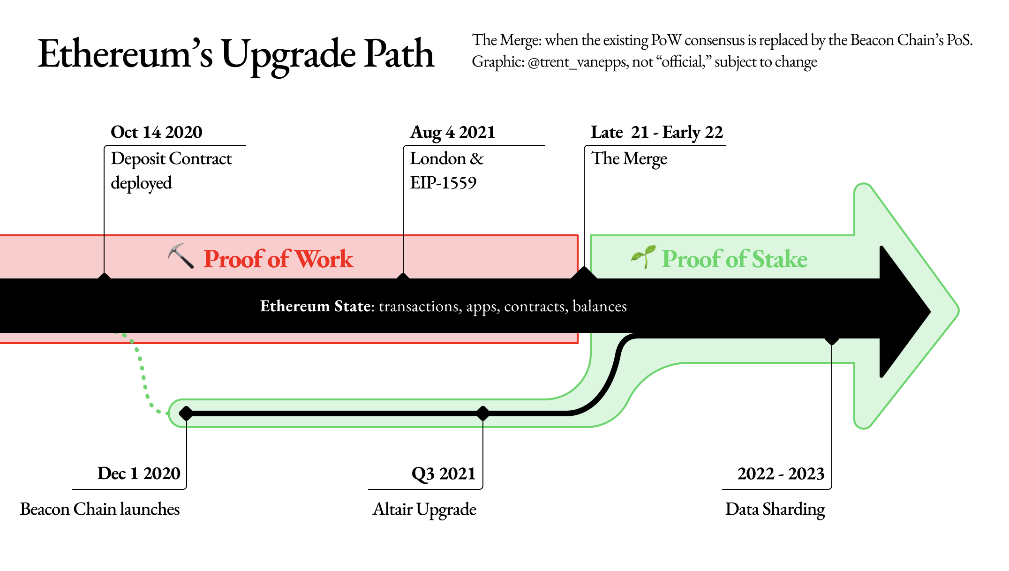
A complete switch to PoS is an important milestone in the ETH 2.0 upgrade, and it is still too early.
Now, the Beacon Chain (Beacon Chain) has been launched, that is, the first step of switching the consensus mechanism has been realized in essence. The Beacon Chain is a public chain based on PoS, which is completely independent of the Ethereum main network. ) to the main network, completely introducing PoS to Ethereum.
When the merger is successful, the current ETH of the main network will no longer operate, and will be replaced by ETH2 of the beacon chain. However, due to the large number of Ethereum main network nodes, it takes a very long time to coordinate the transition of all nodes from PoW to PoS.
After completing the merger of the main network and Beacon Chain, the last stage will be sharding, but the premise is the stable operation after the merger.
The purpose of sharding is to improve the processing speed, which is similar to splitting the database horizontally to avoid network congestion at a single point.
first level title
04
secondary title
1. Kain Warwick (founder of Synthetix)
Synthetix is a synthetic asset agreement project on the Ethereum chain. Kain is firmly optimistic that Layer 2 can solve the shortcomings of Ethereum and is a solution suitable for the continued long-term development of Ethereum.
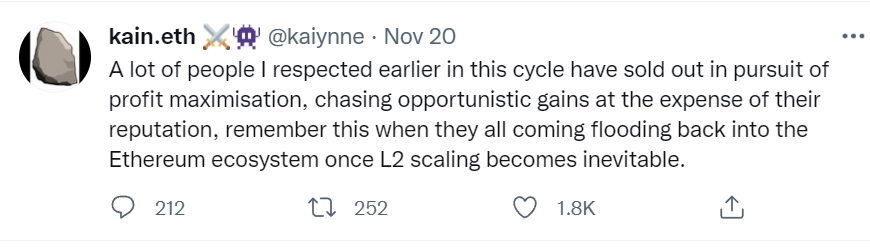
So he was disappointed when he insinuated some early investors in ethereum in a Nov. 21 tweet that they had been reduced to speculators.He said that these are industry insiders whom he respected very much before, but now he chooses to become a short-termist in pursuit of profit.
secondary title
2. Hayden Adams (founder of Uniswap)
secondary title
3. Chris Burniske (Partner, Placeholder VC)
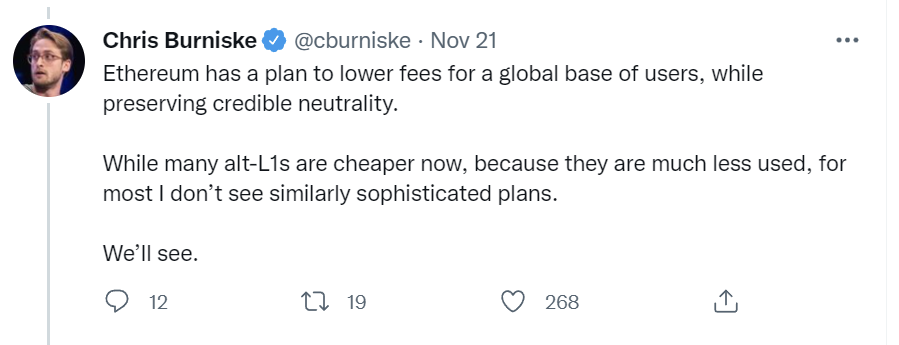
Chris was the first Wall Street investor who proposed the valuation of encrypted assets. He said that he is optimistic about Ethereum, because although the transaction fee of Ethereum is more expensive than other Layer 1, it also far exceeds other Layer 1 in terms of the number of users. It has a mature ecology and Community.
summary
05
summary
There are many challenges facing the upgrade of Ethereum, including challenges from performance upgrades, transitional adjustments to the consensus mechanism, challenges that fee rates must be reduced, and challenges from whether the economic model works, just as V God himself predicted , it may take about 6 years for the upgrade to be fully realized.
Although the current progress is slow, through the efforts of the community, the first phase of PoS switching has been successfully realized.
In terms of capacity expansion, in the short term, expansion through Layer 2 is the most ideal solution, but after all, ROLLUP cannot completely place all transactions in Layer 2, and still needs to process some transactions in Layer 1, and the overall performance cannot meet the larger concurrency. From a longer-term perspective, sharding is a must.
From the perspective of sustainable development, switching POS is the strategic value of Ethereum, and the realization of other modules is only a matter of time.





