


Vitalik Buterin: Ethereum's Endgame


Article translation: Block unicorn
Article translation: Block unicorn
Special thanks to a large group of people at Optimism and Flashbots for their discussions and thoughts on this article, as well as Karl Floersch, Phil Daian, and Alex Obadia for their feedback and reviews.
Consider "big blockchains" in general - very high block frequency, very large block size, thousands of transactions per second, but also highly centralized: only a few tens or hundreds because the blocks are too large Nodes can run a fully participating node and can create blocks or validate existing chains. How can such a chain be made acceptable, trustless and censorship resistant, at least by my standards?
Here's a reasonable roadmap:
Add a second layer of collateral with low resource requirements for distributed block verification. Transactions in a block are divided into 100 buckets, each bucket is followed by a Merkle or Verkle tree state root. Each secondary staker is randomly assigned to one of the buckets. A block will only be accepted if signed by at least 2/3 of the validators assigned to each bucket.
Introducing fraud proofs, or ZK-SNARKs, to allow users to directly (and cheaply) check block validity. ZK-SNARKs can directly cryptographically prove block validity; fraud proofs are a simpler scheme where if a block has an invalid bucket, anyone can broadcast a fraud proof for that bucket. This provides another layer of security on top of randomly assigned validators.
Introduced data availability sampling to allow users to check block availability. By using DAS checks, light clients can verify that a block was published by simply downloading some randomly selected blocks.
Add secondary transaction channels to prevent censorship. One approach is to allow secondary stakers to submit a list of transactions that must be included in the next main block.
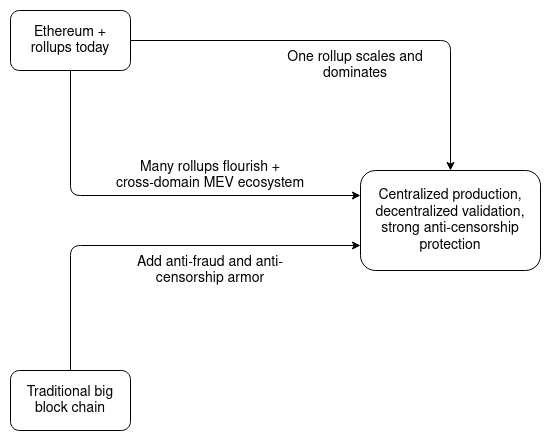
After doing all this, what do we get? We get a chain where block production is still centralized, but block validation is trustless and highly decentralized, and specialized anti-censorship magic prevents censorship by block producers. This is aesthetically ugly, but it does provide the basic assurance we're looking for: Even if every major stakeholder (block producer) intends to attack or censor, the worst they can do is completely down line, at which point the chain stops accepting transactions until the community pools their resources and establishes an honest primary stakeholder node.
Now, consider one possible long-term future of aggregation...
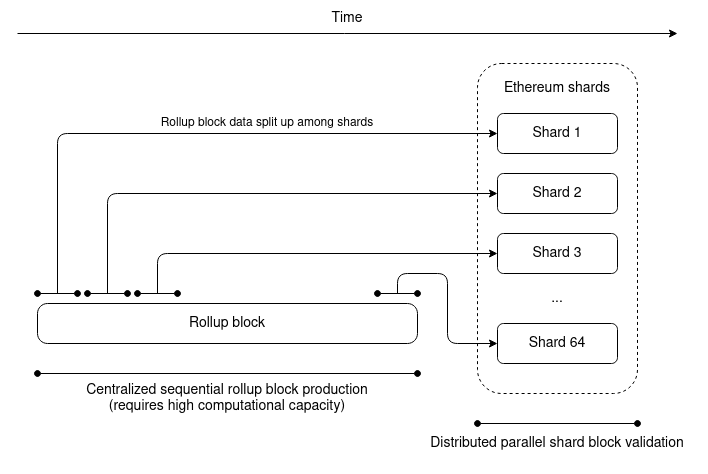
Imagine that a particular rollup - whether it's Arbitrum, Optimism, Zksync or something entirely new - did such a good job designing their node implementation that it could really handle 10,000 per second if given enough powerful hardware affairs. The technique for doing this is well known in principle, and has been implemented by Dan Larimer and others many years ago: splitting execution into one CPU thread, running unmatched but cheap business logic, and lots of other threads running expensive business logic. But highly parallelizable cryptography. Also imagine that Ethereum implements sharding via data availability sampling, and has room to store this aggregated on-chain data across its 64 shards. As a result, everyone migrated to this rollup. What would that world be like?
text
text
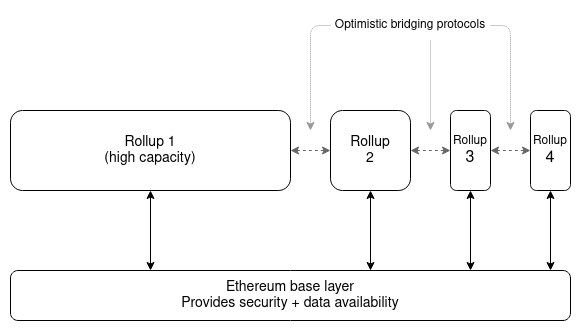
None of the rollups have successfully aligned with the majority of Ethereum activity. Instead, they both top out at a few hundred transactions per second. We get the multi-aggregation future of Ethereum - the Cosmos multi-chain vision, but on top of a base layer that provides data availability and shared security. Users often rely on cross-rollup bridges to jump between different rollups without paying high fees on the main chain. What would that world be like?
image description
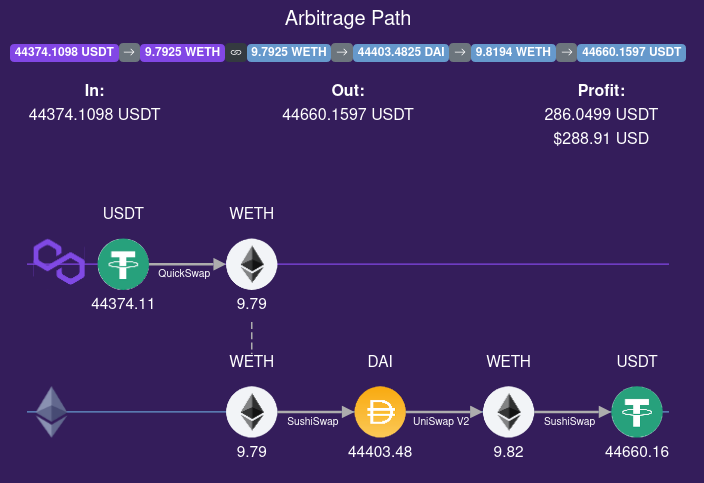
Cross-Domain MEV Opportunities Discovered by Western Gate
Thus, in a multi-domain world, there is enormous pressure on the same person who controls block production on all domains. It may not happen, but it is likely to happen, and we must prepare for that possibility. What can we do about it? The best approach we know of so far is to use a combination of two techniques:
Either Rollups implement some mechanism to auction blocks each slot, or the Ethereum base layer implements proposer/builder separation (PBS) (or both). This at least ensures that any tendency toward centralization in block production does not lead to an entirely elite-captured and centralized stake pool market dominating block validation.
Summarizes the anti-censorship bypass channel, and the PBS anti-censorship technology of the underlying tool of Ethereum. This ensures that if the winner of a potentially highly centralized "pure" block production market tries to censor transactions, there is a way to bypass censorship.
image description
secondary title
So what does this mean?
While there are many paths to building a scalable and secure long-term blockchain ecosystem, it looks like they are all heading towards a very similar future. The odds are high that block production will eventually be centralized: network effects in rollups or network effects in cross-domain MEVs each push us in this direction in their own way. However, what we can do is use protocol-level techniques such as committee validation, data availability sampling, and bypass channels to "regulate" this market and ensure that winners cannot abuse their power.
What does this mean for block producers? Block production is likely to become a specialized market, and domain expertise is likely to span across different domains. 90% of a good Optimism block producer also makes a good Arbitrum block producer, a good Polygon block producer, and even a good Ethereum base layer block producer. If there are many domains, cross-domain arbitrage may also become an important source of income.
What does this mean for Ethereum? First, despite the inherent uncertainty, Ethereum is well suited to adapt to this future world. The far-reaching benefit of having a roadmap centered around Ethereum rollup is that it means that Ethereum is open to all futures and doesn’t have to have an opinion on which one will necessarily win. Would users really want to be on a rollup? Ethereum follows its existing course and can become its base layer, automatically providing high-volume domains that require secure anti-fraud and anti-censorship "armor". Is it technically too complicated to make a high-volume domain, or do users just have a high need for variety? Ethereum can also be its base layer — and a very good one, because a common root of trust makes it easier to transfer assets securely and cheaply between aggregates.
Moreover, Ethereum researchers should seriously consider the degree of decentralization that can actually be achieved in block production. If cross-domain MEV (even from one aggregated cross-shard MEV occupying multiple shards) makes it unsustainable, then adding complex pipelines to simplify highly decentralized block production may not be worth it.
What does this mean for big blockchains? There is a path for them to become trustless and censorship resistant, and we will soon find out if their core developers and community really value censorship resistance and decentralization enough for them to do so!
All of this could take years to complete. Sharding and data availability sampling are techniques that are complex to implement. It will take years of improvements and audits before people can store their assets in a ZK-rollup running the full EVM with complete confidence. Cross-domain MEV research is also still in its infancy. However, it is looking increasingly clear that a realistic and bright future for scalable blockchains may lie ahead.





