


ETH Weekly | The Ethereum Foundation is expected to launch the test network Kintsugi in early December; V God and others proposed EIP-4488 to reduce the Gas fee of Layer 2 (11.22~11.28)


Author | Qin Xiaofeng
Editor | Hao Fangzhou
Produced | Odaily
1. Overall overview
Author | Qin Xiaofeng
Editor | Hao Fangzhou
1. Overall overview
Second, the secondary market
1. Spot market
EIP-4488 tries to further reduce the gas fee of the second layer in two ways: reduce the transaction call data (calldata) cost (this is the main mechanism of Optimistic Rollups and ZK-Rollups), and increase the total amount of transaction call data in a block upper limit. According to Vitalik Buterin, increasing the amount of data space available for Rollups is feasible today because block sizes are nowhere near the size that threatens network stability.
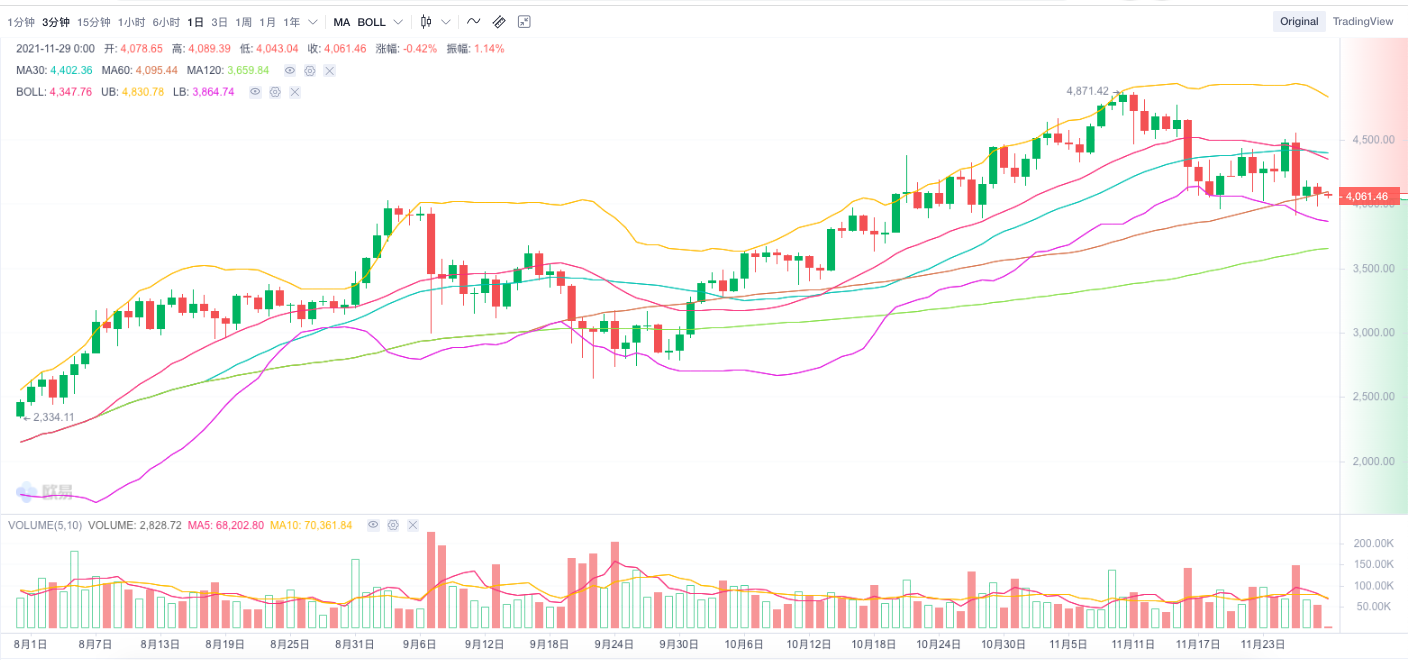
In terms of the secondary market, the current ETH price may pull back slightly in the short term, with a support level of $4,000 and a resistance level of $4,400.
According to OKEx market data, the price of ETH once fell below US$4,000 last week, and closed at US$4,076 during the week, a month-on-month decrease of 6.6%.
2. Large transaction
OKlink dataThe daily chart shows that the price is currently moving on the lower track of the Bollinger Band. The resistance level is the middle track of $4,384. In the short term, it may continue to fall to around $4,000, which is also near the 60-day moving average; if it falls below $4,000, it will be the next support level It is $3650 (120-day moving average).
3. Rich list address
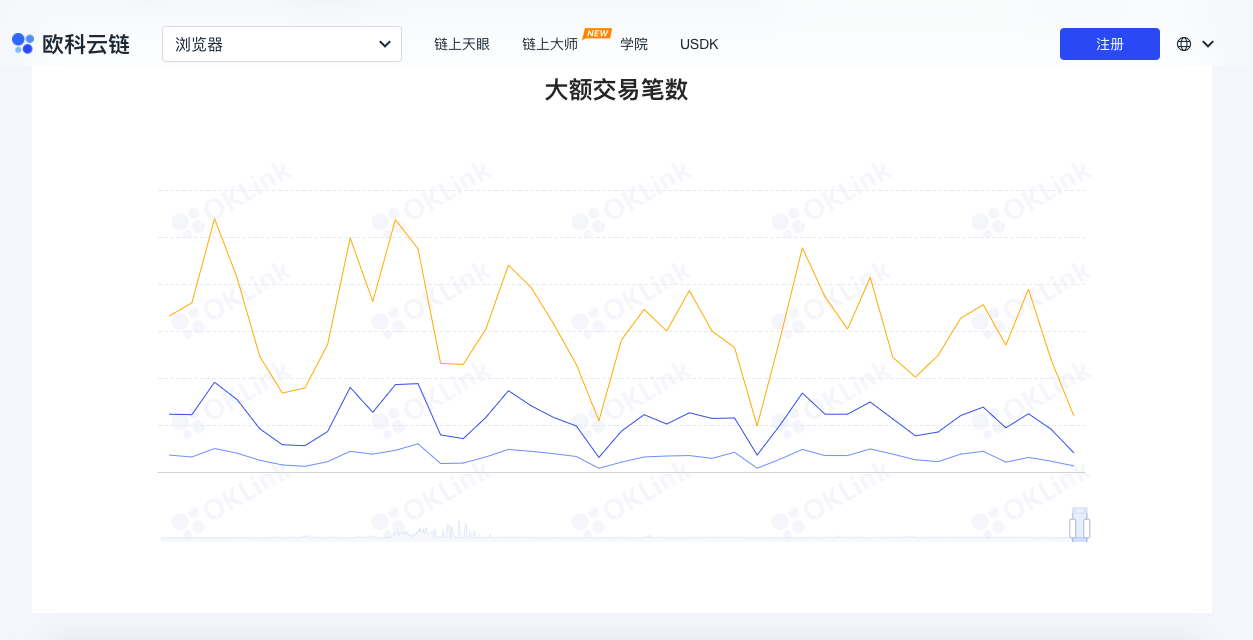
OKlink dataIt shows that the number of on-chain transfers dropped slightly last week, with "above 1000 ETH", "above 2000 ETH" and "above 5000 ETH" decreasing by 11%, 15%, and 20% month-on-month, respectively.
3. Ecology and technology
1. Technological progress
OKlink data
It shows that the current top 300 ETH holdings hold a total of 53.47% of ETH, an increase of 0.36% month-on-month; in addition, the entire position distribution presents an oval structure, and the proportions of each part are: 1st to 100th, accounting for 39.51%, 101st to 300th, accounting for 13.97%, up 0.18% from the previous month; 301st to 500th, accounting for 6.28%, down 0.03% from the previous month; 501st to 1000th, accounting for 7.34%, down 0.06 from the previous month %; after the 1001st place, accounting for 32.96%, a decrease of 0.25% from the previous month.
1. Technological progress
(1) Ethereum Foundation: It is expected to launch the test network Kintsugi in early December
In addition, the Ethereum Foundation also announced that the Ethereum Arrow Glacier network upgrade will be carried out at block height 13773000 (about December 8th), and nodes must complete the upgrade before December 5th.
(2) Vitalik proposed two possible solutions to deal with the historical data of Ethereum
A user asked about block proposer/block creator separation (PBS). Buterin recently posted about this method, which aims to prevent block proposers (or miners) from adding transactions to blocks in their favor. PBS has not been fully developed and tested. (AMBCrypto)
(3) V God released a step-by-step roadmap for expanding Rollups using calldata expansion and sharding
V God released a "step-by-step roadmap for scaling Rollups with calldata scaling and sharding". Buterin stated that transaction fees on L1 have been extremely high, so it has become more urgent to take any necessary measures to help facilitate the transition of the entire ecosystem to Rollups. Rollup has significantly reduced fees for many Ethereum users: l2fees.info shows that Optimism and Arbitrum offer fee reductions to about 1/3-1/8 of the Ethereum base layer itself, however, even these fees are prohibitive for many users too expensive.
Ethereum founder Vitalik Buterin and Ethereum developer Ansgar Dietrichs co-authored the Ethereum improvement plan EIP-4488 this week, which aims to reduce the gas fee of the second layer expansion solution of Ethereum. This proposal aims to more directly address the high gas cost issue while developing a more robust solution.[Original link]
2. Voice of the Community
According to reports yesterday, Vitalik released a step-by-step roadmap for expanding Rollups using calldata expansion and sharding. V God proposed 4 steps, the first step is tx calldata expansion, the second step is some shards, the third step is N shards and is protected by the committee, and the fourth step is data availability sampling (DAS). But this leaves a question: if the Ethereum core protocol doesn't store this data, who does? Vitalik proposed several possibilities: personal and institutional, block browser, Rollup DAO, client, portal network, The Graph and other protocols. Some of these solutions (individual and institutional volunteers, block explorers) are already available. (Crypto Briefing)
3. Project trends
2. Voice of the Community
Ethereum developer Ryan Berckmans tweeted that according to Dune Analytics data, the current amount of Gas used by the Ethereum Layer 2 network accounts for about 0.5% to 1% of the total Layer 1 Gas, and this value may increase to 50% in the next few years. Therefore, even if the gas fee used by end users decreases, the total gas fee of the Ethereum network will still increase rapidly.
(1) Report: $1.8 billion has been bridged from Ethereum to Axie Infinity sidechain Ronin in 2 weeks
(2) OpenSea has reached a cooperation with Christie's to sell a series of NFTs to art collectors
(3) Nansen, a blockchain analysis platform, supports Arbitrum, the second-layer expansion plan of Ethereum
(4) BlockFi stopped providing free withdrawals of tokens such as ETH
4. Borrowing
DefipulseCryptocurrency lender BlockFi will switch to an interest rate-based withdrawal fee structure starting Dec. 1, ending free withdrawals due to “increasing transaction costs on the Ethereum network.” The move will apply to Ethereum, Chainlink, PAXG, Uniswap, and BAT. As for bitcoin, litecoin and stablecoins, BlockFi noted that customers will continue to receive one free monthly withdrawal. Additional withdrawals beyond this will incur fees that vary by token. (CoinDesk)
4. Borrowing
5. Mining
(data from etherchain.org)
etherchain.orgFrom the perspective of individual projects, the top three lock-up values are: Maker $18.08 billion; Curve $14.76 billion; AAVE $11.89 billion.
4. News
5. Mining
image description
(data from etherchain.org)
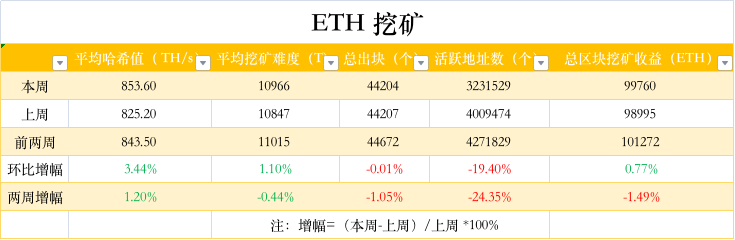
The data shows that the average computing power increased by 3.5% month-on-month, temporarily reporting 853TH/s; the average mining difficulty increased by 1.1% month-on-month, temporarily reporting 109667T; up 0.8%.
4. News





