


An article exploring market dynamics before and after the Ethereum merger


This article is compiled from Messari, author Davis
image description

Source: Elias Simos, Dune Analytics; https://dune.xyz/eliasimos/Eth2-Liquid-Staking
image description
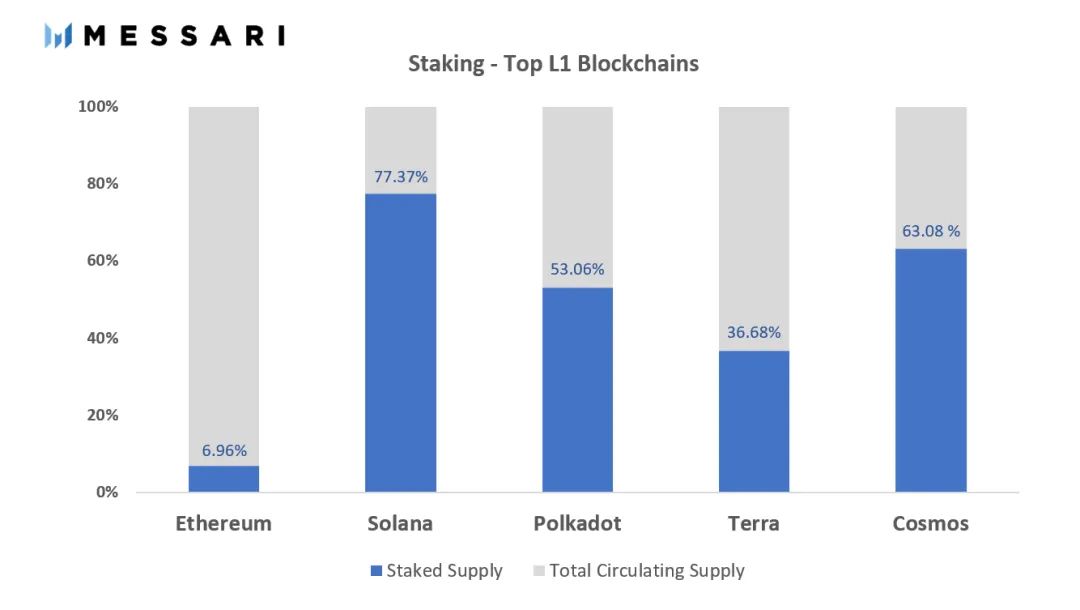
Source: Messari, https://messari.io/screener/staking-supply-(top-5-pos)-C1C07858
Still, in absolute terms, the total value of staked ETH is about $34 billion, and it ranks in the top ten of all digital assets by market capitalization, with over $7 billion of that in staking pools like Lido, Stakehound, and StakeFi. From this perspective, there is actually significant network value, even though the amount of ETH staked as a percentage of the total supply is not high. Anyone interested in the orderly functioning of the Ethereum network over the next few years, or its mid-term pricing dynamics, should pay close attention to the changing dynamics of liquidity in the ETH staking pool.
As Paul Simon (American pop music singer-songwriter) said, "You know that the closer you are to your destination, the more you slide farther away", this may feel to some liquid staking pool participants on Ethereum today. very apt. Unlike the GBTC discount, the staked ETH has a redemption date, which is expected to be the first half of 2022. But like GBTC, all of the top ETH-staking derivatives have been discounting the value of their underlying ETH over the past few weeks, some for longer.
first level title
1
coasting on the highway
First, a quick review of the fundamentals of Ethereum staking. Ethereum 2.0 staking requires validators to stake 32 ETH in the official staking contract in order to participate as a full validator. Once staked, validators must meet a series of technical and operational requirements in order to perform blockchain functions, such as batching transactions and checking other validator blocks. Validators that fail to meet uptime requirements can be penalized in the form of losing staked ETH in a process known as slashing. When a validator satisfies these conditions, it is compensated with variable returns in staked ETH. The rate of return is calculated based on the total amount of ETH staked by all validators, and is tracked and updated through the Launchpad website.
While many ETH holders may have the technical knowledge to launch a validator node, the penalties associated with slashing may have scared off a significant number of them from self-hosting (32 ETH at launch) worth just under $20,000). From the beginning, the exchange was a clear choice for hosting staking, but users faced a lock-up period before eventual consolidation. Therefore, non-exchange node operators and decentralized staking providers enter the market, offering users an alternative where ETH stakers can: 1. Invest less than 32 ETH; 2. Maintain liquidity; 3. Simultaneously There is an option to re-hypothecate their newly issued derivative tokens elsewhere in the market.
image description
text
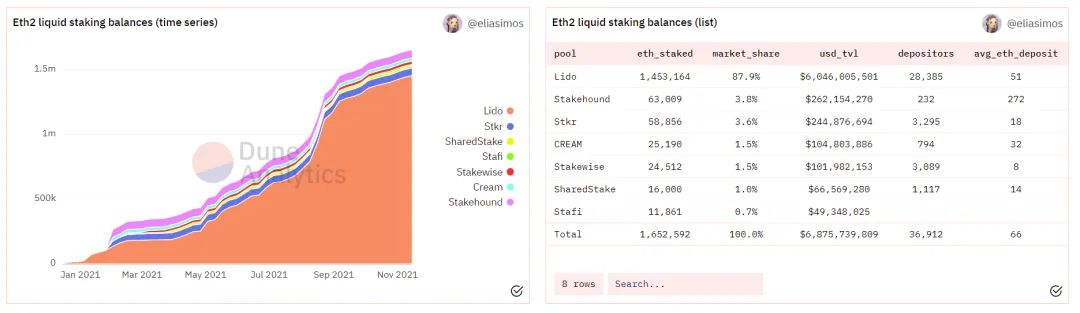
Lido, a DAO that manages the liquidity staking protocol, is the undeniable winner in terms of liquidity staking market share, accounting for over 88% of the total decentralized ETH staking market. Stakehound and Ankr’s StakeFi (abbreviated as “Stkr” above) account for 7.5% of the remaining market, and these three players represent the vast majority of decentralized ETH staking. Due to an unresolved dispute with custodian Fireblocks, Stakehound no longer has access to the encryption keys securing more than 38,000 customers’ staked ETH. As a result, the company discontinued its liquidity staking service in August to focus entirely on recovering users’ locked-up funds. This makes Lido and Ankr’s StakeFi the largest active liquidity collateral providers in the market.
image description
Source: Elias Simos, Dune Analytics; https://dune.xyz/eliasimos/Eth2-Liquid-Staking
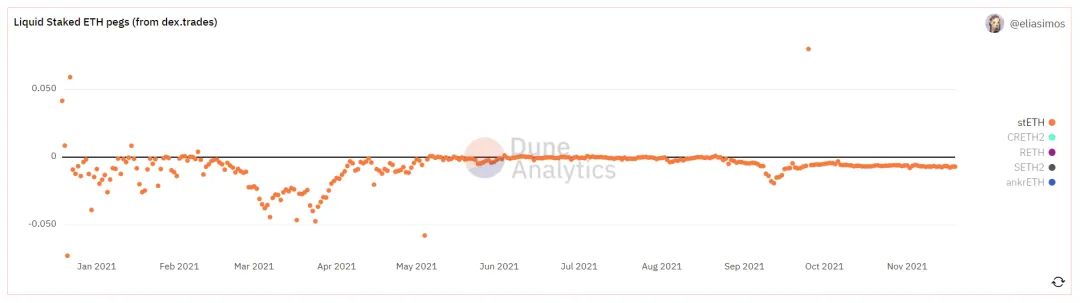
That said, the road isn’t always “coasting on the highway,” and stETH’s parity to ETH has shown more volatility in recent weeks. The 90-day deviation of stETH is about -0.48%. While this degree of deviation is not significant, it is not negligible as it means that any holder of the derivative token stETH has seen an average cut of 0.48% over the past 3 months.
image description
Source: Elias Simos, Dune Analytics; https://dune.xyz/eliasimos/Eth2-Liquid-Staking
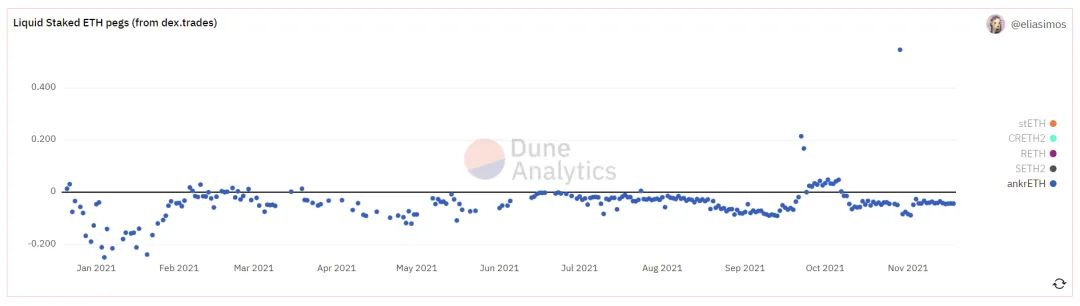
With uncertainty surrounding the exact date of the Beacon Chain merger, it is logical that ETH collateralized derivatives are trading at a discount, at least temporarily. Even devout hoarders need liquidity from time to time. Nonetheless, ETH derivatives currently represent the initially staked ETH, plus all staking rewards earned since December 2020. ankrETH expects this base value to currently be 1 ankrETH = 1.051 ETH. Lido's stETH is a repriced token whose value reflects staking interest earned over time, with a similar exchange rate expected. As the clear leader in market share, Lido's huge market liquidity makes the long-term peg to ETH price more stable. That said, both Lido and StakeFi show relatively large deviations from the peg when tracked against the Net Asset Value (NAV) of their underlying assets (i.e. ETH staked plus interest earned).
The primary strategy these pools use to maintain a peg to NAV is by incentivizing token holders to provide liquidity pairs to decentralized exchanges in exchange for further yield. Lido incentivizes yield farming by rewarding liquidity providers with Lido's own governance token, LDO. StakeFi relies on third parties to provide incentives for pool participants. One example is OnX Finance, which rewards early ankrETH depositors with OnX governance tokens to provide liquidity. These strategies may have affected the ability of the two projects to hold the peg, as many holders were incentivized to earn more than 5% through governance tokens. In many cases, when factoring in NAV discounts and the accompanying yield of governance tokens, holders may net more than 5%.
first level title
2
What will happen before the merger?
For investors who care less about ETH's mid-term price dynamics and are willing to hold during the consolidation process in the first half of 2022, staking derivative tokens may represent simple alpha. Tokens like stETH and ankrETH are widely available in the market, sometimes at a considerable discount and reflecting a redemption value of 1.05x ETH. Plus, those tokens can earn yield elsewhere in the market. Naturally, risks abound in DeFi, and liquidity betting on ETH is no exception. If the ETH merger is delayed further, one might see a more pronounced deviation from the peg.
Once the date of the merger is confirmed, the demand for ETH-derived tokens may increase significantly. Especially in the days leading up to a redemption event, one would expect any discount to convert into a premium. This is more likely to happen if the consolidation occurs during an ongoing bull market cycle. On the other hand, if any kind of massive risk aversion and market correction happens ahead of the merger, it could dampen the dynamic. In this case, one might expect deeper discounts during the sell-off as market participants flee riskier bets in favor of perceived safe assets such as stablecoins.
This article comes from Tao of Yuan Universe, reproduced with authorization.
This article comes from Tao of Yuan Universe, reproduced with authorization.





