


Under the fierce competition in the stablecoin market, where is the imagination space for exploring LUNA?


Editor: The Tao of DeFi
Editor: The Tao of DeFi
Today, the founder of LUNA reposted the English article "Terry: The Moon Also Rises". Based on the article and my own understanding, I discussed in detail what the project is, how it is done, and what are the risks and opportunities. LUNA is different from ETH, SOL, and BSC, and takes the road of financial payment. The track is great, whether it is metaverse or WEB3.0, stable currency is an important part.
The stablecoin track is fiercely competitive. From USDT, USDC, BUSD to DAI, Ampl, Ohm, does the LUNA project have much room for imagination? In fact, the LUNA project is the governance token of the Terry project, and its current stable currency is UST. The ingenious combination of the two promotes the growth of the ecology. Currently ust ranks fifth, and its usage has soared in the past month. Where does its growth affect LUNA? What is the relationship between the two?
The LUNA project was co-founded by Daniel Hyunsung Shin and Do Kwon. The former is the founder of the Korean e-commerce platform TMON and has unique experience in finance and payment. Do Kwon founded anyfi company in 2016 and joined the terry ecosystem in 2018. The other team members all have backgrounds in finance, payment, and blockchain, and are very strong. In addition to Binance, Huobi, and OK, the investment lineup also includes payment service providers such as MONEX.
The main tokens of the project are UST and LUNA, the former aims to be the most widely used, and the latter is responsible for providing security. In the beginning, the price of UST and LUNA is 1 USD. When UST is higher than $1, the system destroys LUNA to create more UST, causing UST to fall. At this time, the destruction of LUNA drives LUNA to rise. When UST is lower than $1, UST will be burned to make LUNA, and the price of LUNA will drop.
Every time the system burns, the system will charge a fee. This part of the fee is given to the firm LUNA pledgers. The fee is paid in UST. When UST rises and LUNA falls, a large amount of burning will make the stakers' income soar. This even makes luna resistant to bear markets (described later). This is different from other staking projects. For example, the annualized rate of CAKE is very high, but the income is inflation, so if you have more coins, the price may also fall; if the price falls, your income will be less.
Theoretically, ust does not need a treasury like OHM to keep the project alive—as long as the market has confidence in LUNA, the pledgers can get high returns. For example, if you fancy a piece of clothing and pay $200 with a terra credit card, the store will receive the $200 and it will be completed in a few seconds, which is consistent with the traditional experience, but in the background it is settled through the chain, and the handling fee generated will be returned to pledger.
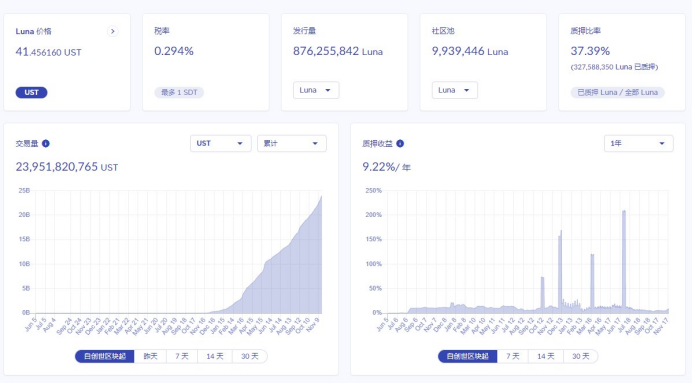
The higher the adoption rate of UST, the better the prospects for luna. According to official data, it can be seen that the transaction volume is showing a very good trend (this is due to payment projects such as chai, which can be used in many fields such as e-commerce). In fact, UST is US dollars, but better, you can get a safe and stable annual interest rate of 20% (described later). Unlike other algorithmic stablecoins, UST is advancing synchronously on and off the chain to promote ecological expansion.
OHM’s gameplay is, when I fall down, I use the money in the treasury to buy the bottom. If you don’t die, the higher the coin you buy, the higher the return—— use money to attract more money, until one day it’s infinitely large, so big that it’s not easy to die . I prefer UST's gameplay, which is to build ecology, take a multi-chain route on the chain, promote everyone to hold and use UST, pay under the chain, hold digital cards, and support casual payments in currencies of various countries.
How does UST perform in the Luna ecosystem? You can look at the volatility index. The volatility is currently at $0.082 among top products, which is still relatively large, but this is mainly due to the sharp drop in May. LUNA has experienced a death spiral test - LUNA fell, the market feared, UST also fell below $1, arbitrageurs burned UST to create LUNA, further diluting LUNA, triggering a death spiral.
Algorithmic stablecoins are nicknamed "born to fail", and how to avoid the death spiral is the top priority. In June of this year, the Titan project, which adopted two tokens similar to the LUNA project, staged a death spiral. The governance tokens fell, and people used the stablecoin Iron to mint more Titans. The situation deteriorated and returned to zero directly. What is the ultimate moat of stablecoins? The most ingenious financial model in the world? Or the broadest ecology?
UST relied on ecology in the past to avoid the death spiral, but the sharp drop in May put the project through the test, and it has now rebounded to $42—all the drops will eventually condense the community consensus. Project founder Do Kwon called people who fear selling cockroaches or idiots, but he still compromised, saying that he would build a multi-billion dollar reserve pool to protect it.
How is the ecology of UST? The most important thing about a stablecoin is that someone will use it. Chai, the most successful payment application at present, has received an investment of 75 million US dollars from companies such as Softbank. It is currently used by many companies. The latest data is shown in the figure. The total transaction volume is still higher than that of traditional channels. A lot of space. The coolest thing is that Terra can accept payment in any fiat currency, convert it into UST on the chain, and then transfer it to the merchant in local currency—a global stable currency!
One of the risks of UST or LUNA comes from supervision. The founder received a subpoena from the SEC before. The latest news is that he is suing the Sec, which is a bit cool. He said,"It's okay if I go to jail, I won't change the Terra network, that's against my code of ethics". A founder with ideals above money is a good thing for the community, but how to get along better with supervision is something that needs to be strengthened.
The SEC’s subpoena is mainly aimed at the Mirror project. Synthetic assets can be traded in U.S. stocks (I wrote a research report in the previous issue), and UST is still doing well. At present, there is another great project in the LUNA ecosystem is anc, that is, Anchor Protocol. Users can earn 20% annualized income by depositing UST, and even pledge LUNA to lend UST to obtain certain leverage and further expand income (risky). This project I will talk about it separately later.
At present, the problem of LUNA development also includes the need to improve TPS, which is currently only 1,000 times (here is a preview, I will talk about whether the fastest SOL can become the strongest in the next long push). The team has established the dawn plan and promised to provide 1 billion The above dollars are used to upgrade infrastructure and enrich the ecology.
To sum up: First, the project vision is great and there is huge room for development. The second is that the project is advancing very quickly, the founder has a militarized style, and the team is extremely efficient. The third is that once successful, it will be irreversible. As long as the off-chain and on-chain payment ecology is established and consumption habits are formed, it is almost monopoly-monopoly means wealth code.
Original link: https://twitter.com/BTCdayu/status/1462749928338321409





