


ETH enters the "deflation season": more than 700,000 pieces were burned, higher than the circulation for 4 consecutive days


The EIP-1559 proposal introduced in the Ethereum London upgrade is becoming more and more effective. According to data from ultrasound.money, as of November 1, the amount of ETH burned has exceeded 700,000, worth about 3.06 billion US dollars.
Based on this destruction schedule, ETH can burn 3 million pieces a year, which is more than half of the current annual increase of 5.4 million pieces, reducing its annual inflation rate from 4% to 2.1%.
What is striking is that due to the recent ecological activity on the Ethereum chain, from October 27th to 31st, the amount of ETH destroyed exceeded the issuance amount for several days, and its actual supply decreased by 8571.24 pieces in 4 days, which means that its usual The issuance of certificates temporarily turns from inflation to deflation.
ETH entering the "deflation season" hit a record high of $4,460 during this period. While the Layer 2 network on its chain is developing and prospering, the Layer 2 ecology is also developing rapidly this year. According to L2BEAT data, as of October 31, the total locked position of Ethereum Layer 2 was 4.68 billion US dollars, an increase of 532.43% compared with 740 million US dollars two months ago.
first level title
The amount of ETH destroyed exceeds 700,000 pieces, which is higher than the circulation for 4 consecutive days
Since EIP-1559 went into effect on August 5, a certain amount of ETH will be destroyed for every transaction on the Ethereum chain. After nearly three months of accumulation, as of November 1, the amount of ETH destroyed has exceeded 700,000, reaching 712,400, worth about 3.06 billion US dollars.
The huge amount of destruction is due to the active application ecology on the Ethereum chain. According to the data of ultrasound.money, as of now, OpenSea is the application that burns the most ETH, with a total of over 91,800 ETH destroyed, the second is Ethereum chain transfer, with a total of 66,000 ETH destroyed, and the third is Uniswap V2. A total of 53,000 ETHs were destroyed. The following are Tether, Metamask, Axie Infinity, etc.
This list ranked by the number of burns clearly reflects the hot spots of the Ethereum ecology in the past few months, including NFT, transactions, stable coins, and blockchain games.
The ultrasound.money website shows that during the current on-chain boom, about 5.63 ETH was destroyed every minute, worth about $24,200.
This "burn" rate significantly reduces ETH's inflation rate. According to the ETH economic model, its annual inflation rate is 4%, and the current annual additional issuance is about 5.4 million. According to real-time data calculations, ETH can destroy 3 million each year, which has exceeded half of the additional issuance. Annual inflation fell to 2.1%.
It should be noted that the above is a relatively macro data. In the case of accelerated destruction in recent days, ETH has entered a phased "deflation season".
image description
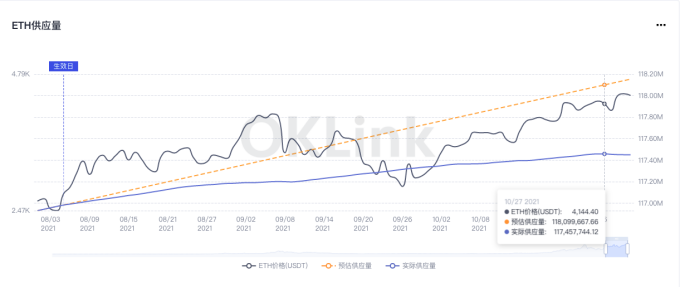
Recently, the amount of ETH burned has increased significantly
From October 27th to 31st, the amount of ETH destroyed exceeded the issuance amount for consecutive days, and the actual supply decreased by 8571.24 pieces in total in 4 days, which means that the issuance of its tokens temporarily changed from inflation to deflation.
first level title
The L2 lock-up volume has increased significantly, and institutions have increased their long positions
ETH has entered the "deflation season", providing an upward impetus for its market value growth. On October 30, ETH rose to a record high of $4,460 in the secondary market. Currently, ETH is still fluctuating at a high level, with a quotation of about $4,300 on November 1.
Some traders believe that as long as the Ethereum ecology continues to develop, its token destruction rate will increase day by day. The combination of the two factors will give ETH a higher growth potential.
From the perspective of chain precipitation, ETH is still the king of public chains. On November 1, the total locked value (TVL) of each DeFi protocol on the ETH chain was 136.94 billion US dollars, which was at the normal high point of "All Time High". Occupying 86.67% of the total lock-up value of all mainstream public chains in the market.
Nevertheless, network congestion and high transaction fees are still the long-term crux of Ethereum. Before the arrival of the ETH 2.0 era, the progress of on-chain expansion is an important criterion for evaluating its development.
Not long ago, at the 2021 Blockchain Global Summit, Ethereum founder Vitalik Buterin admitted that expansion is one of the biggest challenges facing the blockchain field. There are two ways to achieve expansion. One is to increase the block size and increase Gas upper limit, another way is to use Layer 2 technology. Vitalik believes that Layer 2 is the future of Ethereum expansion, and using Layer 2 to achieve Ethereum expansion is the only safe method that can also ensure decentralization.
image description
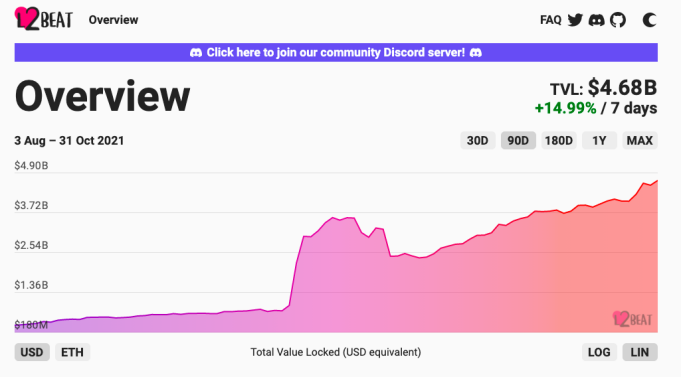
The total locked position of Ethereum Layer 2 reaches 4.68 billion US dollars
Currently, Arbitrum has the highest lock-up volume, with a TVL of about US$2.8 billion, accounting for 59.82%; followed by dYdX, with a TVL of US$1.01 billion, accounting for 21.66%; Optimism ranks third with a TVL of US$453 million, Accounting for 9.68%, an increase of 65.91% on the 7th.
The Ethereum L2 network and applications are characterized by greatly improving transaction efficiency and reducing transaction costs without sacrificing decentralization. According to the actual measurement, the gas fee for each transaction on Arbitrum is around $5, while the transaction on the derivatives protocol dYdX does not need to destroy the gas fee, and the fluency of contract transactions is comparable to that of centralized exchanges.
The implementation of the Layer 2 expansion plan and the accelerated growth of TVL have brought new growth points to Ethereum. In addition, ETH2.0, which has been widely concerned by the outside world, has also made new development progress. On October 27, the Ethereum beacon chain activated the Altair hard fork upgrade, which is one step closer to the goal.
The Ethereum Layer 1 network and L2 go hand in hand, and with the advent of the "deflation season", the market is raising its expectations.
Recently, the U.S. Commodity Futures Commission (CFTC) announced the latest weekly CME futures report. The report shows that between October 20 and 26, the largest ETH dealer’s long position rose from 287 to 383, a record high, while the short position fell from 58 to 31. Dealer accounts made a net long position adjustment during this period, revealing that institutional investors are optimistic about the future market of Ethereum.
Previously, many people in the industry predicted that the market value of ETH would gradually overtake BTC. However, the current market value of ETH in circulation is 511.198 billion US dollars, which is still far from the market value of BTC of 1.17 trillion US dollars. However, with the increasing deflation of ETH and the development of Layer 2, the "battle for the throne" in the encryption market will become more and more interesting.





