


Supervision is tightened, and some US SEC law enforcement cases are controversial, triggering a wave of protests in the encryption industry


The "boots" of US regulation on stablecoins may be on the ground. According to Bloomberg, people familiar with the matter revealed that the U.S. Treasury Department will release a report this week declaring that the U.S. Securities and Exchange Commission (SEC) has significant jurisdiction over stablecoins.
The growing stablecoin market is seen as the most pressing risk by U.S. Treasury Department officials. According to the data, the market value of USDT has increased from US$21 billion at the end of last year to nearly US$70 billion. The second-largest stablecoin, USDC, also rose to $32.6 billion from $3.9 billion last year. Similar to investors’ concerns, U.S. regulators need to ensure that stablecoin issuers have sufficient reserves behind them.
For SEC Chairman Gary Gensler, further strengthening of regulatory power is one of his expectations. Since taking office earlier this year, he has tried to build a regulatory system around cryptocurrency exchanges, DeFi, and stablecoins to fill the gap in regulating the encryption industry.
However, the SEC is facing resistance due to the lack of legal basis for enforcement and the lack of regulatory clarity before.
In September this year, after the SEC stopped Coinbase’s plan to launch lending products, the company’s founder, Armstrong, sent more than 20 tweets to criticize the SEC’s lack of clear legal guidance; It was criticized as "abuse of power" and even gave birth to an online group called "XRP Army" dedicated to mining evidence of regulatory misconduct.
first level title
U.S. Treasury to Empower SEC to Regulate Stablecoins
On October 26, Bloomberg quoted people familiar with the matter as reporting that the U.S. Department of the Treasury will release a "highly anticipated" report this week announcing that the U.S. Securities and Exchange Commission (SEC) has significant regulatory power over stablecoins such as Teher. The report would also urge Congress to pass legislation to regulate stablecoins in a similar way to scrutinizing bank deposits, according to people familiar with the matter.
In the past, Federal Reserve Chairman Powell and SEC Chairman Gary Gensler have both expressed concerns about the growing stablecoins. According to a Bloomberg report on Sept. 17, U.S. Treasury Department officials had determined at the time that Tether and other stablecoins posed the most pressing risks and required stricter oversight.
The U.S. financial management department has continuously released signals of "imperative" in the regulation of stablecoins, and the SEC is likely to become the regulatory agency that takes over the power.
image description
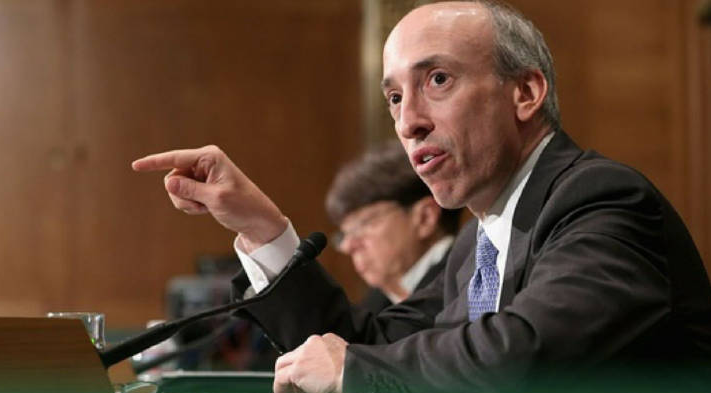
SEC Chairman Gary Gensler
It’s no surprise that U.S. financial regulators are heavily regulating stablecoins. In the past few years, the stable currency market has expanded extremely rapidly. According to data from CoinMarketCap, the market value of USDT issued by Tether has increased from US$21 billion at the end of last year to nearly US$70 billion. The second-largest stablecoin, USDC, also rose to $32.6 billion from $3.9 billion last year.
Why are regulators so worried about dollar-pegged stablecoins? Officials’ primary concern, as with investors, is whether stablecoin issuers have sufficient margin reserves behind them to ensure investors can reliably move money in or out, according to people familiar with the matter. In addition, regulators are also concerned that the issuance and selling of stablecoins may threaten financial stability and bring systemic risks.
first level title
SEC is accused of abusing power, triggering crypto industry protests
As a new thing, encrypted assets always seem to be one step ahead of regulation. Since Gensler took office at the beginning of this year, he has deliberately established a regulatory system for the encryption industry and has as much regulatory authority as possible.
For example, in terms of stablecoin regulation, Gensler once said that many stablecoins that invest in corporate bonds and other assets look similar to money market mutual funds and may fall under his jurisdiction; after the rise of DeFi, Gensler also promoted the first DeFi The regulatory case came to fruition, and an agreement called DeFi Money Market was sued by the SEC in August this year.
Judging from a series of developments, the SEC has more and more regulatory powers, stricter scrutiny, and more and more subdivided fields. However, problems have also emerged. Due to the lack of legal basis in law enforcement and the lack of clear regulatory regulations before, the SEC has been accused by many industry companies of abusing power.
Coinbase, one of the most influential companies in the encryption industry, has changed from a "good boy" to a "tempered".
In September of this year, Coinbase planned to launch an encrypted asset lending service on the site, but was unexpectedly stopped by the SEC. According to Paul Grewal, chief legal officer of Coinbase, on the official blog, the SEC issued a Wells notice to it (Wells notice, the notice before law enforcement agencies plan to take action), warning it that if it continues to advance users to lend encrypted assets and collect interest Projects will be formally prosecuted by law enforcement.
This threat-like approach baffled Grewal in a blog post. He said that while the SEC allowed the company to defend the notice in writing, that defense was futile in the context of the company not knowing "what exactly the regulators are worried about." He called on the SEC to give clearer business guidance.
Compared with this written statement, Coinbase founder Brian Armstrong's reaction was more intense. He posted more than 20 tweets in a row, questioning the SEC's judgment on such lending projects as securities, and criticized the other party's refusal to give clear legal guidance. He also mentioned that when he went to Washington, DC to meet with regulators in May this year, The SEC declined to meet and said it "will not meet with any cryptocurrency business."
image description
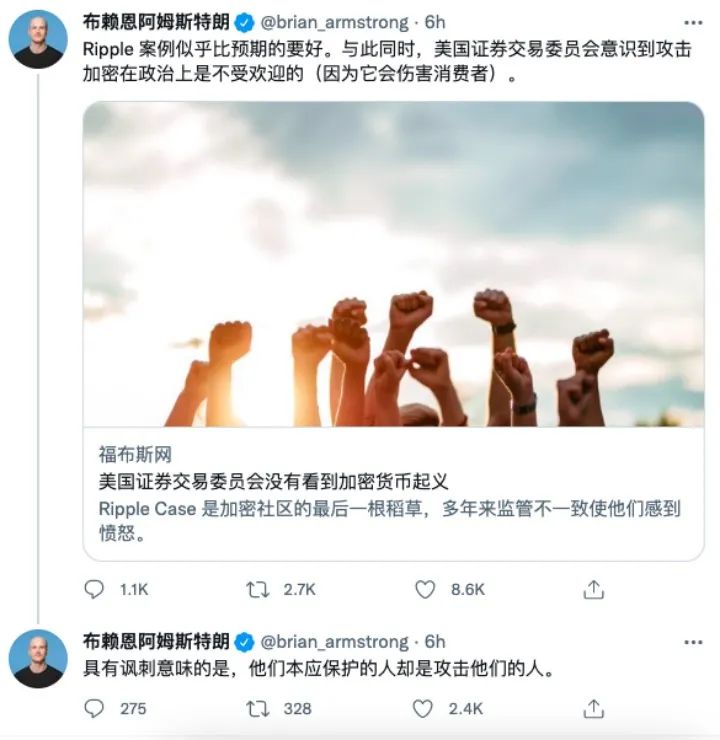
Armstrong retweeted the SEC
In fact, when it sued Ripple for issuing unregistered securities, the SEC encountered resistance from a private force. According to Forbes, an online group calling itself the "XRP Army" has joined the fray. Together, they have more than 1 million followers on YouTube and Twitter, and around this lawsuit, they kept reporting, analyzing legal and market facts, and digging for evidence of regulatory misconduct. Such means have a certain negative impact on the public reputation of the SEC.
Some people in the crypto industry believe that there is nothing in the US Securities Act of 1933 that refers to cryptocurrencies, but the SEC made a baseless decision (suing Ripple) without warning or implementing procedures. "Their abuse of power is such that it disturbs all practitioners".
The SEC, which has high-profile regulation of the encryption industry, is facing pressure from the encryption community. What is quite dramatic is that the SEC has recently been "counter-prosecuted". According to a Coindesk report on October 23, Do Kwon, the builder of the DeFi platform Terra, is suing the SEC. This stems from the fact that the SEC is eyeing the Mirror protocol on Terra, which can cast and trade the synthetic stocks of some US stock companies. The SEC sent a subpoena to Kwon to ask him to provide testimony, but he questioned it. Crypto industry lawyer Stephen Palley believes pre-emptive legal action may make sense in this case.
Judging from various cases, the lack of clear legal basis and improper procedures in law enforcement are the most criticized parts of the current SEC. For Ripple, Coinbase, and stablecoin issuers, they obviously hope that the SEC will provide exact regulatory regulations before implementing regulation, so as to guide the business and follow up the changes. Looking at it now, if the SEC does not handle this properly, it may lead to collective protests from the encryption industry.





