






ETH Weekly Report | 17% of addresses control more than 80% of Ethereum NFTs; Israel's central bank team uses Ethereum's technology to conduct CBDC experiments (10.18~10.24)


Author | Qin Xiaofeng
Editor | Hao Fangzhou
Produced | Odaily
1. Overall overview
Editor | Hao Fangzhou
Produced | Odaily
text
Second, the secondary market
1. Spot market
text
The Bank of Israel is working on a central bank digital currency (CBDC) and is experimenting with technology based on Ethereum. Yoav Soffer, the CBDC project manager of the Bank of Israel, said that they did an experiment with Ethereum technology, not because we thought it would be a technology we would use, but because it was a technology that we could use now. In the pilot project, the IT department set up a trial environment based on the Ethereum blockchain, running on a closed network that is not connected to the Ethereum mainnet. The Bank of Israel tested economic, legal and technical aspects of the CBDC during the pilot, using techniques similar to those used earlier by central banks in Australia, Hong Kong and Thailand.
1. Spot market
2. Large transaction
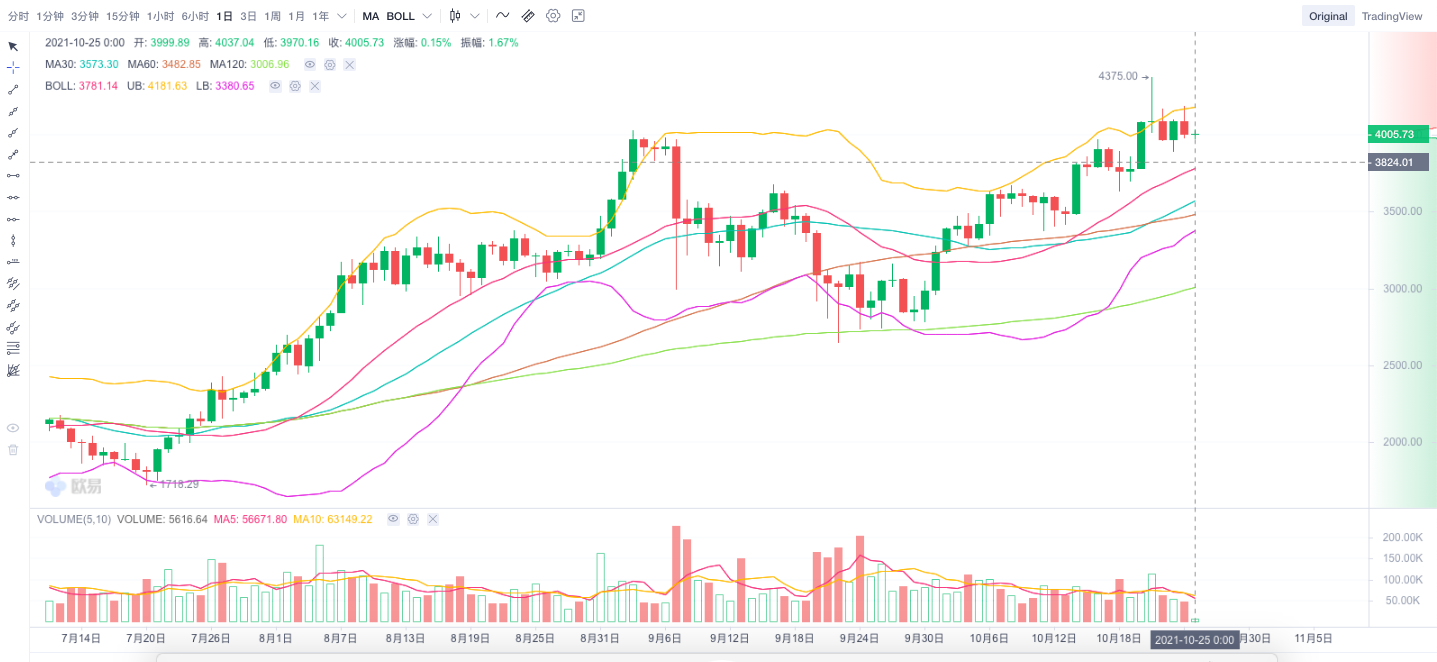
OKlink data(ETH daily chart, picture from OKEx)
3. Rich list address
OKlink dataOKlink data
3. Ecology and technology
1. Technological progress
3. Rich list address
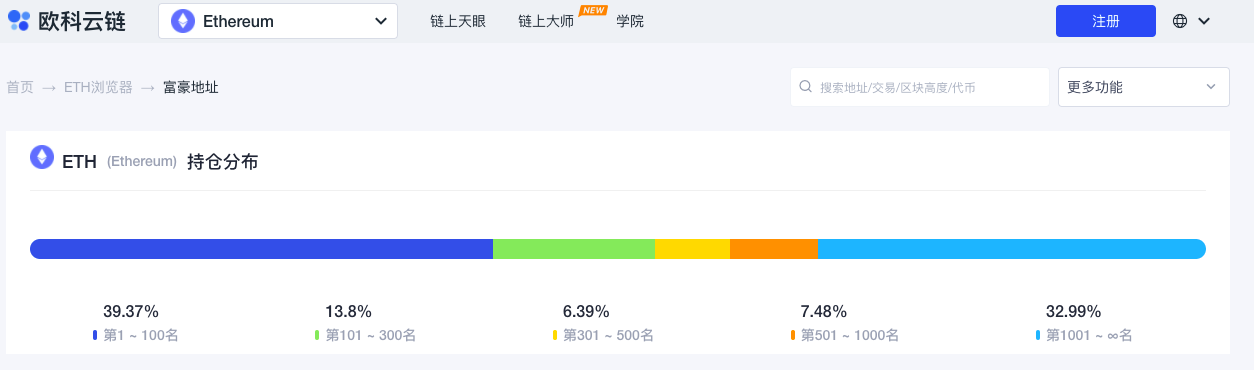
It shows that the current top 300 ETH holdings hold a total of 53.17% of ETH, an increase of 0.26% month-on-month; in addition, the entire position distribution presents an oval structure, and the proportions of each part are: 1st to 100th, accounting for 39.37%, 101st to 300th, accounting for 13.8%, down 0.06% from the previous month; 301st to 500th, accounting for 6.39%, down 0.09% from the previous month; 501st to 1000th, accounting for 7.48%, down 0.06 from the previous month %; after the 1001st place, accounting for 32.99%, a decrease of 0.13% from the previous month.
1. Technological progress
2. Voice of the Community
(2) Geth client developer Péter Szilágyi proposed a technical solution to the problem of client diversity: the niche client project
3. Project trends
A high-level communication layer between consensus layer and execution layer clients has the added benefit of being able to collect and report behavioral metrics uniformly across various clients; and potentially detect operational degradation issues before they get out of control and cause network outages. The communication middleware also allows for the uniform collection of an audit trail of events between the two tiers, potentially helping to debug client-side issues.
2. Voice of the Community
The victim projects in the Parity Multisig Wallet hack incident jointly issued a document, saying that as long as the hacker returns 90% of the stolen funds, he will not be held accountable
3. Project trends
(1) Arbitrage bots make an average daily profit of $6,800 by sending spam to the Polygon network
Data found on a Polygon forum suggests that attackers inflate transaction volume by 90% by stuffing each block with “meaningless transactions” and only pay about 0.02 MATIC to spam an entire block, About $1000 for a full day. A deeper look into transactions and address interactions on the Polygon network reveals that approximately 30% of the network's transaction volume comes from two contracts identified as arbitrage bots, making thousands of transactions to various DEXs every day. The exact reason why the spammer chose to fill each block when the bot was only making 2000-4000 transactions per day is uncertain, but one theory is that it was done to prevent anyone else from making transactions earlier.
(2) The Ethereum Foundation and other teams launch a website login.xyz to track the progress of "Sign-In with Ethereum"
Sign-In with Ethereum is a set of technical specifications for logging in to third-party web applications through Ethereum accounts, enabling users to control their digital identities through Ethereum accounts and ENS configuration files instead of relying on traditional middlemen. It is currently used in Web3 and aims to standardize on best practices to make Web2 services easier to adopt as well.
(3) The lossless option protocol KAKI was officially released and launched on the Arbitrum mainnet
The non-destructive option protocol KAKI announced its official release and launch on the Arbitrum mainnet. KAKI has previously been audited by SlowMist. KAKI said that it will soon provide a cross-bridge service for fast transfers between Arbitrum and Ethereum based on the lossless protocol, providing a better infrastructure for the Arbitrum ecosystem.
Optimism, the Ethereum expansion program, stated on Twitter that in order to conduct more tests on possible problems before the mainnet goes live, the launch of OVM (Optimism Virtual Machine) version 2.0 will be postponed for two weeks. It will go live at 1:00 on November 12. According to previous reports, Optimism announced that version 2.0 of its OVM will be deployed to the Ethereum mainnet on October 28, and there may be a downtime of 4 to 6 hours at that time.
4. Borrowing
DefipulseEmpire Token recently launched the Empire NFT marketplace on Binance Smart Chain (BSC). This November, Empire also plans to expand the marketplace to Ethereum and Solana chains. Where users can mint, trade and auction their crypto collectibles. One of the planned features is to allow users to rent out their artwork for commercial use. In this way, creators' digital assets can be rented directly to publishers through the marketplace. Another feature is allowing projects to use the platform as a Launchpad for their NFT collections and be able to list and trade NFTs using their native tokens. (Globe Newswire)
Optimism, the Ethereum expansion program, stated on Twitter that in order to conduct more tests on possible problems before the mainnet goes live, the launch of OVM (Optimism Virtual Machine) version 2.0 will be postponed for two weeks. It will go live at 1:00 on November 12. According to previous reports, Optimism announced that version 2.0 of its OVM will be deployed to the Ethereum mainnet on October 28, and there may be a downtime of 4 to 6 hours at that time.
5. Mining
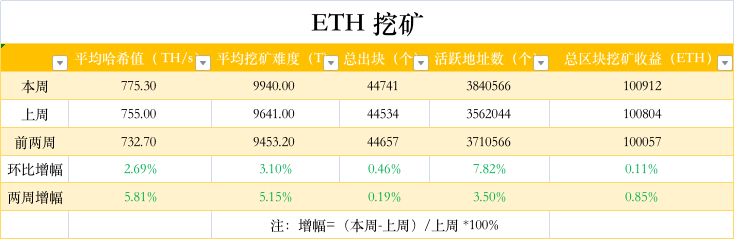
(data from etherchain.org)
etherchain.orgThe data shows that the value of locked collateral on the chain rose from US$95.39 billion to US$103.054 billion last week, an increase of 8% a week; the net increase of US$4.467 billion in the previous week was a net increase of US$7.664 billion last week, a month-on-month increase of 71.5%. Specifically, ETH mortgages rose from 7.196 million to 7.466 million last week, an increase of 3.7%; BTC mortgages rose from 198,443 to 210,487, an increase of 6%.
4. News
5. Mining
(data from etherchain.org)
4. News





